Your Content Calendar Might Be Missing Its Most Valuable Assets
This post explores how businesses can spot overlooked content pieces with strong repurposing potential and turn them into a more consistent social media marketing system. It will show how a balanced mix of human oversight and AI support helps teams cre...
How To Repurpose Content For Social Media
Most businesses struggle with social media consistency while ignoring the valuable assets they already created. Content repurposing solves this by transforming webinars, blogs, and podcasts into platform-specific posts. This approach cuts production costs significantly while driving higher engagement. By combining human oversight for brand voice with AI tools for formatting, you can build a sustainable system that turns a single strong asset into dozens of strategic touchpoints.
Key Takeaways
- Ninety-three percent of small businesses struggle to maintain consistent social media schedules.
- Only a fraction of marketers actively repurpose content, leaving a massive competitive opportunity open.
- AI-driven repurposing workflows can reduce content production expenses by over half.
- Systematic repurposing drives significantly faster lead generation and higher engagement rates.
- Balancing human creativity with AI efficiency produces the best content results.
How Do Marketers Solve The Endless Content Cycle?
Marketing teams face an exhausting cycle of creating fresh content for every social platform. You finish one week of posts only to face another empty calendar on Monday morning. It feels exactly like watering plants in a desert.
The irony? Most teams are drowning in deadlines while their most valuable content sits completely unused. You likely already have the exact insights your audience wants. They're just trapped inside old formats.
Content repurposing offers a reliable way out of this trap. This strategy involves taking your existing long-form assets and breaking them down into native social media posts. According to the 2026 Small Business Social Media Challenges Report, 93 percent of small businesses struggle with social media challenges, including the inability to maintain a consistent posting cadence. Repurposing solves this exact pain point by ensuring your best ideas get maximum visibility.
What Content Should You Actually Repurpose?

Illustration of auditing existing content assets to find high-performing pieces for repurposing.
High-value content is evergreen, builds authority, and already has a proven track record with your audience. You want to look for assets that thoroughly solve a specific customer problem.
Many businesses overlook their best material. Common overlooked assets include webinar recordings, sales call transcripts, comprehensive blog posts, and customer success stories. These assets get ignored because they're in the wrong format for social media. They get published once and quickly forgotten because teams lack a system for revisiting them.
This creates a hidden gold mine. Content that performed well initially never reached its full potential. According to the 2026 Content Marketing Benchmark Study, only 35 percent of marketers actively repurpose content across channels. This gap offers a huge advantage for those who do.
You're likely missing out on the most lucrative formats. Short-form video delivers the top return on investment for 49 percent of marketers according to the 2026 Social Media ROI Report. Yet, most long-form video content never gets transformed into these bite-sized clips.
Why Does Content Repurposing Matter Now?
Social media algorithms now heavily reward consistency over sporadic attempts to go viral. Platforms want creators who show up reliably.
Audience fragmentation also forces your hand. Your target customers exist across four to six different platforms today. They have completely different consumption habits on LinkedIn compared to YouTube or X. Producing original content for every single channel will break a lean marketing budget.
AI tools have democratized production capabilities that used to require a massive enterprise team. According to the 2026 Marketing Efficiency and AI Adoption Study, AI-driven repurposing can reduce content production costs by up to 65 percent. Lean teams can now execute omnichannel strategies simply by extracting more value from what they already own.
"The strategic shift from volume to value is mandatory today. We can no longer just publish more content; we have to extract more value from the best content we already have, transforming single assets into comprehensive ecosystems."
Robert Rose, Chief Strategy Advisor at Content Marketing Institute, 2026.
How Do You Find Content Worth Repurposing?
You need a systematic way to separate your best assets from the rest. The best approach relies on a simple scoring framework.
Step One: Audit your performance metrics. Look at engagement, organic traffic, and conversion data over the last twelve months. High traffic indicates strong interest.
Step Two: Assess the evergreen value. Is the information still accurate? Does it address ongoing pain points that your customers still face today?
Step Three: Test for format flexibility. A great candidate has strong visual potential, highly quotable moments, and actionable insights that make sense when isolated.
You can use a simple "Content Asset Scorecard" to rate potential pieces. Score your content from one to five on performance, relevance, and adaptability. A webinar with two hundred attendees and fifteen insightful audience questions holds extremely high repurposing value. A company news announcement from last year holds almost zero value.
How Do You Transform One Asset Into Multiple Touchpoints?
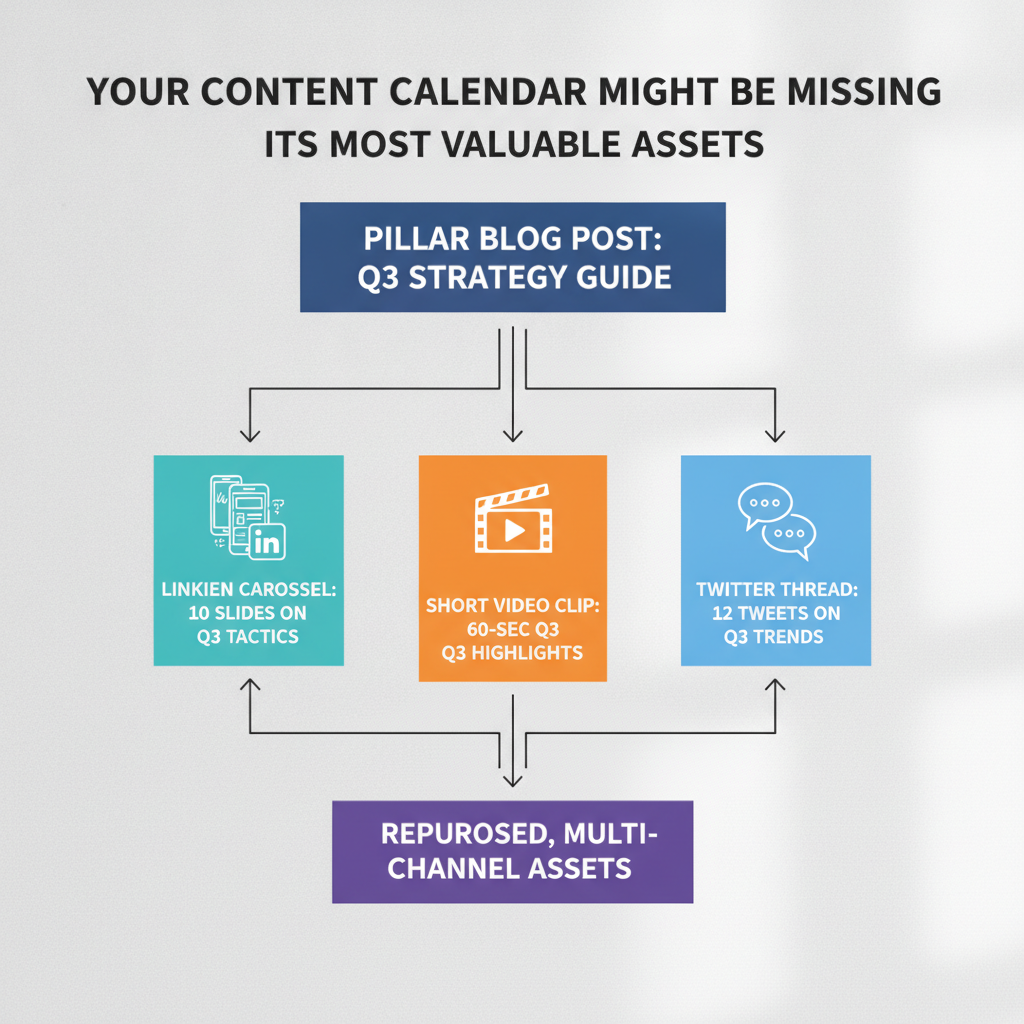
Diagram demonstrating how one piece of pillar content transforms into various platform-specific social media posts.
Transforming a single piece of content into a month of social media posts requires a deliberate framework. You have to move from a broadcast mindset to a distribution mindset.
First phase: Identify your evergreen winners. Go beyond simple vanity metrics and look at engagement depth. Find the content that sparked the most detailed comments, direct messages, or follow-up questions.
Second phase: Adapt the material for platform-specific context. You cannot simply copy and paste a paragraph everywhere. A long blog post should become a structured LinkedIn carousel, a conversational thread on X, and an Instagram story sequence. A sixty-minute webinar should turn into multiple YouTube Shorts, quote graphics, and podcast audio clips.
Third phase: Build a sustainable repurposing system. Establish clear triggers for when to repurpose an asset. For example, any blog post that crosses five hundred organic views automatically gets queued for transformation.
Companies using systematic repurposing report 3.7 times higher engagement rates compared to those relying entirely on net-new creation according to the 2026 Content Marketing Benchmark Study. A single two-thousand-word blog post easily contains enough raw material for fifteen to twenty-five unique social media posts.
Can AI Tools Replace Human Content Creators?
The short answer is no. AI tools cannot fully replace human marketers, but they dramatically change how human marketers spend their time.
The primary AI advantage lies in speed and consistency. AI handles mechanical tasks flawlessly. It can transcribe a podcast, resize a video, or extract key bullet points from a PDF in seconds.
But AI lacks brand voice nuance. It has no context about your specific audience relationships or industry politics. Relying entirely on automated generation leads to generic content that quickly erodes brand trust.
The most effective solution balances both sides. Humans set the strategy and maintain the brand voice. AI handles the heavy lifting of execution and formatting. Tools like Repostra serve as amplification systems rather than replacement systems. You use them to scale your best human thinking, catching tone-deaf mistakes before they ever reach a social feed.
What Does A Working Repurposing System Look Like?
A successful system runs on a predictable weekly schedule. It requires a defined tool stack and clear quality checkpoints to maintain your brand integrity.
Repostra acts as the operating system for this exact workflow. It bridges the gap between auditing your old content and scaling it across new platforms. What used to take four hours of manual copying and pasting now takes less than forty-five minutes.
A practical weekly timeline looks like this:
- Monday: Spend fifteen minutes reviewing what content performed best last week.
- Tuesday: Spend ten minutes selecting one or two high-performing pieces to put into the pipeline.
- Wednesday: Spend forty-five minutes using AI to draft transformations, followed by human refinement.
- Thursday: Spend twenty minutes scheduling the finalized assets across all your platforms.
This ninety-minute investment yields fifteen to twenty high-quality, platform-native posts. Even solo creators can maintain a massive digital footprint using this exact cadence.
What Mistakes Kill Content Repurposing Efforts?
Many teams try to repurpose content but abandon the effort when they don't see immediate results. This usually happens due to a few common strategic errors.
Mistake: The copy-paste mentality. Posting identical text and formatting across every single platform will suppress your reach. LinkedIn prefers professional formatting, while TikTok requires fast-paced visual hooks.
Fix: Always rewrite the hook and adapt the formatting to match native platform expectations.
Mistake: Over-automating the process. Letting an AI tool publish directly to your feeds without human review leads to robotic, off-brand messaging.
Fix: Always implement a mandatory human review step before hitting schedule.
Mistake: Repurposing absolutely everything. Choosing quantity over quality clutters your feed with mediocre ideas.
Fix: Only repurpose your top twenty percent of performing assets.
How Do You Know If Content Repurposing Is Working?

Analytics dashboard visualizing content repurposing success through engagement rates and production efficiency.
You must track the right metrics to prove the value of this system. Vanity metrics like total impressions will go up naturally, but they don't tell the whole story.
Track your content production efficiency first. Measure how many platform-ready pieces your team creates per hour invested. Next, look at your cost per piece of content before and after implementing the repurposing workflow.
Meaningful business metrics include:
- Engagement rate by content format.
- Lead generation attribution tied to repurposed assets.
- Brand consistency scores across multiple platforms.
Benchmark these numbers against your own past performance. According to the 2026 Content Marketing Benchmark Study, organizations with systematic repurposing achieve 40 percent faster lead generation. When you see a specific format driving cheaper, faster leads, you know exactly where to double down your efforts.
FAQ
How much time does content repurposing actually save?
Teams using systematic repurposing workflows report reducing content production time by fifty to sixty-five percent while increasing output volume by three to four times. A single thirty-minute webinar can generate twenty platform-specific pieces in under ninety minutes of total work using AI-assisted tools. Doing this from scratch would take over eight hours.
What size team do you need to repurpose content effectively?
Content repurposing works for solo creators and large marketing teams alike. The success relies on the system, not the headcount. Solo marketers can manage their entire repurposing workflow in two to three hours weekly using tools like Repostra. Larger teams can simply divide responsibilities to process a greater volume of source material.
How often should you repurpose the same piece of content?
Evergreen, high-performing content can be repurposed multiple times across a twelve-month period. You should space out repurposed variations four to six weeks apart on the exact same platform. But you can post different formats of the same core idea simultaneously across different platforms because audience overlap is rarely absolute.
Will audiences notice you are repurposing content?
When done correctly, your audience won't notice or care. Repurposing means transforming core ideas into platform-native formats with fresh angles. A blog post becomes a visual carousel with new data points and a video highlighting a single specific section. Your audience simply sees relevant content in the format they prefer.
What content types repurpose most effectively?
Long-form, educational content with multiple distinct insights repurposes best. Comprehensive blog posts over fifteen hundred words, webinars, podcasts, case studies, and original research reports are ideal. These assets contain enough raw material for dozens of derivative pieces. Short news updates or highly topical posts have very limited repurposing value.