When Content Creation Slows Down, Repurposing Keeps Marketing Moving
This post explores how businesses can maintain a consistent social media presence by repurposing existing content instead of constantly creating from scratch. It will show how a balanced mix of human oversight and AI support helps teams distribute high...
Content Repurposing: The Strategy That Saves 60-80% of Creation Time in 2026
TL;DR: Content repurposing transforms one high-quality asset into multiple platform-specific formats, solving the biggest marketing challenge of 2026. Brands using this approach generate 114,907 monthly social media views compared to 45,516 for original-only creators, while saving 60 to 80 percent of creation time. The key is combining AI efficiency tools with human oversight to maintain authentic brand voice across all channels.
Key Takeaways
- Massive time savings: Repurposing saves 60 to 80 percent of creation time while extending asset ROI
- Higher visibility: Brands repurposing content generate 114,907 monthly views compared to 45,516 for original-only creators
- Industry shift: Over half of marketers cite consistent content creation as their top 2026 challenge
- Multiplied ROI: Human-AI collaboration delivers 2.4x better content ROI than either approach used independently
- Competitive edge: Only 35 percent of marketers actively repurpose content today
The Content Treadmill Is Breaking Marketing Teams
Picture a marketing manager staring at a blank screen on a Tuesday morning. They need fresh material for YouTube, TikTok, Instagram, LinkedIn, and the weekly newsletter. The pressure is relentless.
Audiences now expect daily updates on multiple channels. Most teams simply don't have the headcount to film, write, and design net-new pieces for every platform. This constant demand creates a vicious cycle of rushed production and quick burnout.
What if the answer isn't creating more content from scratch? The smartest solution is reusing your best ideas in a more strategic way.
In 2026, the most successful brands have shifted away from a creation-first approach. They now use a repurposing-first strategy. This method relieves the pressure of constant production while actually improving overall audience reach.
Why Is Creating Enough Content the Biggest Marketing Challenge in 2026?
According to the Content Marketing Institute's 2026 Benchmarks and Trends report, over 50 percent of marketers now identify creating enough high-quality content consistently as their primary challenge. This represents a massive increase from just 17 percent the previous year.
The multi-platform reality is highly demanding. The average brand now maintains four to six active social channels. Audiences expect consistency and authenticity on every single one of those platforms.
Team capacity simply hasn't grown to match this platform expansion. Marketers are expected to be video editors, copywriters, data analysts, and community managers all at once. Rising production costs and shrinking marketing budgets only compound the problem.
Common mistake: Brands try to hire their way out of the problem. Adding more junior creators often leads to fragmented brand messaging rather than a cohesive strategy.
| Marketing Challenge | 2025 Reported Rate | 2026 Reported Rate |
| Creating content consistently | 17% | 51% |
| Proving ROI of organic social | 32% | 28% |
| Managing platform algorithm changes | 29% | 15% |
| Securing budget for paid ads | 22% | 6% |
What Is Content Repurposing?
Content repurposing means transforming one foundational piece of content into multiple platform-native formats. It involves atomizing your best ideas to reach different audiences in their preferred formats.
What it is: Atomizing a core message into smaller, native pieces. You take the research from a whitepaper and turn it into an engaging podcast script.
What it isn't: Copy-pasting the exact same post everywhere. It's not lazy recycling or lowering your quality standards just to fill a content calendar.
Examples of effective repurposing show how one asset fuels an entire month of marketing. A single investment pays dividends across every channel you manage.
- Long-form blog post: Becomes a LinkedIn article, three Instagram carousels, five quote graphics, and two short video clips
- Webinar recording: Turns into a full YouTube upload, multiple audiogram clips, a Twitter thread, and a dedicated email newsletter
- Customer success story: Transforms into a case study PDF, a series of testimonial graphics, a sales enablement one-pager, and a short documentary-style video
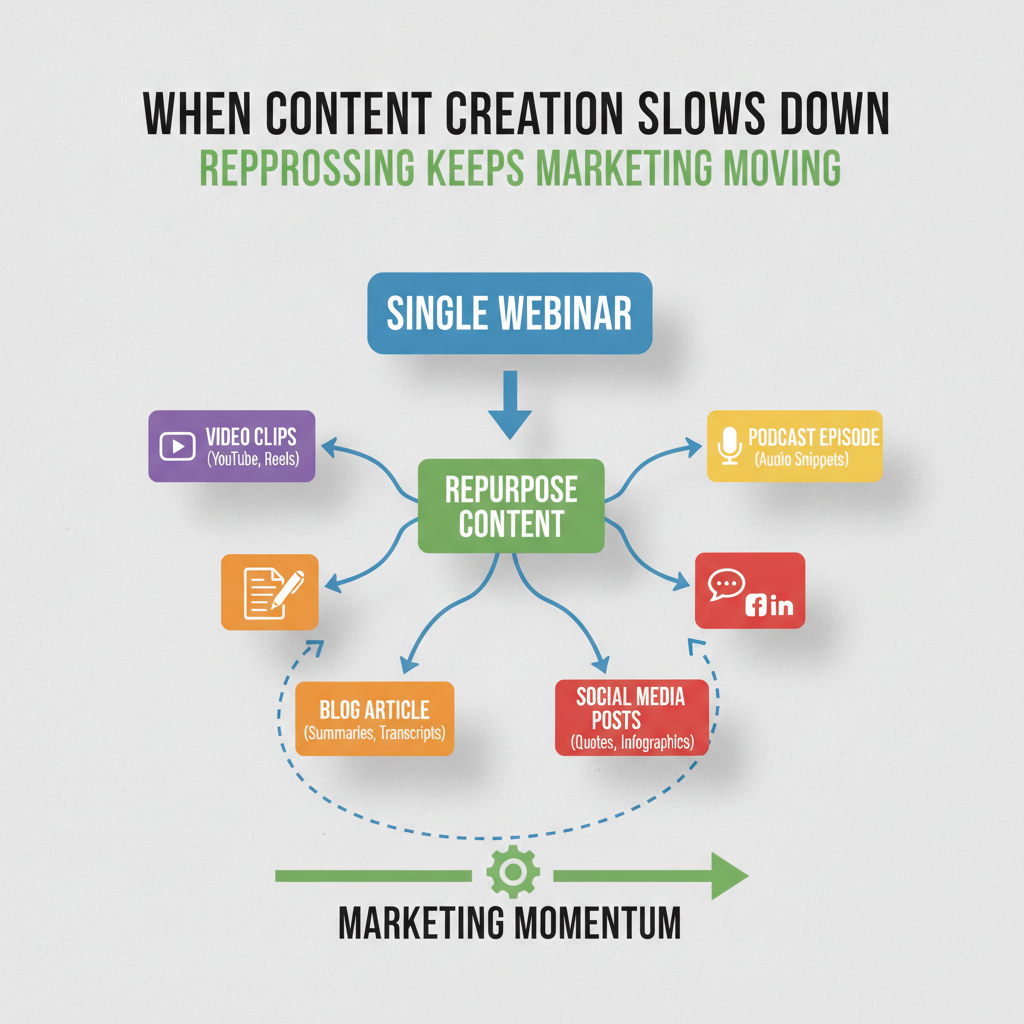
Flowchart illustrating content repurposing from a core asset into multiple formats
How Much Time and Money Does Content Repurposing Actually Save?
Strategic repurposing saves 60 to 80 percent of content creation time. You skip the hardest parts of content creation completely. Ideation, outlining, and primary research are already done.
According to a 2026 Marketing Efficiency Study by HubSpot, AI tools used for repurposing can reduce production costs by up to 65 percent. Teams no longer need expensive freelance writers to draft every single social post.
Consider a direct cost comparison. Creating 20 original posts requires starting from scratch 20 times. Repurposing four foundation pieces into 20 derivatives requires a fraction of the research and drafting time.
| Content Task | Time for Original Post | Time for Repurposed Post |
| Ideation & Hook Creation | 45 minutes | 5 minutes |
| Primary Research & Fact Checking | 60 minutes | 0 minutes |
| Drafting Copy | 90 minutes | 15 minutes |
| Platform Formatting | 15 minutes | 15 minutes |
| Total Time per Post | 210 minutes | 35 minutes |
Teams can redirect this reclaimed time toward strategy, audience engagement, and creative thinking. Time saved on execution becomes time spent on relationship building.
The bottom line: Only 35 percent of marketers actively repurpose content. This leaves a massive competitive advantage for teams that adopt the discipline right now.
Why Does Content Repurposing Drive Better Marketing Results?
Brands that repurpose content average 114,907 monthly social media views. Those creating only original content average just 45,516 views.
According to Sprout Social's 2026 Performance Research report, content marketing overall delivers an impressive ROI of $7.65 per $1 spent. Repurposing pushes this ROI higher by maximizing the value of every dollar invested in foundational content.
Consistency builds deep trust with your audience. A regular posting schedule keeps your brand top of mind without causing a drop in quality. When audiences see high-quality insights repeatedly, they view your brand as a true authority.
Platform-native adaptation also increases engagement. An Instagram carousel performs better on Instagram than a linked article from your blog. People want to consume content without leaving the app they're currently browsing.
Message repetition aids brand recall. Audiences often need seven or more touchpoints before taking a commercial action. Repurposing naturally creates these touchpoints across the web. It also offers major SEO benefits by getting more content indexed across platforms pointing back to your core ideas.
"Create once, distribute forever. The brands winning in 2026 aren't the ones publishing a new blog post every day. They're the ones taking a single incredible piece of research and turning it into a month's worth of platform-native assets that actually reach their audience where they hang out."
Ross Simmonds, CEO at Foundation Marketing
How Does the Human-AI Partnership Work for Content Repurposing?
According to a 2026 Social Media Management survey by Hootsuite, nearly 90 percent of social media teams use AI tools weekly or daily. Think of AI as your infrastructure and humans as the operators.
You can't simply hand your content strategy over to an algorithm. Letting AI run wild usually results in generic, off-brand content that audiences spot immediately. The magic happens when software speed meets human taste.
What AI handles well:
- Drafting initial platform adaptations from a source text
- Summarizing long-form video transcripts into bullet points
- Generating dozens of headline and hook options in seconds
- Resizing graphics and handling basic visual layout tasks
What humans must control:
- Protecting brand voice authenticity and subtle humor
- Managing cultural sensitivity and current event context
- Executing fact-checking and ensuring technical accuracy
- Making strategic decisions about which core assets to repurpose
According to Gartner's 2025-2026 Marketing Technology Research, AI-human collaboration achieves 2.4x better content ROI than either approach used alone. Software provides the blank canvas and the rough outline. Humans provide the color, the emotion, and the final polish.

Human and AI collaboration in a marketing setting
What Does a Practical Content Repurposing Workflow Look Like?
A successful strategy requires a repeatable system. You need a workflow that your team can execute every single week without confusion.
Step 1: Audit Your Content Library
Identify evergreen, high-performing pieces from your archive. Look for strong engagement metrics and prioritize assets with long relevance windows. A blog post that drove massive traffic last year is a perfect candidate for repurposing today.
Step 2: Map Platform Requirements
Understand format specs for vertical video, carousels, and text threads. Know each platform's audience preferences so adaptations feel native. A formal tone might work for a LinkedIn newsletter but will fail completely on TikTok.
Step 3: Create a Repurposing Matrix
Plan out 10 to 15 derivative assets from a single webinar or whitepaper. Assign specific formats to team members or software tools. Schedule the distribution of these pieces across several weeks to avoid overwhelming your audience.
Step 4: Use AI for First Drafts
Feed your source content into AI tools for summaries and reformatting. This helps generate multiple copy options quickly. Prompt the AI specifically to extract the most counter-intuitive or surprising facts from your source material.
Step 5: Human Review and Brand Voice Injection
Edit the AI drafts for authenticity and flow. Add unique insights, personal anecdotes, or current context to the copy. Make sure your tone stays completely consistent across all platform adaptations.
Step 6: Schedule and Analyze
Use scheduling tools for consistent distribution across time zones. Track which repurposed formats perform best and feed those learnings back into your strategy. If short videos outperform text posts, adjust your next matrix accordingly.
How Can Repostra.app Help Teams Implement Repurposing Strategies?
Repostra.app serves as the bridge to close the efficiency gap for marketing teams. It's designed specifically to extract maximum value from existing content libraries.
The platform supports a balanced AI-human workflow out of the box. It automates repetitive formatting tasks where helpful while leaving humans in control of the final message. You get the speed of automation without sacrificing your hard-earned brand reputation.
This tool helps teams shift their internal mindset. Instead of asking what they should post today, teams look for high-performing assets they can easily adapt. This builds sustainable content ecosystems and avoids the endless creation treadmill entirely.
Repostra.app maintains brand consistency across every single platform adaptation. It stores your brand voice guidelines, preferred vocabulary, and visual style. Every piece of repurposed content looks and sounds exactly like your best human creators wrote it.
Shift to a Repurposing-First Mindset
Stop chasing the content treadmill and start building a content ecosystem. Your best ideas deserve a much wider reach than a single social post allows.
Key takeaway: Efficiency isn't laziness. It's highly strategic resource allocation. AI accelerates the mechanical process while humans authenticate the core message.
Consistency beats occasional perfection in the 2026 algorithm landscape. Platforms reward accounts that show up every day with valuable insights. Repurposing is the only financially viable way to maintain that daily presence.
The competitive advantage window remains open because most marketers haven't adopted repurposing systematically. They're still starting from scratch every Monday morning.
Next step: Audit your content library this week. Identify three high-performing pieces to repurpose immediately and map them out across your core channels.
FAQ
How many times can you repurpose the same piece of content?
There's no hard limit. It depends heavily on whether the content is evergreen or tied to a timely event. Your best-performing assets can easily generate 10 to 20 derivative pieces over a few months. For example, a single expert interview can become a short video, an audio clip, a written transcript, several quote graphics, and a dedicated newsletter. Refresh and update the core content periodically rather than doing exact repeats. Stop repurposing a specific piece only when your engagement data shows clear audience fatigue.
Does repurposing hurt SEO by creating duplicate content?
No. When done correctly, repurposing doesn't trigger duplicate content penalties from search engines. Cross-posting identical text verbatim across multiple pages of your own website would be problematic. However, adapting content for different platforms is strategically sound and highly encouraged. Google actively rewards comprehensive topic coverage across different mediums. According to Search Engine Journal guidelines, search engines understand and encourage adapting content to serve different user intents, such as turning a written guide into a video tutorial.
What types of content work best for repurposing?
Evergreen educational content works incredibly well for adaptation. Look for how-to guides, conceptual frameworks, and broad industry insights. High-engagement posts from the past six to 12 months are also prime candidates for a refresh. Long-form assets like webinars, audio podcasts, and comprehensive blog posts provide the most raw material to work with. Avoid trying to repurpose highly timely content, trending topic commentary, and time-sensitive promotional offers once their window has passed.
How do you maintain brand voice when using AI for repurposing?
Treat all AI output as a first draft, never as final copy ready for publishing. Create a strict brand voice guidelines document to reference during the editing process. Train your human team members to recognize and reinforce specific voice characteristics. Always add human context, personality, and your current perspective to the AI-generated drafts. Review adaptations side-by-side to ensure tonal consistency. Test the repurposed content with your most loyal audience members and gather their feedback on its authenticity.
What's the difference between content repurposing and content recycling?
Content repurposing is the strategic transformation of a core asset into platform-native formats. Content recycling is simply reposting identical content with minimal or zero changes. Repurposing adds tangible value through reformatting, updating, or recontextualizing the information for a new audience. Recycling risks boring your existing audience and makes your brand appear lazy. Effective repurposing requires thoughtful adaptation to each platform's unique culture and technical format requirements.