Why Content Repurposing Works Better With a Clear Distribution Plan
This post explores how businesses can pair content repurposing with a structured social media distribution strategy to reach more people without creating everything from scratch. It will show how better planning helps teams stay consistent, save time,...
Why Content Repurposing Needs a Distribution Plan
TL;DR: Content repurposing paired with a strategic distribution plan helps businesses reach 300% more people without constantly creating new content from scratch. By transforming one high-quality pillar piece into multiple platform-native formats and distributing them systematically, teams save 60-80% of creation time while maintaining consistency. The key is not producing more—it means distributing smarter across channels where your audience already engages.
Key Takeaways
- A single repurposed content piece generates 300% more reach when distributed strategically
- Effective repurposing saves 60-80% of content creation time and cuts costs by up to 65%
- Platform-native adaptation drives 5x more engagement than generic promotional content
- Only 35% of marketers actively repurpose content, offering a massive competitive advantage
- Strategic distribution requires 5-7 touchpoints to move prospects effectively through the buyer journey
The Content Hamster Wheel Is Broken
If you're scrambling every Monday to fill a blank calendar, you're playing the game on hard mode.
Many marketing teams fall into the trap of treating every social post, blog article, or video as an entirely separate creation task. This constant demand for fresh material creates an exhausting hamster wheel of original creation. It burns teams out and rarely delivers proportional results.
The reality today is that content volume no longer equals success. With attention spans fracturing and platforms constantly shifting algorithms, producing a massive quantity of mediocre content is a losing strategy. Instead, implementing a solid content repurposing distribution plan is the efficiency advantage most teams miss. This approach takes your best ideas and ensures they actually reach your audience, rather than burying them under a pile of endless new drafts.
Why Does Single-Use Content Publishing Fail?
Publishing a highly researched article once and abandoning it creates a massive content trap. You invest hours of high effort into ideation, drafting, and editing, only to receive a short spike of traffic before the piece collects digital dust. When a piece is published just once, it misses the majority of your potential audience who weren't online that specific day or who prefer consuming information in a different format.
Consistency remains the top hurdle for marketing teams today. When you rely solely on original creation, maintaining a steady drumbeat of publishing becomes nearly impossible without ballooning costs. According to research from Semrush's State of Content Marketing 2024, only about 35% of marketers actively repurpose content. Teams waste thousands of dollars annually by leaving the vast majority of their content's potential reach on the table.
Marketer struggling with content creation hamster wheel
How Does Strategic Content Repurposing Actually Work?
Pillar creation. Build one high-value, long-form asset like an in-depth blog post, a webinar, or a detailed white paper.
Atomization. Extract the most valuable nuggets from that pillar. Pull out punchy quotes, surprising statistics, key takeaways, and short audio or video clips.
Distribution. Adapt these smaller atoms into platform-native formats tailored for the specific channels where your audience spends their time.
Consider turning a two-thousand word blog post into a visual LinkedIn carousel, an educational X thread, three Instagram reels, and a short excerpt for an email newsletter. This process is highly efficient when supported by AI-driven workflows that speed up the extraction of key points. This isn't lazy recycling. It's strategic scaling that maximizes the value of your core message.
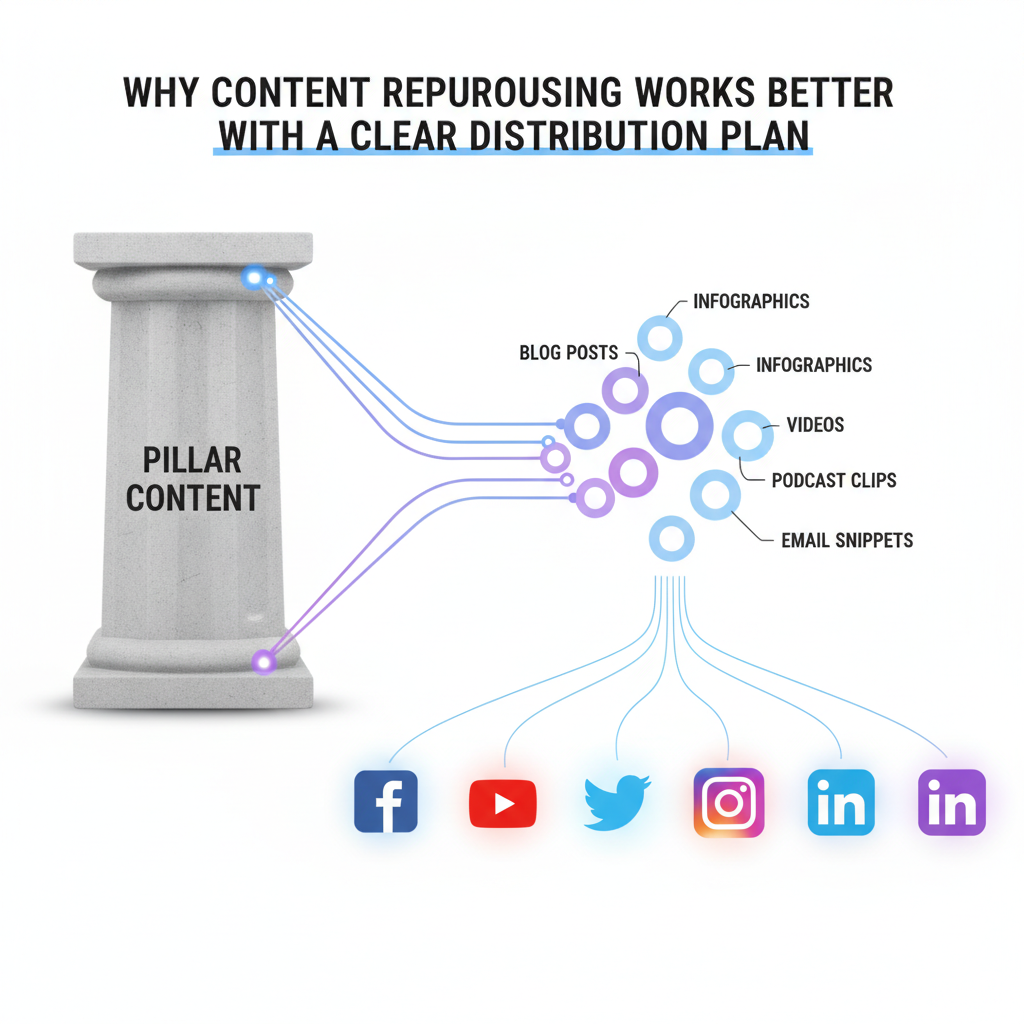
Pillar to atomize to distribute content marketing framework
How Much Time Does Content Repurposing Actually Save?
Systematic repurposing transforms the economics of a marketing department.
The heaviest lifts in marketing are ideation and initial drafting. When you repurpose, you skip the blank page entirely, moving straight to editing and formatting. Creating ten entirely original posts could take a team fifteen hours. Creating one strong pillar and repurposing it into ten adapted posts often takes less than five hours.
According to Content Marketing Institute research from 2024, teams implementing systematic repurposing workflows report saving 60-80% of content creation time. Production costs also drop by up to 65% when teams implement AI-supported repurposing workflows.
"Don't create something and assume that the job is done. The central idea is to stop constantly creating new content. Instead, invest in high-value content that you can repurpose, remix, and redistribute repeatedly across various channels for long-term ROI."
- Ross Simmonds, Founder of Foundation Marketing
What Makes a Content Distribution Plan Essential?
A content repurposing distribution plan is the blueprint that dictates exactly where, when, and how your atoms are shared. Without it, repurposing devolves into random, disorganized posting. Strategic distribution serves three core functions.
Platform-native adaptation: Tailoring the message to fit channel-specific formats, like formatting a detailed case study into a visually appealing Instagram story.
Buyer journey coverage: Distributing content that speaks to prospects at the awareness, consideration, and decision stages simultaneously.
Message reinforcement: Achieving the repetition necessary for audience retention. Research from marketing studies consistently shows that prospects require 5-7 touchpoints with a brand before making a purchasing decision.
A distribution plan ensures you hit those touchpoints efficiently. Copy-pasting the same text across LinkedIn, X, and Instagram fails because the audience expectations on those channels are vastly different. A structured plan forces you to respect the native environment of each platform.
How Much More Reach Can Repurposed Content Generate?
Multiplying your formats multiplies your audience.
When you repurpose one core message into a video, an infographic, and a text thread, you hit completely different audience segments in their preferred consumption styles. This creates a massive reach multiplication effect, expanding your brand's footprint far beyond a single blog audience.
Marketing performance data from HubSpot's 2024 State of Marketing Report shows that multi-channel content distribution can generate up to 300% more reach than single-platform publishing. Reach alone isn't enough, but the interactions follow suit when the content is valuable. Recent social media benchmark studies reveal that educational posts derived from repurposed content generate approximately 5x more engagement than purely promotional updates.
Repurposing also provides an excellent testing ground. By presenting the same core message in multiple formats, you gather hard data on exactly what resonates best with your buyers.
Why Must Repurposed Content Be Platform Native?
Common mistake: Copying the same paragraph and pasting it across every social network.
Platform-native content respects the unique culture, aspect ratios, and formatting norms of each specific channel. Audiences log into different apps for different reasons, and your content must match their mindset to earn their attention.
- LinkedIn: Users expect professional insights, data-driven analysis, and longer-form text.
- Instagram: Audiences want visual-first, aspirational, and story-driven aesthetics.
- X (Twitter): The feed moves fast, requiring conversational quick takes and tightly structured threads.
- TikTok: Entertainment value is paramount, demanding a strong hook within the first three seconds.
- Email: Readers expect a personal, direct tone with a deeper dive and a clear call-to-action.
Using AI tools like Repostra.app enables efficient platform adaptation without manually rebuilding every asset from scratch. If your text is identical across all platforms, your distribution plan is failing.
How Does Repurposing Create a Competitive Edge?
Most brands are still sweating on the content hamster wheel, churning out isolated pieces of media that fade away in twenty-four hours. The opportunity gap here is massive.
As noted earlier, only about 35% of marketers actively use a systematic approach to repurposing according to Semrush data. The rest rely on sporadic sharing when they happen to remember an old post.
A systematic approach shifts your competitive stance from content volume to content impact. You no longer compete to see who can publish the most original articles per week. You compete to see who can extract the most value from a single brilliant idea. Early adopters of a formalized distribution strategy gain a significant first-mover advantage, capturing broader market awareness while spending a fraction of their competitors' budgets.
How Do You Build an Effective Content Repurposing Distribution Plan?
Audit existing content assets to identify your best-performing long-form pieces as potential pillars.
Map the specific platforms where your target audience is currently active.
Define the platform-specific format requirements for those channels.
Create atomization templates that outline exactly what to extract from each pillar type, like pulling three quotes and one statistic from every podcast episode.
Set a distribution calendar dictating the timing and frequency of posts per platform.
Implement tracking to measure reach and engagement by format to inform future campaigns.
Managing this across half a dozen manual tools causes friction. Instead of manually reformatting across multiple applications, platforms like Repostra.app act as central hubs. They turn one pillar asset into a week's worth of platform-native content while maintaining a consistent brand voice. This streamlines the workflow, freeing your team to focus on high-level strategy rather than repetitive production tasks.
What Are the Biggest Content Repurposing Mistakes?
Copy-pasting across platforms. This lacks native adaptation and signals to the algorithm and users that you're automating poorly. Avoid this by adjusting the tone and formatting for each network.
Repurposing low-quality pillar content. Garbage in means garbage out. Only atomize pieces that contain strong data, unique opinions, or deep research.
Posting without a distribution calendar. Random posting undermines consistency and confuses your audience. Use a scheduled matrix.
Ignoring performance data. If your LinkedIn carousels consistently flop but your X threads soar, adjust your extraction templates.
Over-repurposing. If an audience sees the exact same graphic too frequently, ad fatigue sets in. Space out your distribution over weeks or months.
Frequently Asked Questions About Content Repurposing and Distribution
How many times can you repurpose the same content?
There's no hard limit, but timing and format variation matter greatly. A strong pillar piece can live for twelve to eighteen months across different platforms. The key is ensuring each repurposed version offers a unique value or perspective, making a short video feel entirely different from a written email discussion on the same topic.
What is the difference between repurposing and republishing?
Republishing means posting the identical piece of content again on the same or a different platform. Repurposing means transforming one piece into multiple platform-native formats with adapted messaging. Republishing can sometimes trigger duplicate content issues, whereas strategic repurposing creates fresh assets that algorithms treat as original content.
Which content types work best as pillar pieces?
Long-form blogs over 1,500 words, webinars, podcasts, research reports, and case studies make ideal pillars because they contain dense information. Look for content packed with data, statistics, expert quotes, step-by-step processes, or multiple subtopics that can be easily extracted as independent atoms.
How do you measure content repurposing success?
Track three main metrics: time saved in content production, cumulative reach across all channels from one pillar piece, and engagement rate by platform format. Compare the total performance of a repurposed content suite against individual original posts. Success looks like higher overall reach and engagement per hour invested in creation.
Can small teams realistically implement this strategy?
Yes, small teams actually benefit the most. Instead of struggling to create twenty original posts monthly, a small team can create two or three quality pillar pieces and systematically repurpose each into six to eight platform-native assets. With AI-assisted tools like Repostra.app, atomization and adaptation that once took hours now takes minutes.
Start Repurposing Smarter, Not Harder
A distribution plan transforms repurposing from a sporadic tactic into a predictable strategy.
By shifting your mindset from content volume to content scaling, you gain up to 300% more reach and drastically cut down your creation costs. The brands winning attention today aren't working harder to pump out endless drafts. They're distributing their best ideas more intelligently.
Bottom line: Take one hour this week to audit an existing high-performing piece of content and map out its repurposing potential across five different formats. If you're ready to move from manual copy-pasting to systematic distribution, tools like Repostra.app can help you automate the atomization and platform adaptation. Let the system handle the repetitive execution so your team can focus on the strategy that actually drives growth.
---
Title: Why Content Repurposing Needs a Distribution Plan
Meta Description: Learn how pairing content repurposing with smart distribution saves time, boosts reach by 300%, and maximizes every content piece's ROI.
Primary Keyword: content repurposing distribution plan