Why Smart Content Teams Build Once and Publish Everywhere
This post explores how businesses can create a more efficient content marketing system by turning one strong asset into multiple social media and marketing formats. It will show how to balance human oversight with AI-powered repurposing to stay consist...
Build Once Publish Everywhere: The CORE Framework That Cuts Content Creation Time by 80%
Smart content teams in 2026 don't build from scratch for every platform. They use the CORE framework to create once and repurpose everywhere. One pillar asset transforms into multiple platform-native formats with AI assistance and human oversight. Teams slash creation time while boosting output. The secret? Balance automated generation with editorial judgment to protect brand voice across all distribution channels.
Key Takeaways
- Build once publish everywhere strategies cut creation time by up to 80%
- Systematic repurposing workflows push content to 3.4 channels on average
- Human-in-the-Loop oversight improves final content performance by 67%
- Platform-native adaptation drives significantly higher engagement than simple cross-posting
- The CORE framework relies on pillar content, atomization, and strategic distribution
Marketing teams often find themselves trapped on a content hamster wheel. They create 20 or more pieces of content weekly, starting entirely from scratch for every post. This cycle leads to burnout and diminishing returns.
Smart teams take a different approach. They build once and publish everywhere. This method replaces the endless grind with a sustainable engine. You'll learn how to create more high-quality content with less effort using the CORE framework.
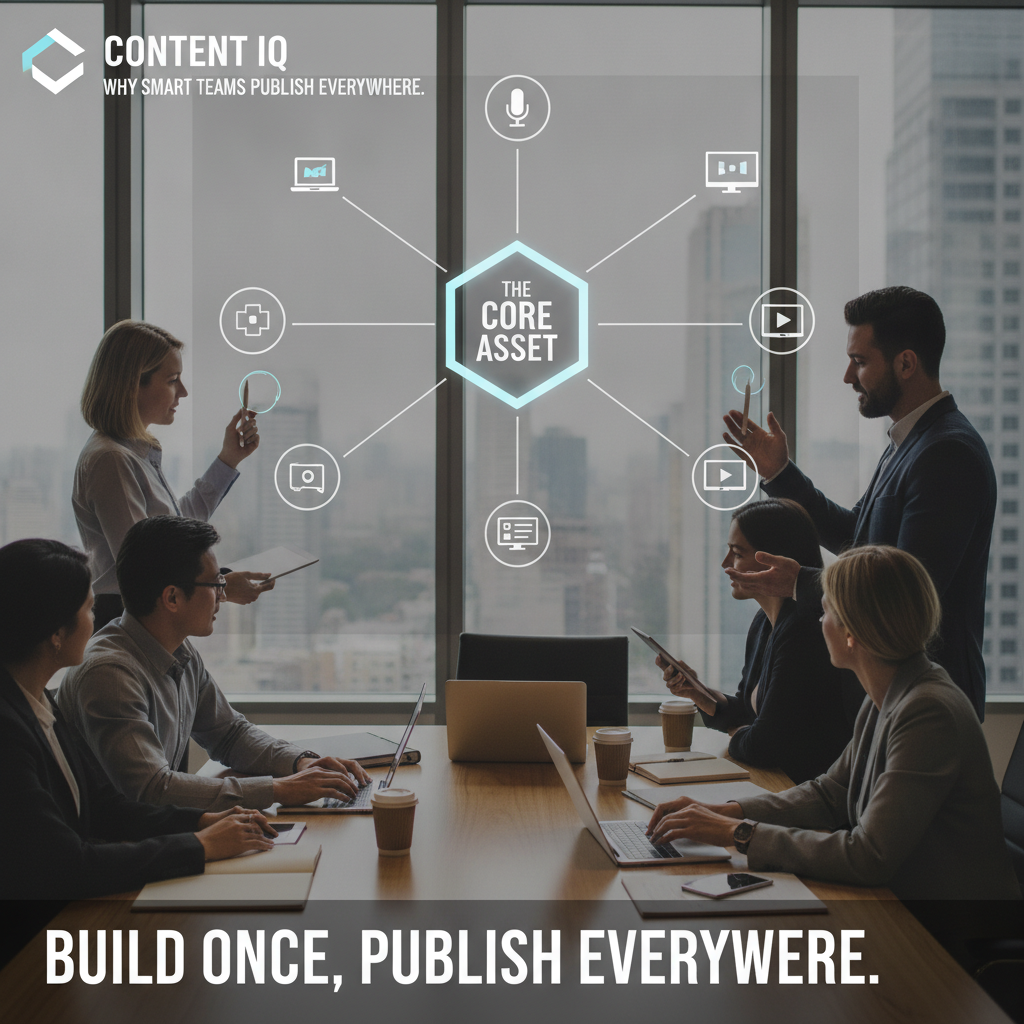
A team planning a build once publish everywhere content strategy
What Does "Build Once, Publish Everywhere" Actually Mean?
The concept originated as COPE (Create Once, Publish Everywhere) at NPR in 2009. Back then, it meant using technology to send identical articles to different digital endpoints from a single database.
In 2026, the strategy has evolved into CORE (Create Once, Repurpose Everywhere). Identical cross-posting fails. Modern audiences expect native experiences on each app. CORE focuses on taking one main message and adapting it to fit the specific algorithms and user habits of different platforms.
Here's an example. A 30-minute podcast interview doesn't just get uploaded to YouTube. It becomes a long-form article, 15 distinct social media text posts, a curated newsletter, and several short-form video clips.
According to a 2026 Repostra.app industry research report, creators using systematic repurposing tools publish to an average of 3.4 channels. Those relying on manual workflows manage only 1.8 channels.
Why Do Smart Content Teams Use the CORE Framework?
The Efficiency Multiplier
Systematic repurposing fundamentally changes how teams allocate resources. According to content marketing research, systematic repurposing can save teams 60 to 80% of creation time.
That same research found this approach increases total content output by 40%. Teams use these saved hours to conduct deeper original research and engage directly with their communities.
The Quality Paradox
Many marketers assume that publishing more content automatically degrades quality. The opposite is true when you start with strong foundations. Deep, authoritative pillar content performs better over the long term.
We're seeing a major trend toward depth-first storytelling in 2026. Audiences are highly selective, which forces a higher baseline of quality for anything you publish.
The Sustainability Factor
The traditional create, publish, and forget cycle breaks down creative teams. Repurposing builds sustainable workflows that protect energy. This resilience provides a massive competitive advantage in saturated markets.
How Does the "Pillar, Atomize, Distribute" Framework Work?
Create your pillar content before opening any social media app. Pillar content must be substantive and either evergreen or highly timely. Excellent examples include a research report, a recorded webinar, or a long-form article. You invest heavily in this single session to ensure the quality is undeniable.
Atomize the content into platform-native formats. Atomization means breaking the main asset into smaller, distinct pieces. You must match the format to the platform.
- LinkedIn: Professional insights and carousel posts
- Twitter/X: Key quotes, statistics, and thread-starters
- Instagram/TikTok: Visual highlights and behind-the-scenes clips
- YouTube Shorts: Direct clip extractions with captions
- Blog: Detailed SEO breakdowns
Platform-native formatting always beats generic cross-posting. Social media algorithm studies consistently show native content receives two to three times more engagement.
Distribute strategically across your calendar. Don't drop all 15 assets on the same day. Space them out over weeks or months. Monitor performance by channel to see which formats resonate best. Iterate your atomization strategy based on this hard data to avoid audience fatigue.
What Role Does AI Play in Content Repurposing?
AI as the Heavy-Lifting Engine
Modern technology handles the manual labor of content creation in seconds rather than hours. AI excels at automatic transcription, turning heavy video files into text instantly.
AI agents easily identify high-impact clips from a long webinar. They generate draft summaries for newsletters. They also handle format conversions, easily reducing a 500-word excerpt into a 280-character post. Tools like Repostra.app help automate these structural transformations seamlessly.
What AI Still Gets Wrong
Artificial intelligence can't replicate genuine human experience. AI models often miss emotional nuance and struggle with brand voice consistency. They lack cultural context and can't supply personal stories.
Nick Eubanks, Global CMO of Digistore24, captures this dynamic perfectly for 2026:
"AI can draft, but humans must craft. The difference between good and great content is always in that final layer of human judgment."
Why Is Human Oversight Still Essential in 2026?
The Human-in-the-Loop Approach
Human-in-the-Loop (HITL) means a person actively reviews, edits, and approves AI outputs before publication.
Humans provide the essential vibe check. Editors ensure strategic messaging decisions align with business goals. They verify facts and make ethical judgment calls that machines can't comprehend.
According to 2026 marketing operations research, companies that implement systematic human oversight of AI workflows report 67% better content performance. They also experience 45% fewer brand consistency issues compared to those using unguided AI.
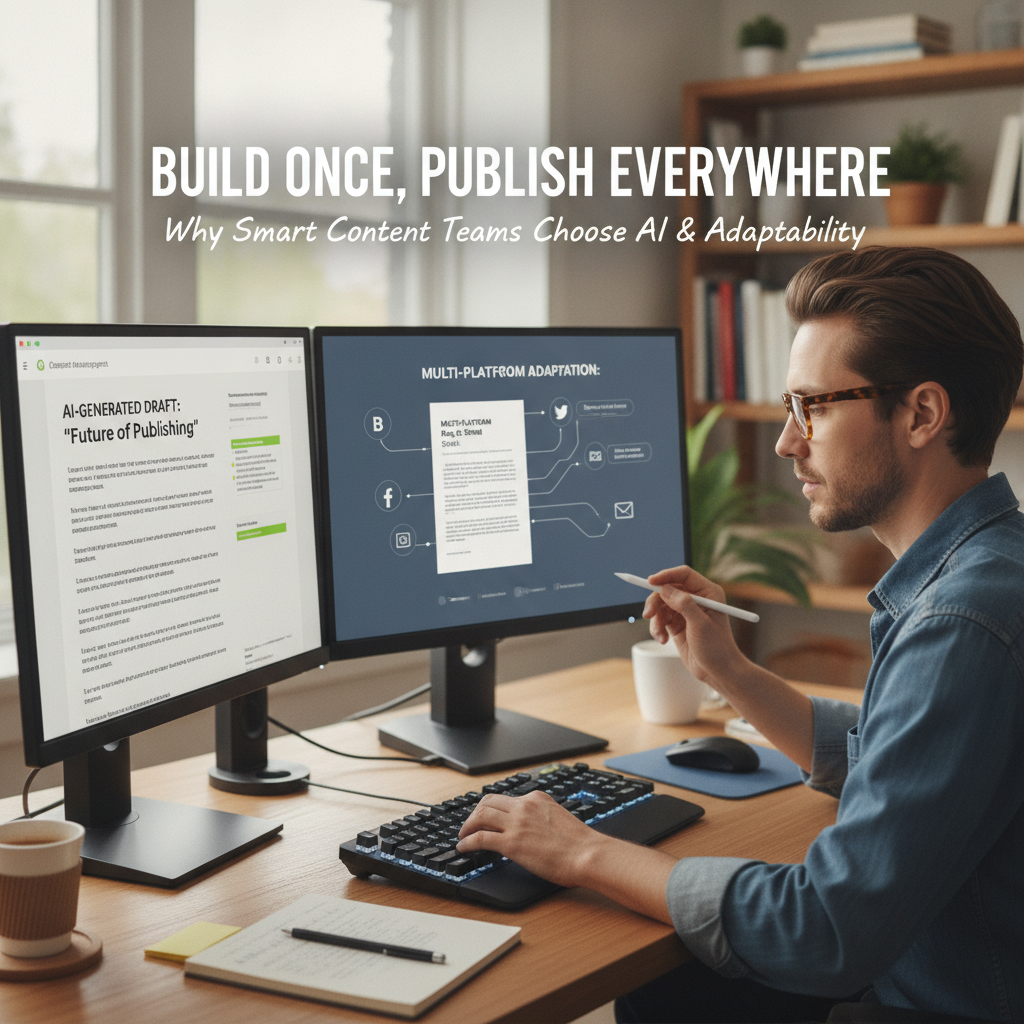
Human in the loop editing AI content drafts
The Hybrid Advantage
The optimal framework allocates roughly 80% of the work to AI automation and 20% to human refinement.
Here's a real-world scenario. An AI model transcribes a customer interview and drafts five social posts. The raw drafts sound slightly robotic. A human editor spends ten minutes injecting the brand's unique tone and adding a personal anecdote. The final product is authentic and took a fraction of the time to create.
How Do You Build a Sustainable CORE Workflow?
Start by taking an inventory of your existing assets. Analyze which channels currently drive the most engagement for your brand. Evaluate your team's capacity and review your current tool stack. Look for past high-performing pieces that make excellent pillar candidates.
Establish foundational processes. Integrate your new approach directly into your central content calendar. Build specific repurposing templates for each format. The barrier to progress in 2026 is less about technology and more about foundational readiness. You need defined team roles and quality control checkpoints to make this stick.
Implement and iterate. Start small by selecting exactly one pillar content type. Test the derivative pieces across three or four primary channels. Track the hours saved, engagement rates by platform, and team satisfaction. Refine your templates based on this data before scaling up your operations.
What Content Formats Work Best for Repurposing?
High-Value Pillar Assets
Some content types yield more derivative pieces than others.
- Video content: Webinars and interviews offer visual, audio, and text potential. You can extract 10 to 15 derivative pieces.
- Podcast episodes: Audio translates perfectly to text. You can expect 8 to 12 pieces, largely driven by easy quote extraction.
- Research reports: Original data builds immediate authority. You can pull 12 to 15 pieces by highlighting different angles and statistics.
- Long-form articles: Pieces over 2000 words establish strong SEO foundations. Section-by-section breakdowns yield 6 to 10 social posts.
- Live presentations: These offer great behind-the-scenes content bonuses. Recaps and highlights usually generate 8 to 10 unique pieces.
Format Transformation Matrix
Use this simple structure to map your efforts.
- Video to Text: Transcripts become blog posts
- Audio to Social: Compelling soundbites become quote graphics
- Data to Visual: Survey results become carousel slides
How Does Repurposed Content Impact SEO and AI Discovery?
Search Engine Benefits
Repurposing content naturally builds deep topical authority. You create multiple internal linking opportunities across related pieces.
Updating and atomizing older pillar pieces sends fresh content signals to search engines without requiring full rewrites. According to Google Search Central documentation, maintaining deep, updated content clusters directly supports long-term ranking stability.
Answer Engine Optimization (AEO)
Tools like ChatGPT, Perplexity, and Google AI Overviews look for specific structures. Repurposed content appears in multiple queries when properly formatted.
To optimize for generative engines in 2026, include clear standalone answers and structured data. Use question-based headings, bulleted lists, and concise TL;DR summaries at the top of your pages.
Multi-Channel SEO Advantage
YouTube SEO and Google Search work together seamlessly. Social media platforms act as discovery entry points that funnel users to your owned properties. Even newsletter archives serve as indexed content that captures long-tail keywords.
What Are Common Mistakes to Avoid?
Identical cross-posting across platforms kills your reach. Algorithms penalize duplicate content, and audiences ignore it. Always adapt the tone and format to the specific platform.
Repurposing low-quality pillar content wastes time. The garbage in, garbage out principle applies heavily here. Only atomize content that meets a strict quality threshold. If the original asset lacks depth, don't waste time chopping it up.
Over-automation without human review leads to brand voice drift and accuracy issues. Follow the 80/20 rule. Automate the structural creation, but mandate human review for the final polish.
Skipping a strategic distribution plan causes audience fatigue. Publishing 15 pieces of content on the same topic in one week leads to content cannibalization. Build a strategic spacing framework to stagger your content.
FAQ
How many pieces of content can I create from one pillar asset?
You can realistically generate 8 to 15 distinct pieces from a single high-quality asset. For example, a 45-minute podcast interview can become one full transcript blog post, five social media quote graphics, three short video clips, an email newsletter summary, and a Twitter thread. Quality always matters more than sheer volume.
Won't repurposing make my content feel repetitive to my audience?
Platform-native adaptation prevents repetition. Social media reach algorithms mean most followers never see every piece of content you publish. By spacing out your distribution and varying the format, you reinforce a consistent message without boring your audience.
What tools do I need to build once and publish everywhere effectively?
You need transcription services, basic video editing software, and a social media management platform. AI writing assistants are also essential for fast reformatting. While you can stitch separate tools together, using an operational partner platform like Repostra.app simplifies the entire workflow into a single hub.
How much time does content repurposing actually save?
Systematic repurposing can cut your content creation time by 60 to 80%. A team spending 20 hours a week creating disparate social media posts can reduce that workload to 6 or 8 hours. You spend more time reviewing AI drafts than staring at a blank page.
Should every piece of content be repurposed, or only certain types?
Apply the 80/20 rule to your content planning. You should only repurpose your most substantive, high-value pillar assets. Short, timely updates or brief announcements should remain standalone content. Reserve your heavy atomization efforts for deep, evergreen research or interviews.
Making "Build Once, Publish Everywhere" Work for Your Team
A build once publish everywhere mindset fundamentally changes how marketing teams operate. It replaces the anxiety of constant creation with a sustainable, high-output engine. You gain massive efficiency and protect your baseline quality simultaneously.
The partnership between human creativity and AI automation is non-negotiable. Machines provide the speed, and humans provide the soul. Start your transition this week by choosing one high-performing piece of existing content. Map out your platform-native adaptations, set up a human review checkpoint, and track the results.
As content marketing evolves through 2026, operational partners like Repostra.app will prove vital to maintaining this balance. Build your CORE workflow today, and watch your team's output soar while burnout finally disappears.