Still Treating Social Posts as Separate Tasks?
This post explores how businesses can simplify content creation by turning each core asset into a repeatable stream of social media content. It shows how content repurposing and light AI automation can save time while keeping quality and brand control...
From Burnout to Brand Consistency: Why Content Ecosystems Beat Isolated Social Posts in 2026
Treating social posts as separate tasks causes burnout and fragments your brand messaging. High-performing brands in 2026 use content ecosystems instead. They create one core asset and repurpose it across platforms. Combined with AI automation, this approach saves up to 80 percent of creation time while improving engagement. The shift from isolated posts to interconnected content drives sustainable growth.
Key Takeaways
- The separate task approach to social media creates rapid team burnout
- Content repurposing via ecosystems reduces creation time by 60 to 80 percent
- AI tools handle production tasks so teams can focus on strategy
- One core asset can easily generate 10 platform-specific pieces of content
- Interconnected content improves visibility in AI search engines and traditional platforms
Why Does Your Social Strategy Feel So Exhausting?
Scrambling to fill calendar slots feels terrible. Treating each post as a new deadline exhausts your team.
The emotional cost? Team burnout and decision fatigue set in quickly when you start from scratch every day.
The business cost? You waste valuable resources recreating similar content repeatedly.
Modern audiences encounter brands across six to eight touchpoints before taking action. They move between search, video, social, and email without realizing it. If posting feels like a never-ending homework assignment, you're stuck in the separate task trap.
What Happens When You Treat Social Posts as Separate Tasks?
Working post-by-post breaks your brand voice across channels. It also destroys narrative continuity and story building.
According to HubSpot's 2025 Marketing Strategy Report, 63% of marketers cite content creation as their top time-consuming task, with social media requiring an average of 6 or more hours per week per platform.
When team members are unavailable, content gaps appear immediately. The time invested doesn't compound.
Bottom line: You lose the ability to track the customer journey across touchpoints because your analytics are completely fragmented.
How Does a Content Ecosystem Work?
A content ecosystem is an interconnected network where one core asset feeds multiple channels.
You start with one high-value piece. This could be a long-form article, a detailed video, or a podcast episode.
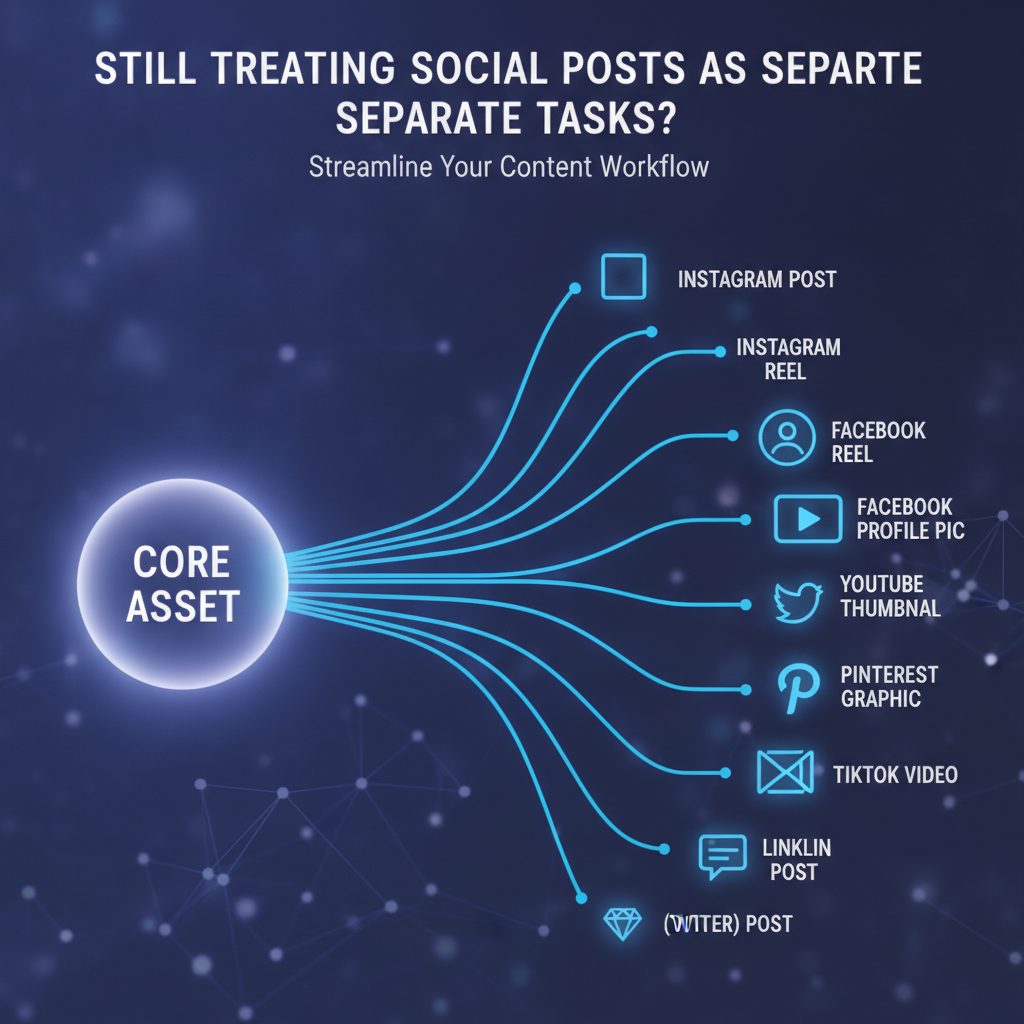
Visual diagram of a content ecosystem where a single blog post turns into videos, social posts, and newsletters
The adaptation process transforms formats while keeping your message consistent. One blog post becomes a LinkedIn article, five Instagram carousels, three short videos, a newsletter segment, and a Twitter thread.
Brands implementing content repurposing strategies report 2.3x higher engagement rates compared to those creating isolated posts, according to the Content Marketing Institute's 2026 Benchmark Report.
How Much Time Does Content Repurposing Actually Save?
The traditional approach takes hours. Ten separate posts usually require ten hours of work.
The ecosystem approach takes a fraction of that time. One core asset plus its adaptations takes about three to four hours total. This 60 to 80 percent time savings comes from a smoother workflow.
Teams spend less time on production and more time on strategy. You can use this recovered time to build relationships with your audience. Systems improve over time as templates mature.
"The teams I consult with consistently see 45-70% time recovery within their first month of implementing content ecosystems. The key is treating content as assets, not assignments."
Sarah Mitchell, Content Strategy Director at MarketingProfs (2026)
Does Content Repurposing Hurt Quality or Authenticity?
Lazy copy-pasting will absolutely hurt your quality. Strategic adaptation is entirely different.
Brand voice consistency actually improves when you work from core messaging. You optimize the presentation for each platform rather than posting the exact same file everywhere.
Audiences in 2026 value human-made strategy. They don't mind if AI handles the production mechanics.
Quality control happens through templates and clear brand guidelines. Repurposing gives you more time for authentic storytelling. The consistency builds psychological confidence for your entire team.
How Should You Use AI for Content Repurposing in 2026?
AI has evolved from a basic caption assistant to a complete workflow engine.
What AI handles well: Format adaptation, platform optimization, scheduling, and initial drafts.
What humans must control: Strategy, brand judgment, emotional resonance, and relationship building.
According to "The State of AI in Marketing 2026" report published by the Marketing AI Institute, AI adoption in content teams has increased to 78 percent.
Workflow example: A human creates the core asset. The AI generates platform variations. The human reviews the output and adds authentic touches. Use AI as a tool rather than a replacement to avoid generic sameness.
How Do You Build Your First Content Ecosystem?
Building an ecosystem requires a straightforward framework. You can start small with one ecosystem per week.
Step 1: Choose your core asset type based on what you create best.
Step 2: Map out your specific distribution channels.
Step 3: Create adaptation templates for each platform.
Step 4: Set up a consistent production workflow.
Step 5: Test your results and refine the process.
A 2026 case study published by Harvard Business Review detailed how a mid-sized tech brand used this ecosystem approach. They increased their total reach by 400 percent without hiring additional writers.
Restructure your content calendar around themes instead of planning individual posts.
What Platform Differences Matter When Repurposing Content?
Platforms in 2026 function heavily as search engines. You must adapt to native expectations.
LinkedIn: Focus on thought leadership, longer-form insights, and a professional tone.
Instagram: Prioritize visual-first content, carousel success, and native Reels formatting.
Twitter or X: Design conversation starters, threads, and real-time engagement hooks.
YouTube: Use this as your video ecosystem hub with deep SEO optimization.
TikTok: Participate in trends and match native content expectations perfectly.
Facebook: Build community features and utilize longer video performance.
Interconnected content significantly improves your chances of citation by AI search engines across the board.
What Metrics Prove Your Content Ecosystem Is Working?
Look past simple vanity metrics to see what actually matters.
Cross-platform tracking: Follow the customer journey across multiple touchpoints. Measure engagement depth rather than just surface breadth.
Track your time savings by counting the exact hours recovered each week. Review your brand consistency scores and content ROI. Compare the cost per asset against the total reach achieved.
Long-term indicators: Watch for audience growth, authority building, and organic search visibility over several months. Set realistic expectations for your timeline.
Why Do Some Content Repurposing Strategies Fail?
Copying and pasting the exact same text everywhere is the fastest way to fail.
Common mistake: Repurposing low-quality core assets. If the original piece is weak, the spin-offs will be worse.
Ignoring platform-native best practices will suppress your reach. Over-relying on AI without human oversight creates generic content. Failing to set up a quality control system guarantees errors.
Forgetting to update or refresh evergreen content leaves your ecosystem stale. Fix these issues by implementing a mandatory human review step before publishing.
How Will Content Ecosystems Evolve Beyond 2026?
AI search engine dominance makes citation importance a top priority. The demand for authoritative, interconnected content will only increase.
Platform algorithm shifts continue to favor topical depth over simple posting frequency. The quality over quantity trend is accelerating rapidly.
Building content equity now creates a compounding asset for your business.
Preparing for next-generation AI tools today gives you a massive competitive edge tomorrow.
FAQ
How long does it take to create a content ecosystem?
Your first ecosystem can be built in two to three hours. You spend one hour creating the core asset and two hours adapting it for five to seven platforms. As you develop templates and workflows, this reduces to 45 to 90 minutes per ecosystem. Most teams see full efficiency gains within four to six weeks.
Can small businesses with limited resources use content ecosystems?
Content ecosystems are actually more valuable for small teams. Instead of struggling to post daily on multiple platforms, you create one strong piece weekly and adapt it. This approach requires fewer total hours while maintaining a consistent presence across channels.
Won't my audience notice I'm reposting the same content?
When properly adapted, ecosystem content doesn't feel repetitive. Each platform gets a unique format, angle, and presentation. Your LinkedIn audience rarely overlaps perfectly with your Instagram audience. Strategic repurposing reinforces your message rather than boring your audience.
What type of content works best as a core asset?
The best core asset is whatever you create most naturally. This could be written articles, video content, podcast episodes, or data reports. Choose the format where you can provide the most depth and value. Everything else adapts easily from there.
How do I maintain authenticity when using AI for repurposing?
Use AI for mechanical tasks like format conversion, initial drafts, and platform optimization. Keep human control over voice, tone, and final messaging. Think of AI as your production assistant, not your content strategist. Always add personal touches, timely observations, and brand-specific language in your final review.
Start Building Your Content Ecosystem Today
You can transition from exhausting separate tasks to a sustainable ecosystem right now.
Immediate benefit: You'll reclaim 60 to 80 percent of your content creation time.
Long-term benefit: You build lasting brand authority through reliable consistency.
Choose one core asset to transform this week. The shift feels difficult at first but becomes natural quickly. Tools like Repostra.app can automate the adaptation process for you. Your content should work for you, not the other way around.