One Piece of Content, Ten Social Posts, Zero Burnout
This post explores how businesses can turn a single strong content asset into a steady stream of social media content without overwhelming their team. It will show how content repurposing and light AI automation can support consistent, high-quality mar...
Content Repurposing: Turn One Asset Into 10 Posts and Cut Production Time by 80%
Content repurposing transforms one high-value asset into a dozen platform-specific social posts, cutting production time by 80 percent and costs by 65 percent. Combining strategic deconstruction with AI-assisted workflows and human oversight allows marketing teams to maintain a consistent multi-platform presence without exhausting their staff. This systematic approach maximizes audience reach across various channels while strengthening SEO performance through frequent, algorithmic-friendly content updates.
Key Takeaways:
- 62 percent of creators report burnout from relentless content demands across multi-platform strategies.
- Transforming a single hero asset saves massive creation time by yielding platform-native posts.
- AI automation handles initial drafting, but editorial review ensures brand voice remains authentic.
- Different formats reach distinct audiences, maximizing the visibility of a single core message.
- A systematic workflow scales output without requiring additional headcount or budget.
Why are marketing teams burning out?
Marketing teams in 2026 juggle YouTube, TikTok, LinkedIn, Instagram, and newer platforms simultaneously. Each platform demands different formats, specific posting frequencies, and unique creative approaches. Social media management often feels less like creative work and more like a mandatory, taxing obligation.
62 percent of creators report burnout from these relentless content demands, according to research on creator economy trends. More effort rarely guarantees better results. A phenomenon known as "Ad Blindness" means users actively ignore scripted, repetitive content. Studies on social media user behavior show that 32 percent of users report severe social media fatigue.
"If you're a content creator, coach, or marketer, you know the drill: You're writing one thing while thinking of three others; Your calendar looks full but feels directionless. Systems beat hustle."
Sonia Akter, Content Marketer and Author, Medium
What is content repurposing and why does it work?
Content repurposing means treating one hero asset as the anchor for a modular content campaign. A long-form blog post, a detailed webinar, or an in-depth white paper becomes the source material for a dozen derivative pieces.
This strategy dominates because it drastically reduces resource drain. AI-driven repurposing workflows save 60 to 80 percent of creation time. Production costs often drop by up to 65 percent.
Different formats serve different consumption preferences. A short video clip might reach a younger audience on TikTok, while a text carousel reaches professionals on LinkedIn. Search engines also favor this approach. Google's algorithms prioritize fresh, frequently updated content to establish brand authority.
How do you turn one asset into ten posts?

Diagram illustrating one content piece splitting into multiple social posts.
Step 1: Choose your hero asset. High-value content like an in-depth blog post or an original research report works best. The material must contain multiple insights, solid data points, and actionable takeaways.
Step 2: Deconstruct the material modularly. Extract the most provocative statistic for a short text post. Break down key arguments into a slide-based carousel for LinkedIn. Use AI to edit a long-form video into 30-second clips for YouTube Shorts.
Step 3: Adapt for the platform natively. Format matters heavily. LinkedIn audiences favor professional insights and data. TikTok rewards raw, authentic storytelling. Adjust the tone, length, and visual formatting to match where the post will live.
What role should AI play in content production?
AI handles the heavy lifting in modern content workflows. It quickly drafts captions, summarizes long text blocks, and generates initial video clips. It easily manages transcription and suggests relevant hashtags.
Critical principle: Always use Human-in-the-Loop AI. Never ship AI output without an editorial checkpoint. AI manages the volume, while humans ensure accuracy, voice, and brand alignment.
Audiences can easily detect purely automated content. Relying entirely on software leads to generic output. Use AI for speed and initial format transformation, but rely on human editors for strategy and quality control.
How can Repostra.app support your strategy?
Bridging the gap between content creation and distribution drains time. Teams need systems that automate logistics so they can focus on high-level strategy.
Repostra.app automates the distribution and transformation of your content. It handles scheduling across multiple platforms and assists with format transformation. This maintains a consistent posting cadence without requiring manual labor.
Bottom line: Repostra helps you scale your output without increasing headcount. It functions as a comprehensive system designed to solve content overload and deliver measurable growth.
What is the Create Once, Publish Everywhere methodology?
The Create Once, Publish Everywhere (COPE) methodology treats content as raw material rather than a finished product. You create content in a modular format and then adapt it for various channels.
Traditional workflows treat every platform as a blank canvas requiring unique content. COPE shifts the mindset toward smart adaptation.
When to use this: Apply COPE whenever you invest significant resources into a major asset. It ensures consistency in messaging while scaling production without a proportional increase in budget or time.
How do you implement this without losing authenticity?
Over-automation risks creating off-brand, robotic content. Efficiency should never sacrifice distinctiveness.
Common mistake: Blindly trusting AI templates without customization. Always document your brand voice guidelines and establish firm editorial review checkpoints.
A standard quality control process flows from AI draft to human edit, followed by a brand alignment check. You can establish platform-specific voice variations like staying formal on LinkedIn and casual on TikTok while maintaining your core brand essence.
What should your zero-burnout checklist include?
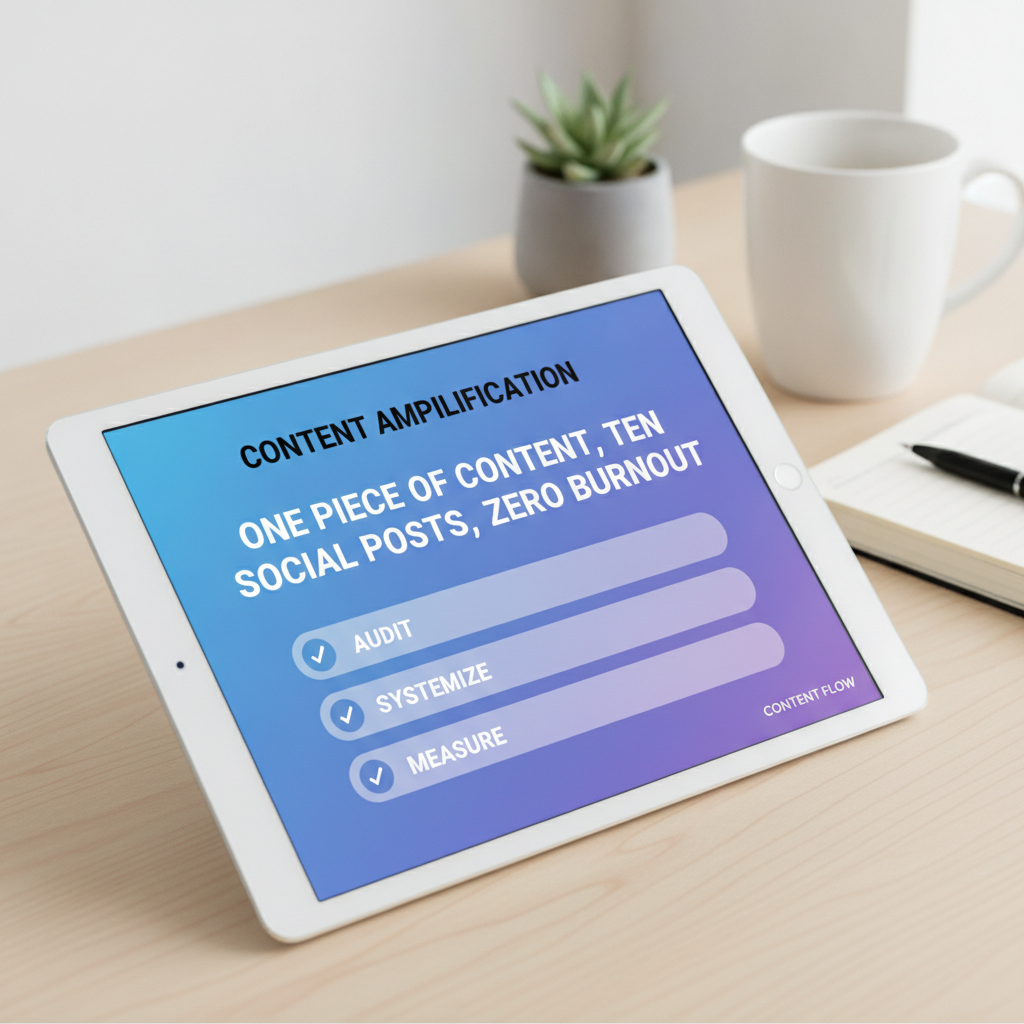
A checklist for zero-burnout content creation workflows.
A structured roadmap prevents teams from slipping back into chaotic creation habits.
- Audit Phase: Review analytics to identify top-performing legacy content. Look for high-engagement posts and webinars with evergreen value.
- Systemize Phase: Document your transformation workflow. Create templates for carousel formats, video snippet structures, and newsletter summaries.
- Automate Phase: Integrate AI tools for draft creation. Set up distribution automation for scheduling and cross-posting.
- Measure Phase: Track engagement per platform. Decide what formats to prune and which high-ROI channels deserve more attention.
FAQ
How much time does content repurposing actually save?
AI-driven workflows save 60 to 80 percent of creation time compared to generating original posts from scratch. Turning an eight-hour blog post into multiple social posts takes only two or three hours with AI assistance and human editing. The initial workflow setup requires a time investment, but ongoing efficiency compounds rapidly.
What types of content work best as hero assets?
Long-form blog posts over 1,500 words, webinar recordings, podcast episodes, and original research reports work best. These formats provide depth, modular structure, and multiple actionable takeaways. Time-sensitive news or shallow listicles lack the substance needed for effective extraction.
Can AI tools maintain my brand voice?
Not without human oversight. AI handles mechanical tasks and mimics structure well, but it lacks brand intuition and cultural context. Use AI for first drafts and mechanical transformation, but always require a human editorial review before publishing.
How do I know which platforms to prioritize?
Start where your audience already engages by reviewing your traffic and conversion analytics. Better to excel on three platforms than produce mediocre content across seven. Test different formats using adapted content, measure the results, and double down on the channels driving the highest return.
What is the difference between repurposing and reposting?
Repurposing involves adapting the content format, length, and presentation specifically for native consumption on a given platform. Reposting means sharing the exact same file or text across every channel. Reposting appears lazy and often performs poorly, whereas adaptation respects audience preferences while keeping the core message consistent.