Are You Creating Enough Content—or Using It Well Enough?
This post explores why content volume alone doesn’t drive results, and how smarter repurposing and distribution help marketing teams get more value from every asset. It offers a practical, approachable look at building a more effective content marketin...
Stop Creating More Content. Start Making What You Have Work Harder.
Creating more content will not solve your marketing challenges. Using what you have strategically will. Successful marketing teams have shifted from volume-based treadmills to a value-driven content repurposing strategy. By creating fewer core assets and systematically distributing them across platforms, brands achieve higher organic traffic while saving massive production time. Make every piece work harder through smart repurposing, AI-powered workflows, and human-led strategy.
Key Takeaways:
- Volume is dead. Quality beats quantity for audience engagement and algorithm favorability.
- Repurposing multiplies impact. One core asset generates twelve derivative pieces to increase reach.
- AI handles execution. Human creativity owns brand voice, strategy, and emotional storytelling.
- Performance optimization matters. Top-performing content requires continuous refinement and targeted re-promotion.
- Strategic distribution drives engagement. Platform-specific formatting dramatically outperforms generic cross-posting.
Why Your Content Calendar Might Be Working Against You

Overwhelmed marketing manager staring at an empty digital content calendar
Picture a marketing manager staring at a blank calendar. The pressure to feed the beast with daily posts feels overwhelming. More content creation does not equal better results.
A sustainable content repurposing strategy matters more than ever. The digital world reached a saturation point in 2026. According to Orbit Media's annual blogger survey, the average blog post now takes over 4 hours to write, yet most content gets buried within 24 hours of publication.
We will explore how to stop churning out disposable posts. It is time to start building lasting value.
What Happens When You Prioritize Quantity Over Quality?
The volume trap happens when a team values frequency over substance. This approach brings three specific negative consequences.
The Saturation Point: Algorithms filter out thin content. Audiences develop blindness to repetitive and low-effort posts.
Vanity versus Reality: Likes and views mean nothing if they fail to convert into tangible business outcomes.
Resource Drain: Constant production treadmills lead to creative exhaustion and severe team burnout.
Brand A posts generic AI-generated articles daily. Brand B publishes one highly researched guide weekly. Brand B consistently sees better lead generation.
Research from HubSpot's 2025 marketing trends report shows that brands publishing 3-4 high-quality posts per week see 2.5x higher engagement rates compared to those posting multiple times daily.
| Strategy Focus | Output Volume | Audience Engagement | Team Burnout Risk |
| Volume-Based | Daily | Low | High |
| Repurposing-Based | Weekly | High | Low |
"We cut our publishing frequency in half and saw conversions triple. The algorithm rewards depth, not speed."
Sarah Chen, Content Director at Buffer, 2025
Why Is Content Repurposing the Secret to Marketing Efficiency?
Content repurposing means strategic transformation. You do not just recycle old links. You adapt a core message for different formats.
This approach acts as a massive competitive advantage.
Efficiency gains: Teams report saving up to 60 percent of their production time when following a structured repurposing workflow.
Output multiplier: Total content pieces increase by 40 percent without extra research.
Performance boost: Systematic repurposing brings compounding benefits to your website visibility. According to Semrush's 2025 content marketing report, websites building content hubs from repurposed core assets see a 27% increase in organic traffic within six months.
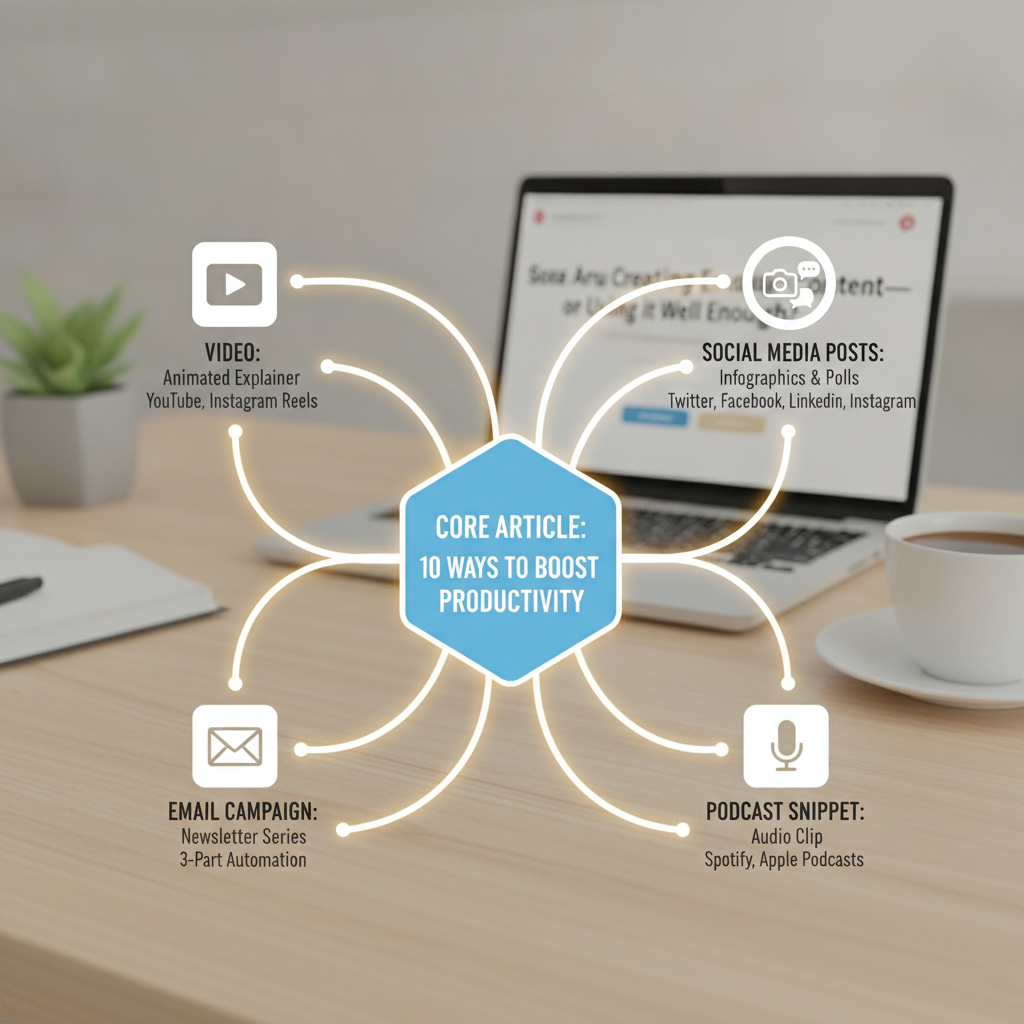
Diagram showing one core asset transforming into 10 different content formats
One blog post becomes ten derivative pieces. You can extract a video script, a carousel, an email newsletter, and multiple social clips.
Do audiences notice the repetition? No. Different platforms provide different contexts and reach entirely different user segments.
How Should Marketing Teams Use AI for Content Creation?
Treat AI as an assistant rather than an architect. Generic AI content gets ignored by audiences and penalized by algorithms. You need a clear division of labor.
Gartner's 2025 marketing technology survey found that 68% of high-performing content teams use AI for execution tasks while reserving all strategic decisions for human team members.
Human responsibilities:
- Strategic thinking and long-term planning
- Brand voice and emotional storytelling
- Editorial judgment and rigorous quality control
- Authentic relationship building
AI responsibilities:
- Initial research and data gathering
- First-draft generation and rapid summarization
- Format transformation
- Technical formatting and basic search optimization
Follow the 80/20 rule. AI removes 80 percent of the execution friction. Humans dedicate 100 percent of their energy to strategic decision-making.
How Do You Build a Content Strategy That Actually Works?
You need an actionable framework to escape the daily grind. Follow these three practical steps.
Build Core Assets. Start with a comprehensive piece of over 2,000 words. Think of ultimate guides, original research reports, or in-depth video interviews. Publish one excellent piece monthly instead of twenty mediocre posts.
Execute Systematic Distribution. Transform the asset for specific platforms. Turn your guide into an educational LinkedIn carousel. Record a short video hook for TikTok. Send a detailed excerpt to your email newsletter. Stagger these releases over four to six weeks for maximum reach.
Optimize Continuously. Abandon the launch and leave mentality. Track which formats drive traffic. Refresh your best content quarterly with new data and better examples. Archive underperforming pieces to maintain a high-quality library.
What Stops Teams from Repurposing Content Successfully?
Several barriers prevent teams from adopting this workflow. Let us look at the most common objections.
Common mistake: Believing you lack the time to repurpose.
The reality: Repurposing saves massive amounts of time compared to starting from scratch. Front-load your effort on the core asset and back-load the distribution.
Common mistake: Fearing your audience will notice repetition.
The reality: Data shows 90 percent of your audience misses any single post. Different formats reach entirely different segments of your followers.
Common mistake: Feeling unqualified for video or graphic design.
The reality: AI design tools and simple templates lower the barrier to entry. Start with basic text-on-screen videos or simple quote graphics.
Common mistake: Yielding to leadership demands for daily original content.
The reality: Show them performance data. Compare engagement rates to prove that algorithms favor quality over frantic speed. Designate a repurposing champion on your team to own the process.
How Do You Know If Your Content Strategy Is Working?
Shift your focus from vanity metrics to tangible business value. You must track indicators that prove your efficiency and impact.
Efficiency metrics: Track the time spent per published piece. This number should decrease over time. Total pieces generated from one core asset should increase.
Engagement quality: Monitor comments, saves, and shares. Ignore simple views.
Business outcomes: Count lead generation, newsletter signups, demo requests, and direct revenue attribution.
SEO impact: Measure organic traffic growth and new keyword rankings.
Expect to see meaningful data after 90 days of consistent execution. Review your core metrics weekly. Conduct a full analysis every month.
Will Content Repurposing Still Work in 2027 and Beyond?
This strategy offers lasting staying power. Major platforms like Google and LinkedIn continuously update their algorithms to reward depth and dwell time over sheer frequency.
As AI-generated content floods the web, human-crafted strategy becomes vastly more valuable. Stay flexible with format preferences. Short-form video dominates now, but platform tastes change. The core principle of quality combined with strategic distribution will remain untouched.
Train your teams in critical thinking rather than just tactical execution. Content libraries built systematically today will compound in value for years. Disposable daily posts vanish into the void within hours.
From Content Treadmill to Strategic Engine
Escape your content calendar anxiety. Marketing is not about feeding the beast. It is about building long-term equity.
Create once, distribute everywhere, and optimize continuously. This approach leads to less burnout, better results, and highly sustainable growth. Start with a single core asset this month. Commit to transforming it into eight different formats.
Content remains king, but it operates as a kingmaker driven entirely by strategy. Try this method for 90 days. You will see a massive difference in both your metrics and your team morale.
FAQ
How many pieces can I realistically create from one core asset?
A well-researched guide can generate eight to twelve derivative pieces. You can extract one long video, three short social videos, a carousel, an infographic, an email newsletter, and multiple quote graphics. Plan for this from the start by including rich data points and pull quotes in your original piece.
Will my audience get tired of seeing the same content repeatedly?
No. Social media algorithms organically show your posts to a very small fraction of your followers. Different platforms also attract completely different audience segments. Spacing out your distribution over several weeks prevents any potential saturation.
What differentiates repurposing from just reposting the same thing?
Repurposing transforms the content to fit specific platform contexts and user expectations. Reposting just copies the exact same caption and link everywhere. LinkedIn users want analytical depth, while TikTok users want quick entertainment. You must adapt the core message to fit the medium.
How do I convince leadership to publish less frequently?
Present a data-driven pilot program. Track your current performance metrics for 30 days. Test a reduced frequency strategy with heavily enhanced quality for the next 60 days. Show the side-by-side metrics to prove that strategic posting outperforms rushed volume.
Which AI tools work best for content repurposing?
The best workflow combines text assistants for format transformation and design tools for quick visual creation. Video platforms can easily extract short clips from long-form content. Always remember that AI handles the tedious execution, while human strategy and careful editing remain absolutely essential.