Why Your Best Content Ideas Are Hiding in Old Posts
This post explores how businesses can turn existing blog posts, videos, and social updates into fresh marketing assets without starting from scratch. It shows how thoughtful content repurposing and light AI support can help teams create more consistent...
Content Repurposing: How to Turn One Asset Into 25 Pieces of Marketing Gold
Your best marketing ideas already exist in your archives. Content repurposing transforms existing blog posts, videos, and social updates into fresh assets across multiple channels. This strategy saves 60 to 80 percent of creation time and cuts production costs dramatically. Successful 2026 marketing teams use systematic frameworks to extend every piece's lifespan and maintain a consistent presence without expanding their headcount.
Key Takeaways:
- Content repurposing saves significant creation time compared to starting from scratch.
- Only 35 percent of marketers actively repurpose content right now.
- One well-researched asset can generate a month of social posts.
- AI tools accelerate workflows while human editorial judgment ensures brand safety.
- Systematic repurposing delivers higher ROI and reduces per-lead costs.
Why Is Your Marketing Team Stuck on the Content Treadmill?
Marketing teams spend forty hours a week creating new content. Meanwhile, thousands of dollars in existing assets gather digital dust. The cycle of creating, publishing, and forgetting is not sustainable.
Content saturation is a harsh reality in 2026. Organizations now allocate over 25 percent of their total marketing budget to content. Your team needs a way to scale output without sacrificing quality.
Content repurposing offers a practical solution. You can access hidden value in your archives without starting over every Monday morning.
What Is Content Repurposing?
Content repurposing means transforming one core asset into multiple formats for different channels. It represents the shift from simple content creation to full content orchestration.
There is a clear difference between repurposing, reposting, and updating. Reposting is publishing the exact same piece again. Updating is just refreshing old facts. Repurposing changes the format and angle entirely to fit a new medium.
A single long blog post can become a LinkedIn carousel, an email newsletter, and five short social posts.
According to the Content Marketing Institute, content marketing generates three times more leads than outbound marketing at a 62 percent lower cost. Despite this clear financial benefit, only 35 percent of marketers actively repurpose their content. This leaves a massive competitive advantage for early adopters.
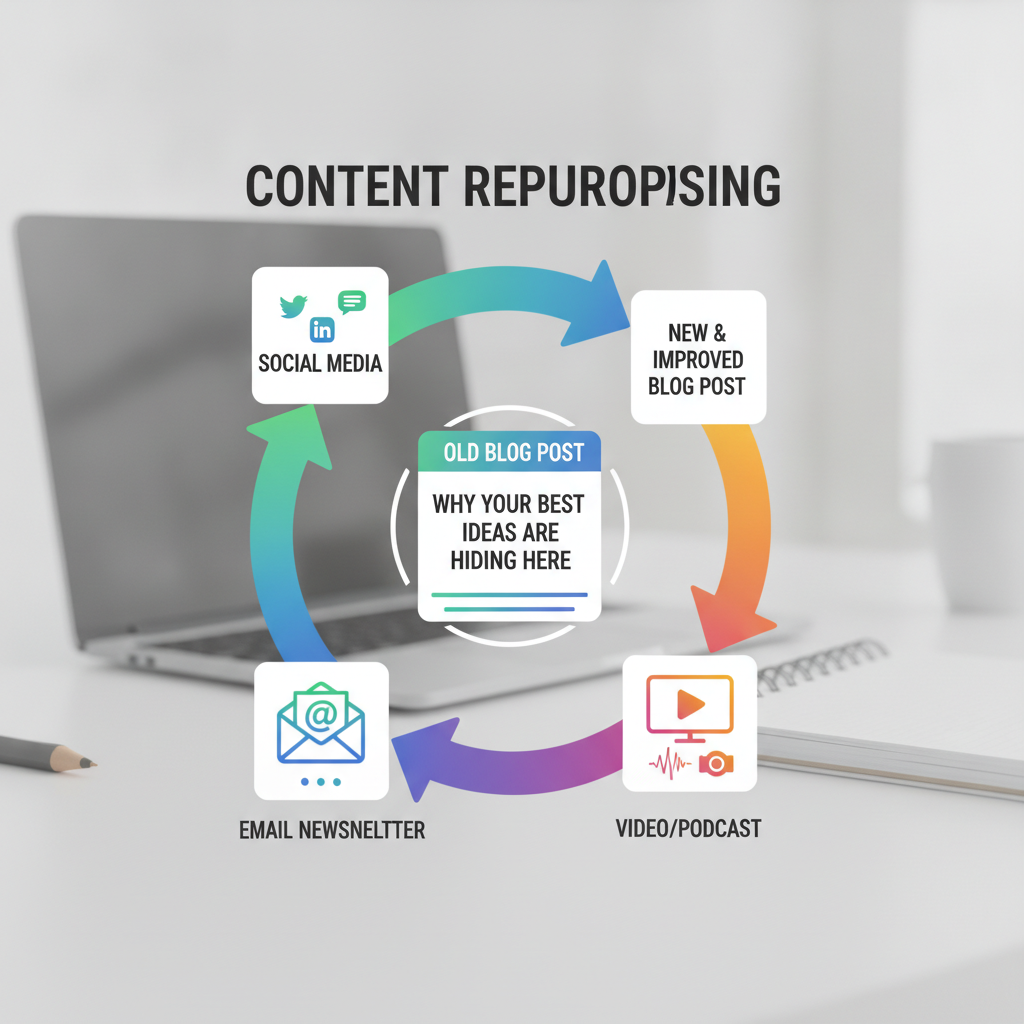
Diagram illustrating the content repurposing workflow from one asset to many
How Much Time and Money Does Content Repurposing Actually Save?
Repurposing fundamentally changes your marketing economics. AI-driven repurposing saves 60 to 80 percent of creation time and cuts production costs by up to 65 percent.
Sarah Jenkins, Chief Marketing Officer at TechGrowth, explains the shift: "Repurposing changed our content economics entirely. We are producing three times the output with the exact same team size simply by remixing what we already own."
Here is a comparison of the traditional approach versus a repurposing approach for a standard month of distribution:
| Approach | Assets Needed | Time Required | Cost Impact |
| Traditional | 20 net new posts | 40 hours | High |
| Repurposing | 2 core assets | 8 to 12 hours | Low |
Systematic repurposing reduces creative burnout and significantly speeds up your time to market.
Which Old Posts Should You Repurpose First?
Start with your most successful evergreen content. These pieces solve persistent audience problems and maintain steady traffic month over month. Focus first on assets with high historical engagement and valuable keyword rankings.
Long-form blog posts, webinars, and customer case studies make excellent repurposing candidates. Original research and comprehensive guides also provide dense material you can easily split up.
Apply the shelf life test to any historical asset. If the core insight will still solve a customer problem in six months, it is worth your time to repurpose it.

Content audit interface showing high traffic blog posts selected for repurposing
How Do You Turn a Single Asset Into Multiple Formats?
The core framework turns one major asset into many derivative formats. You extract smaller themes from a large piece to serve different platforms natively.
Phase One: Create social snippets. Build data visualizations for LinkedIn or extract key insights for text threads.
Phase Two: Develop video content. Pull strong quotes to script short-form clips for visual platforms.
Phase Three: Design visual assets. Turn dense data sections into simple infographics or presentation slides.
Phase Four: Feed your email marketing. Use a specific subtopic from a guide as a feature for your weekly newsletter.
A single two-thousand word article contains enough distinct ideas to fill four weeks of a social media calendar.
How Should You Use AI for Content Repurposing Without Losing Your Voice?
AI acts as your orchestrator rather than your originator. It excels at surfacing trends in your existing content and summarizing long text. You can also use it to generate multiple format variations for simple A/B testing.
Humans must remain entirely in control of brand voice and strategic messaging. Marketing teams must retain full responsibility for quality assurance and fact-checking.
Relying on AI to dictate your emotional resonance often leads to generic output and tone-deaf messaging. Use AI for speed and humans for authenticity.
How Do You Build Your Content Repurposing System?
You need an operational playbook to make this strategy work. A simple workflow makes multi-channel presence entirely manageable.
First, inventory your existing assets and tag them by topic and performance. Next, select three to five primary platforms that match your audience preferences. Then, create specific format templates for your social posts and emails. Build a dedicated repurposing calendar to schedule derivative content and maintain variety.
Tools like Repostra.app help teams systematically transform blog posts and videos into fresh marketing assets. These platforms make the transition seamless even for small marketing departments. Finally, track engagement by format to see exactly what resonates with your buyers.
Why Aren't More Marketers Repurposing Content?
Many creators worry that reusing ideas feels like cheating. In reality, you are simply serving different segments of your audience in their preferred formats. Most of your followers never saw the original post anyway.
Some teams argue they lack the time to implement a new system. Yet repurposing actually saves time compared to constantly building from scratch. Technical skills are also no longer a barrier. Modern software has democratized the process so you do not need a design degree to create good visuals.
The 65 percent of marketers not doing this systematically are simply working harder than they need to.
What Results Can You Expect When You Commit to Repurposing?
Committing to a reuse strategy expands your reach dramatically. The same core message finds entirely new audiences across different platforms.
You also gain significant SEO benefits. Comprehensive topic coverage across various formats boosts your overall topical authority. Brand cohesion naturally improves because your core messaging remains remarkably consistent everywhere your buyers look.
We see this pattern constantly in successful B2B companies today. They turn one weekly blog post into twenty-five different social assets. The compounding effect ensures that each repurposed piece builds long-term brand equity.
FAQ
How often should I repurpose the same content?
Repurpose evergreen content every three to six months with fresh angles or updated data. High-performing pieces can be reformatted for different platforms quarterly without audience fatigue since platform algorithms rarely show the same content twice to the same person.
Will repurposing hurt my SEO or look like duplicate content?
No. Search engines distinguish between formats and platforms. Repurposing across different mediums does not create duplicate content penalties. Comprehensive topic coverage across formats actually boosts topical authority and SEO performance.
What if my old content has outdated information?
Update facts, statistics, and examples during the repurposing process. This refresh makes your content more valuable. Add a note indicating when it was originally published and updated for transparency. The core insight often remains valid even if specific data points need refreshing.
Can small teams with limited resources really do this?
Yes. Repurposing is actually more valuable for small teams. With tools like Repostra.app and a simple workflow, a solo marketer can maintain a consistent presence that would otherwise require five people. Start with your top three pieces and one secondary format.
How do I repurpose content without sounding repetitive to my core audience?
Vary your angles, formats, and hooks while maintaining the core insight. A blog post about email building can become a data infographic, a personal story, a tactical thread, and a contrarian take. It is the same topic with entirely different entry points.