Why Smart Content Teams Repurpose Before They Even Hit Publish
This post explores how planning for content repurposing at the creation stage helps teams save time, stay consistent across channels, and distribute high-quality content more effectively. It shows how businesses can combine human oversight with AI-assisted workflows to make content marketing more scalable.

Stop Creating More Content: Why Smart Teams Repurpose Before Publishing
Smart content teams plan content repurposing during creation, not as an afterthought. Treating every blog post, video, or webinar as anchor content with a planned multi-platform afterlife saves 60 to 80 percent of production time. Combined with human oversight and AI-assisted workflows, this proactive strategy transforms content marketing from an exhausting creation treadmill into a scalable, high-ROI system that maximizes reach.
Key Takeaways:
- Pre-planning your repurposing strategy cuts content creation time by 60 to 80 percent
- AI workflows reduce production costs by 65 percent when paired with human editors
- Treating assets as anchor content boosts output by 40 percent without new ideas
- Platform-native adaptation prevents your social feeds from looking like link graveyards
- Selecting high-performing, evergreen assets maximizes your repurposing returns
What is the Content Hamster Wheel Problem?

Content marketer overwhelmed by the demand for continuous content creation
The create-publish-forget model drains resources and burns teams out. You spend weeks researching, writing, and designing a core piece of content. You publish it, share it once on social media, and immediately move on to the next project. Single-use content creates a massive bottleneck for modern marketing departments.
Bottom line: Producing entirely original content for every channel is no longer sustainable.
Why Does Content Repurposing Before Publishing Matter?
The mindset shift: Stop focusing on creating more assets and start distributing your best ideas smarter. When you plan repurposing early, you treat your core assets as anchor content. This foundational piece serves as the raw material for dozens of smaller, targeted variations.
ROI maximization: You get more mileage out of every creative investment. According to the Content Marketing Institute's B2B research, pre-planned repurposing saves 60 to 80 percent of content creation time compared to starting from scratch. It also boosts total content output by approximately 40 percent.
Team sustainability: You prevent creative fatigue. When the plan for a LinkedIn carousel, a short video, and an email newsletter is baked into the original outline, writers don't have to stare at a blank page.
How Does Pre-Planned Content Repurposing Work?

The Iceberg Strategy for content repurposing
The strategy: Think of your published piece as an iceberg. The published article or video is just the tip. The hidden value lies beneath the surface in the form of pull quotes, data points, and subtopics waiting for extraction.
Real-world execution: You decide to host a webinar. Under a traditional model, you hit record, host the event, and post the replay link. Under a pre-planned model, your production team maps the derivative assets on day one. You plan for five short video clips for TikTok, a LinkedIn carousel summarizing the presentation, a long-form SEO blog post based on the transcript, and three email newsletters breaking down the questions.
When to use this: Apply the iceberg method to any high-investment format. Original research reports, whitepapers, and long-form videos work best.
What Role Does AI Play in Content Repurposing?
AI acts as a creative partner that handles the heavy lifting of reformatting, while humans manage strategy and brand voice.
The Human-in-the-Loop model: You feed your anchor content into AI agents to generate rapid drafts, script highlights, and format variations. A human editor then reviews these outputs to ensure authenticity, check facts, and apply the brand's unique tone. This prevents the output from feeling synthetic.
Cost efficiency: Systematized production workflows drastically lower the barrier to entry for omnichannel marketing. According to the Marketing AI Institute's research, production costs drop by up to 65 percent when teams combine AI-driven systems with structured human oversight.
How Do You Maintain Consistency Across Different Platforms?
The omnichannel challenge: Your core message must stay the same, but the delivery format must adapt to the specific culture and technical requirements of each platform.
Platform-native adaptation: Never just dump links. A URL posted to a social feed gets suppressed by algorithms and ignored by users. You must adapt the tone, visuals, and structure to match the channel. Keep LinkedIn professional and document-heavy. Build vertical, trend-aware hooks for TikTok and Reels. Make your email newsletters conversational and value-first.
"The biggest mistake marketing teams make is treating every platform like a link graveyard. You cannot just drop a URL into LinkedIn and walk away. You have to translate the core message into the native language of that specific channel."
Ann Handley, Chief Content Officer at MarketingProfs
Common mistake: Treating adaptation as dilution. Changing the format to suit a platform doesn't mean dumbing down your expertise.
Which Content Should You Repurpose First?
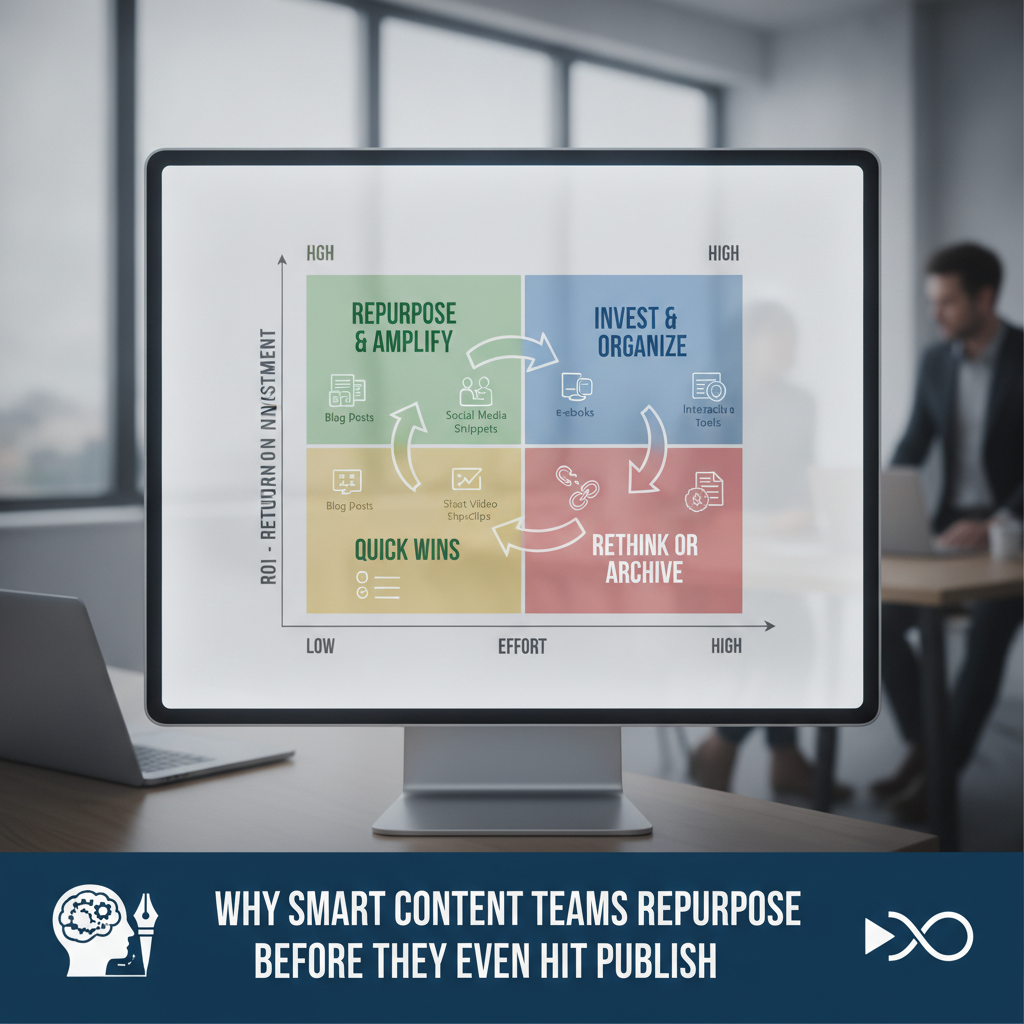
Content repurposing decision matrix
Audit your existing content library using strict, data-driven selection criteria. Avoid repurposing short, single-idea content because it lacks the substance needed for multiple derivative pieces.
Selection filters:
- Performance data: Look for pieces with historically high engagement, organic traffic, or conversion rates
- Evergreen potential: Prioritize timeless topics over news-based or highly seasonal content
- Strategic alignment: Ensure the core message still supports your current business goals and product features
Decision framework: Map your candidates on an ROI versus effort matrix. High-performing evergreen content that requires minimal updating should always be your first target.
What Are the Essential Content Repurposing Strategies?
How Do You Use the Iceberg Planning Method?
Treat long-form content as a hidden value repository. Map your derivative assets during the initial outline phase so your writers know exactly which subheadings will become standalone social posts.
How Do You Handle Platform-Native Translation?
Adapt tone, visuals, and format per channel. Follow the specific technical requirements for video specs and character counts. If you use a blog post for a Twitter thread, rewrite the hooks entirely.
Why is Performance-Based Iteration Important?
Use analytics to identify your winners. When a repurposed piece of content goes viral on LinkedIn, take that specific angle and expand it back into a new piece of anchor content.
How Does SEO Multiplication Work?
Target multiple keywords with format variations. Search Engine Journal's SEO studies demonstrate that building topical authority through comprehensive, multi-format coverage significantly improves domain rankings.
How Much Time and Money Does Content Repurposing Actually Save?
The hard numbers make the business case clear.
Time savings: Pre-planning repurposing cuts 60 to 80 percent of creation time. Under a traditional approach, creating ten unique pieces of content from scratch takes a team roughly forty hours. With a repurposing workflow, extracting ten derivative pieces from one anchor asset takes about twelve hours.
Output increase: You gain a 40 percent output increase because your team stops researching new topics for every single post.
Cost reduction: The 65 percent cost reduction comes from minimizing external freelancer hours for raw drafting and reducing the time internal subject matter experts spend on interviews. Your team's newly freed capacity can go toward strategy, relationship building, and innovation.
How Do You Build a Content Repurposing Action Plan?
How Do You Audit Your Content Library?
Step one: Identify your top five high-performing pieces from the last year. Score them for evergreen potential. If they're outdated, schedule a quick refresh before moving forward.
How Do You Map Your Repurposing Matrix?
Step two: Create a standard template. Map one anchor piece to six or eight derivative pieces. Match these formats strictly to your active, highest-performing channels.
How Do You Establish Your AI-Human Workflow?
Step three: Choose your tools and define your approval process. Set strict brand voice guidelines for your AI prompts so the initial drafts require less human editing.
How Do You Create Your First Repurposing Package?
Step four: Execute the workflow on a single piece of anchor content. Measure how long the process takes, document the friction points, and refine your prompts.
How Do You Systematize and Scale?
Step five: Build standard operating procedures. Train your team on the workflow and set up feedback loops to track the performance of the derivative assets.
FAQ
Does repurposing content hurt SEO with duplicate content penalties?
No. Search engines distinguish between cross-platform repurposing and malicious duplicate content on the same site. When you adapt a blog post into a LinkedIn article or a YouTube video script, you create unique formats that serve different audiences. Use canonical tags for similar web content and always add unique value to each version.
How often should I repurpose the same piece of content?
High-performing evergreen content can be repurposed indefinitely if you update it regularly. Aim to refresh the core asset every six to twelve months and adapt it for new platforms or angles. Focus your energy on your top twenty percent of content, as these pieces deserve continuous distribution.
What is the difference between repurposing and copying content?
Repurposing adapts your core message for different formats, audiences, and platforms while adding new context. Copying is verbatim duplication. A blog post repurposed into a video requires visual storytelling, different pacing, and platform-specific hooks, rather than just reading the article aloud.
Can small teams without AI tools still repurpose effectively?
Absolutely. While AI accelerates the process, the strategic framework works perfectly with manual workflows. Start simple. Pull quotes for social media, convert blog headers into LinkedIn posts, or turn webinar Q&As into a frequently asked questions page.
What types of content work best as anchor content?
Long-form, comprehensive pieces with multiple insights work best. Research reports, in-depth guides, webinars, podcasts, case studies, and interviews contain enough raw material, data points, and frameworks to create dozens of derivative pieces.
How Do You Build a Sustainable Content Engine?
Content marketing in 2026 focuses on impact and reach, not just raw publication volume. Transitioning away from the exhausting creation treadmill toward a sustainable, systemized workflow gives your team their time back. More output with less burnout allows you to dominate your market.
The future of content marketing relies on working smarter. Repostra.app empowers teams to implement these high-efficiency workflows, turning your best ideas into a consistent, multi-channel presence without the manual grind.