Why Serial Content Beats Standalone Posts for Audience Retention
Explain how recurring content themes and episodic formats can build anticipation and improve consistency across channels. The post can help brands turn scattered publishing into a habit-forming content strategy.
How Serial Content Builds Audience Retention (and Why One-Off Posts Don't)
TL;DR: Serial content transforms casual viewers into loyal subscribers by packaging your brand's message into predictable, recurring episodes. Unlike isolated posts that audiences forget immediately, episodic formats trigger anticipation, train algorithms to favor your content, and build deep topical authority while reducing production burnout.
Key Takeaways
- Serial formats create psychological anticipation that pulls audiences back repeatedly
- Predictable content reduces cognitive load and builds viewer trust
- Social algorithms reward the repeat engagement generated by recurring series
- Structured episodes streamline production workflows and reduce decision fatigue
- Topical authority grows naturally when you publish tightly themed episodic clusters
Why Are Content Teams Stuck on a Publishing Treadmill?
Content teams often find themselves trapped in an endless cycle. You post daily, hoping to catch a viral wave, only to watch audiences scroll past without forming any meaningful connection. The digital landscape is flooded with content, making it nearly impossible to stand out through sheer volume alone.
Brands exhaust themselves creating endless standalone posts that fail to build momentum. Viewers consume one piece of your content, maybe hit the like button, and immediately forget who you are. The relationship remains entirely transactional.
The solution? Shift from volume-driven publishing to value-driven storytelling. True growth happens when your audience actively seeks out your next post rather than passively stumbling upon it in a crowded feed.
What Is Serial Content?
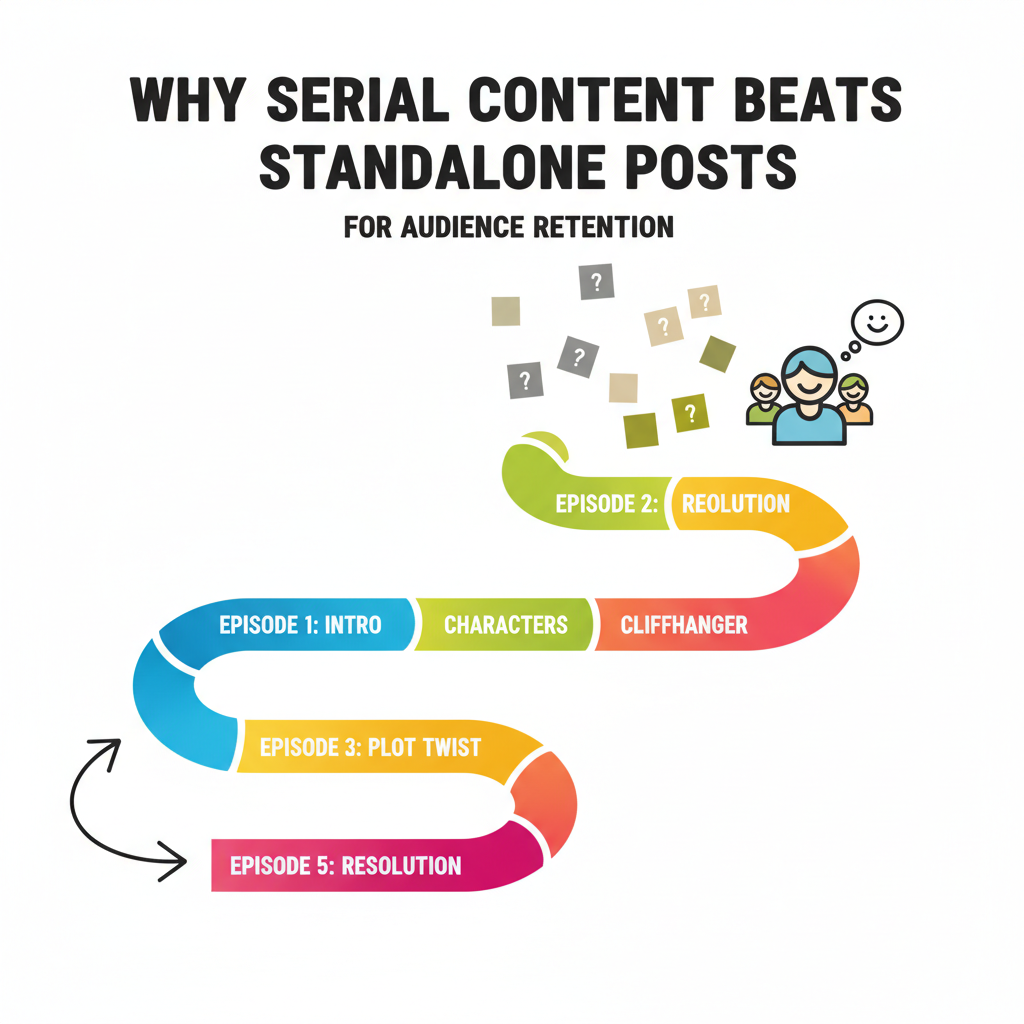
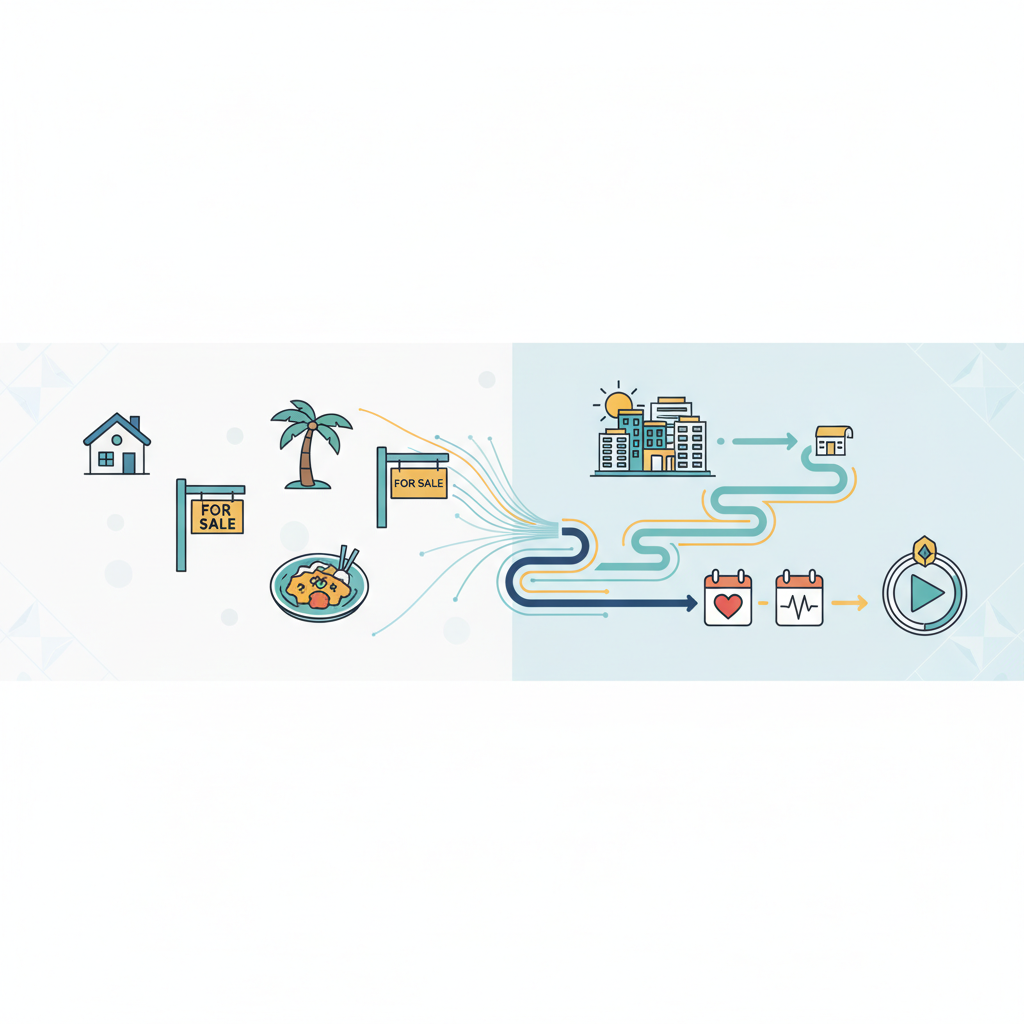
Illustration showing the transition from scattered content to an organized episodic content series
Serial content packages your brand's messaging into recurring themes, episodes, or narrative arcs. Instead of tossing isolated ideas into the void, you group related concepts into a predictable structure.
You've seen these formats everywhere. "FAQ Fridays," "30 Days of Innovation," or weekly behind-the-scenes vlogs all qualify. They differ drastically from standalone posts, which are one-off, isolated pieces that lack continuity.
Audiences suffer from severe fatigue when bombarded with fragmented marketing messages. We crave narrative. Just like a compelling streaming television series, an episodic marketing format provides a comfortable, familiar framework that audiences willingly invite into their routines.
How Does Serial Content Improve Audience Retention?
This strategy works because it fundamentally alters consumer psychology. You move from a push marketing model to an anticipation economy. Serial content creates an irresistible "pull" effect.
Viewers mentally commit to returning for the next installment. When you end a post with an open-ended question or unresolved tension, you activate the cliffhanger effect. This neurological investment practically guarantees return visits. Sprout Social's 2024 research confirms that optimizing for follower retention rather than pure reach requires creating ongoing narratives that entertain and educate consistently.
Predictability reduces cognitive load. Familiar formats act as powerful trust signals, telling your audience that your brand is reliable. Over time, checking for your newest episode becomes an ingrained habit rather than a random occurrence.
Why Does Serial Content Perform Better in 2026?
The digital attention economy now favors depth over breadth. Social media algorithms actively measure whether an account brings users back to the platform.
Algorithms prefer content series because they encourage multi-piece engagement. When a user watches part one and immediately searches your profile for part two, platforms log that high-intent behavior. Buffer's 2025 analysis found that accounts maintaining consistent content series see significantly better performance in views and engagement compared to standalone posts, strictly because they drive high-intent return visits.
"Podcasting and episodic content is not a traffic generator. It's a relationship accelerator. What it's bad at doing—growing awareness—it more than makes up for in being the world's best vehicle for deepening relationships and turning a passive audience into passionate superfans."
— Jay Acunzo, Author and Founder of Marketing Showrunners
AI content proliferation forces real differentiation. To survive the noise, you need a recognizable format and a persistent voice.
Standalone Posts vs. Serial Content
| Feature | Standalone Posts | Serial Content |
| :--- | :--- | :--- |
| Primary Metric | Reach (fleeting) | Retention (long-term loyalty) |
| Audience Mindset | Passive / Transactional | Active / Invested |
| SEO Impact | Low (isolated signals) | High (establishes topical authority) |
| Content Lifecycle | Short-lived | Evergreen / Renewable assets |
What Are the Business Benefits of Serial Content?
Operational Efficiency:
Converting a complex idea into a structured multi-part series acts as a powerful force multiplier for your marketing team. It streamlines production workflows and drastically reduces the daily brainstorming burden. You build a sturdy content calendar without staring at a blank screen every morning.
SEO and Discoverability:
Search engines prioritize domains that demonstrate deep knowledge. Publishing tightly grouped thematic series naturally aligns with Google's guidelines for establishing topical authority. This approach creates robust internal linking opportunities and generates higher aggregate page views per topic.
Audience Development:
You transform passive viewers into active participants. This narrative resilience builds an owned audience that remains loyal even when platform algorithms inevitably change. Viewers will follow a strong storyline across multiple channels, maximizing the lifetime value of every audience member.
How Do You Create a Serial Content Strategy?

Marketer organizing a step-by-step episodic content framework on a visual planner
Step 1: Choose your format. Decide whether you want a thematic series exploring different angles of one topic, an episodic narrative telling a continuing story, or a time-based recurring segment like a weekly feature.
Step 2: Establish your cadence. Predictability matters far more than frequency. Starting with a sustainable weekly release schedule always outperforms sporadic daily posting. Match your rhythm to natural audience expectations.
Step 3: Structure for anticipation. Use forward-looking teasers at the end of every post. Incorporate callbacks to previous episodes to reward long-term followers and encourage new viewers to explore your archives.
Step 4: Coordinate across platforms. Adapt your core narrative to fit different channels while maintaining cohesive branding. Your audience should instantly recognize the series whether they encounter it on LinkedIn, YouTube, or an email newsletter.
What Mistakes Should You Avoid with Serial Content?
Common mistake: Starting too ambitiously. Many brands overcommit to an aggressive daily schedule and burn out within a week. It's always better to start small, prove the concept, and scale up gracefully.
Common mistake: Inconsistent publishing. Breaking audience expectations instantly destroys the anticipation you worked so hard to build. Stick to a realistic timeline.
Common mistake: Ignoring the onboarding process. New audience members need clear entry points. Use recap strategies, numbered episodes, and dedicated "start here" guides to orient latecomers.
Common mistake: Forgetting standalone value. Each individual episode must offer genuine utility independently. If a post relies entirely on previous knowledge, casual scrollers will bounce before getting hooked.
What's the Difference Between Serial Content and Content Calendars?
A content calendar functions strictly as a scheduling tool. Serial content represents a strategic storytelling methodology.
You need both, but they serve different purposes. A calendar populated exclusively with fragmented, standalone posts remains a scattered strategy, regardless of how neatly it's organized. An episodic series provides the core "why" behind your calendar's consistency.
The structural demands of your series should dictate your calendar planning. When you map out a six-part narrative, six slots on your calendar instantly fill with purposeful, connected material.
How Can Repostra.app Help You Manage Serial Content?
Managing episodic formats manually across multiple networks quickly becomes chaotic. Repostra.app functions as a dedicated series management engine to simplify execution.
The platform helps you group content by theme or season. This visual organization ensures your episodic arcs remain logical and easy to track from ideation to publication.
Automated scheduling maintains your crucial predictable cadence. Repostra enforces consistency by handling cross-platform publishing simultaneously. You can seamlessly break complex cornerstone topics into structured multi-part posts, easily repurposing serialized assets to fit the nuances of different channels without losing the unified narrative.
The Path to Audience Loyalty
Building a loyal audience requires abandoning the chaotic scattergun approach. Recurring themes tap into our innate desire for resolution and familiarity.
Platforms in 2026 actively elevate creators who can hold attention over time. The operational efficiency gained from templated, episodic workflows gives marketing teams their time back. Start by conceptualizing just one manageable, four-part series. You'll quickly see how habit-forming content turns casual traffic into a dedicated community.
FAQ
How long should a content series be?
Start with four to six episodes minimum to establish pattern recognition and habit formation. Successful series often run eight to twelve episodes for a complete "season." The key is committing to completion. An abandoned series damages audience trust more than never starting one at all.
What is the ideal publishing frequency for episodic content?
Weekly publishing strikes the optimal balance for most brands. It keeps momentum alive without overwhelming your production resources. A reliable, predictable weekly or biweekly schedule mathematically outperforms sporadic bursts of daily posts for long-term audience retention.
Can serialized formats work on every social media platform?
Yes, but format adaptation is essential. Text threads work perfectly as numbered episodes on microblogging sites. Instagram supports weekly story highlights, while LinkedIn favors ongoing professional development carousels. Keep the core narrative consistent while modifying the delivery to match native platform norms.
How do I get new followers caught up on an ongoing series?
Create evergreen "start here" posts and number your episodes clearly. Maintain a pinned master thread or playlist and periodically publish summary recaps. Ensure each installment provides enough standalone value so newcomers aren't completely lost.
Does recurring content require more planning than regular posts?
The initial planning phase requires more intensive outlining to establish the narrative arc and visual format. However, ongoing production quickly becomes incredibly efficient. You work from an established template rather than reinventing your strategy from scratch for every single post.