Why High-Performing Content Teams Repurpose Before They Create More
This post explores how smart content teams use repurposing to extend reach, reduce burnout, and improve social media consistency before investing in brand-new assets. It shows how businesses can balance human judgment with AI-assisted workflows to scal...
Content Repurposing Strategy 2026: Cut Production Time by 60% Without Losing Quality
TL;DR: The best content teams in 2026 stopped creating from scratch and started repurposing. By transforming one high-value asset into platform-native formats across channels, teams cut production time by 40 to 80 percent, reduce costs by up to 65 percent, and maintain consistent quality without burning out their creators.
Key Takeaways
- Repurposing cuts content production time by 40-80% and reduces costs by up to 65% compared to creating from scratch
- Only 35% of marketers actively repurpose content despite 93% using AI for production (Content Marketing Institute, 2026)
- The hub-and-spoke model transforms one hero asset into dozens of platform-native pieces without quality loss
- AI handles mechanical tasks like transcribing and reformatting while humans own strategy, narrative, and audience resonance
- Start by repurposing your proven evergreen content before creating anything new
Why is the content treadmill broken?
Picture a marketing team creating five new pieces of content every single day. They feel exhausted. They see diminishing returns on their effort. AI makes creation faster, but pushing out a high volume of generic material is no longer the answer.
High-performing teams in 2026 prioritize a clear content repurposing strategy over raw production. They realize that constantly feeding the algorithms with brand new ideas dilutes their core message. Instead of burning out their best creators, they use a hub-and-spoke alternative to scale their impact intelligently.
The shift makes sense. Creating everything from scratch treats content as a disposable piece. Repurposing treats it as a compound asset that grows in value over time.

Marketing team transitioning from burnout to an organized content repurposing workflow
What is content repurposing in 2026?
Content repurposing means transforming one high-value cornerstone asset into a complete ecosystem of platform-native content. It is absolutely not cross-posting the exact same text or video everywhere.
The strategy has evolved from manual clipping to AI-assisted multiplication. One deeply researched 2,000-word blog post now becomes ten LinkedIn posts, five Instagram carousels, three short-form videos, two email newsletters, and one podcast episode. Each piece is meticulously tailored to how audiences actually consume media on that specific platform.
True repurposing requires platform-native adaptation. You keep the core idea but change the packaging to fit the channel.
The data reveals a massive missed opportunity. According to the Content Marketing Institute's 2026 Benchmarks Report, only 35 percent of marketers actively repurpose content. This remains true despite 93 percent of them using AI for production.
Why does content repurposing matter more now than ever?
The digital landscape changed permanently when AI democratized basic writing and design tasks. Creating content is cheap. Earning attention is harder than ever.
Volume fails to win
AI flooded social channels with low-quality noise. Algorithm updates now favor engagement and dwell time over sheer publishing frequency. Audiences crave authenticity and depth. They ignore daily fresh content if it lacks a unique perspective.
Teams creating everything from scratch face high turnover rates and a noticeable decline in creative quality. The work becomes mechanical and soul-crushing.
Trust acts as currency
Readers in 2026 spot AI-generated generic content instantly. Well-researched ideas built on actual human experiences build real trust. This includes insights from sales calls or direct customer feedback.
Repurposing amplifies your very best ideas instead of diluting your brand with mediocre filler. It also builds brand consistency. Repeating one core message in varied formats leads to stronger audience recall.
The efficiency gap is a competitive advantage
Most marketing teams still have not adopted a systematic approach to reusing their assets. Early adopters are currently gaining market share while their competitors simply burn out.
According to the HubSpot State of Marketing 2025-2026 report, creating content from scratch takes an average of four hours per blog post. The same report notes repurposing can reduce production time by 40 to 80 percent and cut costs by up to 65 percent.
"We stopped measuring success by how much we published and started tracking how far each idea traveled. That single mindset shift doubled our engagement without adding a single headcount."
— Ross Simmonds, Founder and CEO at Foundation Marketing
How does the hub-and-spoke content model work?
The hub-and-spoke model is the strategic framework that turns a single asset into a month of content. It relies on structure and intent.
Create your hub. You need one deep, defensible, high-value piece. This hero asset could be a long-form blog post, a detailed webinar, a podcast episode, or an original case study. It must be well-researched and evergreen. It has to address a real customer pain point.
Identify atomic content opportunities. Break the hub down into modular ideas. Extract statistics, quotes, unique frameworks, and strong visuals. Map each of these smaller modules to a specific platform format. Prioritize these spokes based on where your buyers actually spend their time.
Adapt and format. Different platforms demand different presentations. LinkedIn values professional insights and formatting. TikTok needs an undeniable hook within the first three seconds. Email requires scannable structures and distinct headers. Keep the same core idea but use a different voice for different channels.
Schedule strategically. Use a content calendar to space out your spokes over several weeks or months. Tools like Repostra.app help automate the scheduling and format conversion process. When a specific spoke performs well, amplify it with paid promotion.
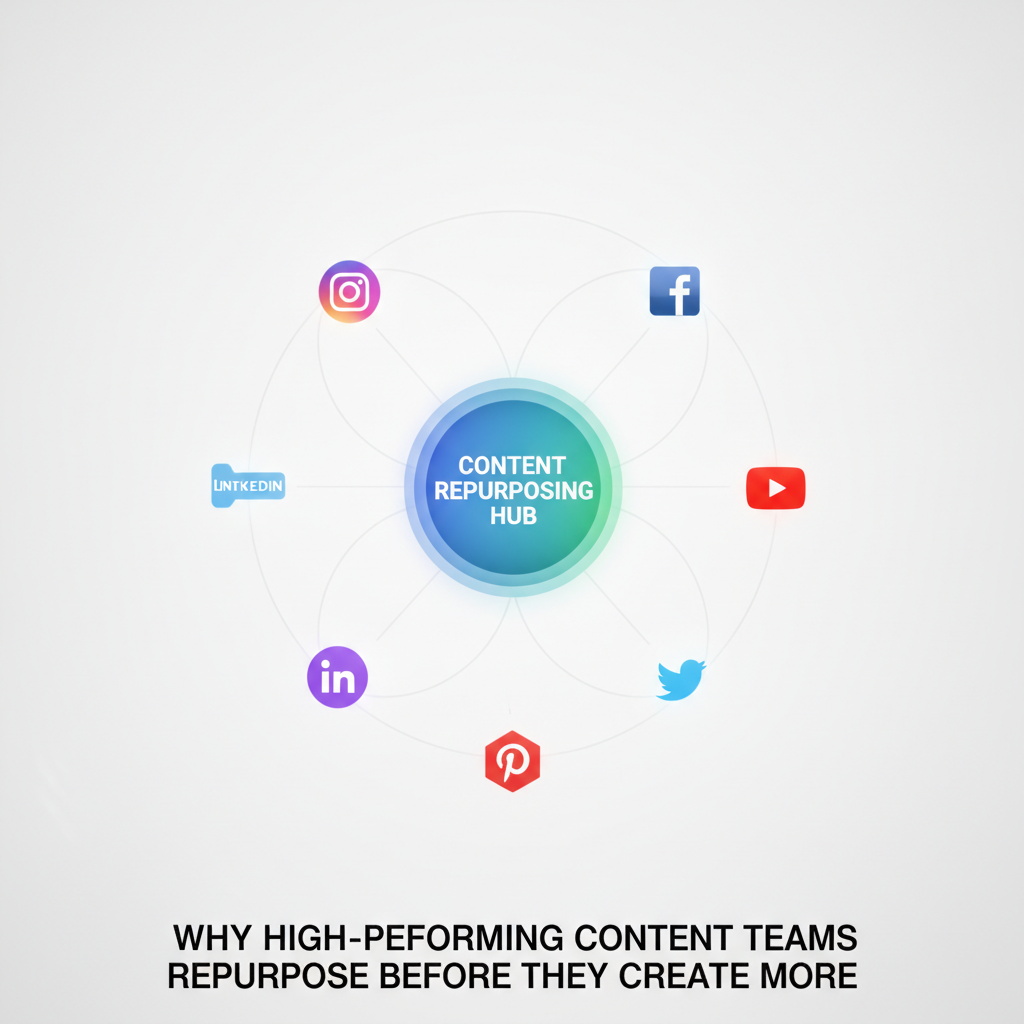
Diagram showing the hub and spoke content model branching into multiple social channels
How can you balance AI tools with human judgment?
The tension between AI efficiency and human authenticity requires strict boundaries. AI should handle the heavy lifting of formatting, but humans must retain total control over the narrative.
According to MarketingProfs' 2026 AI Content Guidelines, brands that delegate strategy to AI lose audience trust within three months.
The AI infrastructure layer:
- Transcribing audio and video files
- Reformatting text from a blog to a social caption
- Resizing images and videos for different platforms
- Summarizing long content into bullet points
- Generating first-draft variations for A/B testing
The human strategy layer:
- Choosing which topics resonate with your audience
- Framing narratives around specific customer problems
- Selecting metaphors and emotional hooks
- Controlling quality for accuracy and brand voice
- Deciding exactly when to retire or refresh an asset
The sweet spot? A human creates the hub. AI generates ten spoke drafts. The human edits and approves the best five. Finally, AI schedules the distribution.
This combination delivers scalable quality without the robotic feel that turns audiences away.
What are the biggest mistakes teams make when repurposing content?
Preempting common pitfalls saves hours of wasted effort. Avoid these traps to build a sustainable system.
Blindly copying and pasting across platforms. Every platform has distinct audience expectations. A Twitter thread pasted into LinkedIn looks lazy. Always adapt tone, length, and format for native consumption.
Repurposing low-quality source material. No amount of clever formatting will salvage a weak idea. Garbage in equals garbage out. Always start with your highest-performing, proven content.
Lacking strategic sequencing. Publishing all your spokes on the exact same day dilutes your reach. Audiences end up seeing repetitive messaging. Space out the spokes over a few months and use analytics to find the best timing.
Forgetting to update evergreen content. Outdated statistics or irrelevant examples damage your credibility. Schedule a quarterly audit of your cornerstone assets and refresh them before extracting new spokes.
Over-automating without a human review. AI frequently introduces errors, misses essential context, or produces off-brand text. Always require a human final approval step before hitting publish.
How do you start a repurposing-first workflow?
Implementing this strategy requires a clear roadmap. Follow these exact steps to transition your team away from the daily creation treadmill.
Audit your existing content. Identify your top ten highest-performing pieces by looking at traffic, engagement, and conversions. Look for evergreen topics that remain highly relevant today. Prioritize content featuring strong human insights, original research, or customer stories.
Define your source of truth standard. Set a strict quality bar for your hub assets. This might mean a minimum of 1,500 words, mandatory data inclusion, and a clear brand voice. Create a standard content brief template for all future hubs.
Map your platform ecosystem. List all the channels where your audience actively engages. Note the specific format requirements for each. You need to know character limits, image specifications, and ideal video lengths. Pick the top three channels to focus on first.
Build your repurposing workflow. Choose reliable tools for automation. Use Repostra.app for scheduling and reformatting. Assign specific roles to your team members. Clarify exactly who creates the hubs, who adapts the spokes, and who gives final approval.
Measure and iterate. Track your reach, engagement rate, and traffic driven back to the hub. Double down on the formats and platforms that actually perform. Quietly retire the spokes that underperform.

Step-by-step content repurposing workflow
How did one B2B team cut production time by 60 percent?
A mid-sized B2B software company recently hit a breaking point. A team of three marketers was creating fifteen brand new pieces of content every week from scratch. They were exhausted. Their brand messaging was highly inconsistent.
They shifted entirely to a hub-and-spoke model. They committed to writing just one long-form hub article per week.
They used AI tools to generate first drafts of social posts, quote cards, and video scripts from that single article. The human writers then spent their time editing, refining, and injecting personality into those drafts.
The results were immediate. They maintained their output of fifteen assets per week but reduced their total working hours by 60 percent. Because the messaging was unified around a single strong theme each week, their audience engagement improved by 40 percent.
The key success factor? They paused new creation to audit and reuse their existing hits.
Frequently Asked Questions About Content Repurposing
How often should I repurpose the same piece of content?
There is no universal limit. Best practice is to space out repurposed pieces over three to six months and refresh the main hub annually. High-performing evergreen content can be repurposed indefinitely as long as you update the statistics and examples. Monitor your engagement metrics closely to know when to retire an asset.
Does repurposing hurt SEO by creating duplicate content?
No, when done correctly. Search engines penalize identical content placed on multiple URLs within your own site. Adapting content for different formats creates unique assets. Canonical tags and platform diversity prevent any duplication issues entirely. Focus on genuine adaptation.
Which content formats work best for repurposing?
Long-form content makes the best hub because it contains multiple distinct ideas to extract. Think blogs, webinars, and case studies. For the spokes, short-form video, LinkedIn carousels, bold quote graphics, and Twitter threads perform best in 2026.
How much does content repurposing cost compared to creating from scratch?
According to HubSpot's industry data (2025-2026), repurposing reduces costs by 50 to 65 percent on average. A new blog post often costs hundreds of dollars in freelance rates or four hours of staff time. Repurposing that post into ten social assets costs just a fraction of that in tool subscriptions and an hour of editing time.
Can small teams with limited resources still repurpose effectively?
Yes. Repurposing is incredibly valuable for small teams. Start with just one hub per month and five distinct spokes. Use affordable tools to edit and schedule. Prioritize your top two platforms rather than attempting to be everywhere at once.
Stop creating and start multiplying
You do not have a content creation problem. You have a content multiplication problem.
A repurposing-first strategy stops the endless treadmill and builds highly sustainable growth. AI makes multiplication easier than ever in 2026, but the core strategy must remain firmly human-led.
Your best ideas deserve to reach your entire audience.
Start by auditing your top ten existing assets this week. Bring in infrastructure tools like Repostra.app to handle the tedious formatting and distribution tasks. Free up your human talent to focus entirely on storytelling.
Multiplying your existing ideas ensures your message is finally heard.