Why Distribution Timing Should Follow Buyer Attention, Not Team Convenience
Offer a fresh take on content calendars by aligning publishing schedules with when audiences actually notice and engage. This angle connects strategy, social media performance, and smarter workflow planning.
Distribution Timing Is Your Content Calendar's Secret Weapon
Publishing great content at the wrong time kills its performance before anyone sees it. Most marketing teams schedule posts around internal workflows, hitting publish when drafts get approved or when the workday starts. Your audience isn't waiting for your Monday morning email blast. They're scrolling Wednesday afternoon between meetings or catching up Sunday evening. When you align your content calendar with actual buyer attention patterns instead of team availability, you transform scheduling from administrative task into strategic advantage that multiplies reach, engagement, and revenue.
Key Takeaways:
- Exceptional content fails when published during low-attention windows, no matter how well written
- Algorithms prioritize posts that gain immediate traction in the first 60-90 minutes after publishing
- Platform engagement patterns vary wildly: B2B audiences and consumer audiences scroll on completely different schedules
- Your own historical data beats generic industry advice every time
- Separating content creation from content distribution requires new tools and workflows
The $10,000 Post That Nobody Saw
Your marketing team spends three weeks researching, writing, and designing a flagship industry report. They finalize the assets Friday afternoon. Monday morning at 8 a.m., someone hits publish and moves on to the next project. By Tuesday, that premium piece of content has exactly 47 views.
Most content calendars get built around internal workflows. Teams schedule posts for when they hold meetings, complete approval cycles, or start their workday. External buyer behavior rarely aligns with internal office hours. In the modern attention economy, distribution timing separates content that drives pipeline from content that dies quietly in the feed.
Treating scheduling as a box to check sacrifices your most expensive marketing assets. Transforming your calendar from a tool of team convenience into an engine of buyer attention requires a complete shift in how you publish.

Split screen comparing an empty office to an active digital audience scrolling social media feeds
Why Does Distribution Timing Matter More Than Ever?
We compete for valuable attention, not just screen time. Buyers are highly receptive when your messaging aligns with their immediate context. A professional seeking industry news at 4 p.m. on a Wednesday has a completely different mindset than someone scrolling for entertainment on a Saturday night.
Modern social platforms use algorithms that rely heavily on initial momentum. Content that misses its attention window rarely gets a second chance. The system assumes a lack of early clicks means a lack of relevance, burying the post permanently.
Early engagement in the first 60 to 90 minutes predicts whether a post reaches a wider audience. If your audience is offline during that crucial window, your reach drops to zero.
"The difference between posting at 9 a.m. and 2 p.m. can be a 300% variance in reach. Timing is the most underutilized lever in content strategy."
— Richard van der Blom, Founder at Just Connecting and author of the Algorithm Insights 2026 Report
This algorithmic reality demands precision. A post published to an empty digital room generates no early signals. A post published during peak active hours captures the immediate clicks required to trigger broader algorithmic distribution.
When Is Your Audience Actually Paying Attention in 2026?
The days of universal posting schedules are over. Every platform operates on its own distinct rhythm based on how users consume media in 2026.
Facebook, Instagram, and Threads: The 9 a.m. magic hour remains strong. Users habitually check these platforms at the start of their day.
LinkedIn and B2B platforms: Professional audiences have abandoned the Monday morning scroll. According to Sprout Social's 2026 data analysis of nearly two billion engagements, the best times to post on social media fall between 11 a.m. and 6 p.m., with Wednesdays at 4 p.m. dramatically outperforming traditional early-week slots.
TikTok and YouTube: These visual networks see their biggest spikes during evenings and weekends. Users dedicate longer blocks of time, typically between 6 p.m. and 10 p.m., for lifestyle and entertainment consumption.
Old rules vs. 2026 data:
| Platform Type | Conventional Wisdom | 2026 Data-Backed Timing |
| Professional (LinkedIn) | Monday 8 a.m. | Wednesday 3 p.m. to 5 p.m. |
| Visual Consumer (Instagram) | Every day at noon | Tuesday/Wednesday 9 a.m. |
| Entertainment (TikTok) | Random daily drops | Weekends and evenings (6-10 p.m.) |
Relying on generic industry averages will only get you so far. You have to map these macro trends against your specific followers.
What's Wrong With Scheduling Around Team Availability?
Traditional content calendars evolved alongside internal corporate rhythms. Marketers built schedules based on status meetings, client approvals, and the standard nine-to-five workday.
The disconnect is brutal. Your team's fresh start at 9 a.m. on Monday is your buyer's most overwhelmed moment. They are clearing out weekend emails, not reading thought leadership articles.
The false efficiency trap catches most teams. Batching content creation saves time and money. Batching the actual publishing of that content around team availability is strategic malpractice. Creating four posts on Tuesday is smart. Publishing all four posts on Tuesday afternoon because the writer is going on vacation costs you pipeline opportunities.
Old Approach vs. New Approach:
| Strategy Component | Old Approach (Team Convenience) | New Approach (Buyer Attention) |
| Publishing Cadence | Whenever the team finishes a draft | Matches audience peak digital habits |
| Platform Strategy | One-size-fits-all across all channels | Platform-specific timing |
| Success Metrics | Output and volume | Engagement and leads per channel |
A B2B software company might launch a webinar promotion at 5 p.m. on a Friday simply because the design team finally delivered the graphics. That post will reach a fraction of the audience it would have reached the following Tuesday afternoon.
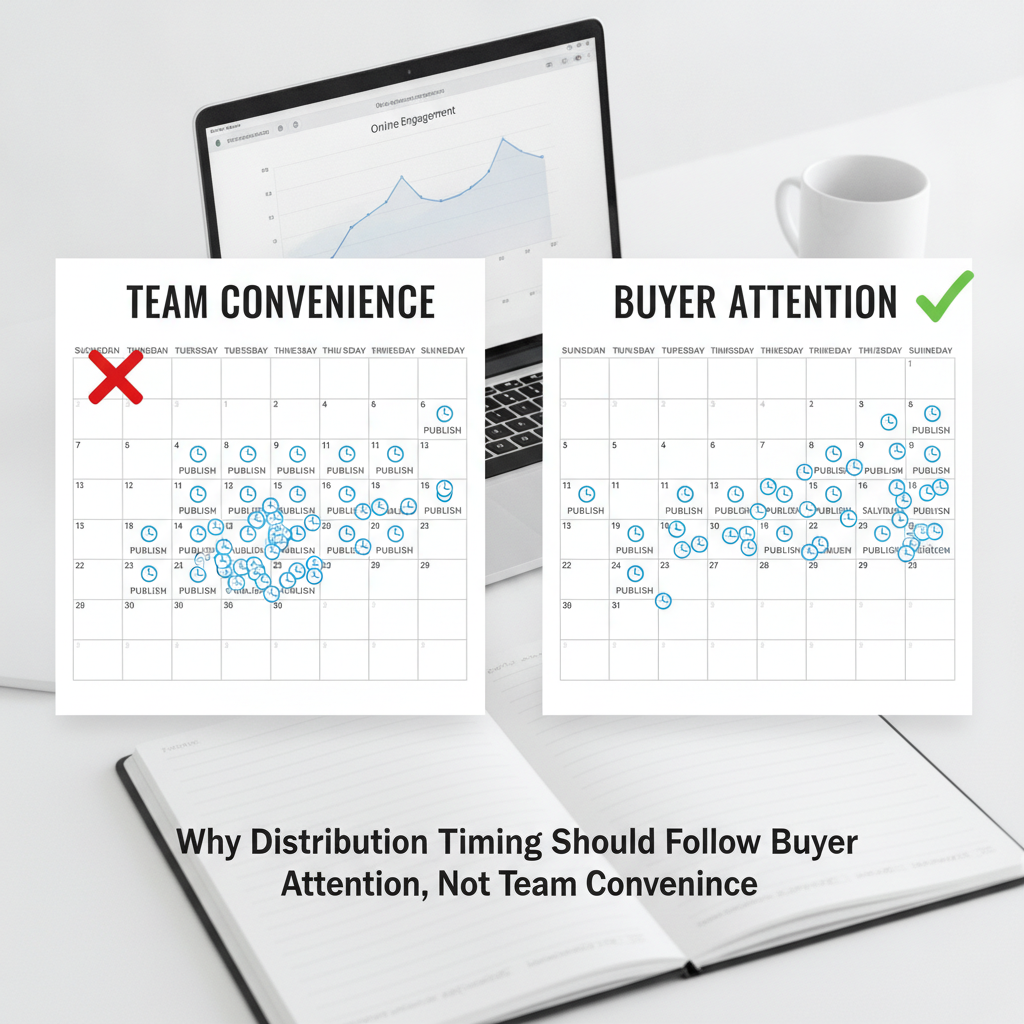
Comparison chart of a traditional team content calendar versus an audience-focused content calendar
How Do You Shift From Team-Centric to Audience-Centric Scheduling?
You need to separate your creation workflow from your distribution workflow. Write content whenever you want. Publish content only when your audience is listening.
Step 1: Audit your past performance. Pull your data from the last 90 days. Identify the top 20 percent of your posts that drove actual pipeline or high engagement. Map that success back to the exact day and time they went live.
Step 2: Adopt a multiplier mindset. When a post fails, marketers usually blame the copy or the graphic. Start asking if the timing was to blame. Treat timing as a variable you can control and optimize.
Step 3: Use predictive scheduling tools. Ditch manual calendar entries. Platforms like Repostra.app analyze exactly when your specific followers are online, rather than relying on global averages. They use your historical data to suggest the precise minute your audience is most likely to click.
Step 4: Build parallel calendars. Maintain an internal project management calendar for deadlines and approvals. Keep a completely separate distribution calendar managed by predictive software.
What Does an Audience-Centric Content Calendar Look Like?
A strategic calendar layers audience behavior data over your specific business goals. It treats time slots as distinct marketing channels.
The anatomy of a smart calendar includes a behavior data layer that highlights when your specific followers are historically active. Platform blocks reserve specific times for specific networks. Contextual matching pairs educational content with workday hours and entertaining content with evening hours. Testing zones leave 10 percent of slots open to test new publishing windows.
B2B professional services framework:
- Tuesday 11 a.m. to 1 p.m.: Deep-dive thought leadership on LinkedIn
- Wednesday 3 p.m. to 5 p.m.: Quick data visualizations or industry takes
- Thursday 9 a.m.: Newsletter distribution
B2C lifestyle brand framework:
- Monday 9 a.m.: Inspirational Instagram Story
- Thursday 7 p.m.: Educational YouTube video
- Saturday 8 p.m.: Entertaining TikTok trend response
Continuous optimization keeps this calendar effective. You never set it and forget it. You constantly test new windows as platform algorithms and user habits evolve.
How Do You Measure the Impact of Better Distribution Timing?
Move past vanity metrics like total impressions. The goal is business impact, which requires tracking specific key performance indicators.
Key metrics to track:
- Engagement rate by time slot: Tracks the ratio of interactions to views during specific hours
- Click-through rate by time: Measures how often users leave the platform to visit your site based on when you posted
- Pipeline attribution: Connects specific leads or revenue to the posts published during optimized windows
A/B testing structure: Take a high-performing piece of evergreen content. Publish it on a Monday at 9 a.m. Wait three weeks. Publish the exact same content on a Wednesday at 4 p.m. Compare the first-hour engagement velocity and the total 72-hour reach.
Expected timeline: Establish your baseline using your last 30 days of standard publishing. Implement your data-backed timing schedule. You should see measurable improvements in early engagement and total reach within 30 to 45 days.
What Are the Biggest Mistakes Teams Make With Distribution Timing?
Relying solely on generic industry articles.
Global averages are a starting point. Always use your own analytics to verify if those averages apply to your specific followers.
Setting a schedule once and never revising it.
Audience habits shift with seasons, algorithm updates, and cultural events. Review your timing data at the end of every quarter.
Broadcasting the same message across all platforms simultaneously.
Stagger your distribution. If you have a major announcement, push it to Instagram in the morning, LinkedIn in the afternoon, and YouTube in the evening.
Ignoring time zones.
If your team is in Berlin but your primary buyers are in California, scheduling a post for 2 p.m. local time means hitting your audience while they are still asleep. Use scheduling software to post in your target audience's local time zone.
Letting internal panic dictate publishing.
When leadership demands a post go live immediately at 4 p.m. on a Friday, show them the data. Explain the cost in lost pipeline when content misses the peak attention window.
Frequently Asked Questions About Distribution Timing
How do I find the best posting times for my specific audience?
Start by reviewing your native platform analytics to see when your followers are most active. Export your last 90 days of posts and sort them by highest engagement, noting the publish times. For a more precise approach, use a third-party analytics tool like Repostra.app to process this historical data automatically. Run controlled A/B tests by posting similar content at different times to validate your findings.
Should I use different posting times for different platforms?
Yes. Platforms serve different psychological needs. People use LinkedIn during workday breaks to network or learn industry news. They use Instagram in the morning for quick updates and TikTok in the evening for entertainment. Publishing the exact same post at the exact same time across all channels guarantees you will miss peak attention on at least two of them.
What if my team cannot publish content during peak engagement times?
Separate your creation process from your distribution process. Your team can write, design, and approve content during regular office hours. Once approved, load the content into a dedicated scheduling tool. Automation handles the actual publishing during peak hours, whether that happens at 8 p.m. on a Sunday or 4 a.m. for an international audience.
How often should I revisit my content calendar timing strategy?
Conduct a comprehensive timing audit once a quarter. Fast-moving consumer brands might benefit from monthly reviews. If you notice a sudden, sustained drop in first-hour engagement across multiple posts, that is a strong signal that the platform algorithm has changed or your audience's habits have shifted.
Does distribution timing matter for all content types equally?
No. Breaking news, event coverage, and trending cultural reactions must be posted immediately, regardless of the time. Evergreen educational content, thought leadership, and promotional campaigns benefit the most from strict timing optimization. Always prioritize the user's need for immediacy over the ideal calendar slot when dealing with real-time events.
Transform Your Content Calendar From To-Do List to Strategic Asset
Distribution timing is a performance multiplier. It cannot save terrible writing, but it ensures your best work actually reaches the people who need to see it. Most brands still schedule around their internal convenience. Those who break that habit gain an immediate competitive advantage.
Stop shouting into the digital void. Build a predictable, high-performing distribution engine by taking these exact steps:
- Export your last 90 days of content data to establish your baseline
- Identify your top three priority platforms and map their unique engagement windows
- Implement a predictive scheduling tool like Repostra.app to handle the heavy lifting of audience-centric timing
- Run an A/B test this week using one high-value piece of content across two different time slots
Your audience is already telling you when they want to hear from you. You just need to adjust your calendar to listen.