Why Distribution, Not Creation, Is Your Real Content Bottleneck
Offer a contrarian take on why many teams do not need more ideas—they need better systems for publishing and reusing what they already have. It is a strong SEO topic for marketers struggling with inconsistent reach.

Your Content Problem Isn't Creation. It's Distribution.
Your content problem isn't a lack of ideas. It's a distribution gap. Organizations spend nearly twice as much money making content than they do sharing it, leaving valuable assets unused. Teams that shift to distribution-first strategies see significantly more output, higher engagement, and massive growth in organic traffic without creating more original pieces. The solution lies in building systems that systematically repurpose and amplify what you already have across multiple channels.
Key Takeaways
- Budget imbalance: Brands spend 41% on content creation but only 22% on distribution.
- Repurposing multiplies ROI: Redistributing content achieves 40% more output without increasing production time.
- Distribution drives engagement: Repurposed content generates 25-35% more engagement than single posts.
- Evergreen content scales traffic: Updating existing posts grows organic traffic by up to 106%.
- Burnout is structural: 73% of creators struggle with schedules, a problem distribution fixes.
The Content Creation Hamster Wheel
If you struggle with inconsistent reach, your problem is not a lack of ideas. You lack a system to make your ideas travel.
You don't need to write more. You need to make what you've already written work harder.
Most marketing teams are trapped in an exhausting cycle. They create, publish, hope for traction, and then immediately start planning the next piece. Months or years of valuable content sits completely unused in Google Drives and CMS archives.
Common mistake: Assuming that your audience saw your post the first time. The algorithm reality of 2026 dictates that a single publication rarely reaches even a fraction of your followers.
Creators are tired. Data shows that 73% of creators struggle to maintain sustainable posting schedules. This burnout happens because organizations allocate resources inefficiently. They spend the bulk of their efforts on creation while distribution gets leftovers. This misallocation guarantees that brilliant work goes unnoticed.
A visual representation of the content creation hamster wheel
Why do most teams prioritize creation over distribution?
Creation feels like progress. Writing a new blog post or filming a new video gives teams a tangible asset to point to. Distribution often feels like repetition.
Many companies suffer from a blank page bias. They glorify new ideas over optimizing old ones. Creating has clear, established workflows. You write a brief, draft the copy, edit, and hit publish. Distribution lacks this standardized process in most organizations.
Key takeaway: Repurposing is not lazy recycling. It's strategic adaptation.
Tools and training largely focus on how to create things faster, not how to amplify them effectively. This leaves a massive operational gap. According to industry research, nearly half of B2B marketers cite insufficient content repurposing as a top scaling challenge.
You can test your own team easily. Look at your content calendar. If it only tracks new pieces and ignores distribution schedules, you have a creation bias.
The Real Problem: The Create, Publish, Forget Cycle
The typical content workflow is broken at the root. A team writes a brief, spends weeks creating the asset, publishes it once, and moves on.
This creates a content graveyard. High-quality assets that cost thousands of dollars to produce never see the light of day again. A single-publication approach fails completely. It can't trigger the early engagement signals needed for algorithmic visibility.
The internet is saturated. Millions of blogs and social posts go live daily. Quality alone doesn't guarantee reach anymore.
Bottom line: Every unused asset represents wasted investment.
Imagine a marketing team that publishes a comprehensive 3,000-word guide. It gets modest traffic on day one. They never touch it again. Instead, they spend three weeks writing the next guide. Now imagine that same guide turned into ten social posts, three newsletters, and one video. That's the cost of the create, publish, forget cycle.
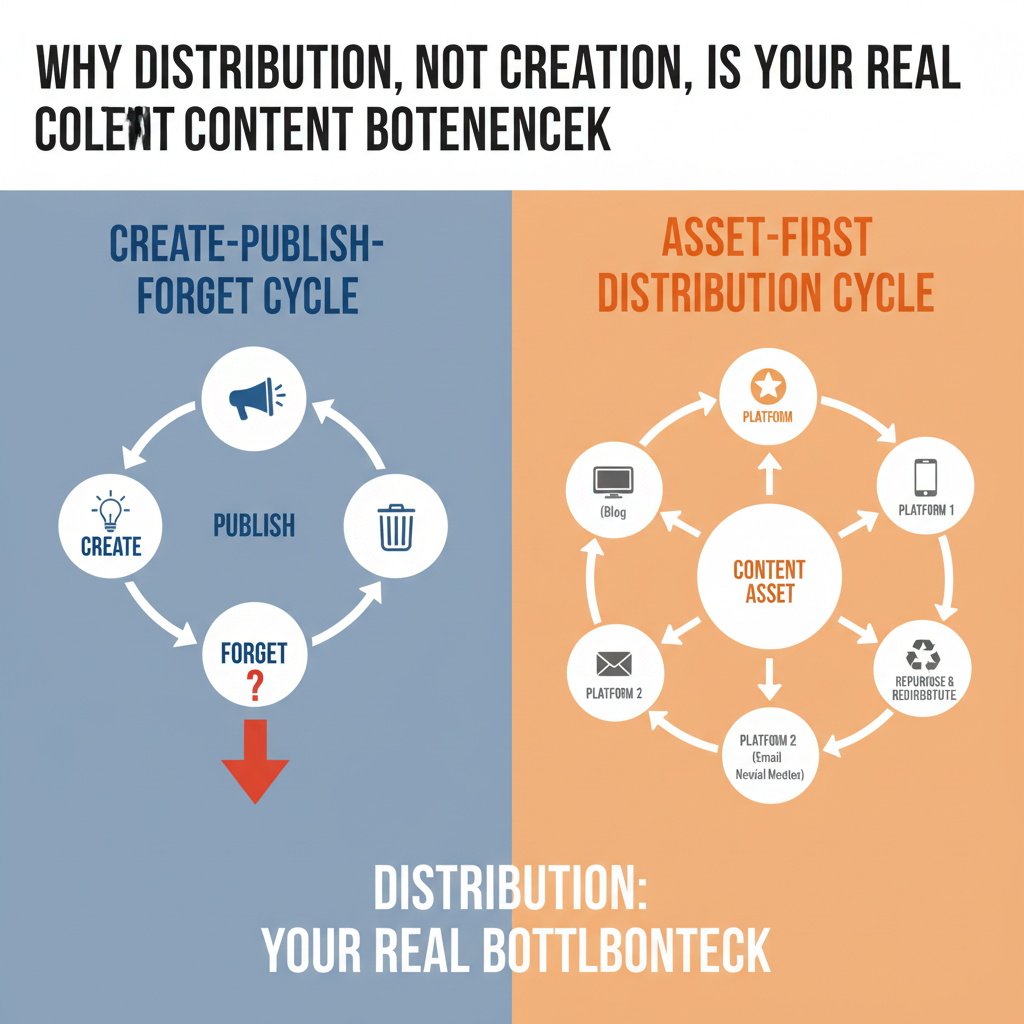
Flowchart comparing the broken content cycle with an effective distribution loop
How does content distribution actually drive growth?
Effective content distribution combines strategic repurposing with multi-channel amplification. It creates a compounding return on investment.
One asset creates multiple touchpoints. This extends the lifespan of your initial idea. Repurposing outperforms single posts because it reinforces your core message while respecting audience channel preferences.
This approach gives your content velocity. Velocity pushes your message further and faster than a single publication ever could. The numbers back this up. Teams who prioritize repurposing see substantial increases in overall content output without proportional time increases.
Those adapted pieces also work better. Platform analysis shows that repurposed content consistently generates 25-35% more engagement versus one-off posts. Updating and republishing evergreen posts can grow organic traffic by up to 106%.
"Create once, distribute forever. The goal is simple: take one high-quality piece of content and distribute it across the right platforms to maximize its reach and impact."
— Ross Simmonds, Founder & CEO at Foundation Marketing
The 1-to-10 rule is a strong starting point. Every pillar asset should spawn five to ten derivative pieces. A smart distribution checklist includes channels, formats, timing, and native optimization.
What should a distribution-first system actually look like?
You need to audit your existing library before you build anything new. Ask yourself what your best content is that nobody is currently seeing.
You must shift from a volume mindset to a velocity mindset. Treat each piece as a pillar asset with planned derivatives. Audiences in 2026 are heavily fragmented across platforms. You have to meet them where they are.
Your workflow needs three essentials. You need a content inventory, a repurposing calendar, and channel-specific adaptation rules.
Step 1: Audit your content.
Step 2: Identify your pillars.
Step 3: Plan your derivatives.
Step 4: Schedule the distribution.
Step 5: Measure and optimize.
You map the same core message to different formats. A blog post becomes a LinkedIn carousel. That carousel becomes a Twitter thread. That thread becomes a newsletter. That newsletter becomes a script for short-form video clips.
The High-Performance Content Audit: 3 Questions to Ask
- Which existing pieces drove the most traffic and engagement?
- Which topics are evergreen and still relevant?
- Which assets have we only published once?
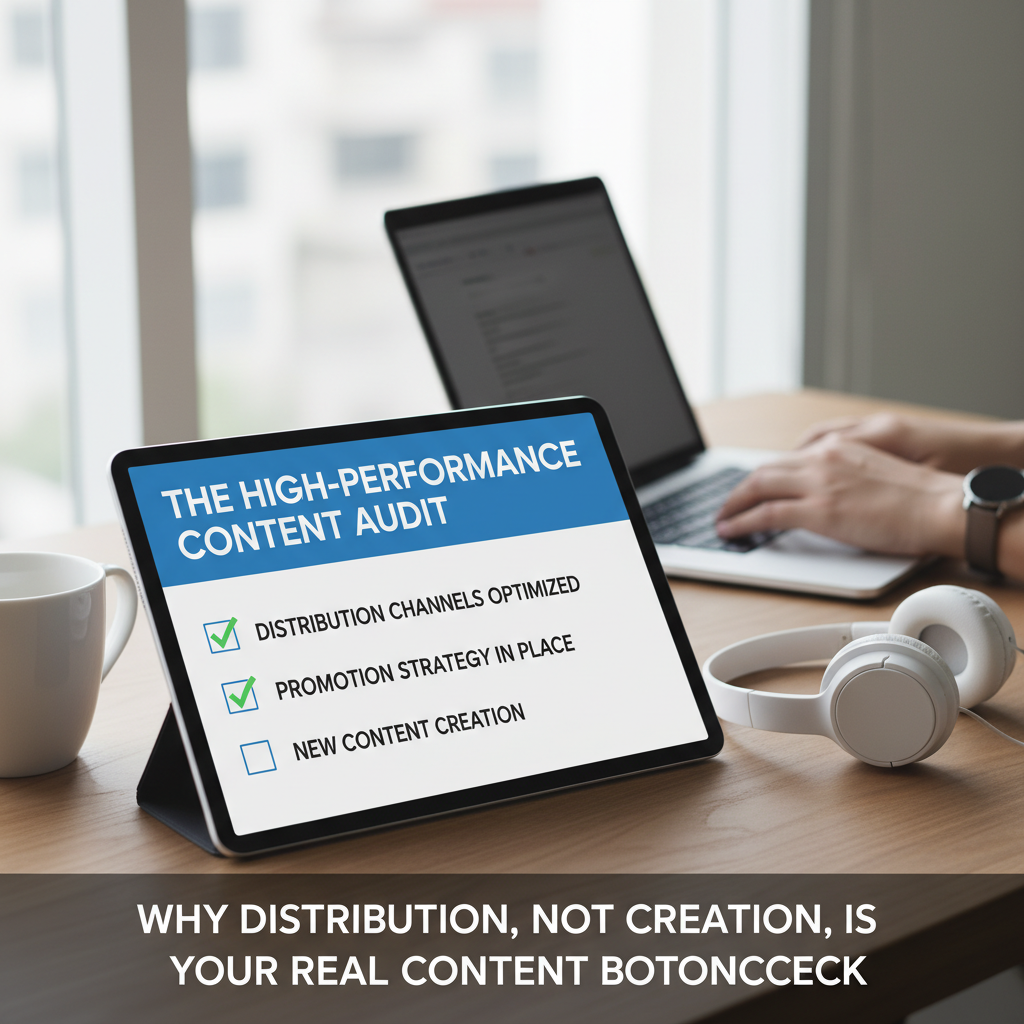
A 3-step checklist for auditing existing content libraries
Why is repurposing more effective than creating new content?
Repurposing offers unmatched efficiency. You get the same quality of output for a fraction of the time investment.
Message reinforcement is another massive benefit. Repetition across channels builds brand recall. Not everyone sees your first post. Different formats on different platforms catch entirely different segments of your audience.
Consistent posting also signals value to platform algorithms. When you repurpose, you protect your overall quality. You can focus your deep creative energy on fewer, higher-quality pillar pieces.
When to use this: Use repurposing when you have a proven, high-performing concept that deserves a wider audience.
Don't mistake repurposing for copy-pasting. It requires genuine skill. You have to translate formats, optimize for specific channels, and customize for distinct audiences. It's smart strategy, not cutting corners.
How can you fix your distribution bottleneck today?
Start by running the high-performance audit. Identify your top five to ten existing assets.
Take one of those pillar pieces right now. Map it to five or more derivative formats. Create a distribution calendar to handle the scheduling. This is different from a standard publishing calendar. A publishing calendar tracks when a blog goes live. A distribution calendar tracks the ten pieces of micro-content that follow it.
To fix the system permanently, you need a content distribution workflow. You should add a distribution plan as a strict requirement for every new piece your team briefs.
Many teams start with manual spreadsheets. This works briefly, but scaling requires help. You need inventory management, multi-channel scheduling, and format adaptation. Platforms like Repostra.app automate the repurposing and scheduling workflow. They turn one pillar piece into multi-channel campaigns in minutes instead of hours.
The 1-Week Distribution Sprint
- Day 1: Audit your top content.
- Day 2-3: Create five derivatives from one pillar piece.
- Day 4: Schedule across three different channels.
- Day 5: Monitor early performance.
- Day 6-7: Document what worked to build your permanent system.
FAQ
How much content should I repurpose vs. create new?
High-performing teams in 2026 follow roughly a 70/30 distribution-to-creation ratio. For every new pillar piece you create, plan five to ten repurposed derivatives across channels. This approach delivers significantly more output without increasing production time. Start by auditing your best existing content, as most teams have six to twelve months of underutilized assets ready to redistribute.
Won't repurposing the same content hurt my SEO or annoy my audience?
No. When done correctly, repurposing strengthens both SEO and audience trust. Updating and republishing evergreen content can double your organic traffic. Audiences consume content across different channels and formats. A LinkedIn carousel reaches completely different people than your original blog post. The key is format adaptation. Each piece must feel native to its platform.
What is the difference between content distribution and content promotion?
Distribution is systematic and ongoing. Promotion is campaign-based and temporary. Distribution means building workflows to automatically repurpose, schedule, and publish content across channels as part of your daily process. Promotion usually means paying to boost a single post for a short time. Distribution compounds value over time, while promotion just creates temporary spikes.
How do I get my team to adopt a distribution-first approach?
Start the conversation around burnout. Point out that the vast majority of creators struggle with sustainable posting schedules. Frame distribution as the exact solution to the pressure of constant creation. Run a pilot program. Take one successful piece, create several derivatives, and track the engagement. Make a distribution plan a mandatory field in all your content briefs.
What tools do I need for effective content distribution?
You need a central content inventory, a distribution calendar, and channel-specific formatting capabilities. You can start with basic spreadsheets, but real scale requires better systems. Look for software that handles repurposing workflows, like turning blogs into social posts or videos into text. Commit to the internal process first, then find the specific tools that support your unique workflow.