Why Content Marketing Needs Version Control, Not More Ideas
Present a contrarian take that the real issue in content operations is often asset chaos, not idea scarcity. Readers learn how version tracking improves collaboration, consistency, and repurposing at scale.

Version Control for Content Operations: Stop Chasing Ideas and Start Managing Assets
TL;DR: Marketing teams waste thousands of hours searching for files in chaotic folders when they should be repurposing existing assets. Version control systems bring software development discipline to content operations, creating a single source of truth that eliminates brand errors, cuts repurposing time by 67%, and unlocks financial value from content libraries already gathering digital dust. The problem isn't creativity. It's organization.
Key Takeaways:
- Asset chaos is the primary bottleneck for most content operations today, halting production and causing costly delays.
- Version control systems track changes to create a single source of truth for every piece of marketing material.
- Repurposing becomes three times faster when teams can instantly locate approved, current asset versions.
- Brand consistency improves significantly when outdated materials are permanently retired from active circulation.
- Existing content libraries contain immense value that structured digital management finally reveals.
Why Will More Ideas Fail to Fix Content Problems?
Marketing departments operate under constant pressure to feed the digital ecosystem. When engagement metrics dip, the standard response is to schedule another brainstorming session. Teams stare at empty editorial calendars and demand fresh concepts. This creates the content treadmill phenomenon.
The contrarian truth is that a lack of creativity is rarely the bottleneck. Most marketing teams already sit on hundreds of high-quality assets that remain completely unused. These files are buried in personal folders or lost in old email threads.
Abundance without organization creates severe diminishing returns.
According to the 2024 Content Marketing Institute research, 63% of B2B marketers cite repurposing existing content as their biggest operational challenge, not idea generation. Chasing new concepts distracts teams from maximizing the value of what they already built. You don't need a new whitepaper topic. You need a system to find the whitepaper you wrote six months ago so you can turn it into ten social media posts.
What Is Asset Chaos and Why Does It Cripple Content Operations?

Illustration of asset chaos in a marketing department
Asset chaos occurs when a team has scattered files, unclear version status, and no single source of truth. It's the operational disease that happens when files are saved on local hard drives, shared via direct messages, and named with confusing conventions.
This chaos manifests through three primary symptoms.
First symptom: Brand inconsistency. Without a definitive final version, outdated logos, incorrect pricing tiers, and stale messaging easily slip into live campaigns. Customers notice these discrepancies immediately.
Second symptom: The repurposing tax. Marketing professionals spend nearly half their day searching for source files instead of doing actual creative work. The friction of finding a usable file prevents teams from adapting content for new channels.
Third symptom: Structural fragmentation. Siloed departments duplicate work unknowingly. The SEO team writes an article about a feature that the product marketing team already documented in a sales deck.
Imagine a scenario where a marketing manager launches a massive email campaign. They attach a product specifications PDF. Unfortunately, nobody knew which file in the shared drive was final. They attach an older version containing last year's pricing. The company loses revenue and customer trust simply because of poor file management.
"Content operations fail not from lack of creativity, but from lack of systems. The best ideas die in Slack threads and email attachments."
Sarah Chen, Director of Content Operations at HubSpot (2025 MarTech Conference keynote)
How Does Version Control Work in Content Marketing?
Version control is a concept borrowed directly from software development. Developers use tools to track who changed what, when they changed it, and why. Translating this to marketing means applying systematic tracking to copy, graphics, and campaign materials.
A centralized repository replaces scattered cloud drives.
Change tracking provides a full edit history and rollback capability. If a junior writer accidentally deletes a crucial paragraph from a landing page draft, the senior editor can restore the previous version instantly.
Branching allows team members to work on drafts without affecting live versions. A designer can update the graphics on a brochure branch while a copywriter updates the text on a separate branch. They merge their work once approved.
Strict access controls ensure only approved assets go live. Junior staff can propose changes, but only campaign managers can approve those changes to the master file.
Modern platforms translate these technical concepts for non-technical users. Purpose-built tools like Repostra.app provide visual interfaces that make version tracking intuitive for writers and designers. You get the rigor of developer tools without the steep learning curve.
Why Should Content Teams Adopt Version Control Now?
Implementing a structured system transforms daily operations across four crucial areas.
Moving from file hunting to asset retrieval: Teams eliminate the anxiety of guessing which file is final. They locate correct assets in seconds instead of hours. According to Forrester Research's 2025 report on information retrieval, knowledge workers spend an average of 2.5 hours per day searching for information. Marketing teams are among the worst affected. Regaining that time boosts output dramatically.
Increased accountability and clarity: Clear ownership workflows prevent costly mistakes. Audit trails show exactly who made a change. If an unapproved claim appears in a social media graphic, leadership can trace the file history to see where the approval process broke down.
True scalability through atomization: The atomization strategy involves taking one massive pillar asset and creating dozens of smaller derivatives. You can't scale this process if your source files are a mess. A definitive source of truth allows a team to confidently slice a webinar into twenty short videos.
Cross-team collaboration without friction: Multiple departments work from the exact same library. The social media manager, the technical writer, and the paid advertising specialist all pull from identical, verified source materials.
What Tools Enable Version Control for Content Operations?
Marketing departments generally choose between three categories of organizational tools.
Basic level: Standard cloud storage solutions offer basic version history. These platforms show when a file was altered, but they lack workflow management, approval statuses, and strong visual search. They're digital filing cabinets, not operational engines.
Enterprise level: Digital Asset Management platforms provide deep centralization. However, these massive systems are notoriously expensive and require dedicated administrative staff to maintain. They often slow down agile teams.
Purpose-built level: Content version control tools sit in the sweet spot. Platforms like Repostra.app offer visual document comparisons, native approval workflows, and clear status tracking. They integrate seamlessly with existing content management systems through user-friendly interfaces.
| Tool Category | Best Used For | Major Limitation | Relative Cost |
|---|---|---|---|
| Cloud Storage | Basic document sharing | No approval workflows | Low |
| Enterprise Systems | Global brand compliance | High technical friction | Very High |
| Content Platforms | Agile marketing scaling | Requires workflow changes | Moderate |
According to Gartner's 2025 Marketing Technology Survey, organizations with formal content governance systems report 45% fewer brand consistency issues and 32% faster campaign execution. Selecting the right tool directly influences your campaign velocity.
How Can You Implement Version Control Without Disrupting Workflows?
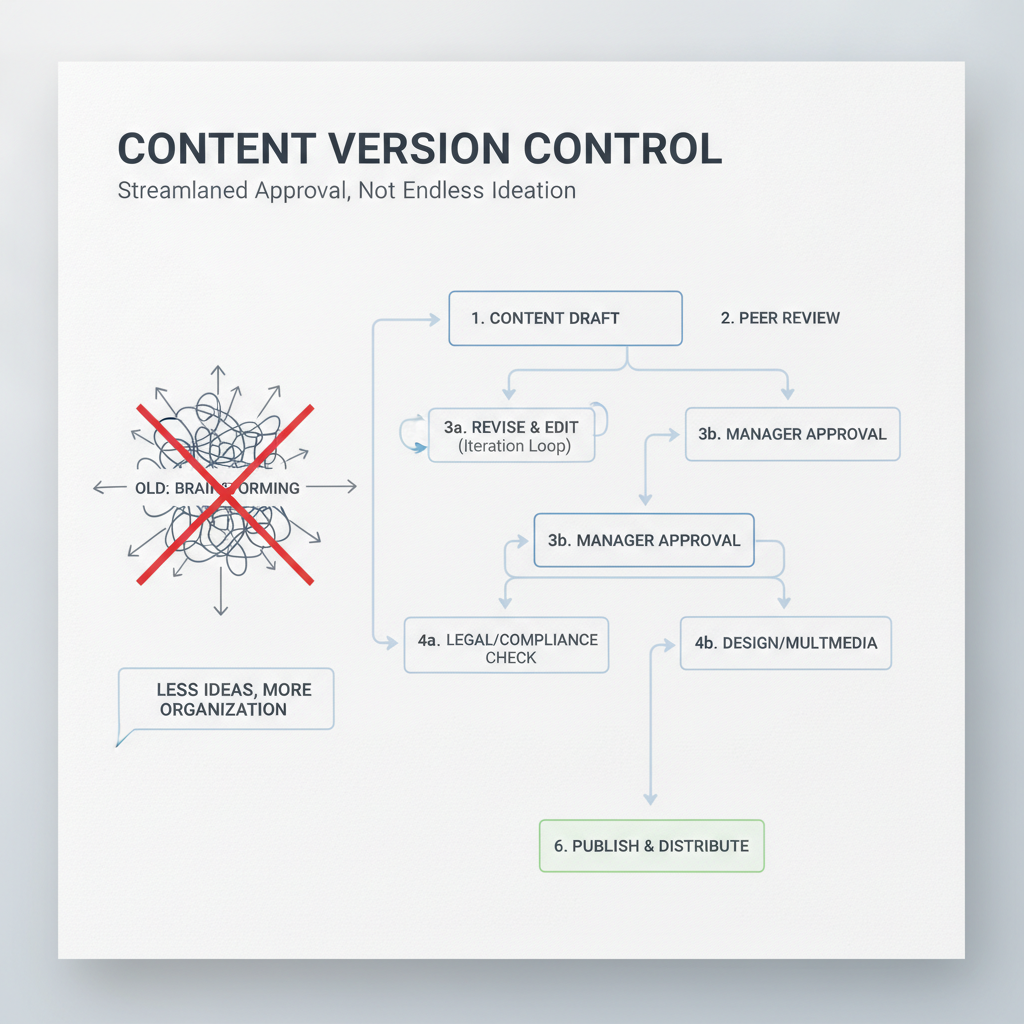
Diagram of a content marketing version control workflow
Transitioning to a new operational system requires a structured, phased approach. Overcomplicating the system on day one is a common pitfall that kills user adoption.
Phase one: Audit and centralize. Spend your first week taking inventory of existing materials across all scattered locations. Move these files into a single repository. Tag the active assets by type, campaign, and current status. Archive the rest.
Phase two: Establish naming and versioning conventions. Create a clear, readable file naming system. Define your numbering logic clearly. For example, drafts might be labeled as version 0.1, while approved files become version 1.0. Document these rules in a team wiki.
Phase three: Build operational workflows. Map out exact approval processes. Assign specific ownership roles so everyone knows who has final sign-off authority. Set up automated notifications to keep projects moving through the pipeline without manual follow-ups.
Phase four: Train and launch. Run team training sessions focusing on practical daily tasks. Do a soft launch with a single, low-stakes campaign. Gather user feedback, adjust the friction points, and then roll the system out globally.
Critical mistake: Failing to designate a content librarian. A system without an owner quickly reverts to chaos. Assign one person to audit the tags and clean up the folders monthly.
Where Is the Financial Return in Your Existing Content Library?
Most brands use less than twenty percent of their created assets to their full potential. The content goldmine principle states that structured management releases massive financial value from materials you already paid to create.
Consider a medium-sized company with five hundred existing blog posts. An active atomization strategy dictates creating five derivative formats for each post. This yields two thousand five hundred individual pieces of content.
In a chaotic environment, manually searching through folders and verifying the correct text takes roughly thirty minutes per repurposed asset. With proper version control, instant retrieval takes about two minutes.
The math: Saving twenty-eight minutes across two thousand five hundred repurposing tasks saves over one thousand hours of labor. At a standard rate of fifty dollars an hour, that equals nearly sixty thousand dollars in saved labor costs over a year.
Strategic repurposing requires rock-solid operational infrastructure. You can't build a factory on a swamp. Platforms like Repostra.app are designed precisely to capture this hidden financial return by eliminating operational drag.
How Have Real Marketing Teams Solved Asset Chaos?
A software company recently struggled with twelve hundred product assets spread across seven different cloud drives. They had absolutely no version tracking in place. Routine campaign launches took six weeks because project managers spent days hunting down final graphics.
They implemented structured version control via a centralized platform. Campaign launch times dropped from six weeks to three weeks. More importantly, they experienced zero brand errors over a six-month period.
A B2B marketing agency faced a different crisis. Client assets were constantly mismanaged. Account managers sent the wrong drafts to clients, leading to severe revision fatigue and lost accounts.
They built version-controlled client libraries with strict, automated approval workflows. Client retention improved by forty percent within a year. Project profit margins increased by twenty-five percent because creative staff stopped wasting hours on avoidable revisions.
Common theme: The initial time investment required to organize files pays for itself within three to four months. Team morale improves drastically as frustration drops and creative output rises. Quality increases even as the total quantity of published material scales up.
Frequently Asked Questions
How is content version control different from just using Google Drive?
Google Drive offers basic version history without structured workflows or purpose-built search tools for marketing materials. It shows when a file changed. True version control shows why the file changed, who authorized it, and provides immediate context for its campaign status.
What size team needs formal version control for content?
Any team with three or more people creating marketing materials benefits from version control. The threshold where chaos becomes actively costly is typically around one hundred active assets. Smaller teams can start with strict naming conventions, but growing organizations need dedicated platforms to maintain velocity.
How much does content version control software cost?
Solutions range from free technical tools with steep learning curves to enterprise platforms costing thousands of dollars per month. Purpose-built platforms designed for standard marketing teams typically cost a few hundred dollars monthly. Most departments recover this cost within ninety days through labor hours saved.
Can version control integrate with our existing systems?
Modern content platforms offer seamless integrations with popular tools like WordPress, Figma, and Adobe Creative Cloud. You should look for solutions offering APIs and webhook support. The best systems act as an invisible layer of truth sitting underneath your current creative tools.
What happens to our old content when we implement version control?
Existing assets migrate into the new system through an initial audit and tagging process. Your older versions are preserved securely, but they receive proper organization and metadata. It functions exactly like moving loose papers from a messy desk into an organized filing cabinet where everything is instantly searchable.
Stop Creating and Start Managing
Marketing leaders must fundamentally reframe their primary operational challenge. Ask yourself if your team is losing more value to internal chaos than it gains from fresh brainstorming sessions. Success requires shifting away from a sheer quantity mindset and adopting a strict systems mindset.
Version control functions as a strategic advantage rather than just a minor operational trick. Your existing content library holds massive financial value. You simply need the proper infrastructure to access it effectively.
Audit your current asset situation before you schedule your next big creative meeting. Taking total control of your files will transform your department from a stressed production house into a highly scalable asset engine.
Visit Repostra.app to see how proper version control brings permanent order to your content operations.