Why Content Consistency Fails Without a Distribution System
Explore why even strong content plans break down when distribution is handled ad hoc. This article can help readers connect consistency, scheduling, and repurposing into one dependable system.
Why Content Consistency Fails Without a Content Distribution System
You published three blog posts this month, recorded two videos, and designed a carousel. But your analytics? Completely flat.
The problem isn't your creativity. You're running distribution on willpower alone, and willpower doesn't scale. The brands winning attention don't just create better videos or write better text. They build reliable distribution engines that ensure every piece reaches its full potential across relevant channels. Without a systematic approach to scheduling, repurposing, and native optimization, even brilliant content sits unseen.
Key Takeaways:
- Marketing teams typically spend 80% of their time creating and only 20% distributing content, creating a massive execution gap
- Platform algorithms reward consistent posting patterns and penalize sporadic, ad hoc updates
- Repurposing one hero asset into multiple native formats prevents creator burnout while maintaining omnichannel presence
- Data-driven scheduling increases engagement significantly compared to intuition-based posting
- Systematic distribution transforms content operations into predictable, scalable growth channels
What happens when you treat distribution as an afterthought?
Creating high-quality content without a distribution plan is like printing a beautiful billboard and leaving it in a storage unit. It sits unseen.
According to the Content Marketing Institute's 2024 B2B Benchmarks report, 71% of B2B marketers say their organization has a content marketing strategy. Yet very few report significant ROI from their efforts. This execution gap exists because teams treat distribution as an afterthought rather than a core function.
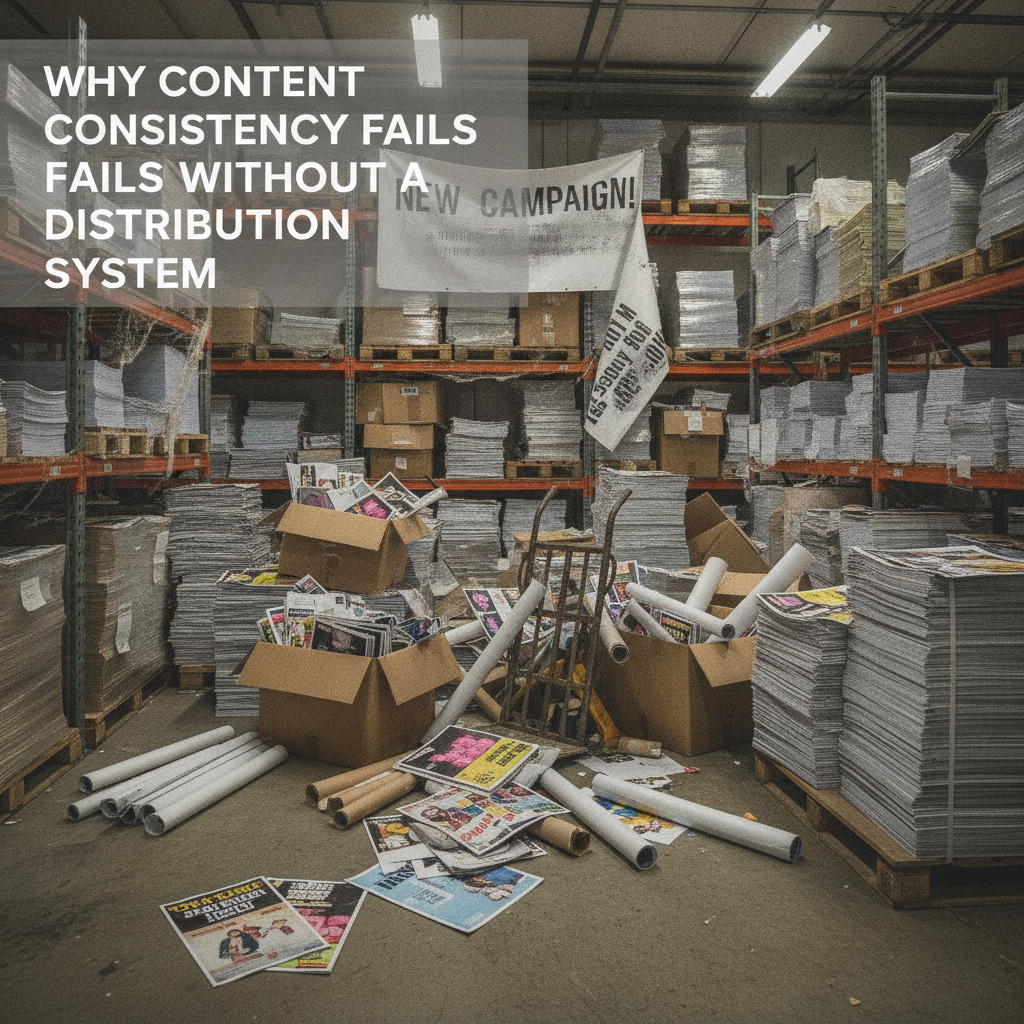
A messy storage room representing undistributed content assets
Most solo marketers spend roughly 80% of their time creating content and only 20% promoting it. This imbalance ruins potential ROI. A brilliant piece of thought leadership generates zero value if nobody knows it exists.
Manual inconsistency creates unpredictable brand presence. When you rely on manual distribution, you inevitably hit the creator burnout cycle. Formatting and posting to five different platforms by hand is exhausting. You start missing optimal posting windows. Your audience experiences large gaps in communication. Content created without structured distribution loses the majority of its potential reach.
Why do algorithms punish inconsistent posting?
Major platforms like LinkedIn, Instagram, and TikTok prioritize predictability. They want to keep users engaged. If you post sporadically, the algorithm interprets your account as low-commitment.
Platforms reward the active and engaged. If you post one incredible piece per month, you give the platform only one data point. If you post solid content regularly, you give the platform continuous data to optimize your reach.
Inconsistent accounts miss early engagement velocity windows, which causes their posts to be buried. Research from Hootsuite's 2023 Social Media Trends report shows that brands posting consistently (3-5 times per week on platforms like LinkedIn) see significantly better organic reach than those posting sporadically.
"Posting consistently is what stimulates social media algorithms. Even when the interaction is low, activity continuously creates momentum."
Brock Johnson, Social Media Expert
The algorithm watches how quickly your first viewers engage. If you post rarely, your audience forgets to check your profile. Your initial engagement drops. The algorithm sees weak early signals and limits distribution. Consistency breaks this cycle.
How does repurposing solve the consistency problem?
Repurposing acts as a content multiplier. You take one hero asset (a podcast episode or an in-depth article) and spin it into six to twelve derivative pieces. This maintains omnichannel presence without the burnout of constant creation.
Buyers typically require multiple touchpoints before making a purchase decision. Marketing research consistently shows that prospects need anywhere from 6-8 interactions with your brand before converting. Repurposing ensures you hit those touchpoints.
A practical framework looks like this:
- Write one long-form article
- Extract key points into a LinkedIn carousel
- Draft three distinct X threads exploring different angles
- Design two Instagram quote graphics
- Record one short video recap for TikTok
- Feature an excerpt in your weekly email newsletter
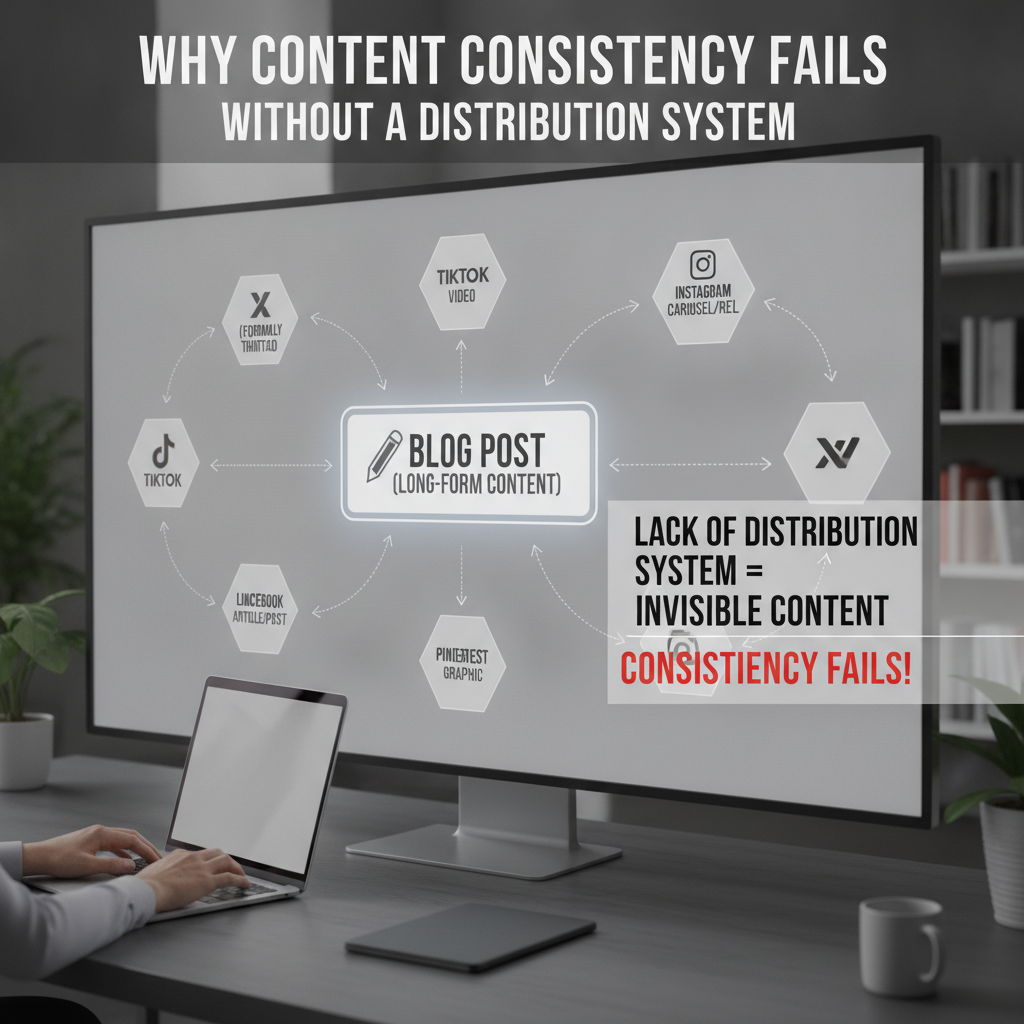
Content repurposing flowchart demonstrating omnichannel distribution
According to HubSpot's State of Marketing Report 2024, companies that actively repurpose content see significantly higher engagement rates compared to those relying solely on original content for each channel.
What does native optimization actually mean?
Cross-posting the exact same link and caption everywhere fails completely. Every network has unique format specifications and reward systems. Native optimization means designing content specifically for the platform where it will live.
Platform specifications to follow:
- LinkedIn: Document carousels and long-form text posts with distinct line breaks
- Instagram: Vertical video in 9:16 aspect ratio and Reels under 90 seconds
- X: Threaded conversations and quote images
- TikTok: Fast-paced vertical video with strong hooks in the first three seconds
Meta's internal research shows that native content (uploaded directly to the platform) consistently receives higher algorithmic distribution than external links cross-posted from other apps. You must respect the environment of the platform to gain visibility.
LinkedIn rewards thoughtful commentary and industry insights. Instagram wants visually striking vertical content. TikTok prioritizes entertainment and fast pacing. X favors real-time commentary and conversational threads. Each platform has its own language.
How do you move from intuition to data-driven scheduling?
Posting based on convenience is a strategic error. Your scheduling should rely on your specific audience behavior data. Generic advice about "best times to post" rarely applies to your unique followers.
You need to track when your specific audience is active. Which formats generate the highest engagement by day? Which channels drive actual conversions rather than just vanity metrics?
Start by testing different posting windows systematically. Try mornings one week and afternoons the next. Compare the engagement rates. Track opens, clicks, shares, and comments. Look for patterns over 30-60 days.
Tools like Repostra.app use your historical data to automate optimal scheduling times, ensuring your posts go live exactly when your audience is ready to engage. This removes guesswork and leverages actual performance data.
What are the core pillars of a content distribution engine?
A fully functional distribution engine connects creation, adaptation, and delivery into a single automated workflow.
Pillar One: Repurposing Infrastructure
Maintain an asset library organized by platform. Document a clear workflow for turning a podcast into a text post quickly. Create templates that accelerate the transformation process.
Pillar Two: Platform-Native Optimization
Keep format specifications documented for your team. Always run quality checks to ensure videos fit the correct dimensions before publishing. Test how each format appears on mobile devices.
Pillar Three: Data-Driven Scheduling
Set a monthly cadence to review analytics. Use automated scheduling based on your performance data to refine your timing continuously. Track which days and times generate the strongest response.
How do you build your first distribution workflow?
You can build a foundational system in four to six weeks.
Audit your current state. Inventory your existing content assets. Document your current posting frequency. Identify your biggest consistency gaps. Where are you dropping off?
Choose one or two hero formats. Pick formats you can reliably create every week. This could be a podcast, an article, or a video series. Plan a repurposing map for each piece showing exactly how it will transform.
Set up templates. Create graphic and text templates for each derivative format. Document the exact steps so anyone on your team can replicate the process. This removes decision fatigue.
Select your scheduling software. Load two weeks of repurposed content to build a buffer. Set up basic analytics tracking to monitor early performance. Start simple and refine as you learn.
What results can you expect from systematic distribution?
Systematic distribution scales what already works. It won't fix a fundamentally broken message, but it will dramatically amplify good content.
Short-term wins (30-60 days): You'll achieve consistent posting frequency. You'll save hours of manual distribution time every week. Platform-specific engagement rates will improve as algorithms recognize your consistency.
Medium-term results (90-180 days): Expect measurable reach and audience growth across multiple channels. Your leads and conversions per content piece will rise. You'll build a content buffer that protects against creative dry spells.
Long-term transformation (6-12 months): Your content becomes a predictable growth channel. Creator burnout drops significantly. You'll experience compounding returns from an established evergreen content library that continues driving traffic months after publication.
FAQ
How much time does it take to maintain a content distribution system?
Once established, a content distribution system typically requires two to four hours weekly for most businesses. This is dramatically less than the ten to fifteen hours spent on manual posting. Initial setup takes four to six weeks working a few hours per week to build templates and configure tools. The time investment shifts from repetitive manual tasks to strategic activities like analyzing performance. Tools like Repostra.app can reduce ongoing maintenance to under two hours weekly by automating the cross-platform posting process.
Can you build a distribution workflow without expensive tools?
Yes, you can start with free tools, though you'll trade money for time. A basic system requires a calendar spreadsheet, native platform schedulers (like LinkedIn's built-in scheduler or Meta Business Suite), and free design templates from Canva. This approach works for one or two platforms. However, scaling beyond this creates significant manual overhead. Mid-tier scheduling software becomes cost-effective when managing three or more platforms. If manually managing distribution takes ten hours weekly, a platform that reduces this to two hours essentially pays you back in reclaimed time.
What makes a content calendar different from a distribution workflow?
A content calendar plans what you'll publish and when. A distribution workflow executes how that content reaches audiences across all channels. Think of a calendar as a blueprint and the distribution system as the construction crew. A calendar might say you need a blog post on Tuesday. The distribution system ensures that same blog post becomes a carousel on Wednesday, a thread on Thursday, and an email segment on Friday. The system includes the operational infrastructure that transforms intentions into multi-channel presence.
How many platforms should you include initially?
Start with two or three platforms where your target audience actively engages. Quality presence on fewer platforms outperforms sporadic posting across many. Identify where your audience actually spends time. B2B companies often prioritize LinkedIn and email. Consumer brands might focus on Instagram and TikTok. Once you maintain excellent consistency on your initial platforms for two months, consider adding another. Your platform selection should be completely data-driven based on where conversions originate, not where you personally prefer to post.
What if content still fails after systematic distribution?
A distribution system amplifies content performance, but it can't fix a fundamentally misaligned strategy. If systematic distribution doesn't improve results after three months, you must audit your foundation. Check your content-audience fit to ensure you're answering real questions your buyers ask. Verify your platform alignment to confirm your audience actually uses those channels. Review your format effectiveness to see if your style matches what the platform currently rewards. Sometimes the message itself needs refinement. Distribution makes good content great, but it won't salvage content that misses the mark.