When One Strong Idea Should Become 20 Social Media Posts
This post explores how businesses can spot high-potential content ideas and repurpose them into a full stream of social media posts without losing quality or control. It will show how a smart mix of human judgment and AI support makes content creation and distribution more efficient.
Create Once, Publish Everywhere: The Ultimate 2026 Guide to Content Repurposing
TL;DR: The Create Once, Publish Everywhere (COPE) framework helps marketing teams turn one high-quality piece of content into 15-30 platform-specific posts. By treating long-form assets as "hero content" and using AI for mechanical tasks while humans maintain creative control, businesses save 60-80% of creation time while reaching audiences across multiple channels with consistent, quality messaging.
Key Takeaways:
- One strong piece of hero content can generate 15-30 unique, platform-native posts
- AI handles transcription, resizing, and drafting while humans control strategy, voice, and accuracy
- Systematic repurposing saves 60-80% of content creation time compared to creating each post from scratch
- Quality repurposed content builds authority and generates leads for years, unlike paid campaigns that stop when budgets run out
- Success requires adapting content to each platform's culture, not copy-pasting identical posts everywhere
Top-performing businesses in 2026 stopped treating every social media update as a disposable creation. They now view long-form assets as hero content that generates multiple platform-specific variations. This strategy combines human creativity with AI operational support to save massive amounts of creation time while maintaining high quality across all channels.
Why Are Marketing Teams Burning Out on Content Creation?
Marketing teams create five to seven posts daily. They constantly scramble for fresh ideas to feed hungry platform algorithms. Treating every post as a brand new creation leads to rapid creator burnout and inconsistent messaging.
Content creator burnout
The solution requires a fundamental shift in perspective. Your best ideas can work significantly harder when you stop treating them as single-use commodities. A systematic approach to content distribution transforms an exhausting treadmill into a scalable operation.
What Makes a Content Idea Strong Enough to Repurpose?
Not every idea deserves widespread syndication. The most successful teams identify "hero content" or "seed content" to anchor their distribution efforts. This usually takes the form of a comprehensive blog post, a detailed webinar recording, an original podcast episode, or a thorough case study.
Key takeaway: A high-potential idea must answer a core audience pain point while containing multiple sub-insights or actionable nuggets.
It should demonstrate a unique perspective or a proprietary framework. Evergreen relevance matters heavily here. Time-sensitive news updates rarely justify the effort of widespread adaptation. Ideas that are too narrow, purely promotional, or already over-covered in your industry serve as major red flags. Evaluate your existing content library against these criteria to spot hidden opportunities.
What Is the COPE Framework for Content Strategy?
The Create Once, Publish Everywhere workflow started as a time-saving trick but has evolved into a strategic discipline for 2026. The saturated digital landscape demands extreme consistency without compromising depth.
The workflow relies on three distinct phases:
Create: Produce one comprehensive, high-quality long-form asset.
Extract: Identify key insights, compelling quotes, statistics, and frameworks from that asset.
Adapt: Reformat those extractions to fit the native consumption style of each target platform.
Think of this as a hub and spoke model. Your hero content sits at the center while adapted variations branch out to specific channels.
Research from the Content Marketing Institute shows that systematic repurposing can save 60-80% of content creation time and reduce production costs by up to 65% when AI assists the process. The business case for this framework centers on maximizing the return on investment for your most expensive creative work.
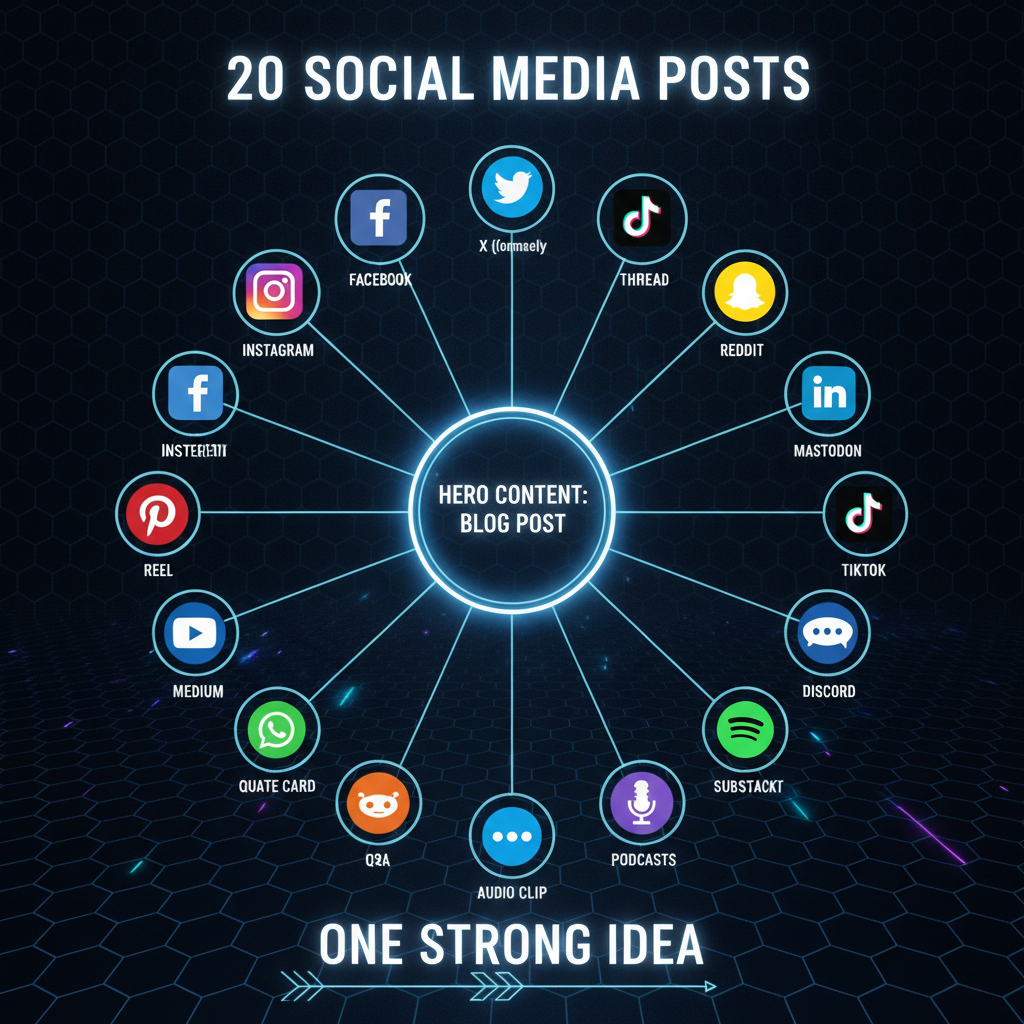
COPE content strategy diagram
How Do You Extract Multiple Posts From One Idea?
Turning one concept into a full distribution schedule requires a methodical breakdown process.
Identifying Content Nuggets
Look for discrete insights within your hero content. Nuggets take the form of memorable quotes, surprising statistics, or actionable tips. AI tools can scan long-form text or video transcripts to highlight these key moments. Human editors then review the suggestions to select the most impactful ideas for their audience.
Matching Formats to Platforms
Adapt the nugget to fit specific platform cultures.
LinkedIn: Transform a framework into a five-slide carousel or a text post ending with a poll.
Short-form video: Pull a 30-second clip highlighting a single hook and takeaway for TikTok or Reels.
Twitter and X: Break down complex concepts into threaded steps or share one-liner insights.
Instagram: Design visually appealing quote graphics or behind-the-scenes stories.
Newsletters: Provide a deep-dive summary or an exclusive perspective not shared on public platforms.
Pinterest: Create a step-by-step visual infographic based on your core framework.
Building a Content Matrix
Track the entire ecosystem. Use a spreadsheet or dedicated software to map the original asset to its derivative posts, target platforms, and publishing dates. Create all variations in one batch session to maintain creative momentum. Schedule these posts strategically over several weeks to avoid overwhelming your audience.
Why Does Content Repurposing Matter More in 2026 Than Ever Before?
More content gets published daily now than at any point in history. Brands must deliver quality and consistency simultaneously to maintain visibility. Your target audience does not live on a single platform. Research from Pew Research Center confirms heavy audience fragmentation across networks, meaning you must meet potential customers exactly where they prefer to consume information.
Algorithms consistently reward accounts that maintain regular posting schedules. Relying entirely on net-new creation makes that consistency nearly impossible. Quality repurposed content provides compound returns. It generates leads and builds authority for years, contrasting sharply with paid media campaigns that stop delivering the moment your budget runs out.
Many marketers now use AI daily, yet most still struggle to implement cohesive repurposing frameworks. This reality creates a massive opportunity for strategic teams to outpace their competitors. Data from the Content Marketing Institute confirms that brands utilizing structured distribution models see significantly higher return on their creative investments.
What Role Does AI Play in Repurposing Content?
The most successful operations treat artificial intelligence as a support engine rather than a complete replacement for creative teams.
AI excels at the mechanical aspects of content production. It transcribes video and audio flawlessly. It resizes visual assets for different aspect ratios and predicts which video segments might generate the most engagement. It can quickly draft a dozen variations of a social caption or facilitate A/B testing for different hooks.
Humans must continue to own the strategic and emotional elements. A human editor defines the overall strategy and selects which ideas merit widespread distribution. People ensure factual accuracy and maintain strict brand voice consistency. Reading the room for cultural sensitivity and optimal timing remains a uniquely human skill.
"The most successful teams in 2026 don't ask AI to do the repurposing in a vacuum. They use it as an operational engine while humans remain the creative directors."
— Robert Rose, Chief Strategy Advisor at Content Marketing Institute
How Do You Maintain Brand Voice Across Platform Variations?
The biggest risk of scaled creation is template fatigue. Posts can quickly start feeling robotic or generic if left entirely to automated tools. You must establish strict brand voice guidelines detailing your preferred tone, vocabulary, and perspective.
You must also adjust that voice for the platform context. A professional breakdown on LinkedIn should sound different than a conversational observation on TikTok, even if the underlying insight remains identical.
Bottom line: Run a strict quality control checklist before publishing anything. Ask if the text sounds like your brand. Verify that it provides genuine value to the reader. Check the accuracy of all claims and sources. Ensure the format invites actual conversation rather than just broadcasting facts.
Adopt the 50/50 rule for your daily activity. Ensure half your output is repurposed hero content while the other half consists of platform-native interactions and spontaneous replies. Use AI-generated drafts only as starting points for your final edits.
What Does a Twenty-Post Repurposing Example Look Like?
Theory requires concrete proof to become actionable. Imagine your team spends four hours writing a highly researched, 1,500-word blog post on a topic relevant to your buyers.
Using AI support, you spend two additional hours extracting the following assets:
- Three LinkedIn carousels highlighting different angles of the post
- Five short-form videos where a team member speaks directly to camera about specific tips
- Four conversational threads for Twitter and X
- Three stylized quote graphics for Instagram
- Two distinct newsletter segments linking back to the full piece
- One slightly modified article published directly to LinkedIn
- Two podcast audio clips discussing the core thesis
This process turns four hours of initial creation into an entire month of consistent social presence. Teams implementing this exact breakdown frequently report massive multipliers in organic reach and engagement.
What Are the Most Common Content Repurposing Mistakes?
Copy-paste syndrome. Publishing identical text and formatting across every platform looks careless. Adapt the format, hook, and call to action to fit the specific culture of each network.
Losing the core message. Getting too creative with variations can dilute the original insight. Keep your north star message visible in your content matrix during the drafting phase.
Poor strategic timing. Dumping all twenty variations on the same day exhausts your audience. Drip the assets out over several weeks or months to maintain a consistent presence.
Forgetting platform culture. Using a stiff corporate voice on a casual platform limits your reach. Study top performers on your target network before adapting your content to match their cadence.
Zero engagement follow-up. Publishing your posts and immediately logging off kills your momentum. Treat repurposed assets as conversation starters. Reply to comments and foster community interaction.
Which Tools Make Content Repurposing Scalable?
You need specific tool categories to build an efficient workflow.
First, you need transcription and extraction software to pull text and insights from audio or video files. Next, you need design utilities capable of rapidly resizing visual content for different platform dimensions. You also require scheduling platforms to manage multi-channel posting calendars effectively. Finally, you need analytics software to track which specific derivatives perform best with your audience.
Integrated workflows matter far more than acquiring a massive stack of disconnected apps. The goal is to avoid tool sprawl. Solutions like Repostra.app excel by bridging the gap between identifying a high-potential idea and managing its multi-platform distribution. Centralizing these tasks prevents creative assets from getting lost in disorganized folders.
How Do You Start Your First Repurposing Project?
The transition from a one-to-one creation model to a scaled system takes time. Start small to build the habit. Even turning one idea into ten posts beats scrambling for daily inspiration.
Week 1: Audit your existing content library. Identify three strong hero assets that performed well in the past.
Week 2: Choose the best asset from that list. Create your content matrix and plan the angles for all derivative posts.
Week 3: Batch-create the formats using AI extraction and human refinement.
Week 4: Schedule the posts across your chosen platforms and monitor the initial engagement.
Week 5: Analyze the performance data. Refine your templates and workflow for the next cycle. Document the entire process so other team members can replicate your success.
FAQ
How many social media posts can you realistically create from one piece of content?
Most long-form assets can generate 15-30 platform-specific posts depending on their depth. A comprehensive guide or a detailed webinar might yield over twenty assets. A shorter opinion piece might produce eight to twelve. Match the original content's substance to your goals. Quality always trumps sheer quantity.
Does repurposing content hurt SEO or look lazy to audiences?
No. When executed correctly, repurposing improves your digital footprint. Search engines do not penalize platform-specific adaptations of a core idea. A blog post, a YouTube video, and a LinkedIn carousel represent different content types. Audiences appreciate seeing valuable information presented in their preferred formats. The perception of laziness only happens with exact copy-paste jobs.
How much time does it take to turn one idea into multiple posts?
Teams utilizing AI support report massive time savings. Creating the original hero content might take four to six hours. Repurposing that asset into twenty derivatives typically takes two to three hours. Producing twenty original posts from scratch could easily take over twenty hours. The initial setup of your templates takes time but pays off quickly.
Which platforms should I prioritize when adapting content?
Start where your audience already engages most actively. Review your analytics to identify the two or three platforms driving the most qualified traffic. Master those channels before expanding. B2B companies heavily prioritize LinkedIn, YouTube, and email newsletters. Consumer brands often focus on Instagram, TikTok, and Pinterest. Let your specific audience data guide this decision.
Can AI tools really maintain my brand voice across different posts?
AI can maintain consistency when properly guided by strict brand voice instructions, robust examples, and human oversight. The most effective workflow uses AI to generate initial drafts based on your style parameters. Human editors then refine those drafts to add emotional resonance and platform-specific nuance. Treat AI as a junior assistant needing clear direction rather than a set-and-forget solution.