What to Repurpose First When Your Team Is Short on Time
This post explores how marketing teams can identify the highest-value content to repurpose first, so they can stay visible without creating everything from scratch. It offers a practical framework for balancing AI efficiency with human oversight across...
Strategic Content Repurposing: Save Time and Multiply Your Marketing Reach
TL;DR: When your marketing team is stretched thin, smart content repurposing can increase your output by 40% while cutting creation time up to 80%. Focus on high-performing pillar assets like webinars and popular blog posts. Use the ROT framework to eliminate low-value material. Apply a Human-AI-Human workflow to transform proven content into platform-native formats while maintaining your brand voice.
Key Takeaways
- Start with winners that have proven performance or conversion power.
- Apply the ROT test to eliminate redundant or outdated material.
- Use a Human-AI-Human workflow to maintain brand authenticity.
- Reshape content specifically for each distinct social platform.
- Save up to 80% on creation time while avoiding the robotic AI trap.
Picture this scenario. Your content calendar is half empty. Your team feels completely overextended. Leadership still expects a steady stream of social posts, newsletters, and thought leadership pieces. Most teams respond by creating more original material from scratch. This only deepens burnout.
Strategic content repurposing offers a smarter path. According to the Content Marketing Institute in 2025, marketers who actively repurpose content see a 40% increase in output without a proportional increase in creation time. The problem is not a lack of content. The real challenge is knowing what to prioritize when time is strictly limited.
This guide provides a practical framework for identifying high-value assets. You'll learn to balance AI efficiency with human oversight and build a predictable distribution system.
Why does content repurposing matter more in 2026?
The content marketing landscape has shifted entirely. We've moved from a pure quantity mindset to a strict focus on smart distribution. Teams produce more assets than ever before. Yet they see diminishing returns because distribution is treated as an afterthought.
Audiences now consume information across six to eight different platforms on average. A single blog post needs multiple lives to be effective. Content that lives in only one place collects digital dust. This represents a massive waste of initial investment.
"The brands winning in 2026 aren't creating the most content. They are maximizing the reach of every piece they already have."
Robert Rose, Chief Strategy Advisor at the Content Marketing Institute
According to the HubSpot State of Marketing Report in 2026, 94% of marketers now use AI in their workflows. This widespread adoption means basic content generation is heavily commoditized. Repurposing your proven, original ideas is now the only reliable way to stand out.
What makes content worth repurposing?
You need a clear audit system to answer the core prioritization question. Don't repurpose indiscriminately. Use this specific framework to find your best material.
Performance metrics that prove durability
Look for content with sustained traffic rather than initial, short-lived spikes. Identify high engagement scores like shares, saves, comments, and time-on-page. A blog post from six months ago still driving hundreds of visits monthly is a prime candidate. Use tools like Google Analytics, social media insights, and email open rates to spot these hidden winners.
Conversion power through pillar assets
Identify content that has historically driven leads, sales, or meaningful user actions. Webinars, customer case studies, comparison guides, and how-to tutorials are classic pillar assets. They've already proven their exact return on investment.
Multiplying their reach directly multiplies those returns. A webinar attended by 200 people holds massive potential. It can easily reach thousands when cut into smaller, digestible clips.
The ROT analysis framework
Before you reshape anything, apply the ROT framework. This established marketing content audit methodology prevents wasted effort across your team.
- Redundant: Look for multiple blog posts saying essentially the same thing. Consolidate them into one definitive guide first.
- Outdated: Check if the data, examples, or advice are still relevant. Skip the asset entirely or update the facts before proceeding.
- Trivial: Determine if this content provided real value or acted strictly as filler. Be ruthless with your cuts.
Bottom line: Focus all repurposing efforts on timeless, evergreen content that provides long-term value.
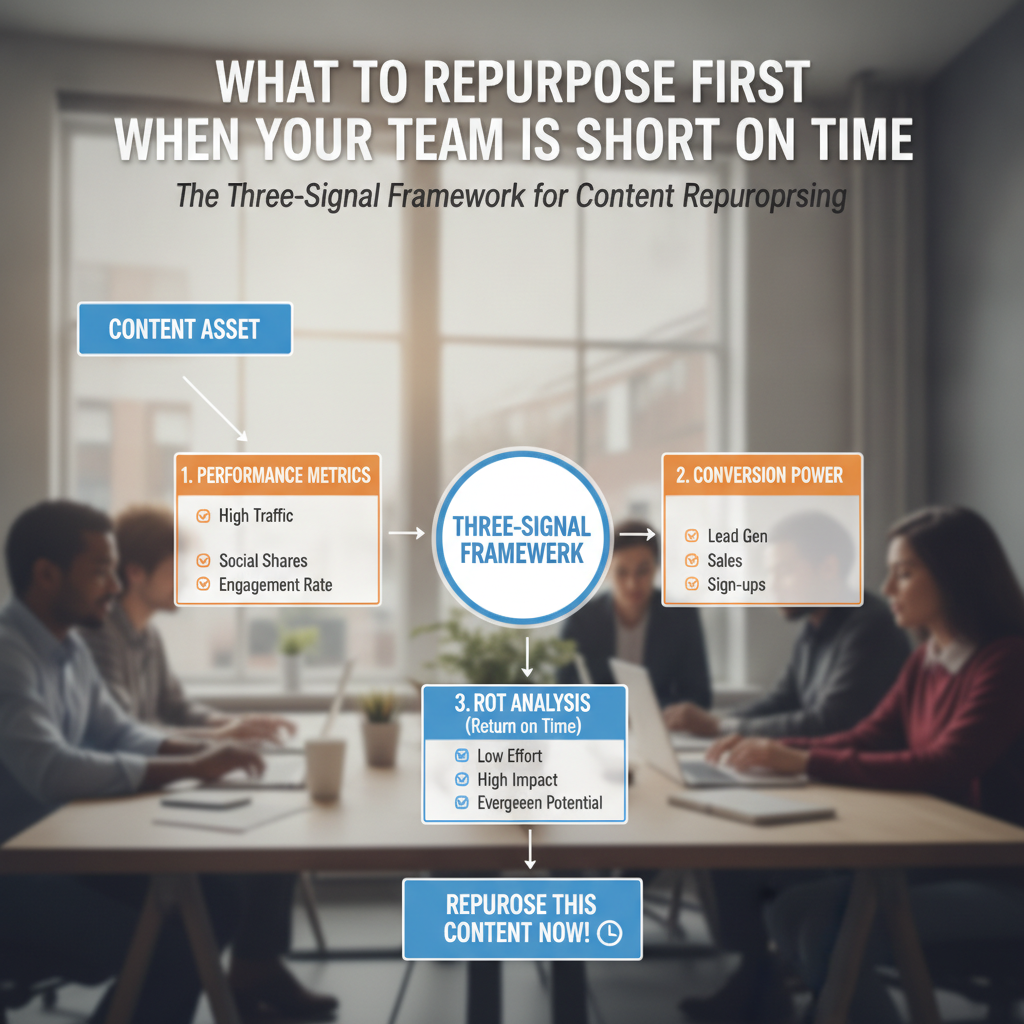
Three-Signal Framework for Content Repurposing
How should you balance AI efficiency with human oversight?
There's a growing tension between automation and authenticity. AI tools can generate text incredibly fast. But audiences can spot generic, soulless content instantly.
According to Sprout Social's 2026 Consumer Index, 33% of consumers say they're less likely to engage with brands that rely too heavily on automated, robotic content. Over-automation actively erodes your brand differentiation. You need a structured workflow to prevent this outcome.
The Human-AI-Human sandwich model
Layer One (Human): Set the specific strategy. Choose the angle and provide the original insight or nugget of value. A human must decide to turn a customer case study into a LinkedIn carousel focused entirely on ROI wins.
Layer Two (AI): Do the heavy lifting. Use AI to atomize the large content into social variations. Optimize these pieces for specific platform-native formats and handle the scheduling mechanics. Tools like Repostra.app serve as the intelligent engine at this stage.
Layer Three (Human): Review and fact-check every piece. Add the necessary brand voice polish. Ensure absolute accuracy and tonal alignment. This acts as your final quality gate before publication.
Why is platform-native formatting non-negotiable?
Repurposing is never copy-pasting. Each platform has completely distinct content expectations.
LinkedIn favors thought leadership, carousels, and long-form posts. X requires quick insights and conversational threads. Instagram demands visual-first hooks and story sequences.
Transforming a blog post correctly takes effort. It often means crafting ten carousel slides, eight distinct tweets, and three graphic layouts. Treating every channel the same guarantees poor performance.
What does a high-impact repurposing workflow look like?
You can build a predictable, repeatable process right now. Follow these sequential steps to get started without overwhelming your team.
Step One: Audit your existing archive. Export your top twenty performers based on historical metrics. Run the ROT analysis to filter out the weak links immediately.
Step Two: Choose exactly one pillar asset to begin. Don't try to repurpose everything at once. Pick your highest-signal piece. A recent webinar or comprehensive guide works best.
Step Three: Map your platform-native variations. Create a simple hub-and-spoke chart. Place the original asset in the center. List platforms like LinkedIn, X, and Instagram as the spokes. Detail the specific format required for each channel.
Step Four: Deploy the human-AI-human model. Brief your angle clearly. Run it through Repostra.app to generate the platform-specific variations. Have a human polish the final results.
Step Five: Schedule and measure the outcomes. Distribute the assets across a two-week span rather than dumping them all on one day. Track which specific variations perform best. Feed these hard learnings directly back into your next cycle.
How does repurposing tie to reach and ROI?
Business leaders need to know if this effort is actually worth the time. The numbers present a compelling, data-backed case.
Reach multiplier: One live webinar with 200 attendees can become 15 distinct pieces of content. That single asset can now reach 20,000 potential buyers across various channels over a single month.
Time efficiency: Reshaping proven material saves massive amounts of time. You save 60-80% of creation time compared to developing entirely new ideas.
Cost reduction: It drastically reduces total production costs. Relying on AI-driven formatting lowers costs by up to 65%.
Consistency benefit: This system keeps your brand highly visible without requiring constant brainstorming sessions. More content variations create more entry points for both search engines and social algorithms.
| Metric | Impact of Strategic Repurposing |
| Creation Time | Saves 60-80% |
| Content Output | Increases by 40% |
| Production Costs | Reduces by up to 65% (when AI-driven) |
| Consumer Sentiment | ~33% avoid content that feels visibly AI-generated |
(Data compiled from Content Marketing Institute 2025, HubSpot State of Marketing 2026, and Sprout Social Consumer Index 2026)

Content Repurposing ROI Metrics
Can we move from content chaos to predictable distribution?
Many teams operate entirely in reactive mode. They experience weekly panic over what to post next. You can completely eliminate this stress by shifting to a proactive distribution system.
A true system requires monthly planning. Identify just one or two pillar assets every 30 days. Spend your weekly cycles repurposing those into dozens of platform-native pieces. Maintain a daily schedule of human review and automated publishing.
You don't need to hire more people. You simply need better systems. Repostra.app helps marketing teams turn a single pillar asset into a full week of distribution-ready content. It provides the specific intelligence to optimize for each platform. You keep your brand voice authentic while scaling your overall reach. Start small with one asset, measure the results, and scale the system from there.
Frequently Asked Questions
How do I know if my content is worth repurposing?
Use the three-signal framework to evaluate your archives. Check for strong performance metrics like sustained traffic or engagement. Look at conversion power to see if it previously drove leads or sales. Run a ROT analysis to ensure you skip anything redundant, outdated, or trivial.
What is the best type of content to repurpose first?
Start immediately with pillar assets like webinars, in-depth blog posts, case studies, or tutorials. These pieces have massive atomization potential. A single comprehensive asset can easily become 10 to 15 platform-native variations.
How much time does repurposing actually save?
Strategic repurposing saves 60-80% of your typical content creation time. You reshape proven, existing material instead of staring at a blank page. This process is significantly faster and carries much lower performance risk.
Can AI handle repurposing entirely without human input?
You absolutely need human involvement. Use the Human-AI-Human model to ensure high quality. Humans lead the strategy and add final polish. AI handles the heavy lifting of formatting and platform optimization. This prevents the robotic tone that actively drives away 33% of consumers (Sprout Social 2026).
How often should you repurpose a single piece of content?
There's no strict limit if the core information remains evergreen. A high-value pillar asset can be repurposed dozens of times across different platforms and timeframes. Focus on reshaping it into genuinely new, platform-native formats rather than simply repeating the exact same message.