What to Repurpose First When Your Content Calendar Falls Behind
This post explores how marketing teams can quickly identify the best existing content to reuse when publishing slows down. It will share a practical, low-stress approach to content repurposing across social media and other channels without sacrificing quality.

Content Repurposing Strategy: How to Maximize Your Marketing Assets in 2026
When your content calendar falls behind, you don't need to panic. The solution isn't creating more from scratch. Smart marketers repurpose high-performing evergreen content and pillar assets like webinars or white papers. Use analytics to identify proven engagement magnets, then atomize these assets into platform-native formats with unique angles. This approach saves teams up to 80 percent of creation time while maximizing return on investment and maintaining consistency without causing burnout.
Key Takeaways
- Audit your analytics first to focus on evergreen content that has already proven to engage your audience
- Start with pillar content like webinars and white papers that contain deep insights you can break down into smaller pieces
- Atomize with purpose by creating unique angles and platform-native formats rather than identical copies
- Conduct a ROT analysis to remove or update redundant, outdated, or trivial content
- Reclaim your schedule by repurposing content, which saves 60 to 80 percent of creation time compared to starting from scratch
Why Does Content Repurposing Matter in 2026?

Marketing professionals reviewing content strategy on a digital board
Content repurposing has evolved from a basic productivity trick to the foundational infrastructure of successful marketing teams. Digital noise has increased dramatically. Audience attention spans continue fragmenting across multiple platforms.
The most effective teams now design content for reuse from the start. Modern brand discovery is interest-led rather than follower-led. This shift requires a consistent presence across channels. According to Typeface research from 2026, non-AI blog creation has dropped to just 5 percent, meaning the total volume of digital noise is higher than ever.
"Taking an awareness piece with great views but low clicks and repurposing it as a conversion ad is a mistake. Match the asset to the goal it already proved it could achieve, then repurpose from there. Repurposing is no longer a hack; it is the foundational infrastructure for modern content teams."
— Elen, Chief Product Officer at IQFluence, 2026
Repurposing existing content saves teams 60 to 80 percent of content creation time. This isn't just a convenience. It's an essential system for survival in today's saturated content landscape.
How Do You Identify What Content to Repurpose First?
Not all content is equally valuable. When your calendar falls behind, use this prioritization framework to identify high-ROI assets quickly.
What Metrics Indicate High-Performance Content?
Pull analytics from all channels. Look at website traffic, social media engagement metrics, and email open rates. Focus specifically on evergreen content. These pieces continue performing months after publication. They are proven engagement magnets that already resonate with your audience.
Tools like Google Analytics and native social platform insights reveal these hidden gems quickly. You're looking for content that has sustained performance over time, not just a single viral spike.
Which Pillar Content Should You Prioritize?
Focus on substantial assets like webinars, white papers, case studies, long-form videos, and research reports. These assets contain deep insights and data that easily break down into dozens of smaller pieces.
One 60-minute webinar can become:
- 8 to 10 social posts
- 3 to 4 blog articles
- 15 quote graphics
- 1 infographic
Pillar content provides the source material with the highest derivative value. Think of it as your content inventory, ready to be distributed across multiple channels and formats.
What Is a ROT Analysis?
Conducting a ROT analysis cleans your library and improves search visibility. ROT stands for Redundant, Outdated, and Trivial.
Redundant: Identify content that duplicates existing messages. Do you have three blog posts saying essentially the same thing? Consolidate them.
Outdated: Flag content with old statistics, previous branding, or expired offers. That case study from 2022 might need a refresh.
Trivial: Remove content that no longer serves strategic goals. Just because you published it doesn't mean it needs to stay live forever.
According to the HubSpot Blog in 2025, regular content auditing and ROT analysis directly improve search engine ranking and user experience. Sometimes updating an old piece is as valuable as creating a new one.
What Is the Atomize and Distribute Strategy?
Visual representation of content atomization strategy
The biggest mistake teams make is simply chopping content into identical chunks. The winning strategy is atomization. This means breaking pillar content into unique angles that serve different content jobs.
How Do You Shift the Angle?
Don't just change the format. Create pieces with different strategic purposes from one source asset.
Educational: Tactical tutorial that teaches a specific skill.
Contrarian: Challenge a common industry assumption or myth.
Narrative: Behind-the-scenes story or lesson-learned format.
Data-driven: Highlight key statistics or research findings.
Each piece serves a different audience need and discovery intent. This prevents content fatigue.
Take one customer case study about reducing cart abandonment. Turn it into a LinkedIn post teaching the specific tactic. Next, write an X thread challenging the assumption that email timing doesn't matter. Then film a short video showing the before and after metrics. Finally, publish a blog post with the full implementation story.
Same source material. Four completely different angles.
Why Do You Need Platform-Native Packaging?
Every asset must feel at home on its specific platform. Don't just resize images. Reimagine the content for each platform's consumption patterns.
LinkedIn carousels: Educational tone, professional context, clear takeaways.
X threads: Punchy insights with a strong hook in the first post.
Short-form vertical video: Visual, fast-paced, hooking the viewer in the first three seconds.
Platform-native content performs better because it respects how users actually consume content on each channel.
How Should You Use AI as a Repurposing Assistant?
Let artificial intelligence handle the heavy lifting. AI transcribes videos, summarizes key points, and generates initial social drafts. Humans then focus on strategy, storytelling, and brand voice consistency.
Use transcription services like Otter or Descript. Use writing assistants for summarization. Always review and refine the output to ensure brand alignment. According to Averi AI research from 2026, 94 percent of marketing teams now use AI in their content creation workflow to boost efficiency.
But here's the thing: AI should accelerate your process, not replace your judgment. The best repurposed content still has human insight and brand personality baked in.
Why Does Content Repurposing Increase Marketing ROI?
Systemized repurposing maximizes the value of your original creative investment.
Efficiency: Repurposing saves 60 to 80 percent of content creation time versus starting from scratch. It reduces team workload and prevents burnout. It allows smaller teams to maintain enterprise-level output.
Increased ROI: This strategy gives your best ideas multiple chances to land across different channels. It reaches audience members with different platform preferences. One expensive video shoot can generate 50 derivative assets over six months.
Consistency Without Burnout: Systemized repurposing enables a predictable presence. The Content Marketing Institute reports in their 2026 B2B benchmarks that consistent content delivery is the top factor in building audience trust.
Interest-led discovery requires consistent touchpoints. It builds brand recognition through repeated exposure to core messages. This creates a sustainable growth engine rather than a boom-and-bust cycle.
How Do You Build a Sustainable Content Repurposing System?
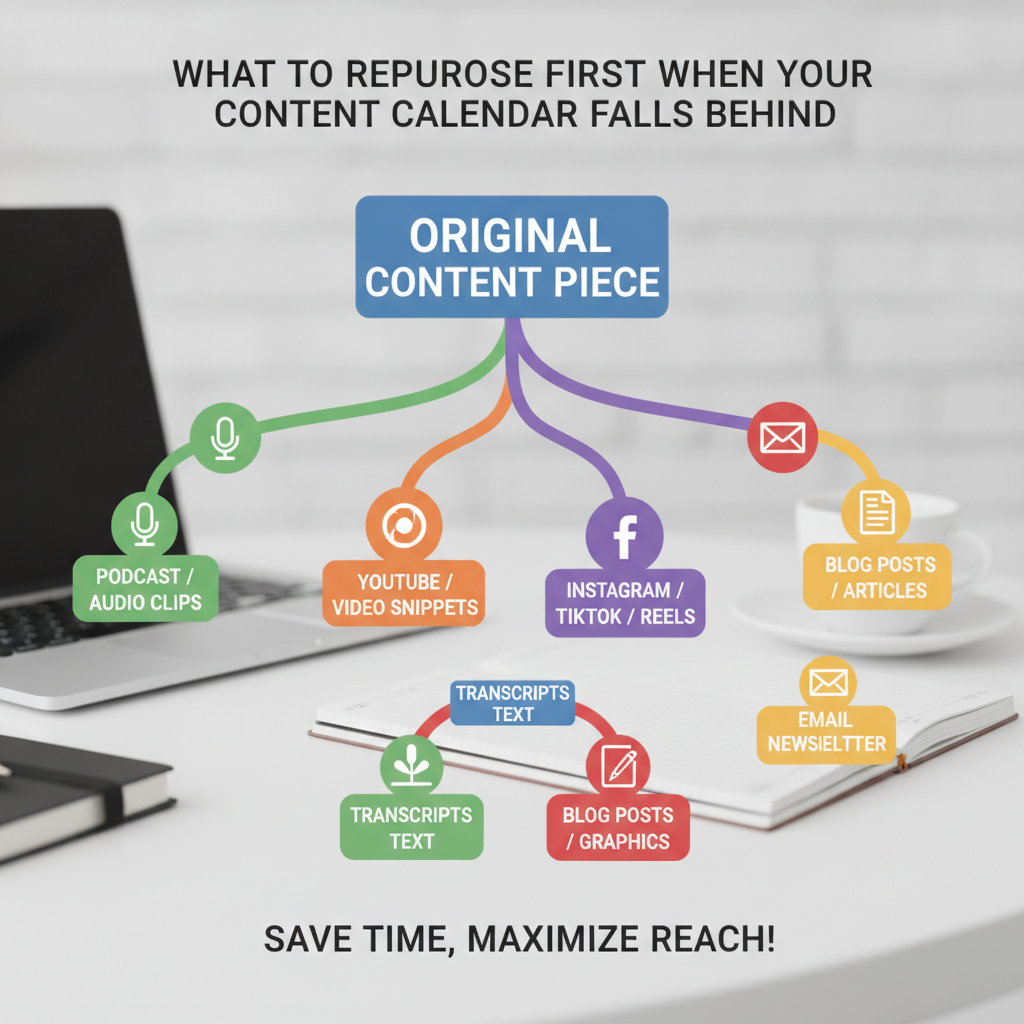
Flowchart of a sustainable content repurposing workflow
Implement these steps when you're ready to move from panic-publishing to a predictable routine.
Design for Reuse from the Start: Plan derivative assets in advance when creating pillar content. Record video and audio for every webinar or presentation. Capture soundbites during creation. Build a repurposing plan into every major content brief.
Create a Central Content Library: Store all assets in an accessible location like a shared drive. Tag files by topic, format, performance level, and last update date. Make it easy for team members to find candidates quickly. If someone needs to hunt for 15 minutes to find an asset, your system needs work.
Establish a Repurposing Workflow: Assign clear ownership. Decide who identifies candidates, who creates derivatives, and who schedules them. Set a regular cadence. Use project management tools to track these projects separately from new content. Build templates for common formats to speed up production.
Treat Content as a Compound Asset: Shift your mindset from a one-off project to an investment that appreciates over time. Every piece of pillar content should generate value for months. Continuously update evergreen content rather than recreating it.
FAQ
How many times can you repurpose the same content?
There is no fixed limit as long as you change the angle and format each time. A single high-value pillar asset can generate dozens of derivative pieces across different platforms. The key is ensuring each piece serves a distinct purpose and audience need. Continue to repurpose evergreen content as long as it remains relevant and performs well in your analytics.
What is the difference between repurposing and republishing content?
Republishing means posting the exact same content again with minimal changes. Repurposing means transforming content into new formats or angles that serve different strategic purposes. Turning a blog post into a LinkedIn carousel, an X thread, and a short video is repurposing. It's highly effective because it meets audiences where they are with platform-native content.
Should you repurpose low-performing content or only focus on hits?
Focus on high-performing content first. These are your analytics-proven engagement magnets. However, some low performers fail due to poor distribution or bad timing. Review underperformers to identify hidden gems. Well-researched pieces might succeed with a new angle, a better headline, or a different platform.
How do you maintain brand voice consistency when repurposing at scale?
Create brand voice guidelines and platform-specific templates. Use AI for initial drafts but require human editors to review for tone and quality. Establish approval workflows where a brand expert reviews atomized content before publication. Consistency comes from clear documentation and quality control processes.
What tools help automate content repurposing in 2026?
Leading tools include transcription services, AI writing assistants, and social media schedulers with built-in atomization workflows. Tools alone cannot create effective content. Start with manual repurposing to understand what works for your audience. Selectively automate repetitive tasks while keeping humans in charge of strategy.