The Hidden Cost of Publishing Without a Content Memory System
Explore why teams keep repeating ideas, missing strong past assets, and wasting creative energy when content is not properly tracked. Position content memory as a practical advantage for faster, smarter marketing.
The $50,000 Blog Post You Forgot You Had: How Content Amnesia Drains Marketing Budgets
TL;DR: Marketing teams lose 91 business days annually searching for past work and recreating identical content. This "content amnesia" wastes 26% of marketing budgets while leaving 60% of created materials unused. A content memory system transforms scattered files into searchable, reusable assets that compound in value over time, cutting production costs and preventing team burnout.
Key Takeaways
- Marketing professionals waste three hours daily hunting for existing assets instead of creating strategy
- 60% of produced content goes completely unused because teams can't find or repurpose it effectively
- Teams spend 80% of their time reformatting existing work rather than developing original ideas
- Content memory systems turn past work into compounding assets that lower cost-per-lead over time
- Strategic repetition of core messages builds brand recognition without constant reinvention
Why Your Team Keeps Reinventing the Wheel
Imagine commissioning a $3,000 white paper on customer retention strategies. Three weeks later, you discover your team produced nearly identical content 18 months ago. It's been sitting in a forgotten cloud folder. Nobody repurposed it. Nobody distributed it. Nobody even remembered it existed.
This create-publish-forget cycle is the default state for modern marketing teams. We call this phenomenon content amnesia. It's a costly organizational blind spot that drains budgets and exhausts creative professionals.
The solution? A content memory system that stops the waste and turns your past work into a practical advantage.
What Is a Content Memory System?
A content memory system is both an organizational discipline and the technical infrastructure required to track, store, and intelligently recall past creative work.
Traditional digital asset management platforms function as static storage. They hold your files. A content memory system acts as an intelligence layer. It connects creation to deployment. The system tracks performance, tags strategic formats, and enables instant reuse.
Repostra.app operates as a Medialake for this exact purpose. It serves as an operating system for content intelligence. Instead of dumping files into a digital drawer, you feed them into a searchable, performance-tracked library. You bridge the gap between a great past idea and its next successful deployment.
You never start from zero.

Marketing professional experiencing content amnesia
How Much Time Is Your Team Actually Losing?
Marketing professionals lose nearly three hours a day on operational busywork. This includes hunting through emails, digging into chat threads, and asking colleagues about past campaigns.
Small searches add up to massive productivity drains.
According to Adobe for Business (2026), full-time US workers estimate losing 91 business days a year to low-impact tasks. For a marketing team of five, that equals over 450 lost workdays annually. You're essentially paying full salaries for people to search for things they already created.
The math is brutal. That's two entire full-time positions devoted to hunting instead of creating.
Are You Falling Into the Creative Burnout Trap?
The 80/20 trap is a notorious productivity killer in content creation.
According to Creator Economy Research (2025), marketing creators spend 80% of their time reformatting, editing, resizing, and rewriting existing ideas from scratch. This leaves only 20% of their week for high-level strategy and actual creative thinking.
This hamster wheel effect takes a psychological toll. Repetitive work without clear impact destroys team morale and drives employee turnover.
As Addy Graves, CEO of Cashew Research, notes:
"We've reached a point where everyone has access to the same tools and the same information. The competitive advantage isn't producing more content anymore. It's having something original to say."
When you constantly recreate the wheel, you rob your team of the energy needed for that originality.
What Happens to Underutilized Assets?
Here's a common mistake: assuming every published piece reaches its full potential immediately.
According to Forrester (2025), 60% of creative work goes completely unused. Assets get stuck in the wrong part of the lifecycle because teams lack the visibility to scale them. A massive webinar sits on a hard drive instead of becoming an email series. A deep case study gathers dust instead of fueling ten social media posts.
Rakuten Marketing (2024) found that marketing teams waste an average of 26% of their budgets on ineffective channels and strategies. A large portion of this waste stems from ignoring high-performing assets that already exist.
Why Can't Teams Demonstrate Content ROI?
Fragmentation makes attribution impossible.
When your content is scattered across different platforms, teams, and time periods, you cannot track its true value. According to the CMO Survey (2023), 65% of marketers cannot quantifiably demonstrate the impact of their content.
Without centralized tracking, teams suffer from a massive visibility gap. They cannot see what worked in the past. Therefore, they cannot replicate their successes.
A content memory system solves this by tracking performance across the entire content lifecycle.
How Does a Content Memory System Turn Content Into a Compounding Asset?
Paid media is a linear spend. When your budget runs out, your traffic stops.
Content should function differently. It should act as a compounding asset. Each piece builds on the success of the last, drawing continuous traffic over time.
A memory system fuels the retrieve-refresh-repurpose cycle. As your library grows, your cost per lead decreases. Repostra.app facilitates this by offering smart searchability, performance tagging, and strategic prompts. It tells you exactly what to refresh and when to deploy it.
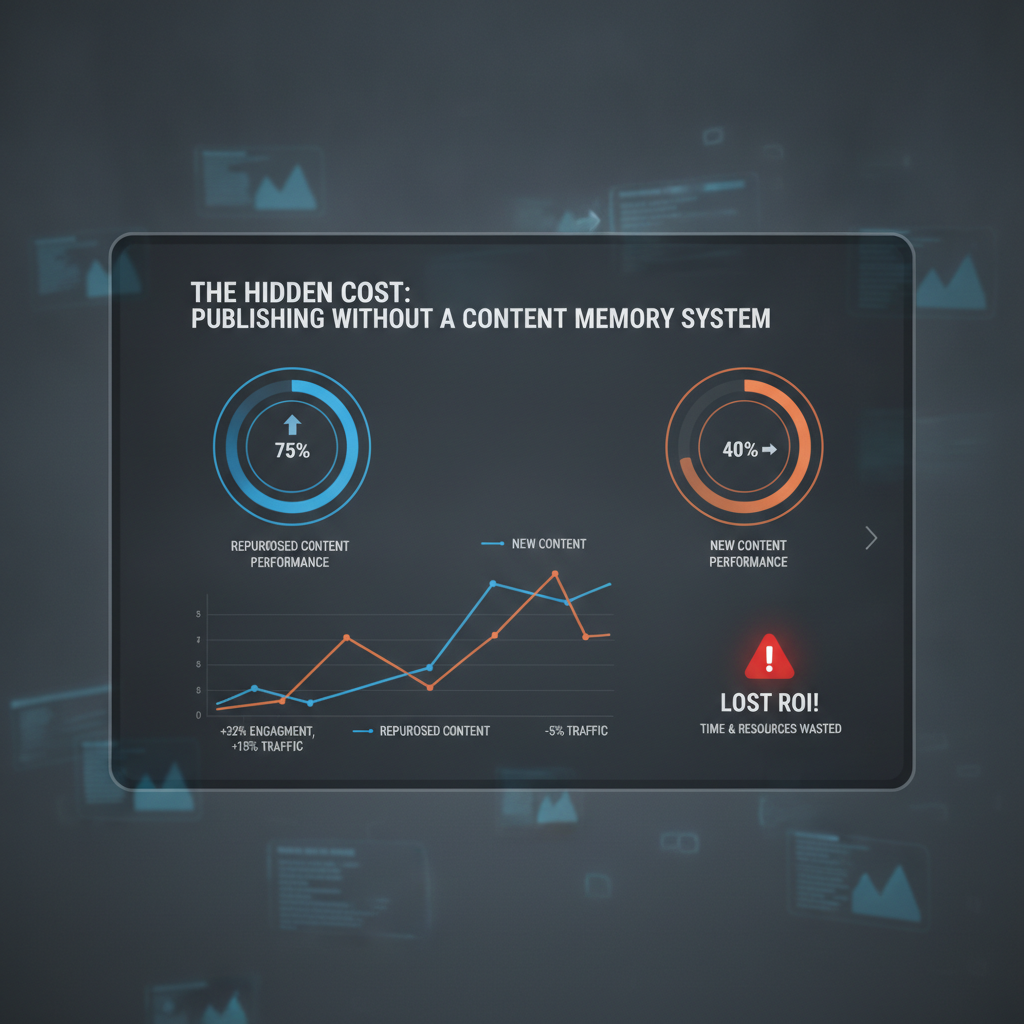
Content memory system dashboard showing compounding asset value
Why Does Strategic Repetition Work?
Psychologists have long known that repetition is the mother of learning. The same applies to brand messaging.
Your brand has a core 10% message. These are the key ideas you want your audience to remember. A memory system allows you to repeat this core message strategically across different formats and contexts without causing audience fatigue.
You might share a core concept as a podcast clip on Monday and a text-based infographic on Thursday. This smart repetition builds deep brand recognition. You achieve consistency without the burden of constant ideation.
What Should a Modern Content Memory System Actually Do?
If you're evaluating a tool to solve content amnesia, look for specific capabilities. A basic cloud drive won't suffice.
Look for a centralized, searchable repository with intelligent tagging that goes beyond simple folder names.
Ensure integrated performance tracking for views, engagement, and conversions tied directly to each asset.
Demand format and channel mapping to show what exists where and in what variations.
Require expiration alerts for time-sensitive materials that need updating or removal.
Verify cross-team collaboration features for maximum visibility across departments.
Check for AI-assisted search to surface similar past work before you commission new projects.
Confirm seamless integration with your existing marketing stack to avoid data silos.
Repostra.app addresses each of these points. It tracks format relationships so you know exactly which blog posts have already been turned into videos. It alerts you when an evergreen piece needs a refresh. It acts as an active research assistant rather than a passive filing cabinet.
How Do You Move From Content Chaos to Content Intelligence?
Moving to a content memory framework is an exercise in organizational maturity. You're shifting from tactical exhaustion to strategic growth.
Start by auditing your current library to locate your highest-performing assets from the past two years. Tag these past winners using a taxonomy that covers formats, topics, funnel stages, and performance tiers.
Establish a capture workflow to ensure every new asset gets logged into the memory system upon creation. Schedule regular review sessions to look for expiring content that needs a quick refresh.
Make it a rule to check the system before commissioning any new project. This single habit will prevent the majority of duplicate work.
FAQ
How much time does the average marketing team waste recreating content?
US workers lose approximately 91 business days per year to low-impact tasks including content recreation and asset hunting, according to Adobe for Business (2026). For a team of five marketers, that translates to over 450 lost workdays annually. This is the equivalent of eliminating two full-time positions entirely.
What percentage of marketing content goes unused?
Research from Forrester (2025) indicates approximately 60% of creative work goes unused. This happens because teams lack visibility into their existing assets and cannot efficiently repurpose them across channels. This means the majority of your creation budget pays for work that never reaches an audience.
How does a content memory system differ from standard cloud storage?
While cloud storage platforms organize files into folders, a content memory system adds an intelligence layer. It includes performance tracking, strategic tagging, format relationships, and AI-assisted discovery. It functions like a research assistant who remembers every successful campaign and suggests relevant past work when you need it.
Can content actually act as a compounding asset?
Yes. Unlike paid advertising, evergreen content continues attracting traffic and leads indefinitely. When properly tracked and refreshed through a memory system, each piece builds upon previous work. This reduces your overall cost-per-lead over time while paid media costs remain constant or increase.
How do I prove content ROI to leadership?
A content memory system provides the tracking infrastructure needed for accurate attribution. By connecting assets to performance data across their entire lifecycle, teams can demonstrate cumulative impact. You can highlight the cost savings from repurposing and show the declining cost-per-acquisition trends to justify your ongoing content investment.