The Best Way to Repurpose Content by Buyer Objection
Explore how to turn common sales objections into targeted content assets for blogs, social posts, and nurture campaigns. This angle helps teams create repurposed content that directly supports conversions, not just visibility.

The Best Way to Repurpose Content by Buyer Objection
Sales teams close deals while marketing content collects dust. Most marketing materials chase visibility but rarely address the specific reasons why a buyer might say no. You can bridge this gap by repurposing content around buyer objections. This framework transforms your existing high-performing assets into targeted answers for specific sales hurdles. When you proactively address silent concerns about price, trust, fit, or timing, you clear roadblocks before they derail deals.
Key Takeaways
- Partner with sales to identify the objections that kill deals most often
- Map repurposed content to specific buyer journey stages and objection types
- Use one anchor asset to create multiple formats addressing different concerns
- Automate distribution through tools that maintain message consistency
- Track conversion metrics rather than vanity engagement numbers
Why should you repurpose content by buyer objection?
Modern buyers research independently before talking to anyone on your team. According to Gartner's 2024 research, 83% of B2B buyers prefer to research and purchase on their own. They need answers to their exact hesitations before ever speaking to a rep.
Buyers carry silent concerns they rarely vocalize early in the process. Anticipating these hesitations makes the buying process smoother and builds immediate trust.
This strategy delivers three distinct benefits. It reduces sales friction by educating prospects during their self-directed research phase. It drives higher conversion rates by directly removing perceived risks. The Content Marketing Institute found in 2025 that content addressing specific objections can increase conversion rates by up to 34%. It also improves efficiency by using proven assets instead of starting over.
"When you willingly address the negative or the objections in your content, you immediately become the most trusted voice in your space." said Marcus Sheridan, Author and Partner at IMPACT.

Sales and marketing professionals mapping out buyer concerns on a whiteboard
What are the most common buyer objections?
Sales and marketing teams must collaborate to categorize incoming feedback. Most friction falls into four distinct categories.
Price and Value: Prospects worry about expense and return on investment. Address this with ROI calculators and cost-benefit case studies.
Trust and Credibility: Buyers wonder if your solution actually works. Overcome this using third-party reviews from sites like G2 or Capterra. Certifications and transparent data also build confidence.
Need and Fit: Companies question if the product suits their specific industry or size. Create comparison charts and targeted demo videos to clear this hurdle.
Timing and Authority: Contacts struggle to get leadership approval. Give them internal business case templates and stakeholder one-pagers.
Hold monthly feedback sessions with your sales reps to keep these categories updated.
How do you identify which objections to address first?
Finding the right objections requires direct access to customer conversations. Start by looking where the friction happens.
Conduct regular feedback sessions with your sales team. Analyze CRM notes from lost deals to spot recurring themes. Review onboarding conversations with customer success managers. These early interactions often reveal pre-sale concerns. Listen to recorded sales calls for pattern recognition. Survey recent buyers about what almost stopped them from signing.
Prioritize these insights using a simple formula. Combine the frequency of the objection with the average deal value and your current content gaps. This priority score tells you exactly which piece to build first.
How should you map content to different buyer journey stages?
Different doubts surface at different points in the buying process. You must map your repurposed assets to the right moment.
Top of Funnel: Awareness stage prospects wonder if they even have a problem worth solving. Extract the awareness sections from long-form content. Turn a detailed case study introduction into a short social media carousel about recognizing the initial problem.
Middle of Funnel: Consideration stage buyers ask how you compare to competitors. Take technical comparison data from your sales decks. Reformat that data into a blog post that answers fit objections.
Bottom of Funnel: Decision stage prospects worry about price and guaranteed results. Break down a massive customer success story into several formats. You can build a written case study, a video testimonial, and an ROI calculator from that single story.
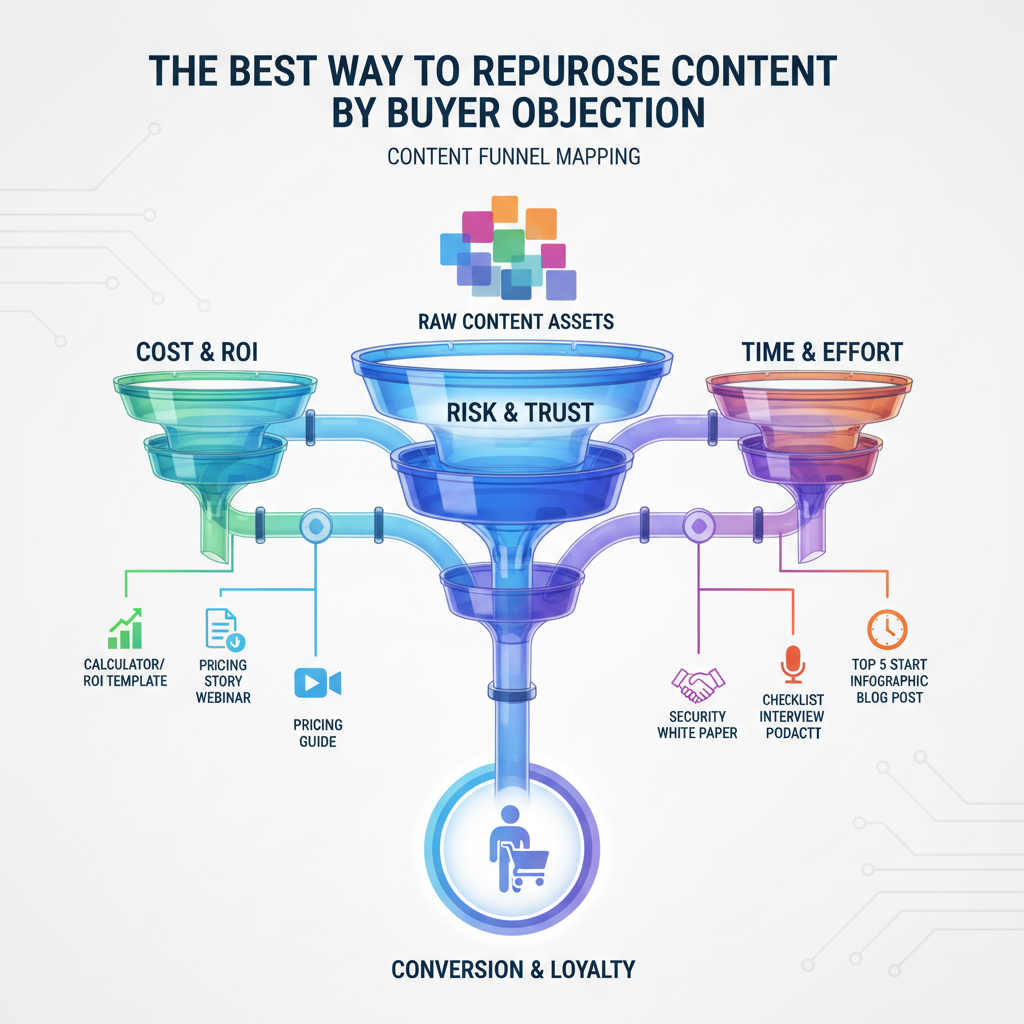
Diagram showing awareness, consideration, and decision stages matched with specific content formats
What content types work best for each objection category?
Matching the right format to the specific concern ensures your message lands effectively.
Price concerns: Interactive tools work best here. Convert a webinar segment about ROI into a standalone calculator page. Cost-of-inaction analyses also help reframe the conversation around long-term value.
Trust hurdles: Buyers want proof from their peers. Extract short quotes from written case studies to build a social proof carousel. Compile short video testimonials and share third-party review data.
Fit questions: Prospects need to see themselves in your product. Segment a general product webinar by industry to create highly targeted nurture tracks. Feature comparison matrices and daily workflow stories show exact capabilities.
Authority roadblocks: Your champion needs tools to sell internally. Extract the executive summary from a dense whitepaper. Format it as a branded internal pitch deck or a stakeholder FAQ document.
How can you scale objection-based content distribution?
Creating the right assets only solves half the puzzle. Those answers must actually reach your buyers.
Build a multi-channel distribution strategy to get your content in front of the right eyes. Store assets in sales enablement libraries organized by specific objections. Trigger email nurture tracks based on prospect behavior.
Use automation platforms to handle the heavy lifting. Platforms like Repostra.app automatically resize content and publish across platforms while maintaining brand consistency. You simply create the anchor asset. The platform automates the derivatives and handles distribution.
Always adapt the presentation for the specific channel. Use visual carousels for complex pricing on LinkedIn. Share quick trust signals on X. Send longer-form objection handling through email.
What are the best practices for repurposing without losing message quality?
Excessive repurposing can easily dilute your core message. Follow a few strict guidelines to maintain quality.
Keep the core message architecture intact. Every new format must answer the same fundamental objection.
Match the format to the platform intent. Buyers on LinkedIn have a different mindset than those watching short-form video. Adjust your tone accordingly.
Always build an anchor asset first. Create a comprehensive guide or webinar. Then link all smaller repurposed pieces back to this main source.
Test and measure by objection type. Track which specific answers actually drive conversions.
Update your library regularly. Conduct quarterly reviews with the sales team to ensure your answers still match buyer reality. Avoid creating content just to fill a calendar. Every piece needs a conversion goal.

A marketer reviewing repurposed content assets on multiple digital screens
How do you measure success of objection-based content?
You must shift your focus from vanity metrics to conversion data.
Sales Impact: Measure the length of the sales cycle before and after deploying your new assets. Track the objection resolution rate directly in your CRM.
Engagement: Look at time on page for focused blog posts. Monitor video completion rates for your testimonials. Check download rates for business case templates.
Attribution: Use multi-touch attribution to see if these specific assets appear in winning conversion paths. B2B buying cycles take time. Direct attribution can be difficult.
Use clear UTM parameters and consistent content tagging to track the journey. Ask your sales team to report on which assets actually help them close deals.
Real-world example of turning a case study into multiple assets
Consider a software company holding a long customer success story. This single anchor asset covers implementation, results, and quotes. Here is how to split it to address multiple concerns.
Addressing Price: Build an ROI infographic showing a massive return on investment over twelve months. Draft a social post featuring a direct quote about cost savings.
Addressing Trust: Cut a short video testimonial from the original customer interview. Post a third-party validation update linking the case study to your recent software ratings.
Addressing Fit: Write an industry-specific blog post detailing the exact workflow solution. Design a one-pager comparing the before and after states.
Addressing Timing: Pull out an executive summary for stakeholders. Map the implementation timeline into a quick visual graphic.
Distribute these through behavioral email tracks and sales folders. The result multiplies your content reach while drastically cutting production time.
FAQ
How often should we update objection-based content?
Review objection-focused content quarterly with your sales team. Major updates should happen whenever your product changes or new competitors emerge. Minor updates to statistics and customer examples can be refreshed monthly to maintain relevance and search performance.
What if our sales team does not track objections consistently?
Start with a simple shared spreadsheet. Ask sales reps to log the top two objections from each call. You can incentivize participation by showing how this content shortens their sales cycles. You can also use conversation intelligence tools to automatically identify patterns in recorded calls.
Can small marketing teams realistically implement objection-based repurposing?
Absolutely. Start with your top three most common objections and one high-performing existing asset. Create a few derivatives per objection using built-in video editors and simple graphic design tools. Focus on quality over quantity. A few well-targeted assets will outperform dozens of generic posts.
How do we repurpose content by buyer objection without sounding repetitive?
Adapt the angle and format rather than repeating the exact same message. For a price objection, create an interactive calculator, a narrative case study excerpt, and a visual comparison infographic. Each format addresses the same core concern differently to reach various learning styles.
Should we address competitor objections directly in our content?
Yes, but do it strategically. Create comparison guides that objectively highlight differences rather than attacking competitors. Use neutral language and back your claims with data. Reserve named competitor comparisons for bottom-of-funnel assets accessed by serious buyers.