The Best Social Media Formats for Every Funnel Stage
Break down which content formats work best for awareness, consideration, and conversion across social platforms. Readers will learn how to match repurposed content to business goals instead of posting the same thing everywhere.

The Best Social Media Formats for Every Funnel Stage: A Strategic Repurposing Guide
TL;DR: Different funnel stages demand different social media formats. Short-form videos and infographics drive awareness. How-to guides and webinar clips build consideration. Case studies and product demos convert. The winning 2026 strategy is "Core-to-Satellite" repurposing: create one substantial asset, then adapt it to platform-specific formats that match where your audience is in their buying journey.
Key Takeaways:
- Short-form video drives awareness by answering "what" and "why" questions quickly
- Consideration-stage audiences need frameworks, carousels, and detailed guides that build authority
- Conversion requires social proof through case studies, testimonials, and direct product demos
- Platform-format alignment matters more than posting frequency
- Track click-through rates and share/save rates instead of vanity metrics
Imagine spending hours researching, writing, and designing the perfect marketing asset. You slice it into a sleek carousel and post it to LinkedIn, Instagram, and Facebook. Then, crickets.
The "spray and pray" method of content distribution is dead in 2026. You can't post the exact same format across every platform and expect your audience to care. Social platforms now function as search engines. Users display entirely different behaviors depending on where they are in the marketing funnel.
Want real engagement? You must match your formats to user intent. Awareness seekers scroll quickly and need punchy hooks. Consideration-ready buyers want deep, educational frameworks. People at the conversion stage demand hard proof before they buy.
Understanding this format-funnel alignment is exactly how users of Repostra.app save time and multiply their results. When you learn how to choose the right social media formats for funnel stages, you stop wasting energy on content that doesn't convert. Here's how to match your repurposed content to actual business goals.
Why do social media formats for funnel stages matter in 2026?
The shift from volume-based posting to intent-based distribution is the defining marketing change of the year. Social media platforms have evolved beyond simple networking feeds. They're where discovery happens.
Users in different funnel stages have completely different consumption habits. Someone casually searching for a solution needs a fast, engaging video hook. A buyer comparing software options needs a detailed breakdown of features and return on investment.
To meet these distinct needs without burning out, modern marketers use the "Core-to-Satellite" repurposing model. You create one massive, valuable asset. Then you spin it out into smaller, platform-native formats tailored to specific funnel stages. Algorithms actively reward these native formats over lazily recycled links.
People no longer want to click away from their native feed. If you want someone to read your blog post, you have to summarize the best points natively on the platform they're currently browsing. This requires formatting the content specifically for their current stage of awareness.
What are the best social media formats for awareness?
Awareness content sits at the very top of the funnel.
Goal: Reach new audiences, build visibility, and educate people on their problems. They're not ready for your solution yet.
Short-form video is the undisputed champion here. Platforms like Reels, TikTok, and YouTube Shorts thrive on 15 to 60-second clips. Infographics and data visualizations work beautifully for complex topics. You can also use thought leadership snippets, controversial takes, and myth-busting listicles.
Why these work: Low friction and high shareability. These formats rely on pattern-interrupt hooks to stop the scroll. They don't ask the user for a heavy time commitment.
Practical repurposing example: Take a 10-minute YouTube video. Cut it into three 30-second hooks that each answer one "What" or "Why" question.
"The solution isn't creating more content. It is repurposing what already works. Content repurposing transforms existing material into new formats optimized for different channels and audiences, guiding them naturally from awareness to consideration."
Ann Handley, Chief Content Officer at MarketingProfs, 2025.
Platform-specific guidance:
- TikTok and Instagram reward raw, unpolished, personality-driven videos
- LinkedIn favors professional context backed by industry statistics
- YouTube Shorts demand educational value with clear on-screen text for silent watching
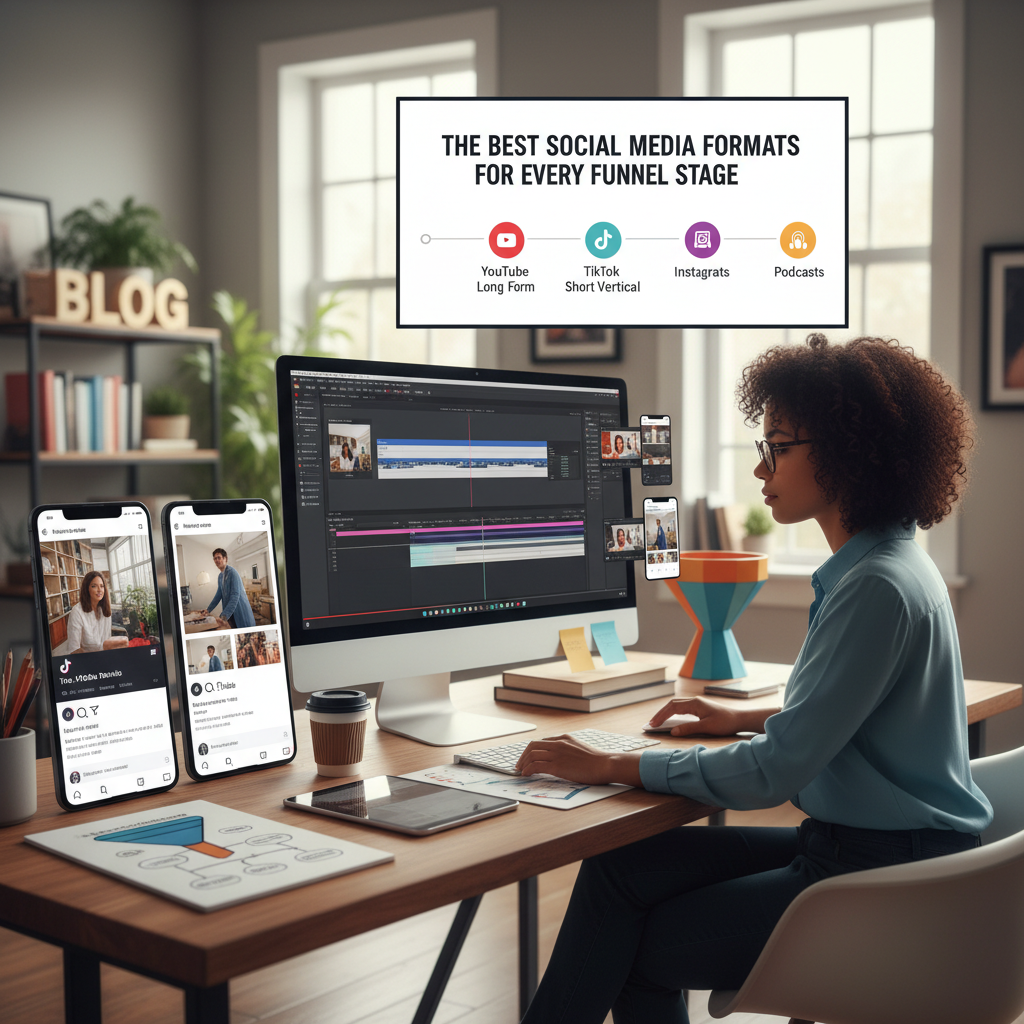
Content creator editing short-form video on a smartphone for awareness stage marketing
Your awareness content must cast a wide net. It should focus entirely on the problem your audience faces. Don't mention your product. Don't ask for a sale. Just provide a quick, valuable insight that makes the viewer want to learn more.
Which content formats drive consideration?
Once you capture attention, you need to build trust. This is the middle of the funnel.
Goal: Demonstrate expertise and help your audience compare solutions.
Step-by-step how-to guides and frameworks dominate this stage. You should lean into 3-to-8-minute webinar snippets and behind-the-scenes demos. Gated resources like templates, checklists, and white papers offer deep value. Email newsletter deep-dives and educational carousels also shine here.
Why these work: They position your brand as the credible expert who understands the exact process the buyer is struggling with. This content proves you have a reliable methodology.
Practical repurposing example: Turn a 2,000-word blog post into a 10-slide carousel. Walk the user through a framework step-by-step.
According to Hootsuite's Social Media Trends Report 2024, carousel posts on Instagram generate significantly higher engagement rates than single-image posts, with users spending more time interacting with multi-slide content.
Platform-specific guidance:
- LinkedIn thrives on long-form posts of 1,300+ words and document uploads
- Instagram audiences expect educational carousels with swipe-through value
- YouTube favors 8-to-15-minute "workshop-style" videos
Consideration content asks for a slightly larger time investment from the user. Because you already earned their attention at the awareness stage, they're now willing to read a longer post or watch a medium-length video. You're bridging the gap between their problem and your potential solution.
What social media formats convert best?
When your audience is ready to buy, your content needs to remove final objections. This is the bottom of the funnel.
Goal: Drive demos, sign-ups, and purchases by providing undeniable social proof.
Case studies with specific metrics are highly effective. Show a specific percentage increase or exact dollars saved. Customer success stories and video testimonials provide the necessary human element. Direct product demos of 2 to 5 minutes show the actual solution in action. FAQ Reels that address common objections head-on also work exceptionally well. "Before and after" transformation posts remain a classic conversion tool.
Why these work: Social proof removes purchase anxiety. Specificity builds confidence. Buyers need to see that your solution worked for someone exactly like them.
Practical repurposing example: Take one long-form client testimonial. Turn it into a visual quote card for Instagram. Cut a 60-second video testimonial for TikTok. Write a full case study breakdown for a LinkedIn article.
Platform-specific guidance:
- LinkedIn handles full case studies and ROI-focused posts perfectly
- Instagram and TikTok are ideal for "day in the life" customer stories and FAQ Reels
- YouTube serves as the home for complete product walkthroughs with chapter timestamps
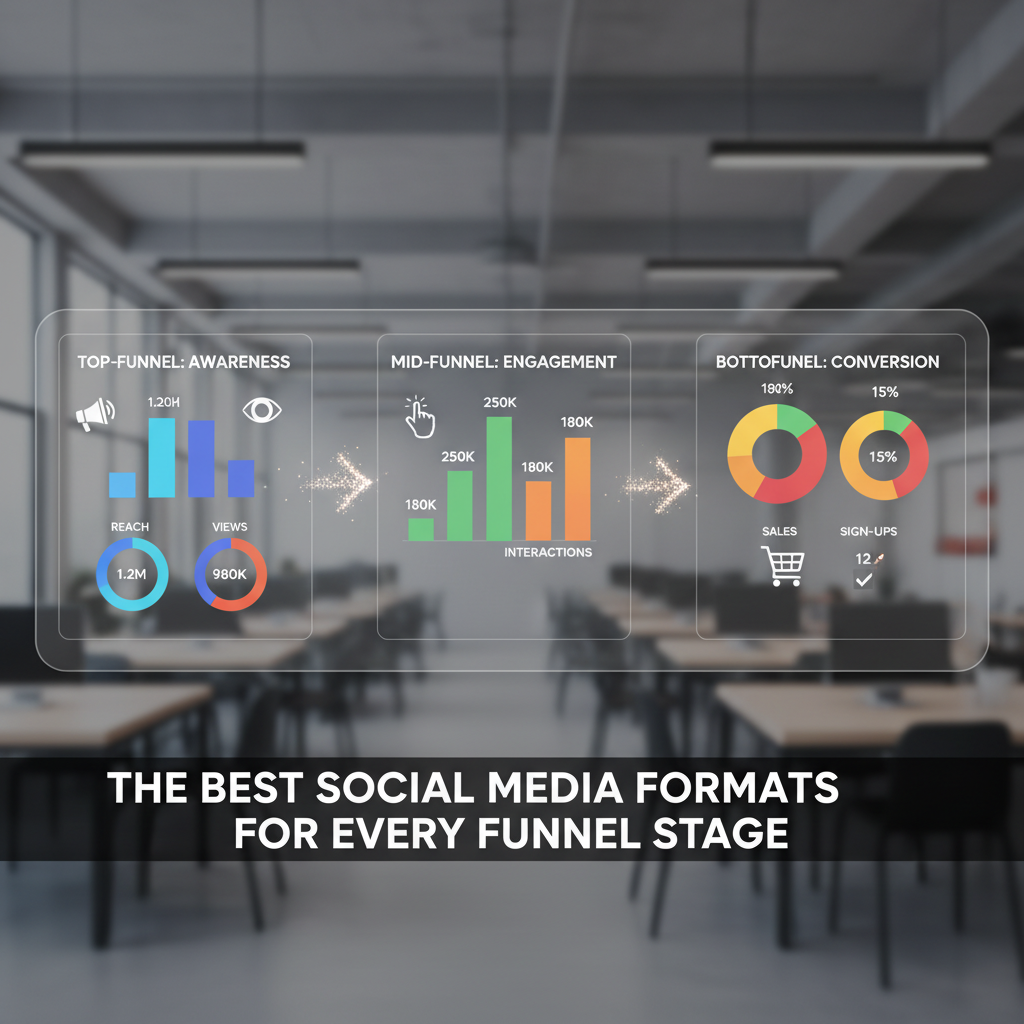
Analytics dashboard tracking social media content from awareness to conversion
Conversion content must have a clear, direct call to action. You can't be subtle here. Tell the user exactly what to click, what form to fill out, and what will happen next.
How should you match formats to platform strengths?
The golden rule of repurposing is that native formats always win over generic reposts.
Platform algorithms and user expectations dictate what formats perform best. You have to adapt your core message to fit the environment.
This platform prioritizes professional authority. White papers, long-form text posts, and carousel documents excel here. This is prime territory for consideration and conversion content. Users on LinkedIn expect actionable career or business advice.
TikTok and Instagram
Users want raw authenticity. Short video is the standard. This is best for awareness, though increasingly effective for consideration. Don't overproduce these videos. A smartphone camera and good lighting are all you need.
YouTube
This is the home of long-form educational and evergreen SEO content. It covers all funnel stages. YouTube operates as the world's second-largest search engine. Content here has a shelf life of years, not hours.
This platform shines for community-building and private group discussions at the consideration stage. Long-form written posts paired with native video perform best in these community spaces.
Twitter or X
This environment is built for real-time commentary. Threads are excellent for driving top-of-funnel awareness.
SEO is entirely social in 2026. Optimize your captions and on-screen text with natural keywords. Don't just use walls of hashtags. Search engines crawl the actual text on your video and the words spoken in your audio.
Try the "Reverse-Engineering Strategy." Create your highest-value conversion content first. Build a comprehensive guide or a detailed case study. Work backward to create awareness hooks that funnel people into that core asset. Use each platform's native format to distribute those hooks.
The Core-to-Satellite Repurposing Strategy
Knowing what formats work is only helpful if you have a reliable system to produce them. The Core-to-Satellite workflow makes this achievable for small teams.
Step 1: Create one substantial "core asset." This could be a white paper, a pillar blog post, a 20-minute video, or a comprehensive guide. Spend 80% of your creative energy here.
Step 2: Map the sections. Determine which funnel stage each section of your core asset addresses. The introduction might be great for awareness. The methodology is perfect for consideration. The results section fits conversion.
Step 3: Extract "satellite" content.
- For awareness, pull 3 to 5 quick tips, myths, or statistics for short-form video
- For consideration, create a framework carousel or how-to guide based on the methodology
- For conversion, highlight case study data or cut video testimonials
Step 4: Adapt each satellite piece to its platform's native format. Change the aspect ratios. Adjust the tone. Rewrite the hooks to fit the platform culture.
Step 5: Cross-link strategically. Ensure your awareness content points to your consideration assets. Ensure your consideration assets point to your conversion landing pages.
Let's look at a real example workflow. If your core asset is a 15-minute YouTube video on "How to Build a Content Calendar," you can extract massive value. Your satellite awareness content becomes three 30-second TikToks answering basic questions like "Why do you need a calendar?" Your satellite consideration content becomes a 10-slide LinkedIn carousel detailing the framework. Your conversion content becomes an Instagram Reel showing the actual template with a call-to-action to download it.
Tools like Repostra.app streamline this multi-format adaptation process. It helps you tweak text lengths, adjust video dimensions, and schedule native formats without opening ten different browser tabs.
How should you measure success across funnel stages?
You can't judge top-of-funnel content by bottom-of-funnel metrics. Stop tracking vanity metrics like likes. They rarely correlate to actual business results.
Awareness metrics
Focus on reach and impressions to see how many new people saw the content. Track the share rate to know if people are passing it along to peers. Monitor the save rate to see if the information was valuable enough to reference later. High shares and saves signal that your content resonates.
Consideration metrics
Look at the engagement rate, specifically meaningful interactions and comments. Track profile visits and new followers. Measure the time spent on content. Look at average watch time on videos or read time on articles. You want to see if people are actually consuming the depth of your information.
Conversion metrics
This is where the money is made. Track your click-through rate (CTR) to landing pages. Measure direct link clicks and email sign-ups. Pay close attention to direct messages and inbound demo requests.
Use native insights like Instagram Insights, LinkedIn Analytics, and TikTok Analytics to measure platform-specific goals. Combine this with Google Analytics to track website traffic sources. Repostra.app also offers centralized tracking to see how your cross-platform performance stacks up against your funnel goals.
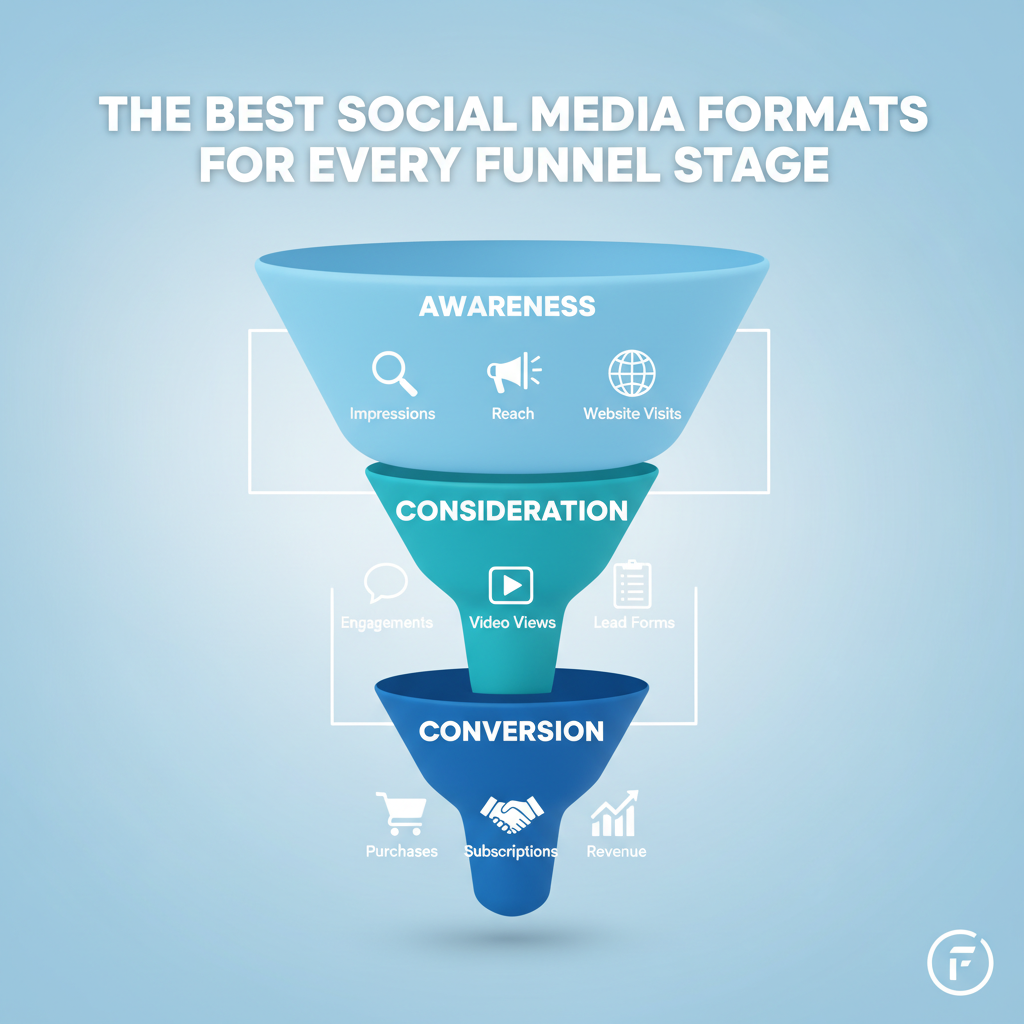
Marketing funnel diagram showing metrics to track at each stage
What are common mistakes when matching formats to funnel stages?
Even experienced marketers stumble when aligning formats with funnel stages. Watch out for these frequent errors to protect your content return on investment.
Mistake 1: Posting conversion content to cold audiences. A direct pitch to someone who doesn't know your brand will fail. You must warm them up with awareness content first. Build the relationship before asking for the sale.
Mistake 2: Using the same call-to-action for every stage. Awareness content needs a soft "learn more" or "follow for tips." Conversion content needs a firm "book a demo" or "buy now." Match the ask to the relationship level.
Mistake 3: Ignoring platform-native formats. Uploading a horizontally formatted video to a vertical-first platform like TikTok ruins the user experience. The algorithm will bury it immediately.
Mistake 4: Not tracking the right metrics per stage. Judging a top-of-funnel awareness video by its direct conversion rate will make you think a successful post failed. Measure the right goals at the right times.
Mistake 5: Creating awareness content that doesn't lead anywhere. Every piece of awareness content must have a logical next step. Guide the user deeper into your funnel with clear directions on where to go next.
FAQ: Social Media Format and Funnel Strategy
Should I post the same content to every social media platform?
No. Each platform has different user behaviors and native format preferences. A LinkedIn carousel that performs well won't work as-is on TikTok. Instead, adapt your core message to each platform's format. Turn that carousel into a 60-second TikTok explaining the same concept verbally with on-screen text. Platform-native content consistently outperforms cross-posts.
How many pieces of content can I create from one core asset?
Typically 8 to 15 pieces. For example, one 15-minute YouTube video can become 3 to 5 short-form clips, 1 or 2 LinkedIn carousels, 2 to 3 quote cards, a blog post, and an email newsletter. The key is ensuring each piece serves a specific funnel stage and platform audience.
Which funnel stage should I focus on first?
Start with your conversion content. Create your case studies, product demos, and high-value resources first. Then work backward to create awareness content that drives people toward those conversion assets. This reverse-engineering ensures every piece of content has a strategic destination.
Do I need different content formats for B2B versus B2C?
The funnel stages remain the same, but platform emphasis shifts. B2B typically leans heavier on LinkedIn for consideration and conversion. B2C can move faster through TikTok and Instagram. B2B still needs personality and authenticity. The professional tone just looks different than it does for consumer brands.
How long should content be for each funnel stage?
Awareness content should be 15 to 60 seconds to hook attention. Consideration content needs 3 to 10 minutes to educate and demonstrate authority. Conversion content should be 2 to 8 minutes for case studies and demos. Quality and value matter more than arbitrary time limits. Keep going until you successfully remove their objections.
Your Next Steps for Strategic Social Media Repurposing
Social media formats must match funnel stages. Short video works for awareness. Deep frameworks serve consideration. Hard proof drives conversion. Platform-format alignment beats raw posting frequency every single time. By utilizing the Core-to-Satellite model, you maximize your content return on investment.
Start by auditing your current content. Identify what funnel stage each piece serves. Find one strong core asset you already have. Map out 5 to 10 satellite pieces across different formats and stages.
Use Repostra.app to streamline this multi-format adaptation process across all your platforms. Measure your success by stage-appropriate metrics, not vanity numbers.
The brands winning on social in 2026 aren't posting more. They're posting smarter by matching social media formats to funnel stages and business goals. Start repurposing strategically today with Repostra.app's format-optimization tools.