Stop Letting Great Content Die After One Publish Date
This post explores how businesses can turn a single strong piece of content into an ongoing social media marketing asset through thoughtful repurposing. It will show how to balance AI automation with human oversight to extend reach, save time, and keep...
Strategic Content Repurposing: Turn One Blog Post Into 20 Platform-Native Pieces
Most businesses waste high-quality content by publishing it once and moving on. Strategic content repurposing transforms one strong piece into multiple platform-native formats, saving 60 to 80% of production time while dramatically extending your reach. The secret in 2026 is balancing AI automation for efficiency with human oversight for brand quality. This approach turns individual content pieces into compounding marketing assets that continue delivering results for months.
Key Takeaways:
- Strategic repurposing saves up to 80% of content production time compared to creating everything from scratch.
- AI handles efficiency while humans ensure quality and emotional resonance through a human-in-the-loop workflow.
- The pillar content approach transforms one strong piece into 15 to 20 native variations across different platforms.
- Context matters more than volume. Transform formatting for each platform instead of copying and pasting.
You spent eight hours researching, writing, and polishing that blog post. It got decent engagement on launch day. Then you hear crickets.
By day three, it's buried in the feed. You find yourself starting from scratch on next week's content.
This cycle drains resources and kills momentum. Content repurposing isn't just a time saver. It's the difference between content that exhausts your team and content that compounds your results. The create, publish, and forget trap costs businesses both time and their competitive advantage.
According to a 2026 report by the Content Marketing Institute, only 35% of marketers actively repurpose content across channels. This leaves 65% of businesses stuck in an endless cycle of manual creation. This article outlines a strategic framework for making your existing content work harder.
Why Does Content Die So Quickly After Publishing?
Content disappears fast because of platform algorithms, audience fragmentation, and the sheer volume of competing posts.
Social feeds prioritize recency. Most content has a lifespan of just 24 to 48 hours on major platforms. Organic reach continues to decline. According to Social Media Examiner, average organic reach for brand pages on Facebook hovers around 5.2% as of 2024, and the trend continues downward into 2026.
The average user follows hundreds of accounts across platforms. Your perfect post competes with thousands of others in any given hour.
Small marketing teams cannot sustain a relentless creation cycle without burning out. This attention economy makes single publish dates highly inefficient.
"Content doesn't fail because it lacks quality. It fails because it lacks distribution. A single publish date is a broken distribution model."
Ross Simmonds, CEO of Foundation Marketing
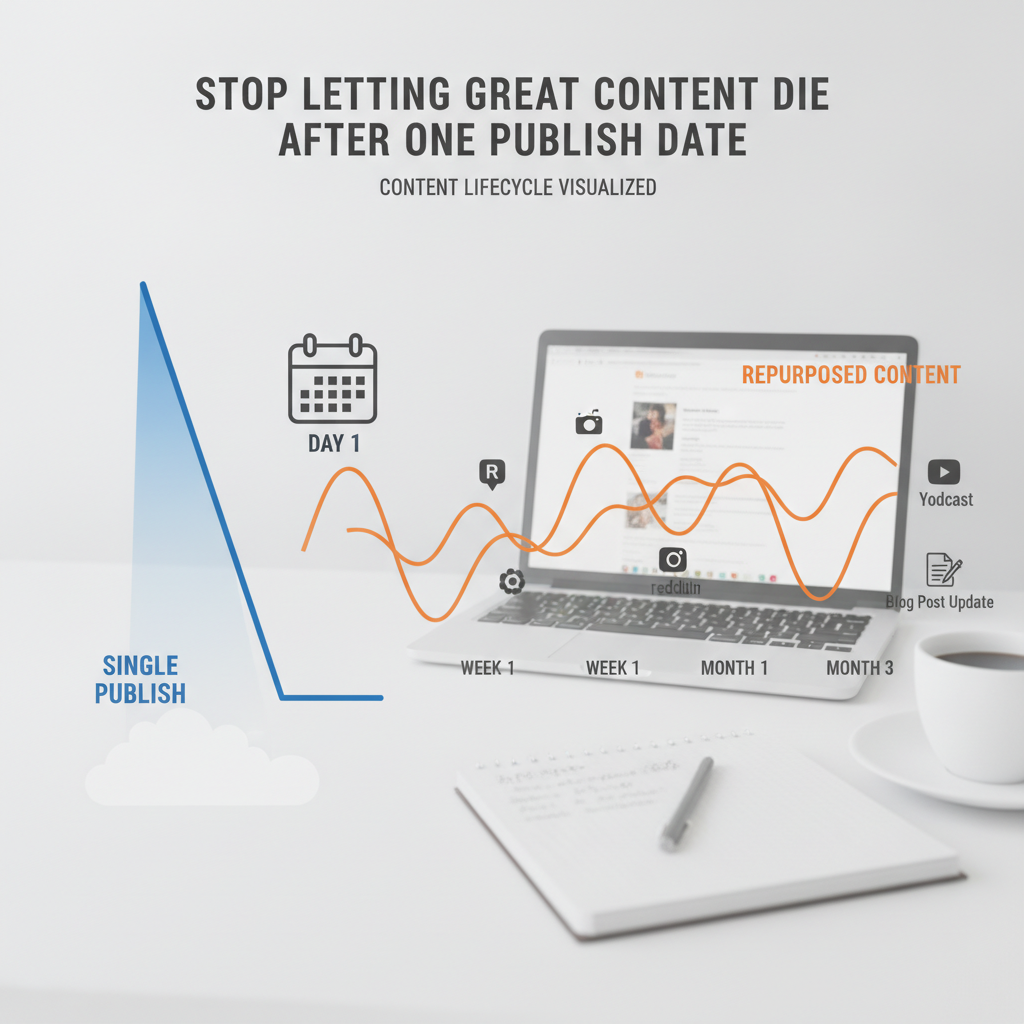
Graph comparing single publish lifespan versus repurposed content lifespan
What Is Strategic Content Repurposing?
Strategic content repurposing means transforming one core message into multiple platform-native formats that feel original to each channel.
Content repurposing adapts existing material into new formats optimized for different audience behaviors. Cross-posting identical content is lazy automation that audiences ignore. Changing just the headline still feels stale. A lack of strategy results in random, disconnected posts that fail to build momentum.
The Pillar and Cluster model: Start by identifying a few pillar pieces. These are evergreen, high-performing assets like guides or research reports. Extract 15 to 20 cluster pieces from each pillar. You're building a content ecosystem rather than just filling a calendar.
Context is king: Each platform features different user intent.
LinkedIn users seek professional learning. Instagram users want visual inspiration. Twitter users look for quick insights. What works as a long article will fail as an Instagram caption.
Platform-native formatting generates significantly more engagement than duplicated cross-platform posts. According to HubSpot's research, content adapted for each platform's unique format performs substantially better than identical content posted everywhere.
How Can AI Speed Up Content Repurposing Without Killing Quality?
AI excels at generating variations and analyzing performance data, but human oversight ensures brand voice, emotional resonance, and strategic alignment.
The solution is a human-in-the-loop workflow. AI handles the efficiency layer. It can generate 10 social posts from one blog in minutes. It converts long formats into scripts, summaries, or bullet points. It also analyzes past performance to identify which content deserves repurposing.
Time savings reality: According to G2's Marketing Automation research, effective repurposing with AI assistance saves 60 to 80% of production time compared to starting from scratch.
The human advantage covers the quality layer. Humans must verify brand voice. AI drafts might be grammatically perfect but tonally off.
Humans provide the emotional intelligence to know when content needs empathy, humor, or urgency. They also handle strategic selection and high-stakes messaging for sensitive announcements.
| Tier | Content Type | AI Role | Human Role | Volume |
| Tier 1 | Standard updates, evergreen tips | Drafts and schedules | Quick 2-minute review | 60-70% |
| Tier 2 | Thought leadership, campaigns | Provides structure and data | Rewrites for brand voice | 25-30% |
| Tier 3 | Crisis communication, major news | Formatting and distribution | Leads creation and strategy | 5-10% |
Avoiding automation complacency: Set mandatory human review checkpoints. Rotate reviewers to keep eyes fresh. Use AI as an assistant rather than a full replacement.
What Is the Step-by-Step Process for Repurposing One Piece of Content?
Effective repurposing follows a clear process from auditing your best content to adding platform-native context and measuring results.
Step 1: Audit your content. Review analytics from the past six to 12 months. Look for high traffic and strong engagement on evergreen topics. Select a few pillar pieces to start.
Step 2: Map platform opportunities. Determine where your audience spends time and what formats suit each platform. LinkedIn favors carousels and text posts. Twitter rewards structured threads. TikTok requires short educational clips.
Step 3: Extract core elements. Pull specific assets from your blog post. Grab three to five key statistics, a few quotable insights, and your main thesis. Add two practical tips and a surprising finding.
Step 4: Transform for context. Don't just shrink the content. Reimagine it.
A blog section about AI risks becomes a LinkedIn post asking an open question. That same section becomes a Twitter thread listing three specific mistakes.
Step 5: Add platform-native elements. LinkedIn needs professional framing and industry context. Twitter requires numbered lists and a conversational tone. Instagram relies on strong visual hierarchy and emoji for scanning.
Step 6: Schedule with strategy. Spread variations over three to four weeks. Don't post everything at once. Place different formats on different platforms on different days.
Step 7: Measure and refine. Track which formats perform best. Double down on your winners and retire the underperformers. Feed these learnings back into your next pillar content selection.
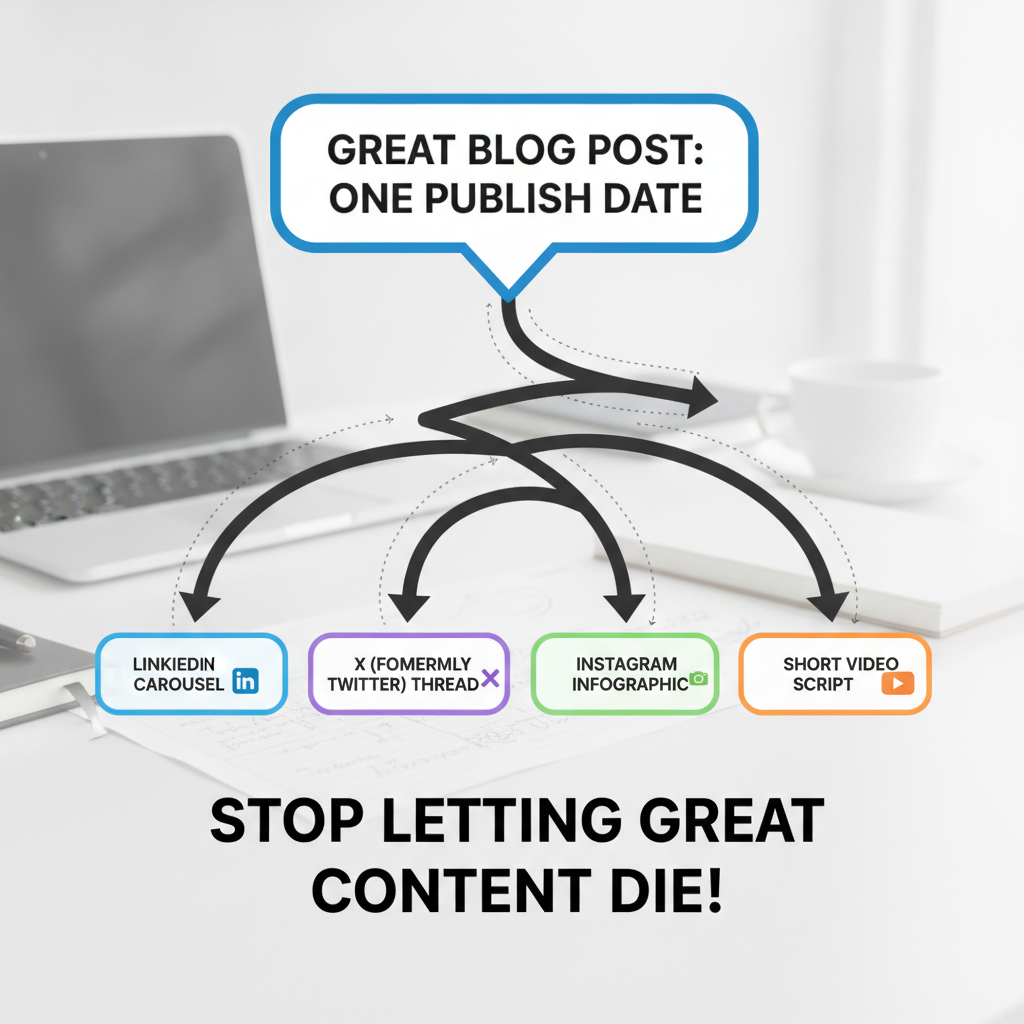
Content repurposing step-by-step flowchart
How Do You Maintain Quality When Producing More Content?
Quality at scale requires brand voice guidelines, mandatory human review checkpoints, and performance-based feedback loops.
A common fear is that producing 20 posts from one article will hurt quality. More content doesn't equal lower quality if you have the right systems in place.
Safeguard 1: Document your brand voice. Create a simple guide covering tone, forbidden phrases, and style preferences. Give AI tools specific examples of what sounds like your brand. Update this quarterly based on performance.
Safeguard 2: Apply the two-minute rule. Every AI-generated piece gets a human read. Ask if you would be proud to put your name on it. If you can't improve the draft in two minutes of editing, the piece needs a complete rework.
Safeguard 3: Build performance feedback loops. Review metrics like engagement rate and click-through weekly. Identify patterns. Adjust your prompts and templates based on real data.
Safeguard 4: Embrace strategic repetition. Counter the fear of posting too much. Your audience doesn't see everything you post. Algorithm filters and platform choices mean most followers see less than 20% of your content. Different formats feel fresh even with the same core message.
Ten high-quality posts beat 50 generic robotic posts every time. Better engagement leads to better algorithmic reach.
How Repostra.app Helps You Repurpose Smarter Not Harder
Executing a repurposing strategy manually can add hours to your week. A dedicated tool streamlines the process while keeping humans in control.
Built for the human-in-the-loop model: Repostra.app uses AI to generate smart variations from your pillar content. You review and approve everything with brand voice controls. You can schedule across platforms from one unified dashboard. This maintains quality while reclaiming 60 to 80% of your production time.
Content transformation engine: Upload one piece of content to get platform-optimized variations. The tool maintains context instead of just copying and pasting text. It even learns your brand voice over time.
Strategic scheduling: Spread content across optimal windows. Avoid audience fatigue with smart spacing. The cross-platform calendar view keeps your strategy organized.
Performance insights: Track which formats and platforms drive results. Identify your best pillar content for future campaigns.
Your content becomes a compounding asset. You spend less time creating and more time strategizing. Quality stays high and stress stays low.
FAQ
Won't my audience get annoyed seeing the same content multiple times?
No, because you're not showing them the exact same content. Most followers see less than 20% of what you post due to algorithm filters and timing. Someone who missed your blog might catch your LinkedIn carousel. Strategic repurposing meets your audience in their preferred format instead of spamming the same message everywhere.
How many pieces of content can I realistically get from one blog post?
One strong pillar piece can generate 15 to 25 social posts across platforms. A 2,000-word article could yield five LinkedIn posts, eight tweets, four Instagram graphics, and three short video scripts. The secret is extracting different angles, statistics, and quotes rather than chopping the same message into random pieces.
How long should I wait between posting repurposed variations?
Space repurposed content across three to four weeks. You can post the same core message on LinkedIn and Instagram in the same week because audiences rarely overlap completely. Wait seven to 10 days before revisiting the same topic on the exact same platform. Evergreen content can be repurposed again after three to six months.
What types of content work best for repurposing?
Evergreen educational content, data-driven research, how-to guides, and thought leadership pieces repurpose best. They stay relevant for months or even years. Avoid heavily repurposing time-sensitive news or trending topics. Content that answers fundamental questions in your industry gives you the most mileage.
Do I need different content for B2B versus B2C repurposing?
The core principles remain the same, but the platform focus shifts. B2B repurposing leans heavily into LinkedIn carousels, detailed Twitter threads, and professional newsletters. B2C repurposing prioritizes visual transformations like Instagram Reels, TikTok clips, and Pinterest graphics. The context and formatting must match the specific audience expectations for each sector.