Repurpose Like a Pro: Turning Blogs into Engaging Videos
A step-by-step guide to transforming written content into compelling video formats for diverse platforms.

Turn Your Blog Posts Into Videos That Actually Get Watched
Picture this scenario. You're staring at a massive archive of fifty blog posts. Your social media feeds are demanding fresh material. You feel the familiar creep of burnout approaching. You know you need to post something today, but the thought of filming an entirely new concept from scratch makes you want to close your laptop and walk away.
This is the content treadmill. It demands constant fresh material, and it rarely slows down.
Video is no longer a fun optional extra. Research from Cisco shows that video accounts for 82% of all internet traffic. If you're not producing video, you're missing out on the vast majority of your potential audience.
The solution isn't forcing yourself to create more from scratch. The real secret is to repurpose smarter. When you turn blogs into videos, you unlock a completely new lifecycle for the hard work you've already done. You take proven, high-quality ideas and give them a fresh visual format. This strategic approach keeps your social channels thriving while protecting your time and energy.
In this guide, we'll explore exactly how to transform your written content into compelling videos. We'll walk through the strategy, the ecosystem, and the step-by-step process to maximize your reach effortlessly.

Content creator transforming blog posts into videos
Why Repurpose Blog Content into Videos?
The Business Case for Video Repurposing
Video captures attention faster than any other medium. It stops the scroll. When you translate your written words into a visual format, your social media reach naturally increases. People are simply more likely to engage with moving images and sound than a static wall of text.
Consider the difference in how we remember information. According to research by Insivia, viewers retain 95% of a message when they watch it in a video, compared to just 10% when reading text. If your goal is to educate your audience and leave a lasting impression, video is the vehicle to get you there.
The benefits extend directly to your website performance as well. Adding video to your blog posts reduces bounce rates. Visitors stay longer to watch the content, signaling to search engines that your page provides value. This improved dwell time directly boosts your search rankings.
Efficiency is another major factor. Marketers who actively repurpose content report a 40% increase in their output without a proportional increase in the time spent creating. It's the ultimate productivity hack. Data from HubSpot and Wyzowl consistently shows that marketers using video report significantly better returns on their investment compared to those who stick to text alone.
What Makes the Current Landscape Different
Content saturation is at an all-time high. Everyone is publishing, and the noise is deafening. The old model of "one and done" publishing simply doesn't work anymore. You can't write a brilliant article, post it once to your company page, and expect it to drive traffic for months.
The shift is moving rapidly toward strategic content leverage. AI tools have democratized video creation. You no longer need a Hollywood budget or a dedicated editing team to produce professional content. The barrier to entry has vanished.
Platform diversity also requires a multi-format presence. Your audience is fractured across different apps, and each app favors native video content. Adapting your core message to fit these various platforms is the only way to maintain relevance.
Understanding the Modern Content Ecosystem
The Pillar Content Strategy
Smart creators rely on the pillar content strategy. Think of it as a hub and spoke model. You create one high-quality, comprehensive piece of pillar content. This is usually your long-form blog post. From that single pillar, you derive multiple smaller assets.
Your blog serves as the foundation. The derivative videos act as amplification tools. They go out into the social media wilderness, grab attention, and point back to your main site.
This approach creates a perfect balance between long-form and short-form content. Short videos are incredible for discovery. They put you in front of new eyes. Long-form written content excels at building trust and authority. Together, they form a complete marketing funnel.
Platform Specific Intelligence
The days of simple cross-posting are entirely over. You can't download a video and blast the exact same file across every single network. Each platform has its own native language and technical requirements.
Aspect ratios are the most obvious hurdle. A vertical 9:16 video is mandatory for TikTok and Reels. A horizontal 16:9 format works best for YouTube. A square 1:1 ratio still holds power in standard feed posts.
Beyond the shape of the video, you must customize your captions for the platform culture. What works on a professional network will fall flat on a fast-paced entertainment app.
You must also design for sound-off viewing. Most people scroll through their feeds in public places, offices, or living rooms with the volume muted. If your video relies entirely on spoken audio without on-screen text, your message is lost.
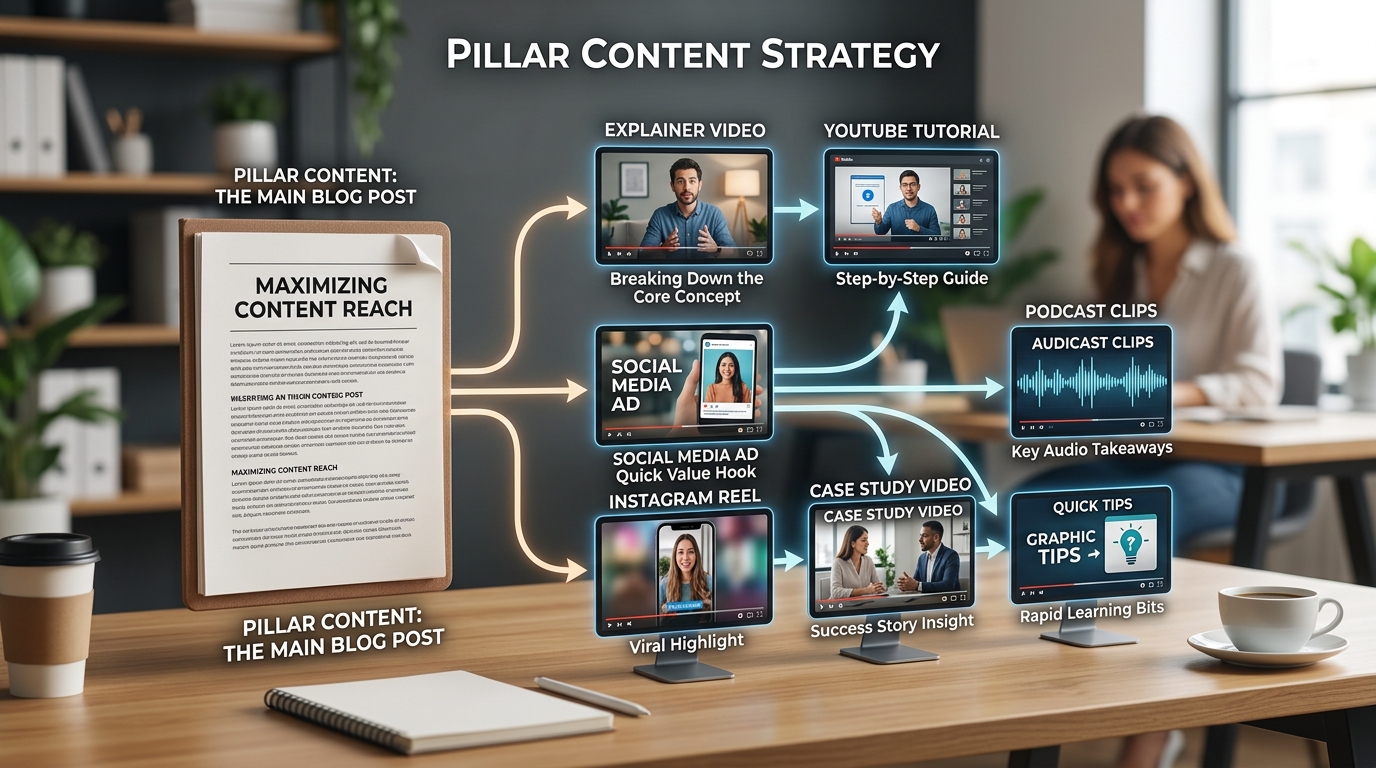
Pillar content strategy diagram
Step by Step Guide to Turning Blogs into Videos
Step One: Audit and Select Your Best Content
Not every blog post deserves to be a video. Your first task is to audit your existing library. Dive into Google Analytics to identify your highest-performing posts. Traffic is a clear indicator of audience interest. Look specifically at pages with high organic search traffic and long average time on page.
Focus on evergreen topics. A post about fundamental industry strategies is a goldmine. Avoid news updates, holiday-specific promotions, or time-sensitive announcements that have already expired. You want to build a library of videos that will remain relevant for months or even years.
Check your social insights. Look for the written topics that generated the most comments and shares. When an idea resonates in text, it usually explodes in video format.
Prioritize posts with clear visual potential. Educational and how-to guides translate beautifully into step-by-step videos. Abstract philosophical musings are much harder to storyboard. Start with the practical, actionable content first.
Step Two: Extract the Core Message
A two-thousand word article won't fit into a sixty-second video. You have to be ruthless.
Identify the hook. What's the most attention-grabbing sentence in your opening paragraph? That becomes the first three seconds of your video.
Distill your key arguments down to two to five main points. Highlight the most actionable takeaways. Video demands conciseness. You must cut the unnecessary fluff.
Consider how people consume information online. Research from the Nielsen Norman Group proves that people skim online content. They don't read every word. Treat your video script the same way. Deliver the highlights and leave the deep dive for the written article.
Step Three: Draft Your Video Script
Writing for video is entirely different from writing for print. You must write for the ear, not the eye. Complex sentences that look brilliant on paper often sound robotic when spoken aloud. Read your script out loud before you record. If you stumble over a sentence, rewrite it immediately. Keep the tone conversational, friendly, and natural.
Keep your scenes or visual slides short and punchy. Aim for ten to fifteen seconds maximum per visual idea. This pacing keeps the viewer actively engaged and prevents them from scrolling away.
Follow a strict structure. Start with a hook in the first three seconds. Deliver a value promise immediately after. Spend the bulk of the time on content delivery. Always end with a clear call to action.
Include natural pauses for visual transitions. Write your on-screen captions as you script the audio. Don't leave text overlays as an afterthought. They're a core part of the viewing experience.
Step Four: Visualize Your Content
You don't need a professional camera crew to visualize your words. High-quality stock footage from sources like Pexels, Unsplash, or Pixabay can set the perfect mood for your narrative.
If you're teaching a software process or a digital workflow, screen recordings are highly effective and cost nothing to produce. For abstract concepts that are hard to film, consider using AI-generated visuals to create engaging, dynamic backgrounds.
Use B-roll footage to maintain visual interest while you speak. Text overlays are essential for emphasizing your key points. Just ensure that all these visual elements align tightly with your brand aesthetic. Consistency builds recognition.

Visualizing written content into video format
Step Five: Brand and Optimize for Accessibility
Your video should look like it belongs to your company even if the logo is hidden. Apply your consistent brand colors and specific fonts.
Adding captions is absolutely critical. Up to 85% of social videos are watched with the sound off, according to research from Digiday and Verizon Media. If you skip captions, you're essentially throwing away the vast majority of your potential reach.
Optimize your thumbnail for each specific platform. Add end screens to guide viewers to their next destination. Include relevant hashtags in your caption planning. Finally, test the color contrast of your text overlays to ensure maximum readability on small mobile screens.
Step Six: Schedule and Distribute Strategically
Creating the video is only half the battle. Distribution determines your success. Use scheduling tools to maintain absolute consistency. Post at the optimal times for each specific platform.
Remember to create platform variations rather than just duplicating the exact same file. Monitor the performance closely and iterate based on what the data tells you.
This is where a dedicated platform becomes invaluable. A tool like Repostra.app simplifies this entire multi-platform management process. It takes the heavy lifting out of the distribution phase so you can focus entirely on strategy.
Tools and Workflows That Actually Work
The Modern Content Repurposing Stack
Building a sustainable workflow requires the right technology. The modern content repurposing stack relies heavily on AI-assisted tools. Platforms like Pictory and Animoto have paved the way for rapid video creation from text prompts.
These tools offer script generation support to help you condense long articles. They provide automated captioning technology that listens to your audio and perfectly syncs the text. They also integrate with scheduling and analytics platforms to form a complete ecosystem.
How Repostra Solves the Content Burnout Problem
Managing multiple social channels manually can easily feel like a grueling full-time job. Repostra.app was built specifically to solve this modern content burnout problem.
The primary benefit is absolute consolidation. You can manage your Instagram Reels, TikTok feed, and Twitter videos from one centralized hub. The platform focuses intensely on efficiency. It streamlines the entire workflow, taking you from a raw written idea directly to a polished, published social asset without the usual software friction.
A standout feature is the Samantha AI assistant. This built-in tool handles the tedious captioning, hashtag generation, and scheduling automation for you. It's perfectly designed for busy marketers and creators who know they need a robust video presence but lack the dedicated production resources to manage it all.
The core value proposition is simple. Leverage your existing content. Stop starting from scratch every single day.
Common Pitfalls to Avoid When Repurposing Content
Mistakes are common when transitioning between formats. The most frequent error is lazy cross-posting. Taking the exact same content and forcing it into the exact same format across every platform is not repurposing. It's spamming.
Ignoring platform culture is another fast track to poor performance. A highly technical, formal video that performs well on a professional networking site will completely flop on a short-form entertainment app. You must adapt your tone.
Forgetting accessibility is a major misstep. Publishing a video without captions means you're voluntarily losing 85% of your potential reach. It's an unforced error.
Many creators also over-complicate the production process. They obsess over perfect lighting and cinema-quality editing. Perfect is the enemy of done. A simple, well-lit video with a clear message will always outperform a highly polished video that never gets published.
Failing to track performance leaves you guessing. You must review the data to see what actually works. Repurpose the winners and kill the concepts that fall flat. Through all of this, make sure you never lose your brand voice. Maintain your core personality even when you adapt the format.
Measuring Success and What to Track
How do you know if your repurposing efforts are actually paying off? You need to look beyond basic vanity metrics.
Focus heavily on the engagement rate. Comments, shares, and saves are far more valuable than passive views. A save indicates that your content was so useful the viewer wanted to keep it. A share means they're willing to stake their own reputation on your message.
Watch time and completion rate are equally critical. Are people actually watching to the end, or do they drop off after three seconds? This metric tells you if your hook is working and if your pacing is correct.
Track your click-through rate. If the ultimate goal of the video is to drive traffic back to the original blog post or your website, you need to know if people are taking that action.
Don't forget to calculate your cost per content piece. Measure the time and resources you saved through repurposing compared to creating net-new videos. This highlights your true return on investment.
Finally, analyze your cross-platform performance. Which networks convert best for your specific brand? Set your benchmarks early and iterate constantly based on incoming data.

Tracking video performance metrics
From Content Treadmill to Content Leverage
Blogs are not just static posts collecting digital dust. They're absolute video goldmines waiting to be excavated. When you transform written words into visual stories, you break free from the exhausting demand of constant creation.
This entire process is about working smarter, not harder. You've already done the heavy lifting by researching and writing the original article. The future of digital marketing belongs to strategic repurposers who know how to maximize their assets.
Start small. Pick exactly one high-performing blog post this week. Extract the core message, draft a short script, and create your first video.
If you want to build a sustainable, long-term strategy, Repostra.app is the perfect partner to help you manage the workload. It removes the technical barriers so you can focus on connecting with your audience.
You already have everything you need sitting right there in your content archive. Now it's time to leverage it.