One Webinar, Weeks of Social Content: A Practical Repurposing Plan
This post will show businesses how to turn a single webinar into a steady stream of social media and marketing content without losing quality or brand consistency. It will cover a simple workflow that blends AI automation with human review to make cont...
How to Repurpose Webinars Into 30 Pieces of Content (Without Burning Out Your Team)
TL;DR: Webinar repurposing transforms one 60-minute session into 20-30 platform-native assets through a proven workflow: a 48-hour sprint for high-impact clips, followed by four weeks of strategic distribution. The approach blends automated transcription with human editing to maintain brand voice while extending content ROI by up to 7x.
Key Takeaways:
- High-performing teams generate 7x more on-demand views than live views through systematic repurposing
- One 60-minute session yields 20-30 pieces of platform-specific content over four weeks
- Automation handles transcription and drafting while human editors ensure brand accuracy
- Ship your highest-impact teaser assets within 48 hours to capture audience momentum
- Never copy-paste across channels because native formats dictate engagement success
What happens to your webinar after you hit stop?
Your team invests 15 hours planning, recording, and hosting a live event. You hit stop on the recording and feel accomplished. That high-value session then enters what we call the content graveyard. It becomes a static video file on a hidden landing page that few people ever revisit.
You need a content engine mindset instead. Treat that same recording as a renewable asset that fuels your marketing campaigns for weeks. Content teams get stuck on a hamster wheel of manual creation. They struggle with stagnant budgets and tight deadlines.
Webinar repurposing offers a clear path off that exhausting wheel. This guide details a practical workflow that blends software automation with human oversight. You'll learn how to maintain quality and brand consistency while multiplying your output.
Why does webinar repurposing matter now?
According to the 2026 B2B Marketing Performance Benchmark Report, high-performing marketing teams now generate roughly 7x more on-demand views than live views. They achieve this reach by systematically extracting value from recorded sessions.
The technology to do this at scale has finally arrived. The 2026 Marketing AI Adoption Study found that 43% of marketers already use generative tools for daily content creation.
The performance multiplier: Content extraction turns one high-effort asset into dozens of platform-native pieces. Research from the Content Marketing Institute confirms that systematic repurposing is the most reliable way to increase organic ROI.
Let's break down the exact math. A standard presentation might cost $2,000 to produce and generate 200 live attendees. Repurposing that session can easily reach thousands of additional people over the next month. You secure those extra impressions without proportional cost increases.
Building authority: Extracted content keeps your brand visible across every relevant channel. It builds trust at each stage of the buyer journey. You establish industry authority without brainstorming net-new ideas every single week.
What is the framework for webinar repurposing?
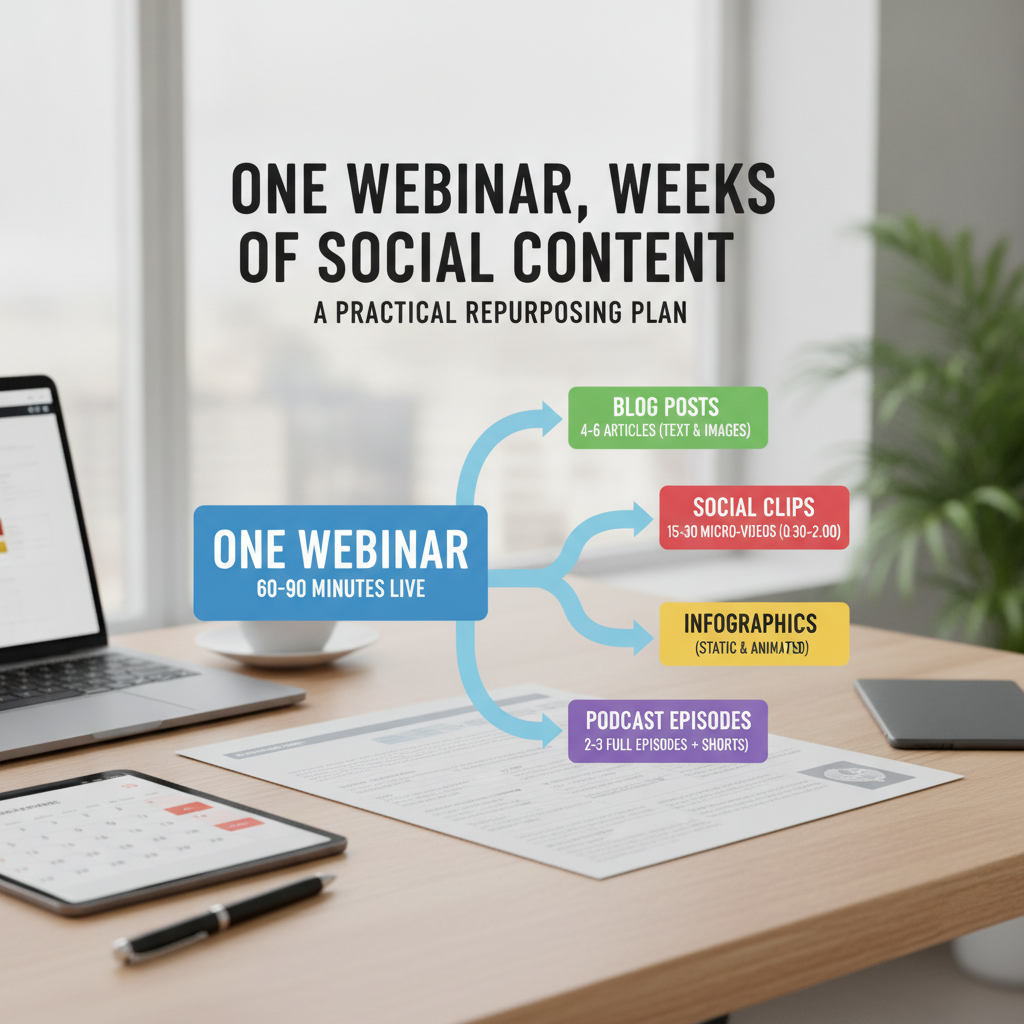
Content repurposing flowchart showing the one to twenty framework
The core of this strategy relies on a strict one-to-twenty ratio. One 60-minute recording provides enough raw material for 20-30 distinct content pieces published over a four-week period.
Macro source concept: Treat the original recording as your single source of truth. All derivative content must maintain consistent messaging with that core asset. This ensures your brand narrative never splinters across different channels.
You can realistically extract a massive inventory from a single hour of video. A standard breakdown includes:
- One long-form blog post of roughly 2,000 words
- Four short-form video clips lasting 60 seconds each
- One LinkedIn carousel utilizing 10 instructional slides
- Five graphic designs highlighting specific statistics
- One tall infographic summarizing the main framework
- One podcast episode utilizing the extracted audio file
- Fifteen written social media posts adapted for specific platforms
Every piece of extracted material serves a specific purpose in your marketing ecosystem.
How do you execute the post-webinar sprint?
Audience momentum fades incredibly fast after a live event concludes. You must ship your most important assets within 48 hours to capture that lingering attention.
Step one: Generate the replay link and a 90-second highlight reel. Create a compelling teaser that hooks people who missed the live session. Controversial takes, surprising statistics, and actionable frameworks make the best highlights. Tools like Descript, Opus Clip, or Repostra.app handle this clipping automation beautifully.
Step two: Publish speaker-led LinkedIn posts. Each presenter should share their most opinionated 60-second clip directly on their personal profile. They need to pair this video with a personal narrative hook. A good text structure starts with a bold claim about the specific industry topic discussed.
Step three: Send the targeted email follow-up. Distribute the full recording to all registrants with clearly timestamped chapter markers. This allows busy executives to jump directly to the sections they care about most.
Workflow tip: Assign ownership of these tasks days before the event happens. Team members must know their exact 48-hour deliverables before the cameras start rolling.
What does long-tail distribution look like?
Your initial sprint covers the first two days of promotion. The following four weeks require a structured distribution roadmap to maximize visibility.
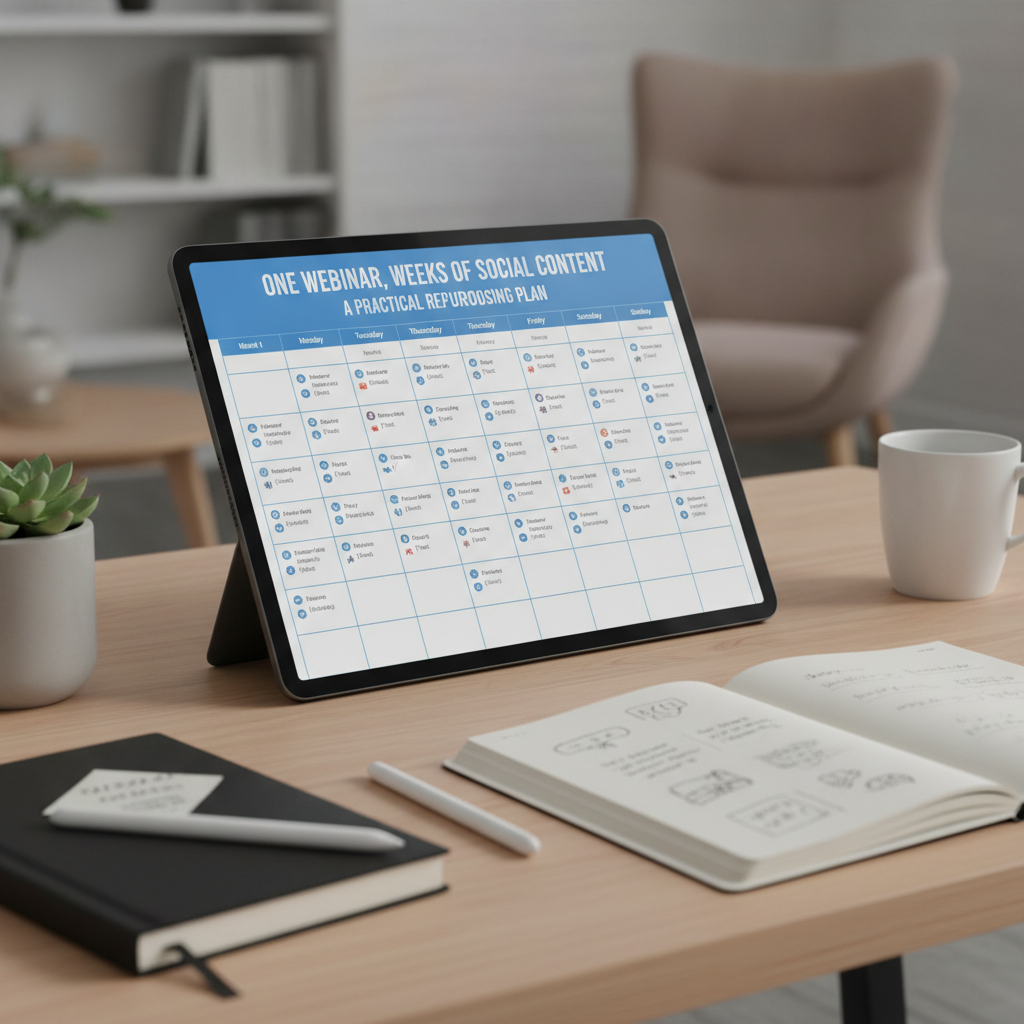
Four-week content calendar for repurposed digital assets
Week one focuses on text content. Transcribe the recording using automation tools like Otter.ai or Rev. A human editor then shapes that raw text into a polished, search-optimized blog post. You break the core arguments from that blog into several separate text threads for LinkedIn and X.
Week two shifts to visual content. Design several clean graphics highlighting key data points from the presentation. Create a comprehensive carousel summarizing the speaker's core framework. Build a detailed infographic tailored for Pinterest and other visual search platforms.
Week three prioritizes short-form video. Extract your most engaging vertical clips for TikTok, Instagram Reels, and YouTube Shorts. You must add dynamic captions and platform-specific visual hooks to hold attention.
Week four secures your evergreen assets. Clean up the audio extraction to release as a standalone podcast episode. Create a pillar page on your company website housing all the related media assets. Schedule automated evergreen social posts to drip out over the next six months.
How do you blend automation with human review?
Modern marketing teams need software to translate and multiply their existing expert insights. Generative tools handle transcription, snippet extraction, and initial draft generation. They write baseline captions and manage tedious format conversions instantly.
Human review remains absolutely non-negotiable in this workflow. Real people must review everything to ensure factual accuracy, emotional resonance, and context-appropriate messaging.
The 80-20 rule: Software handles 80% of the mechanical heavy lifting. Human editors contribute the final 20% of strategic polish that makes the writing feel authentic.
"AI gives us speed, but human editors give us soul. The combination is what transforms good content into content people actually want to share."
Robert Rose, Chief Strategy Advisor at the Content Marketing Institute
Process template:
- Software generates the initial rough draft from the transcript
- A human editor reviews the text for accuracy and brand voice
- A strategist adapts the structure for the intended platform
- A senior manager provides final approval before the piece gets scheduled
Why you cannot just copy and paste across platforms
The copy-and-paste syndrome destroys audience engagement completely. Identical text fails across different networks because each platform has its own distinct native language.
Platform native requirements:
- LinkedIn: Requires professional narratives, thought leadership, and longer character counts
- X: Demands punchy hooks, a continuous thread format, and strict brevity
- Instagram: Prefers visual-first storytelling, swipeable carousels, and a casual community tone
- TikTok: Needs high entertainment value, a massive hook in the first three seconds, and native trending audio
- YouTube: Rewards educational depth, longer viewing sessions, and highly optimized search titles
The adaptation formula: You keep the exact same core message while fundamentally changing the hook, structure, and creative format.
One core insight transforms dramatically depending on the destination. On LinkedIn, you might post a detailed breakdown of three strategy failures. On Instagram, you share a behind-the-scenes carousel featuring quote overlays from your speaker. On TikTok, you record a fast-paced story applying the lesson to a real-world scenario.
What mistakes should you avoid when repurposing?
Common mistake one: Treating the extraction process as an afterthought. You must build your distribution strategy into your event planning from day one.
Common mistake two: Skipping the human review phase entirely. Fully automated content lacks authenticity and frequently introduces embarrassing factual errors.
Common mistake three: Ignoring specific platform culture. Each network operates on unwritten rules regarding tone and formatting. Violating those rules kills your algorithmic reach completely.
Common mistake four: Focusing purely on publishing volume over actual quality. Twenty mediocre posts will never beat the business impact of ten truly excellent ones.
Common mistake five: Operating without a centralized calendar. Random, disorganized publishing wastes the compounding visibility effect that builds real audience trust.
Common mistake six: Forgetting your sales funnel completely. Different pieces must intentionally serve distinct funnel stages like brand awareness, product consideration, and final decision.
Practical safeguards: Establish strict brand voice guidelines to serve as software guardrails. Require platform-specific checklists for your junior team members. Schedule regular quality audits to review previously published materials.
How does this scale authority without burning out your team?
The digital marketing industry is facing a massive burnout epidemic. Content teams feel intense pressure to publish more frequently while operating with fewer resources.
According to the HubSpot State of Marketing Report 2026, content team burnout has reached record highs due to relentless manual creation demands. The extraction solution fixes this problem by pulling maximum value from existing expert material. You stop the exhausting cycle of creating net-new assets every morning.
The compounding effect: Each recording becomes a long-term asset that works for months to build cumulative authority.
Team efficiency gains: This systematic approach reduces content creation time by up to 70%. Senior strategists get freed up to focus on high-value work like campaign planning and audience research. Junior team members can easily manage the software-assisted extraction with minimal oversight.
Relying on a single source of truth guarantees your messaging stays perfectly aligned across all channels. Regular, high-quality publishing establishes your brand as the trusted voice in your niche. You extend your asset lifespan rather than forcing your staff to work harder.
How Repostra enables smarter repurposing
Marketing departments want to escape the tedious cycle of manual formatting and inconsistent output quality.
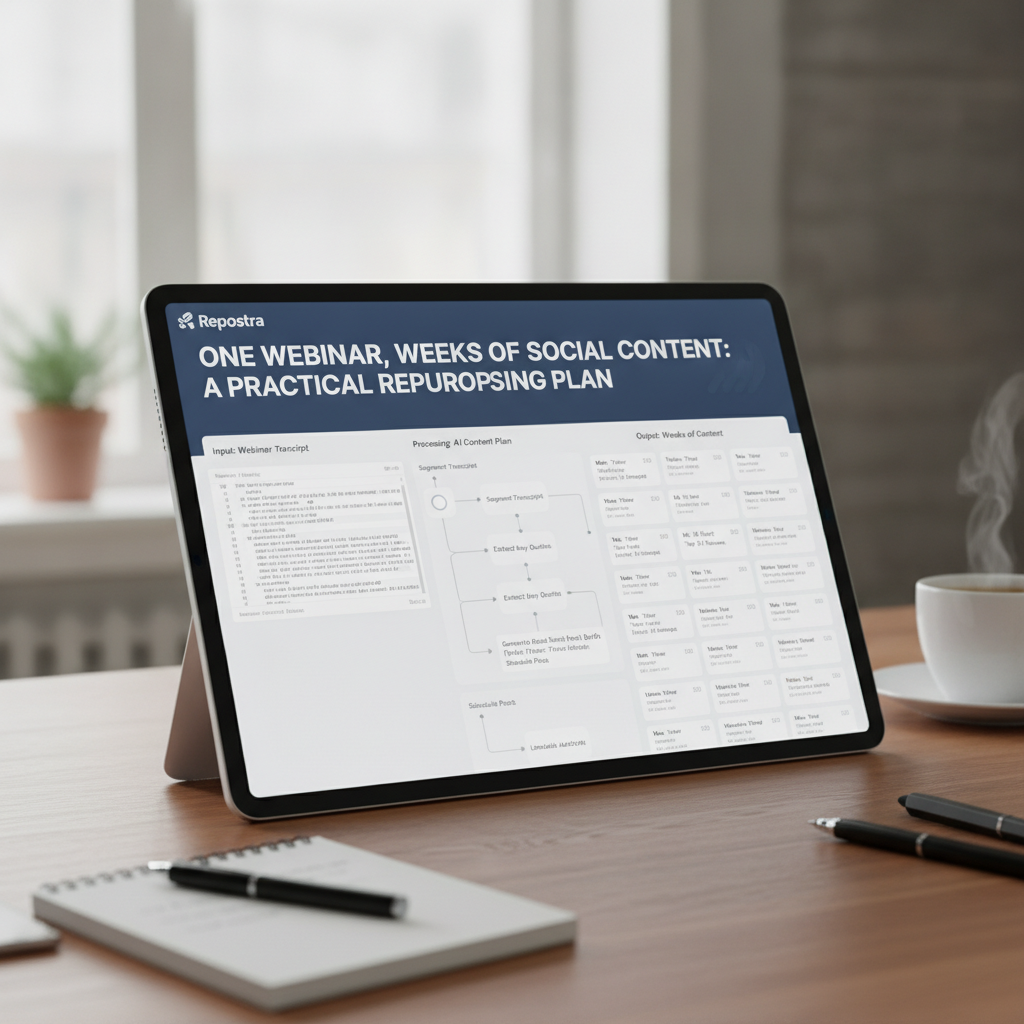
Repostra application dashboard automating video content into social posts
The Repostra advantage: Repostra.app provides automated transcript-to-content workflows paired with platform-native formatting templates. The software allows you to build strict brand voice guardrails directly into the generation process. It also includes comprehensive calendar integration and performance tracking across all your active channels.
Bottom line: Repostra helps you extend the lifespan of your most valuable expert insights. You maximize your return on high-effort productions and build a fully automated distribution engine. This allows you to maintain aggressive brand visibility without burning out your creative staff.
A business software company recently tested this exact workflow on a highly technical product demonstration. They turned that single hour of video into 28 distinct pieces of content over six weeks using Repostra. They generated 12,000 additional impressions and 47 qualified leads utilizing the exact same two-person marketing team.
FAQ
How long should you wait after a webinar before repurposing content?
You should ship your most high-impact teaser assets within the first 48 hours. The full extraction workflow then unfolds over the next four weeks. Don't wait for absolute perfection because early momentum matters significantly more. Evergreen scheduling can extend the lifespan of your material for six months or more.
Can you repurpose webinar content if the topic becomes outdated?
You must separate timeless frameworks from time-sensitive examples during the editing phase. Always update your statistics and case studies before republishing older material. Core business principles remain highly valuable even if specific software references change. Add a quick text disclaimer noting the piece has been updated for the current year to maintain credibility.
How much does automated repurposing actually cost?
Transcription services generally cost between $10 and $30 per hour of audio using platforms like Otter.ai or Rev. Generative software like Repostra.app ranges from $20 to $100 monthly. Professional design platforms cost roughly $15 to $50 monthly. Your total technology investment lands between $50 and $200 monthly, which drastically undercuts the cost of hiring additional staff.
What if the webinars lack professional production?
Substance matters significantly more than visual polish on modern social platforms. You should focus entirely on sharing valuable insights rather than worrying about perfect studio lighting. Transcripts provide excellent written material regardless of the original camera resolution. Rough authenticity often outperforms heavily produced corporate videos when trying to build trust on social media.
How do you maintain brand voice when using generative tools?
You must create a detailed brand voice guideline document for your entire organization. Treat generative software strictly as a first-draft assistant rather than a final publisher. Train your team members on a consistent manual editing approach. Enforce a strict approval workflow where automated drafts receive human polish followed by senior managerial review.
Your webinar is an asset, not an event
Stop treating your online presentations as isolated, one-time events. Start viewing them as renewable digital assets.
The proven workflow requires exactly one solid recording. You follow up that event with a focused 48-hour sprint and four weeks of long-tail distribution. Software handles the massive operational scale. Human editors ensure the final authenticity.
Build a powerful authority engine without burning out your creative team. The most successful organizations get 7x more value from their efforts by systematically extracting content. This strategy is mandatory for marketing success today.
Ready to turn your next presentation into a month of high-quality material? Try the Repostra.app extraction workflow and stop leaving valuable marketing revenue on the table.