Minimizing Content Overload: A Strategic Approach
Tips on how to effectively manage and curate content to prevent overwhelm and maintain audience interest.
Managing Content Overload: The Curation Framework That Saves 19 Hours Weekly
Strategic curation beats endless content creation. With massive data volumes overwhelming workers in 2026, brands need to act as trusted filters rather than noise generators. A structured curation framework saves marketing teams an average of 19 hours weekly while delivering dramatically higher engagement than promotional posts. Quality and relevance simply outperform frequency in today's digital landscape.
Key Takeaways
- Curated content generates 5.3x more engagement than standard promotional posts
- Strategic curation saves marketing teams an average of 19 hours per week
- 80% of workers suffer from information overload and crave trusted filtering
- Adding unique perspective to shared content is mandatory for success
- Balancing curated pieces with original analysis builds lasting brand authority

Professional managing curated content at a computer
Why are we drowning in content nobody reads?
Scrolling endlessly through feeds, saving articles you never read, and feeling perpetually behind is a universal modern experience. The world now generates staggering amounts of data daily. This sheer volume comes with a heavy human cost.
According to a 2024 study by Atlassian, 80% of knowledge workers feel overwhelmed by information and notifications. The paradox here is striking. More content leads directly to less engagement. Your audience is drowning in data. There is a better way to operate than creating more noise.
How does content overload kill engagement?
Content saturation forces audiences to become highly selective about where they spend their attention. Platform algorithms have completely shifted their focus. They now prioritize dwell time, conversation depth, and return engagement over raw posting volume.
The explosion of low-quality AI-generated content has made users deeply skeptical. Audiences actively seek out genuine, human-centered authenticity. Brands that chase high volume quickly lose credibility in this environment.
"We need to create the minimum amount of content for the maximum amount of impact. It is never about more."
- Robert Rose, Chief Strategy Officer, Content Marketing Institute
Bottom line: Quality and relevance now beat frequency across every platform.
What exactly is strategic content curation?
Strategic curation is the deliberate selection, contextualization, and sharing of third-party content. It is the exact opposite of mindless aggregation. Curation adds value through your unique expertise and synthesis.
Sharing links with generic comments is not curation. Every curated piece must answer a specific question. Why does this matter to your specific audience right now?
Human-centered curation acts as a major differentiator in the AI era. You must layer your perspective onto the original piece. This transforms you from a relay station into a trusted authority.

Funnel turning messy data points into glowing curated insights
How much time does strategic curation actually save?
Strategic curation reclaims an average of 19 hours per week for marketing teams. You spend less time staring at a blank page and more time engaging with your community.
According to Curata research, 65% of the most successful content marketers have a documented content curation strategy. Creating less content while achieving more engagement is the new efficiency standard.
AI tools can reduce content discovery time significantly. Teams use this reclaimed time to interact directly with their audience and build deeper relationships.
What is the three-layer curation framework?
A structured approach prevents curation from becoming a disorganized mess. The following framework builds authority without exhausting your team.
Tactical layer: Share relevant industry news or research with quick context daily. This keeps you visible. Time commitment is 15 to 20 minutes a day.
Analytical layer: Connect the dots between multiple pieces of content weekly. This helps your audience see the bigger picture. Time commitment is 60 to 90 minutes a week.
Predictive layer: Use curated trends to forecast industry shifts monthly. This positions you as an authoritative visionary. Time commitment is 2 to 3 hours a month.
How do you build an effective curation filter?
You need four core principles to evaluate content rapidly and accurately.
Quality thresholds: Only share content providing measurable value. You must ruthlessly ignore clickbait and superficial takes.
Source diversity: Avoid appearing biased by utilizing a wide range of reputable sources. Finding fresh voices prevents your feed from becoming an echo chamber.
Obsessive attribution: Maintaining trust is critical. Always credit original sources clearly and visibly. It is both an ethical and a professional imperative.
Content balance: Integrate curated pieces with your own original content. A 60/40 curation-to-original ratio ensures you remain the primary voice.
What results can you expect from strategic curation?
Strategic curation delivers concrete metrics quickly. You stop guessing and start seeing compound growth.
Research from the Content Marketing Institute shows that curated content can increase engagement significantly compared to purely promotional content. The key difference is providing value rather than pushing sales messages.
Your audience begins to view you as a trusted filter. This builds long-term loyalty that volume-based approaches simply cannot match.
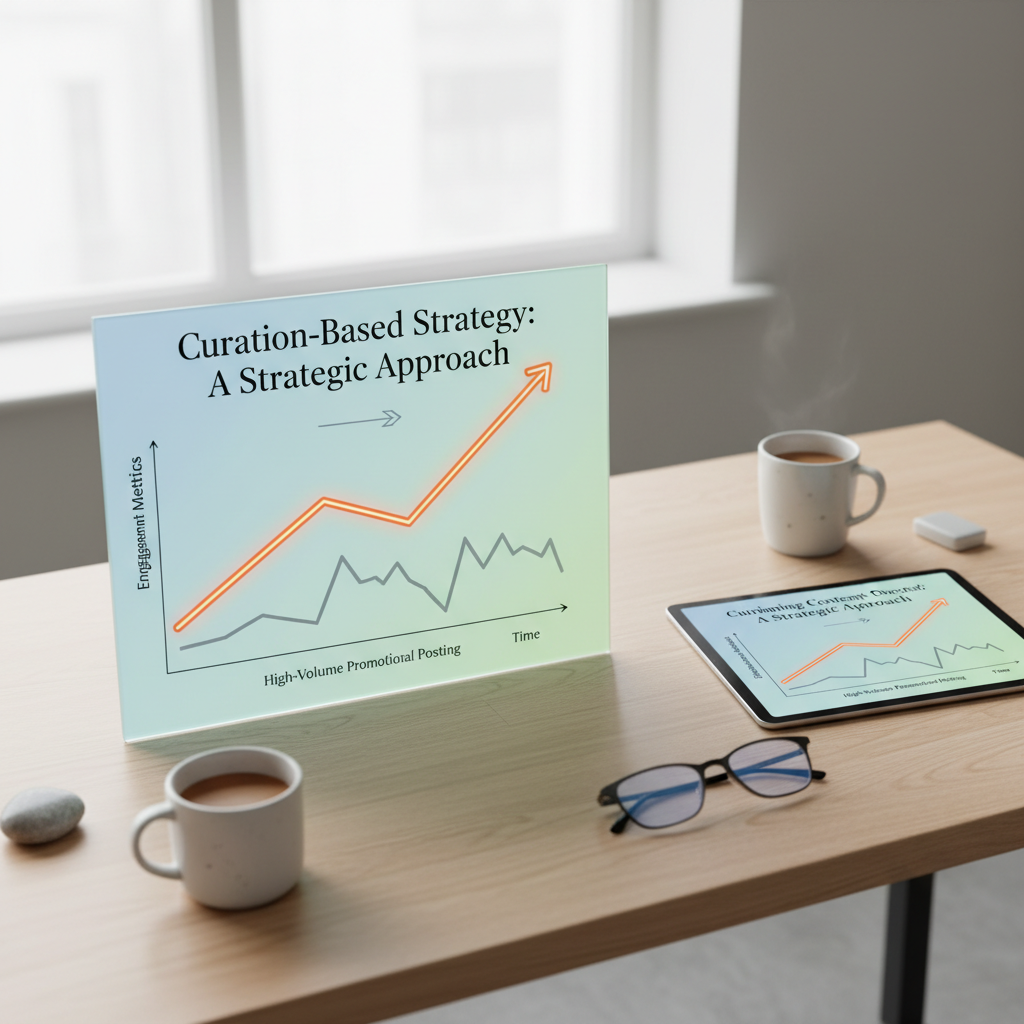
Engagement line graph showing 5.3x growth
How do you implement curation using workflow tools?
Manual curation scales poorly. Workflow optimization tools are essential for modern content teams.
Tools like Repostra help you build an efficient curation engine naturally. You can set up daily, weekly, and monthly routines without losing your authentic voice. Automation handles the repetitive sorting. You maintain complete control over the final filtering and commentary.
Balancing AI efficiency with human judgment is the goal. Smart tools handle the heavy lifting of discovery to give you back valuable time.
What are the biggest content curation mistakes to avoid?
Even smart marketers fall into predictable curation traps.
Over-curation: You become a relay station with no original voice. The fix is simple. Add your perspective to every single share.
Under-attribution: Poor sourcing damages your credibility. Always tag the author and link to the original piece.
Echo chamber syndrome: You only share content confirming your existing views. Force yourself to curate opposing viewpoints with thoughtful critique.
Timing fails: Sharing outdated content makes you look out of touch. Always check publication dates.
No commentary: Aggregation disguised as curation adds zero value. Never post a naked link.
FAQ
How often should I share curated content versus original content?
A healthy balance is typically 60% curated content and 40% original content. This keeps your feed active while ensuring your unique voice remains central. You should test these ratios on different platforms to see what your specific audience prefers.
What is the ideal content curation schedule for small teams?
Small teams should aim for the minimum viable approach. Share one tactical curated piece daily and publish one analytical synthesis piece weekly. This provides consistency without requiring more than a few hours a week.
How do I find quality content worth curating?
Build a discovery engine using RSS feeds, specialized newsletters, and monitoring tools. Set strict quality evaluation criteria. Only save pieces that offer unique data, fresh perspectives, or actionable advice.
Does content curation hurt my brand's originality?
No. Curation actually enhances your thought leadership. When you select high-quality resources and add your own expert commentary, you prove that you understand the entire industry landscape.
Can AI tools handle content curation automatically?
AI tools are excellent for content discovery and initial filtering, but they cannot handle curation completely automatically. Human judgment remains essential for adding context, ensuring relevance, and matching your brand's unique voice.
Conclusion: From overwhelmed to in control
Managing content overload requires a total shift in strategy. Scrolling endlessly and saving articles you never read should be a thing of the past.
The reality is clear. Quality and relevance beat frequency every time. You can reclaim 19 hours a week by stepping off the content treadmill and stepping into the role of a trusted filter.
Start today by curating just one high-quality piece of content with your unique perspective. Tools like Repostra can streamline the process. Be the filter your audience needs and watch your engagement grow.