Maximizing ROI with Strategic Content Distribution
Find out how to distribute your content smartly to maximize reach and ROI.
Maximizing ROI with Strategic Content Distribution: A Complete Guide
You spend hours writing the perfect post. You polish the graphics, review the copy, and finally hit publish. You wait for the likes, comments, and shares to roll in. But all you hear are crickets. Sound familiar? This is the frustrating reality of the post-and-pray method.
Creating amazing content is only half the battle. When you rely on hope as a distribution strategy, you guarantee that your best work will not reach its full potential. Today, success requires a different mindset. You need a system that treats every piece of content as a valuable, reusable asset.
This guide will show you how maximizing ROI with strategic content distribution completely changes your marketing results. We will move away from random posting and build a systematic, data-driven approach. When done correctly, proper distribution can boost your organic reach significantly while saving your team substantial creation time.
Why Content Distribution Strategy Matters More Than Ever
Producing high-quality content in 2025 is expensive. You invest in skilled writers, videographers, designers, and subject matter experts. Your brand pours significant resources into getting the messaging exactly right.
Because of this high upfront cost, a one-and-done publication approach creates a massive ROI problem. Publishing a brilliant insight once and moving on to the next project simply wastes your investment. A true strategy unlocks three core benefits.
First, you gain massive efficiency. Repurposing existing assets saves substantial time compared to creating something from scratch. You already did the hard work of research and ideation. Now you just need to adapt it.
Second, you multiply your reach. Systematic distribution taps into different audience segments across various platforms. You can see significant increases in overall visibility just by meeting people where they prefer to consume content.
Third, you mitigate risk. Relying entirely on one social network or search engine is dangerous. Algorithm changes happen constantly. Spreading your presence across multiple channels protects your brand against sudden drops in organic reach on any single platform.
The Real Cost of Post and Forget
Think about what a brand actually loses by failing to maximize each asset. Imagine a software company that spends two weeks and thousands of dollars producing a high-end customer case study video. They upload it to YouTube, embed it on their blog, and post the link on LinkedIn once. It gets a few hundred views.
That is the real cost of post and forget. They missed the opportunity to clip five short-form videos for TikTok and Instagram Reels. They failed to extract the audio for a podcast episode. They ignored the chance to turn the interview transcript into a threaded post on X. By stopping at one publish button, they left thousands of dollars of potential value on the table.

Marketing team analyzing content distribution metrics
The Content Distribution Landscape: What Has Changed
The internet of 2025 looks very different from the internet of just a few years ago. Tactics that worked flawlessly in the past now fall flat. Understanding these shifts is crucial for adapting your strategy.
From SEO to Search Everywhere Optimization
Search is no longer confined to a single search engine box. AI-driven discovery is reshaping how people find information. Users now ask questions to AI assistants, use conversational search on mobile devices, and search directly within social media platforms like TikTok and LinkedIn.
This means traditional SEO has evolved. Your content must be optimized for Google, yes, but it also needs to provide clear, authoritative answers that AI models can easily parse and cite. Focus on structured data, clear headings, and direct answers to common questions.
The Zero-Click Reality
We are living in a zero-click reality. AI summaries and rich snippets now provide users with immediate answers at the top of their screens. Buyers get what they need without ever clicking a link to visit your website.
This shift forces brands to rethink their goals. You must prioritize building authority and trust over raw traffic numbers. Being cited by an AI engine or mentioned in a prominent industry summary matters just as much as a direct website visit. Your brand needs to be recognized as the definitive source, even if the user consumes the information off-site.
Content as a Supply Chain
Operational excellence is a massive competitive advantage today. The most successful brands treat their content operations like a supply chain. Raw materials enter the factory, and polished, multi-format products ship out on a consistent schedule.
Lean marketing teams cannot afford chaotic workflows. Smart workflow tools are no longer optional. Platforms that facilitate centralized libraries, cross-posting, and automated scheduling keep your team agile and prevent brilliant ideas from getting lost in a messy folder system.
The Rise of Episodic, Social-First Content
Long-form content has fundamentally transformed. Instead of dropping a massive whitepaper or a one-hour video all at once, smart creators serialize it. They turn long-form pieces into episodic, social-first content.
This builds audience habits through consistent releases. Imagine taking an hour-long educational webinar and breaking it down into a six-part weekly tip series on LinkedIn and Instagram. Instead of asking your audience for an hour of their time, you ask for two minutes a week. Over six weeks, you build a consistent touchpoint that keeps them engaged and waiting for the next installment.
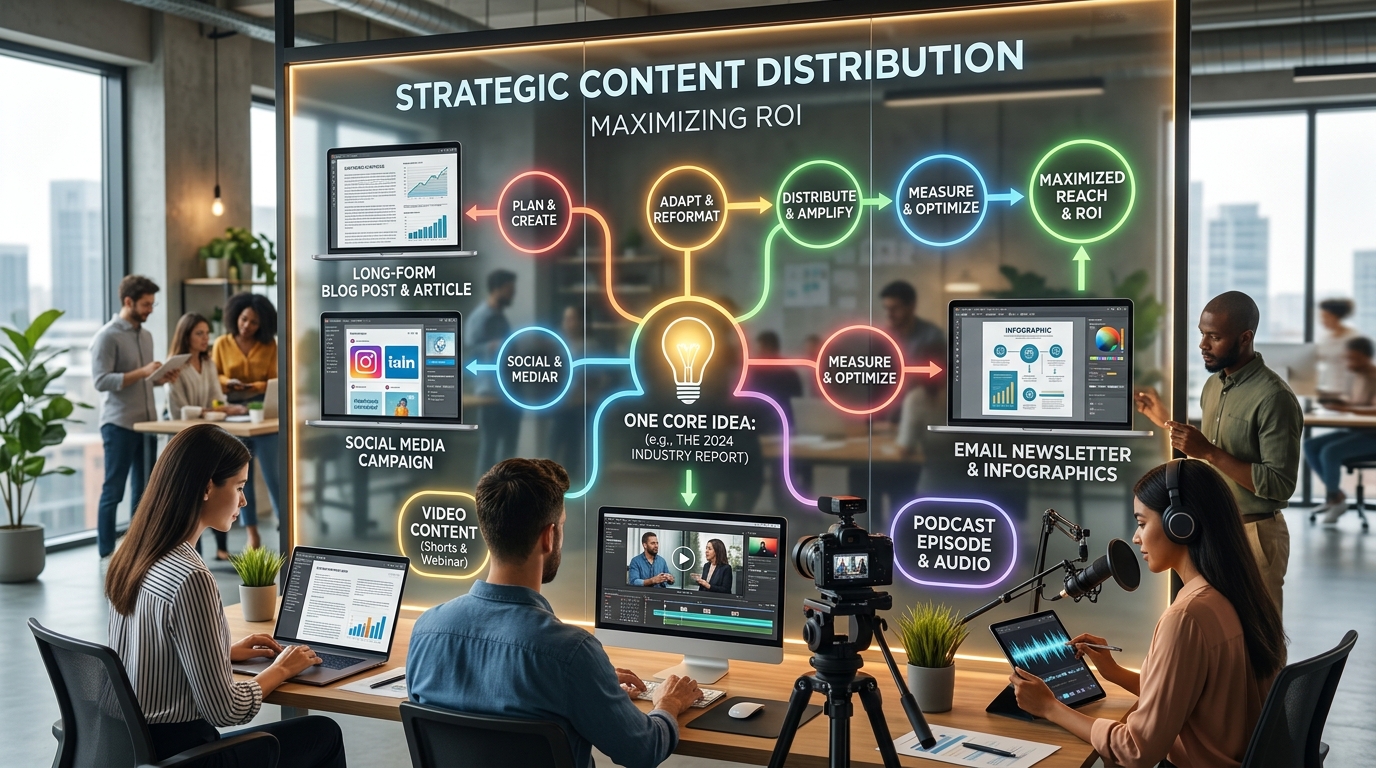
Diagram showing content repurposing from long-form to short-form
The Strategic Content Distribution Framework
To start maximizing ROI with strategic content distribution, you need a repeatable cycle. This is not just high-level theory. It is a highly actionable framework you can implement immediately.
Define Your Distribution Goals
You must clarify your objectives before you publish anything. Are you looking for brand awareness or lead generation? The answer dictates your entire approach.
Top-of-funnel awareness content needs broad reach. You want highly shareable formats placed on platforms like TikTok, Instagram, or YouTube Shorts. The goal is eyeballs and brand recall.
Bottom-of-funnel conversion content requires a different strategy. You want to place detailed, high-trust assets on LinkedIn, through targeted email newsletters, or in gated communities. Knowing your goal prevents you from pushing a hard sales pitch on a platform built for casual entertainment.
Audit and Refresh High Performers
Your past winners deserve another moment in the spotlight. Stop constantly churning out new ideas when you already have proven concepts sitting in your archives.
Identify your evergreen hits. These are the blog posts, videos, or graphics that consistently brought in traffic or engagement months after publication. Give them another life. You can update an old article with new data for 2025. You can reformat a popular text post into a carousel graphic. Schedule quarterly audits strictly for uncovering these hidden gems and putting them back into your distribution rotation.
Tailor Content for Each Platform
Identical cross-posting is a dangerous trap. While software makes it incredibly easy to blast the exact same message to five platforms at once, you must resist the urge. Formats and tones must match the native environment of each platform.
Here is a quick guide to native optimization. LinkedIn requires professional insights, clear formatting, and longer captions that tell a story. Instagram remains visual-first and demands a casual but aesthetically pleasing tone. TikTok requires high entertainment value, fast pacing, and an understanding of current audio trends. X is conversational, punchy, and bite-sized.
Tools can streamline the actual posting process, but your human strategy determines the success of the format.
Use Data to Perfect Your Timing
Do not post at random. Hope is not a scheduling strategy. Analytics reveal exactly when your specific audience is awake, online, and ready to engage.
Initial engagement triggers algorithmic boosts on almost every major network. If you post when your audience is asleep, the platform sees low immediate interaction and buries your post. Use analytics dashboards to find your peak hours. Then, rely on scheduling systems to hit those exact peak times consistently, even if you are out of the office.
Build Interconnected Trust Ecosystems
Do not let your platforms operate in isolation. You need to link your assets together strategically to build a trust ecosystem.
Use your short-form social posts to drive interested users to your deep-dive, long-form articles. Use those long-form articles to drive users toward a newsletter subscription or a conversion page. Incorporate user-generated content and customer testimonials as social proof at every step. This creates a loop. You keep audiences constantly engaged with your brand, moving them naturally from casual viewers to loyal customers.

Analytics dashboard showing engagement metrics across platforms
Measuring What Actually Matters: ROI-Focused Metrics
Do not fall for vanity metrics. A million views means nothing if it brings zero value to your business. Proving ROI requires tracking metrics that directly connect to actual business outcomes.
Engagement Rate by Channel
Where does your content actually spark conversation? Find the platforms where users talk back to you. Likes are a passive metric. Comments, shares, and saves show true resonance. Calculate your average engagement rates across different platforms to establish a baseline. When you see one network consistently outperforming the others in actual conversation, use that insight to double down on what works.
Traffic to Conversion Rate
Content that drives website traffic is good. Content that drives qualified leads is better. You need proper tracking from the initial social click all the way through to the final conversion on your website. Set up clear attribution models. This tells you exactly which articles or videos are actually putting money in the bank, rather than just inflating your website visitor count.
Content Lifecycle Value
How long does a piece of content continue to drive value after its initial publication date? Evergreen content provides compounding returns over months, not just days. Track the performance of your key assets at thirty, sixty, and ninety days post-publication. If a piece continues to generate leads three months later, that asset has a massive lifecycle value and deserves to be heavily promoted again.
Cost Per Asset Analysis
To find your true ROI, you must understand your costs. Calculate the total creation cost, including team hours and production expenses. Add your distribution costs, like software subscriptions or paid promotion. Compare that total against the business value returned. This hard analysis reveals your true content ROI. It helps you prioritize future investments by showing you exactly which formats give you the most leverage for your budget.
How Tools Like Repostra Make Strategy Scalable
A brilliant strategy is powerful, but executing it at scale requires the right tools. Trying to manage native optimization, scheduling, and analytics manually across five platforms will burn out even the most energetic marketing team. This is where content management platforms like Repostra come into play. They simplify the technical workflow so you can focus on creativity.
To support a strategic distribution model, you need a few core capabilities. First, you need a centralized content library. This keeps all your raw files, graphics, and copy in one accessible place, making repurposing incredibly fast.
Second, you need cross-platform scheduling that respects native formats. You want a tool that allows you to tweak the caption for LinkedIn, swap the aspect ratio for Instagram, and adjust the hashtags for TikTok, all from one screen.
Third, an integrated analytics dashboard is crucial for making those data-driven scheduling and formatting decisions. You need to see the metrics clearly to know what is working.
Finally, team collaboration features streamline the entire supply chain. Writers can draft, designers can attach assets, and managers can approve posts without endless email chains.
The ultimate benefit here is focus. Marketing teams should spend their time focusing on high-level storytelling and community engagement, not manual posting and tab-switching. Tools scale human judgment. They do not replace it. They simply remove the friction from the process.
From Content Creation to Content Excellence
Great content does not naturally find an audience. It requires assistance. The internet is too crowded for you to just hit publish and hope for the best.
Success belongs to the brands that combine high-quality storytelling with smart, aggressive distribution. By moving away from post-and-pray tactics and adopting a systematic, data-driven approach, you fundamentally change your marketing economics. You increase your reach. You improve your engagement. You dramatically lower your production costs per asset.
Start treating your content like the valuable business asset it is. Stop letting great ideas die after one day on a single timeline. Begin auditing your current library for repurposing opportunities today, and give your best work the audience it actually deserves.