Interactive Content: Engage More by Doing Less
Explore the benefits of interactive content formats in engaging audiences with minimal effort.
Stop Working Harder: How Interactive Content Lets You Do Less and Engage More
TL;DR
Interactive content generates 52.6% more engagement than static posts while requiring less long-term effort. Instead of constantly creating new material and hoping it resonates, interactive formats facilitate two-way conversations that reveal what your audience actually wants. Users spend 13 minutes with interactive content versus 8.5 minutes with static alternatives. For social media managers, adding simple interactive layers to existing content transforms repurposing into a high-engagement strategy that automatically collects valuable data.
Key Takeaways
- Higher engagement: Interactive content generates 52.6% more engagement than static alternatives
- Increased dwell time: Audiences spend 4.5 minutes longer interacting with dynamic formats
- Double conversions: Simple interactive layouts deliver two times more conversions
- Smart repurposing: 68% of marketers successfully turn old static posts into interactive content
- Built-in research: Every click and vote provides automatic zero-party audience data
Why Does Publish and Pray No Longer Work?
Social media managers often create a graphic, write a caption, click post, and hope for the best. This approach worked a decade ago. In 2026, users simply scroll past standard informational graphics without stopping.
Digital fatigue means audiences ignore passive broadcasts. They expect experiential content that invites them to participate. Brands work harder to produce a higher volume of static images, but they see diminishing returns on their time investment.
The industry shift: Data from recent trend reports shows a clear migration away from static broadcasting. Attention spans require active participation to register a brand message. There's a smarter way to capture attention that requires less ongoing manual effort.

Social media manager reviewing static content performance metrics
What Is Interactive Content?
Interactive content requires user participation to function. Instead of just reading text or watching a video, the audience clicks, votes, types, or swipes to reveal information. Examples include polls, quizzes, calculators, interactive carousels, and assessments.
These formats create a pattern interrupt. When a user scrolls mindlessly, a question or a clickable button forces their brain to switch from passive observation to active decision making. AI-powered tools now make this creation accessible to any social media manager without needing a developer.
According to the Digital Marketing Institute, users spend an average of 13 minutes engaging with interactive content, compared to only 8.5 minutes for static content. This massive increase in dwell time builds stronger brand recall. The same research notes that 93% of marketers believe interactive formats educate buyers far better than passive alternatives.
How Much More Engagement Does Interactive Content Generate?
Interactive content consistently generates 52.6% more engagement than static content, according to recent industry research. It also generates 2x more conversions than passive content.
What engagement means here: This includes comments, shares, increased time spent on the page, and higher click-through rates. The increase happens because you initiate a two-way conversation. You ask the user about themselves, and people love sharing their opinions.
"Static media is easily ignored as background noise on modern social feeds. Interactive content acts as a pattern interrupt. It forces the user to switch from a passive scrolling state to an active decision-making state, which inherently drives deeper cognitive engagement."
— Dr. Sarah Allen, Lead Research Analyst at the Digital Marketing Institute
This jump in engagement drastically changes your content calendar. If one poll gets the interaction of three static images, you can afford to publish fewer posts while achieving better results.
Why Does Interactive Content Mean Doing Less?
The idea that you can get more engagement with less effort sounds impossible. The secret lies in the data collection advantage. Every poll answer, quiz result, and calculator input serves as automated market research.
The feedback loop: You stop guessing what your audience wants to see. If you run a poll asking followers about their biggest daily challenge, the winning answer becomes the exact topic of your next post. You eliminate the wasted effort of creating content nobody cares about.
| Strategy | Effort Required | Insight Gained |
| :--- | :--- | :--- |
| Publish and Pray | High (constant creation) | Low (only vanity metrics) |
| Manual Surveys | High (chasing responses) | Medium (small sample sizes) |
| Embedded Interactivity | Low (repurposing) | High (automatic zero-party data) |
Behavioral data collection removes the guesswork from your strategy. You let user interactions dictate your editorial calendar.
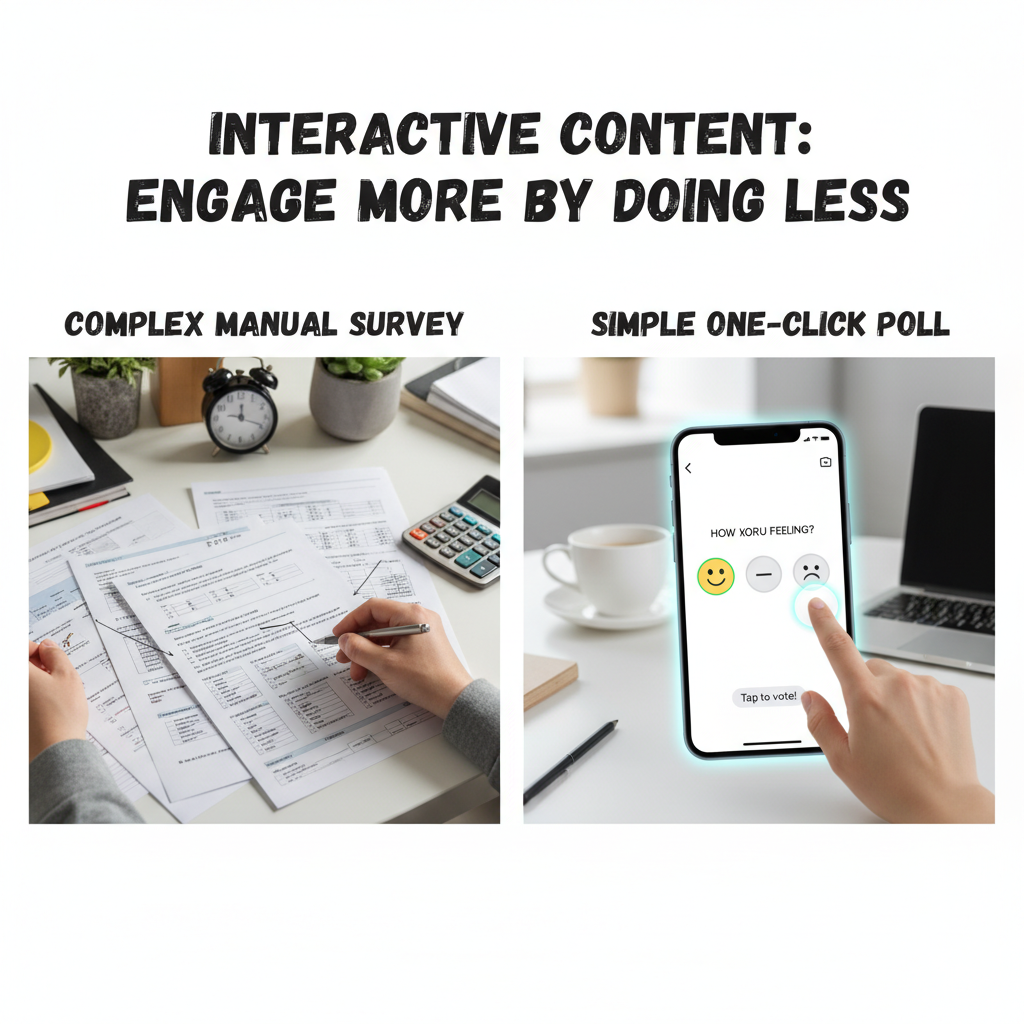
Comparison of effort between manual surveys and interactive content polls
How Can You Repurpose Existing Content?
You can easily turn static posts into interactive carousels, quizzes, or polls. According to recent marketing research, 68% of marketers find that interactive formats make it easy to repurpose existing passive content.
If you use a tool like Repostra.app, you already understand the value of repurposing. The goal is to build a "repurpose for interaction" loop. Before you repost a standard announcement, ask yourself how you can add one interactive layer.
Step One: Take an existing high-performing blog post.
Step Two: Extract the core controversial opinion or main tip.
Step Three: Turn that tip into a one-question poll asking your audience if they agree.
You can also take a static infographic and turn it into an interactive carousel with clickable elements. You get a fresh asset from old material with minimal extra work.
What Are the Easiest Formats to Start With?
You don't need complex production values to see results. The most effective strategy is starting small.
Format One: Polls
These provide instant feedback. A one-question poll takes seconds to create natively on LinkedIn or Twitter.
Example: "What content type performs best for you? Vote and compare results."
Format Two: Quizzes
Knowledge tests or personality assessments offer high engagement returns. They play on the psychological desire for self-discovery.
Example: "The Reposter's Quiz: What is your content repurposing personality?"
Format Three: Calculators
Value estimators provide immediate utility. They work exceptionally well for professional audiences.
Example: A "Social Reach Calculator" showing how much time a user saves with a streamlined reposting workflow.
Pick one simple format and test it this week natively on your preferred social platform.
How Does Interactive Content Help You Understand Your Audience?
Every interaction gives you a specific insight. You learn their content preferences, daily pain points, and demographic behaviors.
Privacy-conscious insights: In 2026, tracking cookies are largely obsolete. Brands rely on zero-party data, which is information a customer intentionally shares. Embedded interaction collects this data naturally and ethically.
When you use Repostra.app to schedule an interactive post, you can track which formats drive the most shares and direct messages. You can use these insights to identify high-value topics and refine your posting schedule without ever running a formal customer interview.
What Mistakes Should You Avoid?
Adding interactivity requires a basic strategy. Avoid these common pitfalls to maximize your engagement rates.
- Making it too complex: Don't ask ten questions when one will do. Complex quizzes cause analysis paralysis and high drop-off rates.
- Interactivity without purpose: Don't add a poll just to have one. The interaction must tie back to your business goals.
- Ignoring the data: Collecting answers is useless if you don't adjust your future content based on what you learn.
- Forgetting mobile optimization: The vast majority of social media engagement happens on phones. Ensure buttons are large enough to tap easily.
Bottom line: Follow the "one interactive layer" rule. Start with the most minimal addition possible and scale up only when the data supports it.
FAQ
How much time does it take to create interactive content?
Simple polls take two to three minutes to set up using native platform tools. Quizzes might require fifteen to thirty minutes for your first attempt, but templates speed this up dramatically. The time investment pays off because one strong interactive post often generates more engagement than five static images, reducing your overall production burden.
Do I need special tools or can I use what I already have?
Most platforms have built-in interactive features that require zero additional tools. Instagram Stories, LinkedIn, and Twitter all support native polling. For more sophisticated calculators, free tools like Google Forms work perfectly. Start with native features before paying for premium platforms.
Will interactive content work for professional audiences?
Interactive content works exceptionally well for professional and business-to-business audiences. LinkedIn polls generate massive engagement among industry experts. Professional buyers appreciate calculators and ROI estimators that help them self-educate before speaking to sales.
How often should I post interactive content versus static content?
Aim for a thirty to seventy split to start. This means thirty percent interactive and seventy percent static. This ratio gives you enough touchpoints to gather data without overwhelming your team. Many brands eventually move to a fifty-fifty split as they get more comfortable with the formats.
What metrics should I track to measure success?
Focus on the completion rate, which shows how many people actually finished your poll or quiz. Track the total time spent engaging, share counts, and click-through rates. Compare these numbers directly against your static content benchmarks. Most importantly, track the qualitative answers to understand what your audience truly values.
Getting Started With Your First Experiment
Choose one piece of high-performing static content from your archive right now. Add one interactive layer to it, like a simple poll question related to the topic. Post it using Repostra.app and track the engagement against the original static version.
Review the results after forty-eight hours. You'll likely see higher visibility and more direct comments. Build this interactive repurposing into your weekly workflow. Start small, learn fast, and engage more by doing less.