How to Use Content Clusters for Improved SEO and Engagement
A guide on using content clusters to boost SEO, improve website structure, and enhance user engagement.
Content Clusters: The Complete Guide to Building Topic Authority in 2026
Content clusters are interconnected groups of articles organized around a central pillar topic. This structure establishes topical authority and matches modern search intent. By creating a comprehensive overview page and linking it to specific subtopic articles, you signal expertise to search engines and improve website navigation. This strategy replaces isolated keyword pages with well-structured ecosystems, reducing bounce rates and increasing organic visibility in AI-driven search environments.
Key Takeaways:
- Content clusters replace outdated single-keyword strategies with interconnected topic ecosystems
- A standard setup includes one broad pillar page and eight to fifteen subtopic articles
- Strategic internal linking passes authority between pages and signals topical mastery to search engines
- Organizing existing articles into thematic hubs improves user navigation and reduces bounce rates
- Regular audits keep information fresh and maintain algorithmic relevance over time
Why Is Your Content Not Ranking Despite Publishing Regularly?
You have published dozens of blog posts, but your organic traffic plateaued months ago. The culprit is often fragmented content that fails to show search engines you truly understand the subject matter. Modern AI-powered search demands topic mastery rather than simple keyword matching.
A social media tool publishing random tips without a unifying structure ends up with orphan pages. Visitors land on one article, read a quick tip, and leave immediately. This disjointed approach ignores how algorithms categorize knowledge. Structured knowledge beats keyword volume every time.
This guide explains how to use interconnected hubs to establish real authority. When you stop chasing individual keywords and start building knowledge systems, you build trust with both readers and search engines.
What Are Content Clusters?
A content cluster is an SEO framework consisting of one main pillar page supported by several related subtopic articles.
[IMAGE: Content cluster hub and spoke diagram]
The pillar page provides a broad overview of a major topic. Think of it as a complete guide to a subject like Instagram marketing. It touches on every aspect of the topic but leaves the deep details for other pages.
Supporting articles explore specific subtopics in depth. These might include detailed tutorials on user-generated content strategies or hashtag research. This hub-and-spoke model physically connects your pages through internal links.
Old SEO focused on ranking single pages independently. This new approach builds interconnected hubs that readers and algorithms easily navigate.
The pillar page acts as the hub. The cluster articles act as the spokes. The internal links hold the entire structure together.
Why Do Content Clusters Work in 2026?
Search algorithms evaluate topical authority to determine if a website comprehensively covers a subject. You cannot rank for highly competitive terms by publishing just one thin article.
AI-driven search tools rely on semantic relationships to map out a site's expertise. Internal linking acts as the connective tissue that teaches AI about your authority. When Google SGE or ChatGPT search scans your domain, it looks for these logical connections.
Visitors also prefer finding answers to multiple related questions in a single visit. When you connect related ideas, you lower bounce rates and increase pages per session. Google's helpful content documentation emphasizes that algorithms reward sites that provide a satisfying, holistic user experience.
"Quality in isolation isn't enough. The page has to be the right answer, on the right domain, from a site that Google trusts to talk about that subject."
Lily Ray, VP of SEO Strategy at Amsive
Search engines want to send users to experts. Creating a cluster proves you own the topic entirely.
How Do You Build a Content Cluster?
Building a functional knowledge hub requires a methodical approach. You need to map out your topics before you write a single word.
Identify your core pillars. Choose three to five broad areas where you hold genuine expertise. A social media app like Repostra might choose Instagram curation, workflow automation, and user-generated content management. Validate these choices through search volume data and business alignment.
Map your supporting topics. Brainstorm eight to fifteen specific subtopics to support each pillar. Look at actual user questions using autocomplete features and keyword tools. Align these subtopics with the buyer journey so you have content for awareness, consideration, and decision stages.
Audit your existing library. Inventory your current articles using a spreadsheet. Categorize them into potential groups and identify gaps that require new writing. Find orphan pages that currently lack internal links and assign them a permanent home within a cluster.
Create your pillar page. Write a comprehensive overview that runs long enough to cover the main subject thoroughly. These pages typically range from 2,500 to 4,000 words. Target broad, high-volume terms on this main page.
Develop the supporting articles. Focus each piece on one specific long-tail intent. These articles usually sit between 1,000 and 2,000 words. Address very specific questions that users type into search engines.
Implement strategic linking. Connect every subtopic upward to the pillar. Link the pillar downward to all subtopics. You should also add lateral links between related sub-articles when contextually relevant.
How Should You Structure Internal Links?
The golden rule: Descriptive anchor text provides clear context for search crawlers. Use phrases like "Instagram reposting best practices" instead of a generic "click here."
Place these links naturally within the body copy. Contextual links inside paragraphs carry far more weight than navigation menus or footer links. When a user reads a paragraph and sees a relevant link, they are much more likely to click it.
Aim for two to five internal links per article connecting to related material. Avoid forced keyword stuffing that reads unnaturally to humans. If the link does not naturally fit the sentence, rewrite the sentence.
Maintain a clean link hierarchy. Authority flows smoothly from your highest-performing pages down to your newer posts. When your pillar page earns external backlinks, that authority trickles down to every connected cluster page.
What Mistakes Should You Avoid When Building Clusters?
Many marketing teams build clusters incorrectly and wonder why their traffic remains flat. You can avoid these pitfalls with careful planning.
Creating thin pillar pages. An 800-word overview rarely competes well in competitive niches. Build comprehensive guides that legitimately cover the entire topic. If your pillar page lacks substance, search engines will not view it as a primary resource.
Keyword cannibalization. Multiple articles targeting the exact same keyword confuse search engines. Map distinct keywords to specific pages. Ensure your pillar page targets the broad term while cluster pages target the specific variations.
Weak internal links. A system only exists if the pages connect. Use a site audit checklist to verify all links function properly. Broken links interrupt the flow of authority and create dead ends for users.
Ignoring search intent. Writing what you want rather than what users need leads to high bounce rates. Match your format to the user's goal. If a user wants a quick tool comparison, do not give them a philosophical essay on marketing.
The set-it-and-forget-it mentality. Outdated information loses rankings fast. Implement a quarterly refresh schedule to maintain relevance.
How Do You Measure Cluster Performance?
You need proper tracking to prove your strategy works. Measure the health of the entire ecosystem rather than just one page.
Track organic traffic growth by grouping related URLs. You can segment traffic in Google Analytics 4 using content groups. A healthy group should show steady quarter-over-quarter growth.
Monitor keyword rankings for both primary and secondary terms. Use tools like Google Search Console or Ahrefs. Watch for broad terms ranking on the main page and long-tail terms ranking on the supporting pieces.
Analyze engagement signals. Time on page and scroll depth show whether visitors actually consume the material. AI search systems heavily weigh these behavioral signals to determine quality.
Measure conversion rates. Track top-of-funnel awareness articles separately from bottom-of-funnel decision pages. Expect an uplift in conversions for bottom-funnel cluster pages that directly address buyer pain points.
Evaluate internal link click-through rates. Heatmaps can show which contextual links attract the most attention. Use this data to optimize link placement and keep visitors on your site longer.
Real World Example: Building Clusters for Repostra
Buyer journey content alignment chart
For a social media tool like Repostra.app, structuring information around user pain points directly drives conversions. A highly relevant cluster cuts through the noise and establishes brand authority.
A pillar titled "Mastering Instagram Content Strategy" anchors the site. This page serves as the ultimate guide for social media managers looking to improve their accounts.
The supporting subtopics cover specific, highly searched needs:
- How to maximize user-generated content for brand trust
- Reposting etiquette and the complete credit guide
- The science behind high-engagement video algorithms
- Optimal posting times for maximum reach
- Content curation versus original creation
- Tools that automate daily social media workflows
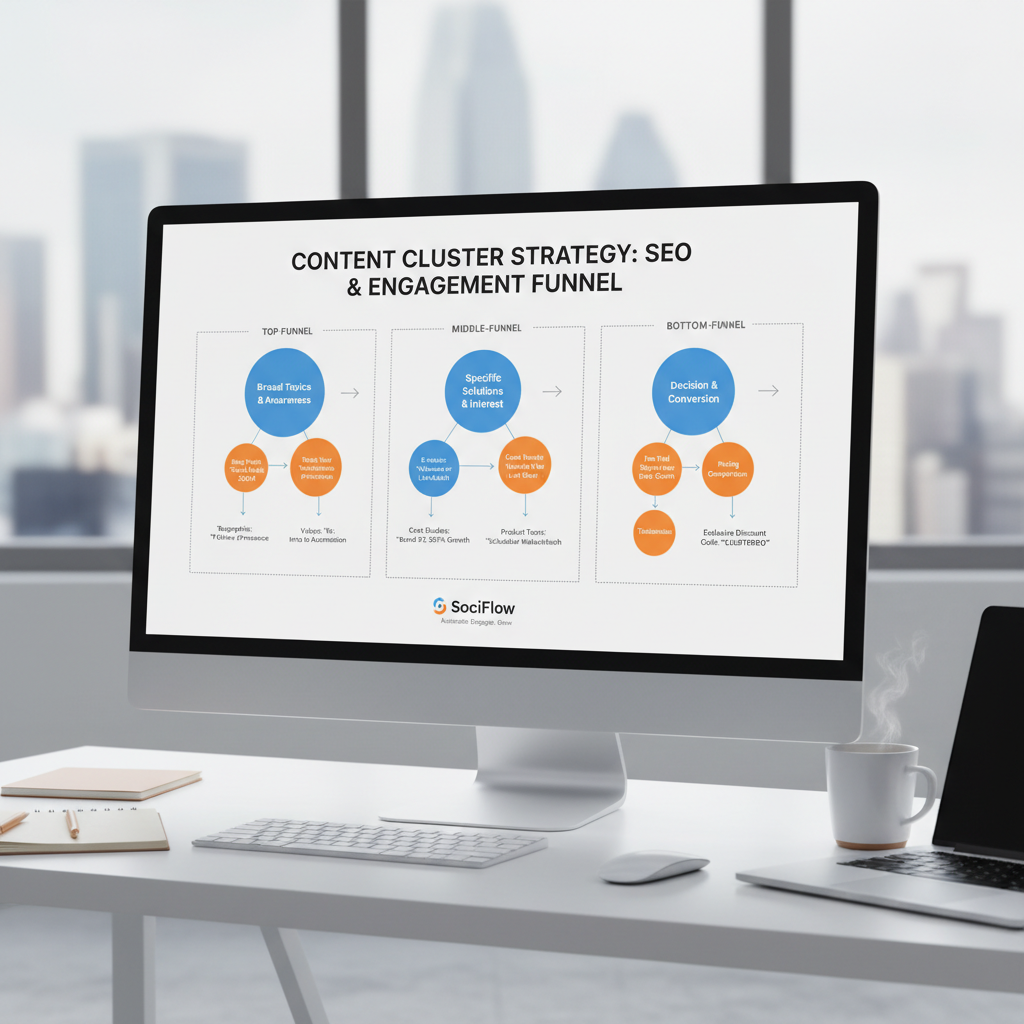
This framework guides visitors from general awareness to a specific purchasing decision. The top-of-funnel posts attract broad traffic. The mid-funnel posts educate the reader on strategy. The bottom-funnel posts present the software as the ideal solution.
Mention the product naturally in bottom-funnel articles. For a reposting tool, emphasize ethical content use and proper attribution. This positions the brand as both a responsible educational resource and a practical software solution.
How Often Should You Update Content Clusters?
Search engines favor recently updated information. Content decay happens quickly in fast-moving industries like marketing and technology.
Schedule quarterly audits to keep your material accurate. Check your analytics to see which pages have lost traffic over the past three months. These are your primary candidates for a refresh.
What to update: Refresh outdated statistics. Replace old screenshots with current interface images. Fix broken links. Add new subtopics that emerge in your industry as technology evolves.
Modify the publication date or add an "Updated" badge to show readers the information is current. A quick refresh works for minor factual changes. A full rewrite is necessary if search intent has shifted entirely. If a page receives low traffic, drives zero conversions, and covers an obsolete topic, redirect it to a broader relevant page.
A well-maintained library outperforms a massive but outdated archive. Keep your clusters tight, accurate, and highly relevant.
Your Next Steps
This organized approach is the modern standard for organic search visibility. You cannot rely on isolated blog posts to drive meaningful traffic anymore.
Identify your first core topic this week. Pick a subject where your brand already possesses strong authority. Audit your existing library for potential grouping opportunities. You might already have a cluster hiding in your archives.
Draft a 90-day publishing calendar. Focus entirely on building out one complete hub before moving to the next. Implement a strong internal linking plan. Connect your existing pieces immediately.
Configure your analytics to track URL groups so you can measure your success accurately.
Shift your mindset from publishing random articles to building comprehensive knowledge hubs. Even a small, tightly linked ecosystem outperforms a scattered library of isolated posts. Start organizing your knowledge today and watch your site's authority grow over the next quarter.
FAQ
How many articles do I need for a content cluster?
A functional content ecosystem typically includes one pillar page and eight to fifteen supporting articles. Start with five detailed pieces and expand as you discover new user questions. Quality matters more than sheer volume.
Can small websites with limited resources execute this strategy?
Yes. Focus on one or two core topics where you possess deep expertise. Build the main page and a few supporting pieces over several months before expanding to new subjects. Even a small website can own a specific niche topic completely.
How long does it take to see SEO results?
Most sites notice measurable improvements within eight to twelve weeks. Significant ranking gains usually appear around the four to six-month mark, depending on competition and existing domain authority. Internal linking benefits often appear faster than external ranking improvements.
Should I create new pages or reorganize existing ones?
Do both. Audit your current library to group related posts, then fill in the missing gaps with fresh writing. Updating existing posts with new internal links often yields the fastest returns because those pages already have some age and authority.
Does this strategy work for B2B and SaaS companies?
It works exceptionally well. B2B buyers conduct extensive research before purchasing software. Structured hubs address their pain points, compare solutions, and demonstrate specific use cases throughout the buying journey.