How to Turn Internal Team Knowledge Into Marketing Content
Show how insights from sales, support, onboarding, and leadership can become a reliable source of high-quality content. This post highlights a practical way to create more original material without depending only on external trends.

How to Turn Internal Team Knowledge Into Marketing Content That Actually Converts
Your marketing team is stuck on the content treadmill, churning out generic posts while your support, sales, and onboarding teams answer the same customer questions every single day. That disconnect is costing you. Learning how to turn internal team knowledge into marketing content solves both the originality and efficiency problem. Build a repeatable system to capture real customer questions, objections, and insights from the people who talk to buyers all day long. Repurpose these authentic stories into blog posts, videos, and social updates. This approach creates trustworthy material competitors cannot copy and cures the blank page syndrome.
Key Takeaways
- Your support, sales, and leadership teams hold an untapped goldmine of insights
- Build a simple capture system like 15-minute interviews instead of one-off requests
- Repurpose one big expert interview into eight or more distinct content pieces
- Internal knowledge creates higher trust than trend-chasing or generic templates
- Document team explanations because they are already creating what your audience needs
Why Are Marketing Teams Stuck on the Content Treadmill?
Marketing teams constantly search for fresh ideas while sitting directly on a knowledge goldmine. The external trend trap catches many creators. Relying on industry news or AI tools produces generic, forgettable content.
Your best content creators are not actually on your marketing team. They are answering customer emails right now.
Building a system to identify believers, capture processes, and repurpose strategically is the way out. This method solves your content volume needs while keeping the quality exceptionally high.
Why Does Internal Knowledge Create Better Marketing Content?
Audiences can spot generic content instantly. Authenticity always beats volume. When you rely on the people actually doing the work, your marketing materials gain immediate authority.
According to the Edelman Trust Barometer, technical experts and company employees consistently rank as the most trusted sources when consumers evaluate brand credibility.
Three competitive advantages:
- Trust: Real experiences from people who build, sell, and support the product resonate deeply
- Originality: Competitors cannot replicate your highly specific customer interactions
- Relevance: The content addresses actual customer questions rather than assumed interests
"The best content marketing doesn't feel like marketing. It feels like advice from someone who's already solved your problem."
Ann Handley, Chief Content Officer at MarketingProfs
If you want your audience to listen, you need to share genuine advice.
Which Teams Hold Your Most Valuable Content Insights?
Every department interacts with different stages of the customer journey. You just need to know where to look.
Support and Onboarding
These teams hold the repeat questions, common frustrations, and exact moments where customers find value.
- Content opportunities: FAQ articles, troubleshooting guides, and best practice tutorials
- Action step: Track your most-asked support tickets monthly to find instant blog topics
Sales Teams
Sales professionals know the exact objections, competitive comparisons, and resonant language needed to close a deal.
- Content opportunities: Comparison pages, objection-handling articles, and case studies
- Action step: Turn field notes from discovery calls into dedicated content pieces
Leadership Teams
Executives provide industry perspective, strategic vision, and a differentiated point of view.
- Content opportunities: Thought leadership, trend analysis, and company positioning
- Action step: Transform an internal CEO memo into a public LinkedIn article
Companies that document and share internal expertise see measurably higher content engagement rates than those relying solely on external sources. The pattern shows up consistently across B2B benchmarking studies.

Internal teams collaborating to share content insights
How Do You Build a System to Capture Team Knowledge?
Ad-hoc requests rarely work. Asking your team if they have any blog ideas just gets you blank stares.
The Scaffold Method:
Schedule recurring, low-friction touchpoints like 15-minute monthly interviews. Ask specific, answerable questions.
- "What was the most difficult question you answered this week?"
- "What do customers constantly misunderstand about our product?"
- "What customer feedback surprised you lately?"
Capture methods:
- Create a dedicated Slack or Teams channel for real-time insights
- Record and transcribe team meetings, training sessions, and webinars
- Shadow customer calls with permission and document your observations
- Conduct post-mortem interviews after big wins or losses
Make it easy. Do not require experts to write anything. Extract quotes from conversations instead. A practical starting point is sending a weekly three-question pulse survey via email.
What is the Best Way to Repurpose Expert Insights?
Starting from scratch every day is exhausting. The Big Rock strategy solves this problem entirely.
The Big Rock strategy explained:
Start with one substantial asset like an expert interview or long-form article. Then slice it into eight to ten derivative pieces.
Repurposing map:
Take one long-form blog post of 2,000 words and transform it into the following assets:
- Five to seven LinkedIn carousel posts highlighting key insights
- Three to four short video clips under 90 seconds
- An email newsletter series broken into four segments
- A detailed Twitter or X thread
- A podcast episode or audio snippet
- An infographic summarizing the main points
Centralize for consistency: Store these insights in Notion, Confluence, or an internal wiki. Tag them by topic, team source, and customer stage. This ensures new hires can immediately access brand voice examples.
For example, a single 30-minute support manager interview easily becomes one pillar article, six social posts, and two email segments.
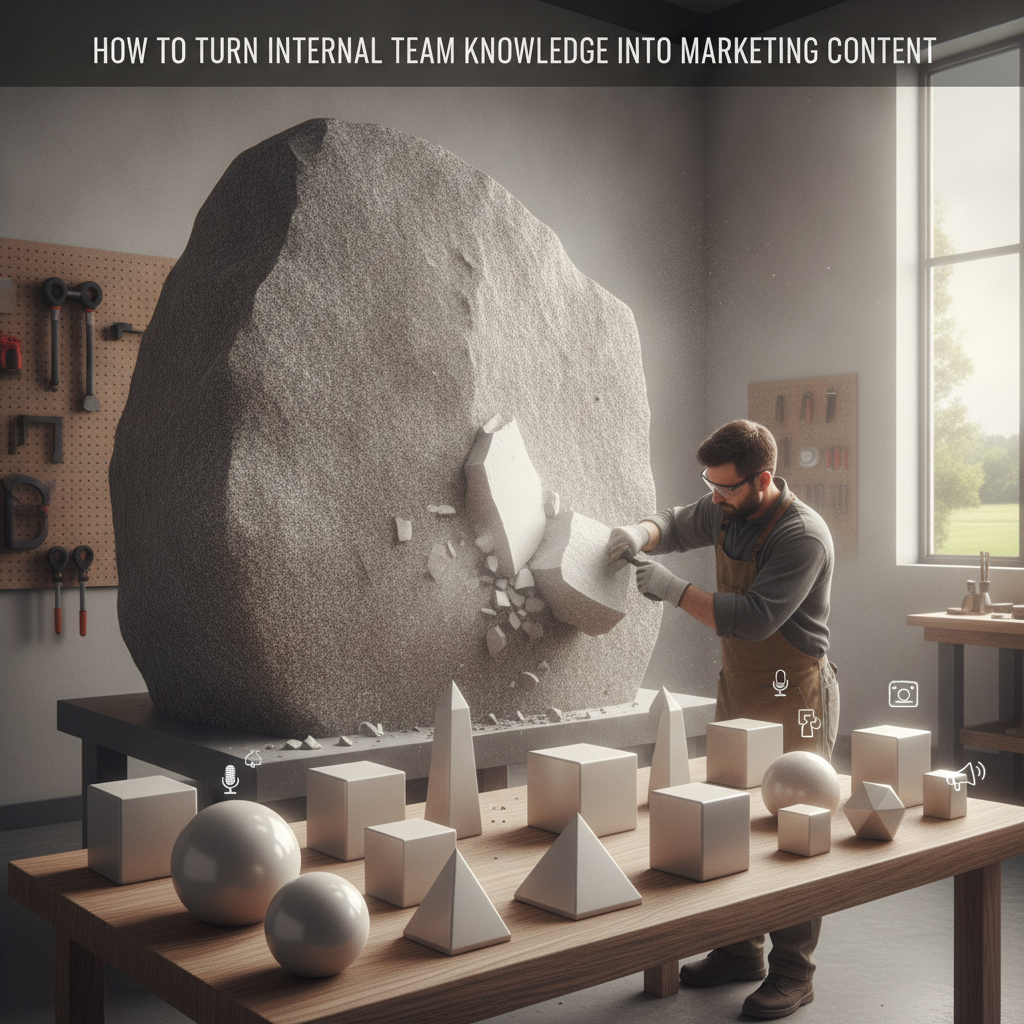
The Big Rock content repurposing strategy
How Do You Get Busy Team Members to Participate?
The most common objection is that a team simply lacks time for content creation. You have to remove the friction.
Solutions for busy experts:
- Frame the effort as helping customers at scale. One interview reaches thousands of users
- Recognize contributors publicly through bylines, internal shoutouts, and LinkedIn tags
- Make participation ridiculously easy by letting them talk instead of write
- Show the return on investment. Tell them exactly how their insights from last month became a top-performing post
Identify your believers: Look for people who naturally share in meetings. Find the enthusiasts who answer Slack questions unprompted. Notice the team members that customers specifically request. Start your pilot program with just one or two willing participants.
Research from Harvard Business Review shows that tapping into intrinsic motivation by highlighting how expertise helps others is far more effective than extrinsic rewards.
How Does This Approach Work for Content Distribution Tools?
Applying this framework to your own product is the ultimate test. If you run a platform like Repostra.app, your internal process becomes your external proof.
If your team constantly explains how to repurpose content to new users, that is your content engine.
Practical application:
- Document customer onboarding questions and turn them into tutorial content
- Record demo explanations and clip them into YouTube Shorts
- Capture the reasons why you built a specific feature for a product marketing blog
This very article demonstrates turning internal knowledge into marketing content. We advise clients using these exact steps, and now those steps serve as helpful public material.
FAQ
How much time does it take to capture internal knowledge monthly?
Plan two to three hours monthly per team for the initial capture process. This includes three 15-minute interviews and one hour of processing. After setup, maintenance drops to just one hour monthly. The time investment pays back quickly. One 30-minute support manager interview can generate six to eight content pieces that would otherwise take ten hours to research and write from scratch.
What if my team says they do not know what to share?
Do not ask open-ended questions. Instead, use specific prompts like asking what question they answered twice this week or what made a customer say wow recently. Record regular team meetings and pull quotes afterward. Experts often do not realize their daily explanations are valuable content. The marketing team's job is extraction and packaging, not expecting subject matter experts to act as writers.
How do you maintain quality when team members are not writers?
Quality comes from authenticity and expertise rather than polished prose. Capture insights through conversation like interviews, recorded calls, or voice memos. Then have marketing edit the transcripts for clarity and structure. The expert provides the knowledge, and marketing makes it readable. Original expert insights with light editing outperform perfectly written generic content every time.
Can this work for small teams without dedicated content resources?
Absolutely. Small teams actually have a distinct advantage due to shorter communication loops and closer customer contact. Start with one 15-minute monthly conversation with your most customer-facing person. Transcribe it using free tools like Otter.ai or Google Docs voice typing. Pull out three key points and turn each into a LinkedIn post or email. Scale only after this becomes a routine habit.
How do you prevent internal knowledge from becoming repetitive content?
Track topics in a simple spreadsheet noting the topic, date covered, and format. Rotate between teams monthly. Focus on support one month, sales the next, and leadership third. As products evolve and customer questions shift, naturally fresh angles emerge. Plus, presenting the same topic through different team lenses offers complementary rather than repetitive value.
Your Content Goldmine Is Already Clocked In
Stop chasing external trends when your internal expertise is vastly more valuable. Turning internal team knowledge into marketing content is not a nice-to-have. It is your most sustainable competitive advantage.
Key takeaway: Follow the three-step framework. Identify believers, build capture systems, and repurpose strategically.
This creates a competitive moat. Your team's specific experiences cannot be copied by competitors or AI. Start this week with one 15-minute interview with your most customer-facing team member. The best marketing content never actually feels like marketing. It feels exactly like advice from someone who has already solved the problem.