How to Repurpose Niche Expertise Into Trust-Building Micro Content
Teach brands how to break specialized knowledge into short, high-value posts that feel useful instead of generic. This topic works well for businesses with subject matter experts but limited marketing bandwidth.
Businesses with Subject Matter Experts Struggle to Create Consistent Social Content. Here's the Solution.
Businesses with subject matter experts often struggle to create consistent social content without burning out their specialists. The most effective solution is to repurpose niche expertise into micro content. By recording single sessions with internal experts and breaking insights into bite-sized posts, brands can maintain high-frequency publishing while showcasing authentic expertise. This expert-to-micro framework remains the key differentiator in a heavily automated content landscape.
Key Takeaways
- Turn one short expert recording into weeks of micro-content
- Authentic insights build more trust than polished marketing materials
- Focus on quality over sheer volume in your content strategy
- Build modular assets from pillar content for different social channels
- Ensure every piece of content takes a clear and defensible stance
Why Do Businesses With Experts Struggle to Create Consistent Content?
The core problem: Subject matter experts possess valuable knowledge but lack the time and skills to package it for social media. Traditional content creation treats these specialists like writers. This is a fundamental mistake.
Marketing teams often lack the technical depth to create highly specialized content alone. The result is a frustrating burnout cycle where marketing asks experts to write a blog post, and the experts simply fail to deliver.
According to the Content Marketing Institute's 2026 B2B Report, 95% of marketers use AI, but only 39% see real performance gains. The writing tools generate text faster. They don't make the underlying ideas any better.
What Makes Micro-Content More Effective Than Long-Form?
We've reached a saturation point where generic automated content is everywhere. Humanized content serves as the primary competitive advantage for modern brands. Buyers actively filter out generic outputs in favor of specific, lived experiences.
Micro-content feels like peer advice rather than traditional marketing. This format matches how professionals consume information today. B2B buying committees for significant purchases now involve many different roles with varying priorities.
According to Forrester's research, the average B2B purchase now involves 13 stakeholders. These individuals need highly shareable, digestible insights to pass around internally. Authentic, bite-sized expertise builds trust much faster than a generic whitepaper.
The Expert-to-Micro Framework for Content Extraction
Move from creating more to extracting more. The recording-first approach solves the time constraints of your subject matter experts.
Conversations naturally draw out better, more nuanced insights than written assignments. You can quickly identify extractable moments when an expert speaks passionately about a topic.
How Do You Extract Core Ideas From Experts?
Step 1: Schedule a simple fifteen to twenty-minute recording session.
Step 2: Ask the expert to discuss a specific client problem or industry trend.
Step 3: Identify three to five core ideas from the transcript.
Step 4: Transform those core ideas into modular micro-units for social media.
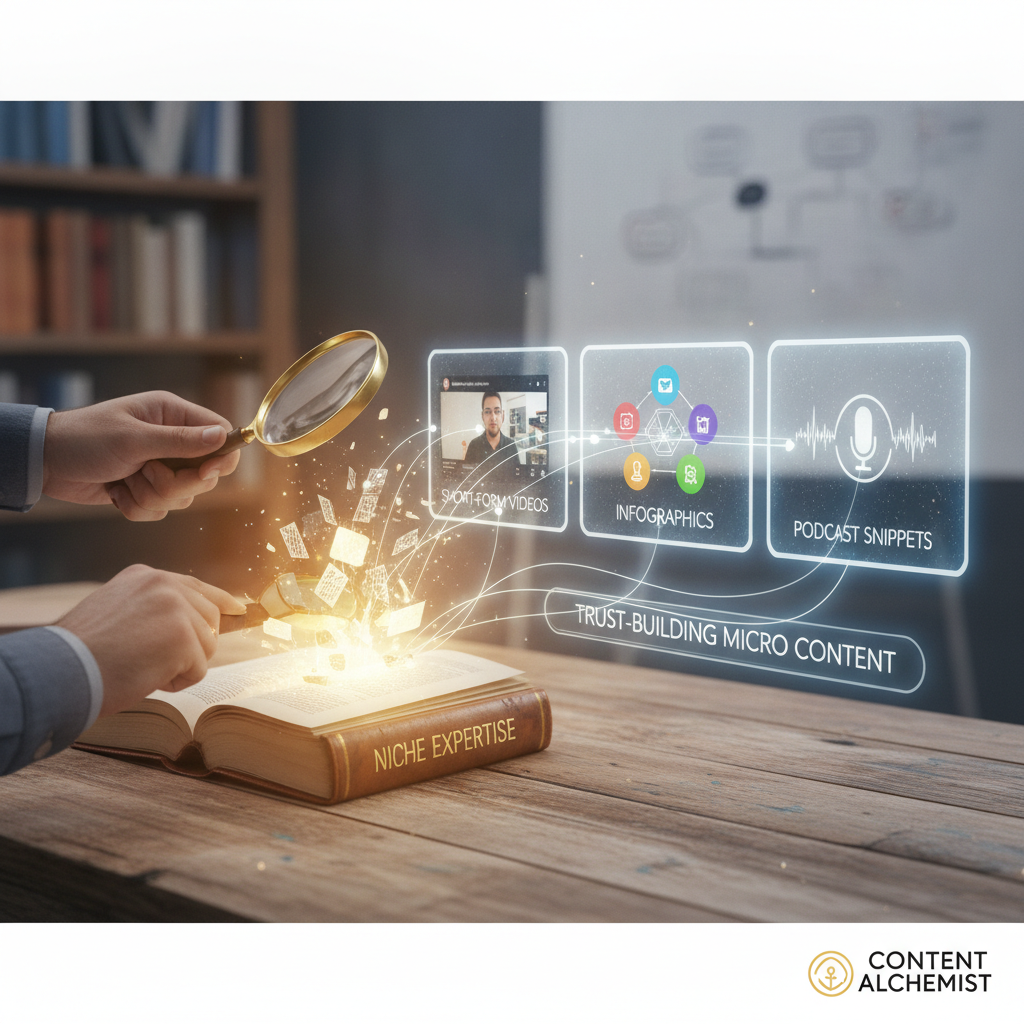
Diagram showing a short video transformed into multiple social media posts
How Does the Lego Content Strategy Work?
Don't treat a piece of content as a finished monument. Build it like a Lego sculpture. The pillar asset provides the raw material.
You then break this large asset down into modular building blocks. One recording yields a massive multiplication effect. A single session generates three to five core ideas. These core ideas then turn into ten to fifteen micro-posts.
What Types of Pillar Assets Work Best?
- Internal expert interviews about common client questions
- Recorded client calls with explicit permission
- Webinar recordings and question segments
- Team knowledge-sharing sessions or detailed Slack discussions
- Quick video reactions to breaking industry news
How Do You Break Down Pillar Content Into Micro-Posts?
Start by transcribing the audio or video. Highlight the most contentious or insightful points the expert makes. Match each core idea to the right social format.
A strong opinion might become a text post. A step-by-step explanation works perfectly as a carousel. A quick tip easily becomes a short video.
What Content Angles Build the Most Trust With Specialized Audiences?
Specialized audiences spot generic advice instantly. They want content that challenges their thinking. Three specific content types build the highest level of trust.
Which Industry Myths Should You Debunk?
Ask your experts what best practices they fundamentally disagree with. Contrarian but defensible positions immediately attract attention. You can use these exact prompts during your recording sessions:
- What is the biggest waste of time in our industry right now?
- What conventional wisdom is actually hurting our clients?
- What metric does everyone track that doesn't actually matter?
How Do You Structure a Micro-Case Study?
Use micro-case studies when you have specific data to share. Ditch the ten-page case study document. Create sixty-second snippets focused on a single metric.
Use a simple before and after format. For example, explain exactly how your team reduced software load times by forty percent in thirty days. Keep the focus entirely on the execution details.
Why Does the Point of View Shift Matter?
A post without a perspective is just a commodity. Useful content takes a clear stand. You must identify your expert's unique angle on a common problem.
Information tells the reader what happened. Insight tells the reader what to do about it.
How Can Small Marketing Teams Implement This Without Burning Out?
Limited bandwidth is the norm for most marketing departments. You need sustainable workflows to make this strategy work.
How Do You Plan a Monthly Content Sprint?
Schedule two to three expert recording sessions per month. This requires only an hour of the expert's time. Use a batch processing approach to edit and schedule the resulting assets. This creates a predictable timeline from recording to publication.
According to the 2026 Marketing Performance Study by Gartner, 74% of marketers who improved their performance did so by refining their content strategy, not just increasing volume.
How Do Repurposing Tools Multiply Output?
Small teams can't manually edit dozens of clips and write matching copy. This is where Repostra.app becomes an essential part of the workflow.
Repostra.app bridges the gap between deep expert knowledge and the high-frequency requirements of modern social platforms. The tool automates the repetitive formatting work while preserving the authentic human voice. You get the efficiency of automation without losing the genuine expertise that builds trust.
Why Does Humanized Content Outperform Automated Content?
The automation saturation problem forces audiences to change their behavior. Buyers easily recognize and quickly dismiss generic content. What makes content feel human is the inclusion of specific context, personal experience, and strong opinions.
"The market has reached peak AI saturation. Buyers don't just want answers. They want answers born from real-world scars. Humanized content is not about being less professional. It's about being more specific. When everyone can generate an article in ten seconds, authentic expertise is the only true differentiator left."
Robert Rose, Chief Strategy Advisor, Content Marketing Institute
The trend clearly favors creator-based, expert-driven material. This validates the strategy of relying on your internal specialists rather than generic writing tools.
How Do Buyers Spot the Difference?
Buyers rely on specific signals to determine if a piece of content is worth their time.
| Feature | Generic Content | Humanized Expert Content |
| Context | Broad industry generalizations | Specific client scenarios |
| Perspective | Neutral and completely objective | Opinionated with a clear stance |
| Examples | Hypothetical situations | Real metrics and direct experiences |
| Tone | Polished but lifeless | Conversational and slightly raw |
What Are Common Mistakes When Repurposing Expert Content?
Common mistake: Over-polishing until authenticity is lost.
Correction: Leave in the natural pauses and conversational tone. Raw expertise builds more trust than a heavily scripted corporate video.
Common mistake: Repurposing without adapting to the specific platform.
Correction: Rewrite the hook for LinkedIn. Recut the video dimensions for YouTube. Respect the format each audience expects.
Common mistake: Treating all expert insights as equally valuable.
Correction: Be ruthless in the editing room. Only extract the gold. Discard the generic background information.
Common mistake: Forgetting the point of view requirement.
Correction: Never publish a summary. Always include the expert's specific take on why the information matters.
Common mistake: Operating without a clear distribution strategy.
Correction: Map exactly which internal stakeholders will share the micro-content before you create it.
Frequently Asked Questions
How long should the initial expert recording be?
The optimal length is fifteen to twenty minutes. This is long enough to provide real depth but short enough to respect the expert's time. You should focus on one specific topic or theme per session rather than trying to cover everything at once.
What if our subject matter experts hate being on camera?
Audio-only recordings work perfectly well. You can transcribe the audio for text posts or create static quote graphics. You can also analyze their detailed email responses or internal Slack messages to find extractable ideas without ever hitting record.
How many pieces of micro-content can one recording typically generate?
One focused conversation typically yields three to five core ideas. Each of those ideas can become two to four platform-specific posts. A single short session often results in ten to twenty highly relevant pieces of content.
How often should we schedule expert recording sessions?
Start with two to three sessions monthly. This requires only thirty to sixty minutes of total expert time. This schedule provides enough raw material for daily posting across one or two platforms without overwhelming your subject matter experts or your marketing team.
What platforms work best for expert micro-content?
LinkedIn remains the dominant platform for B2B expert content. Twitter provides an excellent venue for rapid thought leadership. YouTube Shorts works very well for reaching younger professional audiences. You should choose the platform based entirely on where your specific buying committee actively engages.
Getting Started With Your First Content Sprint
You can launch this process immediately. Your focus for the first week is simply finding the right expert and the right topic.
How Do You Execute the Monthly Implementation Roadmap?
Days One to Seven: Identify your most vocal subject matter experts and select one specific client problem to discuss.
Days Eight to Fourteen: Conduct your first two short recording sessions using simple template questions.
Days Fifteen to Twenty-One: Extract the core ideas and format the content into modular pieces.
Days Twenty-Two to Thirty: Publish the micro-posts, tag the experts, and measure the initial engagement.
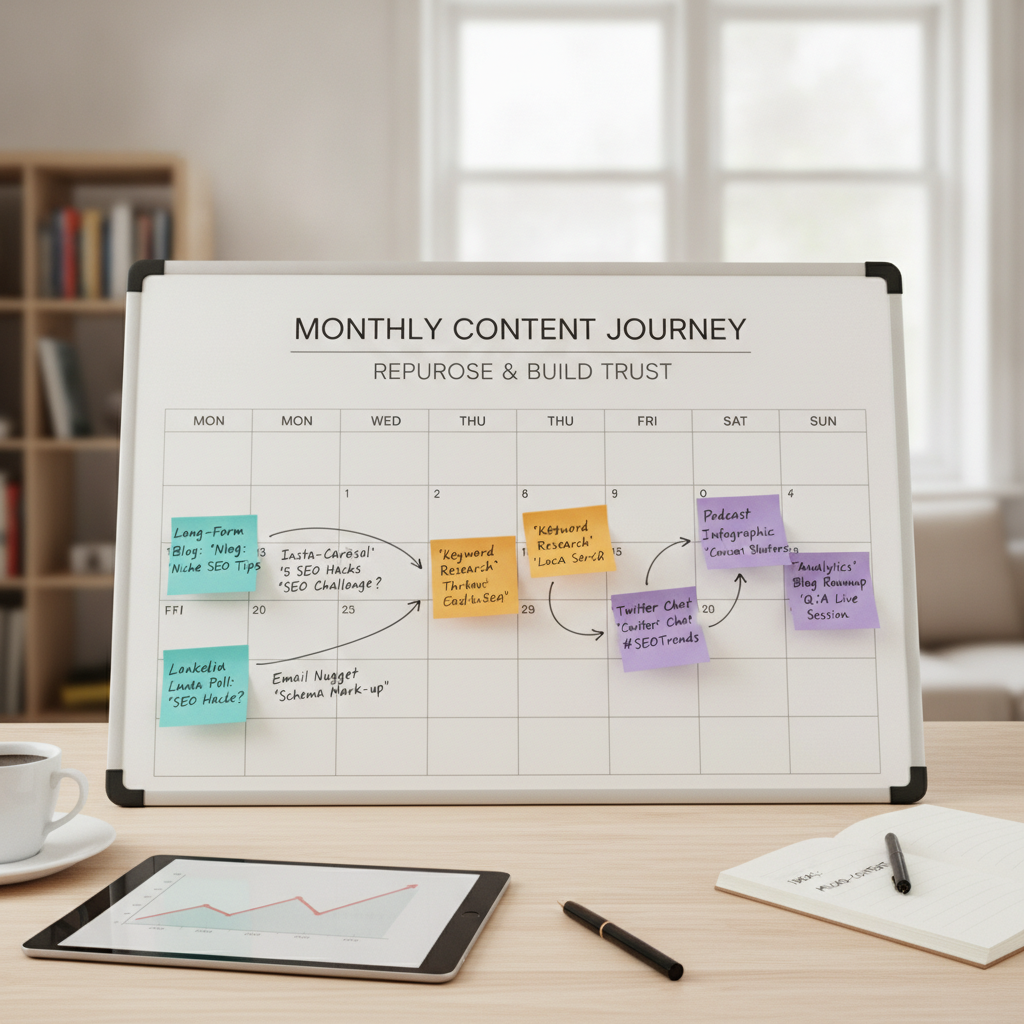
Calendar graphic showing the four week implementation plan for the micro content sprint