How to Repurpose Customer Success Stories Beyond the Case Study
Show how one customer story can fuel social posts, short videos, email content, and sales enablement. This offers a fresh angle on getting more value from proof-driven marketing content.

Repurpose Customer Success Stories: Turn One Case Study Into 15+ Marketing Assets
Static PDF case studies are dead weight in your content library. You pour weeks into interviewing clients, gathering data, and designing beautiful documents that get downloaded a handful of times and forgotten. Meanwhile, your buyers are scrolling LinkedIn, checking email, and researching solutions across seven different channels before they'll ever talk to sales.
The fix? Stop treating each case study as a single asset. One solid customer interview can fuel your entire content engine for months. Break it into social posts, video clips, email sequences, sales tools, and more. This approach meets buyers where they actually spend time, builds trust through repetition, and maximizes every dollar you invest in customer interviews.
Key Takeaways:
- A single case study easily generates 10-15 distinct content pieces across multiple formats
- Repurposed content reaches buyers at different funnel stages, from awareness to decision
- Multi-format distribution builds credibility faster than standalone PDFs ever could
- Sales teams win more deals when they have bite-sized proof ready for live objections
- Automated tools extend your reach without manual distribution work
Why should you repurpose customer success stories across multiple formats?
Buyers don't trust your marketing claims anymore. They trust other buyers.
According to the Content Marketing Institute's 2025 B2B Report, 71% of B2B buyers consume three to five pieces of content before engaging with sales. If your customer proof lives behind a single form fill, most prospects will never see it. You need to extract the best parts and distribute them where your audience already hangs out.
Think about your own research behavior. You check LinkedIn. You scan email. You read reviews on G2. You watch quick videos. Rarely do you download a 2,000-word PDF unless you're already deep in the buying process.
Different formats also serve different learning styles. Some prospects want hard data in infographics. Others prefer the human narrative of a video or the quick validation of a quote card. Research from G2 and Heinz Marketing shows that 92% of B2B buyers are more likely to purchase after reading a trusted customer story. But that story only works if they actually see it.
Marketing teams face constant pressure to do more with less. Repurposing a single strong customer story into an entire content ecosystem maximizes your initial investment. Seeing the same customer win in multiple contexts reinforces your brand's credibility.
"Make your customers the hero of your stories. But remember, those stories need to live where your buyers actually spend their time. Atomizing your biggest successes into smaller, channel-specific formats is how you guarantee your message gets heard."
— Ann Handley, Chief Content Officer at MarketingProfs
What are the most effective formats for repurposed customer stories?
Start with these formats. Test engagement. Then expand based on what actually performs.
Social media stat graphics grab attention instantly. Pull the single most impressive metric from your case study. Bold numbers work best on LinkedIn for immediate credibility.
Quote cards with customer photos build emotional connections. Authentic testimonials paired with a human face drive high engagement. Text alone can't achieve that.
Short-form video clips deliver 15 to 60-second soundbites from the original interview. Behind-the-scenes footage adds authenticity that polished ads lack.
Email nurture sequences highlight specific pain points, solutions, and results. Segment by industry to keep relevance high.
Sales enablement one-pagers distill full case studies into single-page reference sheets. Organize by objection type so reps have proof on demand during live calls.
Blog post deep-dives expand the narrative with added context and actionable lessons. Optimize for prospects researching solutions via search engines.
Interactive ROI calculators turn customer metrics into tools. Prospects plug in their own numbers to estimate potential results.
Podcast segments serve auditory learners and mobile-first audiences. Publish recorded customer interviews as episodes.
Slide decks for pitching work incredibly well for video meetings. Visual storytelling helps sales teams close deals.
Website testimonial widgets rotate customer quotes or video snippets on your homepage and pricing pages. Constant social proof for casual visitors.
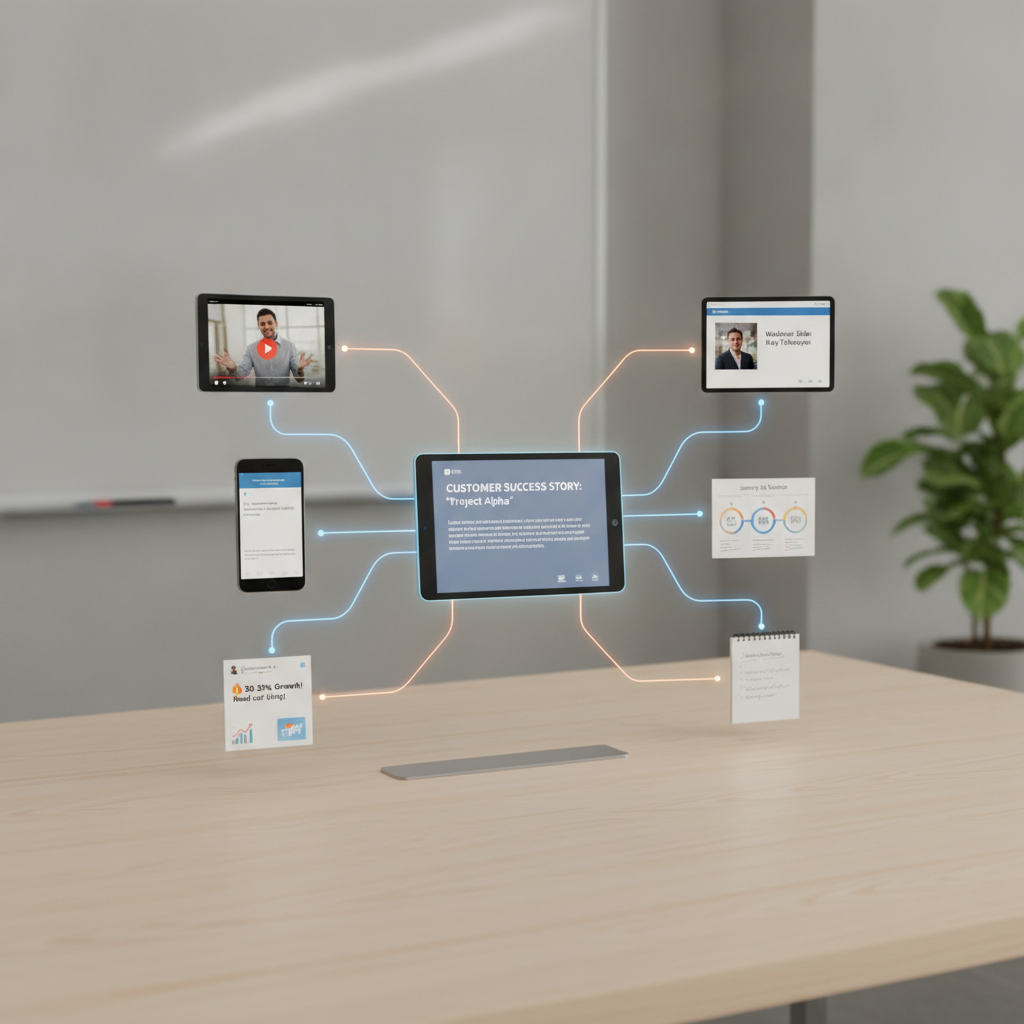
Diagram showing one case study branching into multiple content formats
How do you transform a case study into social media content?
Social media demands fast, engaging content. You can't post a PDF link and expect results.
Extract high-impact metrics first. Identify your top three numbers. Create simple stat graphics using design tools. A solid formula: state the percentage improvement over a specific timeframe alongside the customer's logo.
Create quote cards that stop the scroll. Pull direct customer quotes expressing emotional transformation, not just raw results. Include the customer's name and title. Keep text under twenty words. Use contrasting colors for maximum readability.
Develop short-form video content. If you recorded the customer interview, use that footage. Keep clips between 15 and 30 seconds for main feeds. Hook viewers in the first three seconds by stating the biggest result immediately. Always include captions. Most social video gets watched silently.
Share behind-the-scenes content. Post about the case study creation process itself. Screenshots of collaboration or quick interview outtakes humanize your brand and showcase strong customer relationships.
Spread this content over several weeks rather than dumping it all on the same day. Test different formats to see what resonates. Reshare top performers quarterly.
What makes customer stories effective in email marketing?
Email gives you a direct line to your audience. But nobody wants promotional walls of text.
Avoid emails that simply ask for a sale. Try a "Customer Spotlight" sequence structured over three emails. The first introduces a relatable pain point. The second covers the solution process and implementation. The final reveals quantifiable results alongside a strong testimonial.
For regular newsletters, use a snippet strategy. Include a two-sentence excerpt of a customer story. Link to the full landing page. This acts as gentle social proof without demanding huge time commitments.
When prospects go dark, send objection-handling emails. Share a targeted story addressing their specific concern. Frame it naturally: "I thought you might find their experience relevant." This approach also works for re-engagement campaigns. Winning back cold leads is easier when your subject line focuses on how a similar company solved a painful problem.
Don't rely strictly on plain text. Embed video thumbnails or visual graphics directly in the email body to significantly improve click rates.
How can sales teams use repurposed customer stories?
Sales reps struggle during calls when they lack immediate proof to handle objections. Equipping them with modular customer stories changes the conversation entirely.
Create an objection-killer database. Organize success stories by industry vertical, company size, and specific objections addressed. A CFO wants to see ROI timelines. An operations manager cares about efficiency. Build a searchable library so reps can instantly pull up a one-pager showing how quickly a similar customer went live.
Train your sales team on contextual story sharing. When they hear a specific pain point during a call, they should naturally transition: "That reminds me of a conversation I had with a similar customer." Following up that call with a targeted one-pager via email solidifies the point.
Include relevant one-pagers as proposal attachments. Matching a specific customer profile to the prospect's current situation proves you understand their context. Sales engineers should weave these real-world examples throughout product demos to make abstract features feel concrete.

Sales representative using an objection-killer database
How do you create sales enablement one-pagers from case studies?
A sales enablement one-pager distills a long story into a quick reference tool. It must be highly scannable and visually clean.
The header needs the customer logo, their industry, their company size, and a one-sentence challenge statement. Below that, place a key metrics box containing the three most impressive results in large, bold fonts.
Follow with a straightforward flow mapping the challenge, the solution, and the result. Use two or three bullet points for each section. Highlight specific pain points, exactly what was implemented, and quantified outcomes with clear timeframes.
Include a single powerful customer quote near the bottom. Keep it under three sentences. Ensure it highlights a major benefit. Add use-case tags at the very bottom so the document remains easily searchable in your sales database.
Keep the layout to a single page. Use white space generously. It should feel customer-focused, not like a dense product brochure.
What video formats work best for repurposed customer stories?
Video captures attention and conveys emotion better than text. Authenticity matters far more than high-end production value.
The 30-second testimonial highlight works perfectly for professional social feeds. Feature the customer speaking directly to camera about their biggest win. Overlay captions and the company logo to ensure branding is clear.
For website use, try a problem-solution mini-documentary lasting 60 to 90 seconds. Structure it to show the initial challenge, the search for an answer, the implementation, and the final results. B-roll footage of the customer actually using your product adds massive credibility.
If your audience is highly technical, use a results walkthrough. Let the customer share their screen to show actual dashboards and system results in real time.
Break longer customer interviews into an excerpt series. A 20-minute recording can easily become six short clips, each addressing a different topic like implementation speed or customer support. Release these slowly over a few months to build an ongoing narrative.
Invest in good audio. A basic smartphone camera works fine, but poor audio will cause viewers to scroll past immediately.
How do you maintain consistency when repurposing across channels?
When multiple people chop up a single document, brand consistency can quickly fall apart. You need systems to protect your messaging.
Create a repurposing template library for your design and content teams. Standardize layouts for social graphics, one-pagers, and email headers. This ensures your visual identity remains intact regardless of who builds the asset.
Develop a strict style guide for customer stories. Define exactly how to refer to clients, how to format metrics, and what constitutes acceptable quote editing. Minor edits for clarity are fine. Never change the underlying meaning.
Using a content distribution platform helps tremendously here. For example, Repostra.app allows brands to automate the distribution of success stories while maintaining total brand control. You can schedule repurposed content in advance and track exactly which formats drive the most engagement across social, email, and sales channels.
Establish a clear approval workflow. While the original case study requires full customer sign-off, build flexibility into your initial agreements so you don't have to ask permission for every single social media graphic you create later.
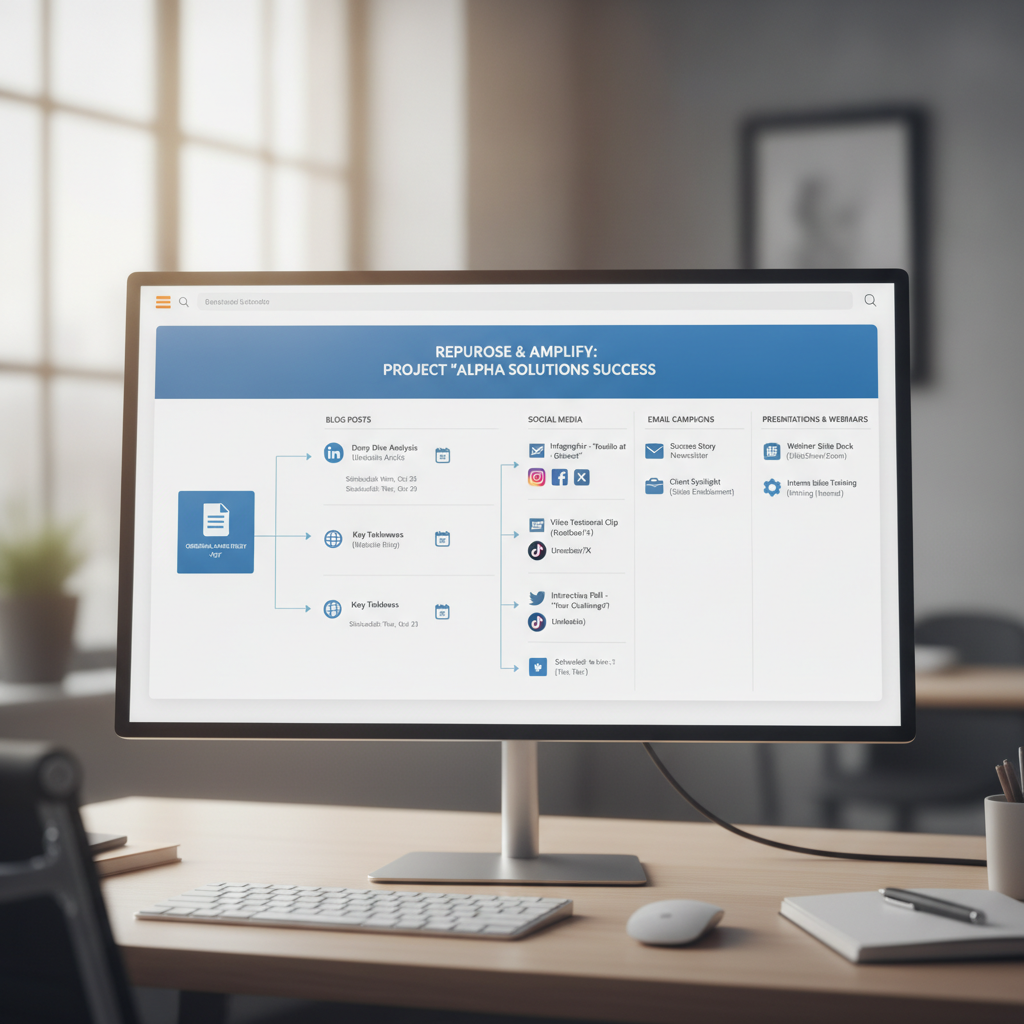
Content distribution dashboard scheduling social and email posts
What's the strategic process for repurposing one customer story?
Treating a case study as a major content anchor requires a methodical workflow. This allows you to build an entire content ecosystem from a single event.
Strategic planning comes first. Identify the unique angle before you conduct the interview. Know what metrics and pain points you want to highlight so you ask the right questions.
The interview is critical. Record the conversation with high-quality audio and video. Ask specific, open-ended questions designed to generate strong, emotional soundbites.
Create the core asset next. Write the comprehensive, detailed case study first. This serves as the single source of truth for all subsequent content. Get full customer approval on this foundational document.
Asset atomization follows. Pass the approved text and video to your design and social teams. Have them generate stat graphics, quote cards, short videos, and sales one-pagers using your established templates.
Distribution and automation close the loop. Load the assets into your sales database and schedule your social and email content over the next quarter. Use distribution tools to ensure the story stays in rotation without requiring manual daily effort.
Align your repurposed content with buyer intent. When you strategically place proof across the entire journey, you stop simply doing marketing and start actively building trust.
FAQ
How many pieces of content can one case study realistically generate?
A single, detailed customer interview can easily produce 10 to 15 distinct assets. This includes several social media graphics, a few short video clips, a dedicated email sequence, a blog post, and a sales enablement one-pager.
Do I need to get customer approval for every repurposed post?
Usually, no. If you secure broad approval for the core case study and establish an agreement that covers promotional excerpts, you don't need to ask permission every time you post a quote card. Always clarify this during the initial sign-off process.
What is the best platform for sharing B2B customer stories?
LinkedIn remains the most effective social platform for B2B buyer research. However, your own email list and direct sales conversations often yield the highest conversion rates, as those audiences are already familiar with your brand.
Can I repurpose older case studies that are already published?
Absolutely. Older case studies are perfect candidates for repurposing. Update the visual branding to match your current guidelines, extract the most impressive metrics, and feed them into your current social media and email schedules.
How do we measure the success of repurposed customer stories?
Track engagement metrics on social platforms, email click-through rates on customer spotlights, and qualitative feedback from your sales team. The ultimate indicator of success is when sales reps report that sharing a specific one-pager directly helped them handle a prospect's objection.