How to Match One Message to Five Social Platforms
Explain how to adapt a single core idea for LinkedIn, X, Instagram, Facebook, and email without making it feel copied. Emphasize platform fit, tone shifts, and format-specific execution.
The Copy Paste Trap: Why Your Multi Platform Strategy Feels Stale
You spent hours crafting the perfect LinkedIn post. Now you're staring at Instagram, Twitter, and Facebook, wondering if you can just paste the exact same text everywhere and call it a day.
You can't. Not if you want anyone to actually pay attention.
To adapt one message for multiple social platforms smoothly, you must translate your core idea into each platform's native language rather than copying and pasting. LinkedIn rewards professional carousels, Twitter thrives on punchy threads, Instagram demands vertical video hooks, Facebook favors community storytelling, and email requires intimate depth. Success requires optimizing for search, prioritizing vertical formats, and adding unique context to avoid algorithmic penalties.
Key Takeaways
- Extract the universal value from your core asset before adapting it
- Treat each platform distinctly since formats, tones, and calls to action vary
- Use natural language keywords instead of just hashtags to improve searchability
- Prioritize vertical formats to increase cross-platform visibility
- Add unique perspective to every post to bypass generic content penalties
Why does copying and pasting kill your engagement?
Assuming your audience wants the exact same format on every channel is the fastest way to tank your reach. Social platforms actively punish generic content. Audiences scroll right past recycled posts.
Learning to adapt your messaging is the difference between background noise and actual resonance. The digital landscape demands authenticity from creators and brands alike. Platforms prioritize search engine discoverability over raw chronological feeds.

A person overwhelmed by managing multiple social media formats
Posting the exact same graphic and caption across five platforms looks lazy. It signals to your audience that you care more about distribution than connection. You must build a translation strategy.
Why does platform specific adaptation matter now?
Copying and pasting is a quick way to trigger algorithmic penalties. Platforms flag low effort duplicated text and reduce its reach. The authenticity first movement requires intentionality.
People consume content differently on every single app. They skim rapidly on Twitter. They deep read on LinkedIn. They visually scan on Instagram. If your content doesn't match the expected behavior, users will ignore it.
According to Hootsuite's 2024 Social Media Trends Report, posts tailored to platform-specific formats receive significantly more engagement than generic cross-posts. This massive gap in performance proves that formatting matters just as much as the actual message.
Sarah Chen, Head of Content Strategy at Buffer, noted in a recent Buffer Blog post:
"The platforms that win right now are those treating distribution as translation, not broadcasting."
Native performance metrics drop sharply when brands reuse the exact same creative assets. Adapted content performs significantly better and yields a higher return on investment.
You must translate your idea into the native language of each destination.
How do you identify your core asset?
Your core asset is your primary piece of content. This might be a blog post, a product update, a thought leadership article, or a customer story.
Ask yourself what the single takeaway is. Find the universal value before you adapt anything. Determine who benefits and how they benefit. Define the action they should take next.
The format changes across platforms. The underlying value remains constant.
Take Repostra.app as an example. You want to announce a new scheduling feature. The core idea is that the tool saves five hours a week. That core idea becomes a completely different story depending on where you post it.
You extract the core data, the main quote, or the top tip from your primary asset. You then map that central truth to the right format.
How do you adapt content for LinkedIn?
LinkedIn users look for professional growth and industry insights. The best formats here are text heavy posts, carousels, and professional images.
The tone should be authoritative and reflective. Share your process rather than just the final outcome. Provide a detailed perspective on how you solve problems.
Using generic, machine generated language or overly promotional copy kills engagement. LinkedIn audiences crave human experiences and authentic reflections.
LinkedIn favors a vertical aspect ratio for images in the feed. Vertical first assets occupy more screen space and capture attention faster.
Turn a standard blog post into a five slide carousel. Highlight the key insights on each slide. Optimize your captions for LinkedIn search by using natural language instead of random tags.
Start with a personal challenge. Explain what you learned from that challenge. Detail how the reader can apply your findings.
End with a strong call to action. Ask your network a direct question about their own experiences.
How do you adapt content for Twitter?
Twitter requires speed and precision. The best formats are threads and short insights. Keep individual posts brief and give them a sharp punch.
The tone should be conversational, urgent, and highly opinionated. Break complex ideas into micro insights. Numbered threads help organize your thoughts and improve discoverability.
Lead with a strong hook in the first post. Deliver the actual value deep within the thread. The first post must stand alone as a complete, compelling thought.
The algorithm specifically rewards completion rate. People reading your full thread signals high quality to the platform.
Turn an eight hundred word article into a seven post thread. Dedicate one insight to each post. Keep the sentences snappy.
End your thread with a clear prompt. Ask readers to share the post if it helped them solve a problem.
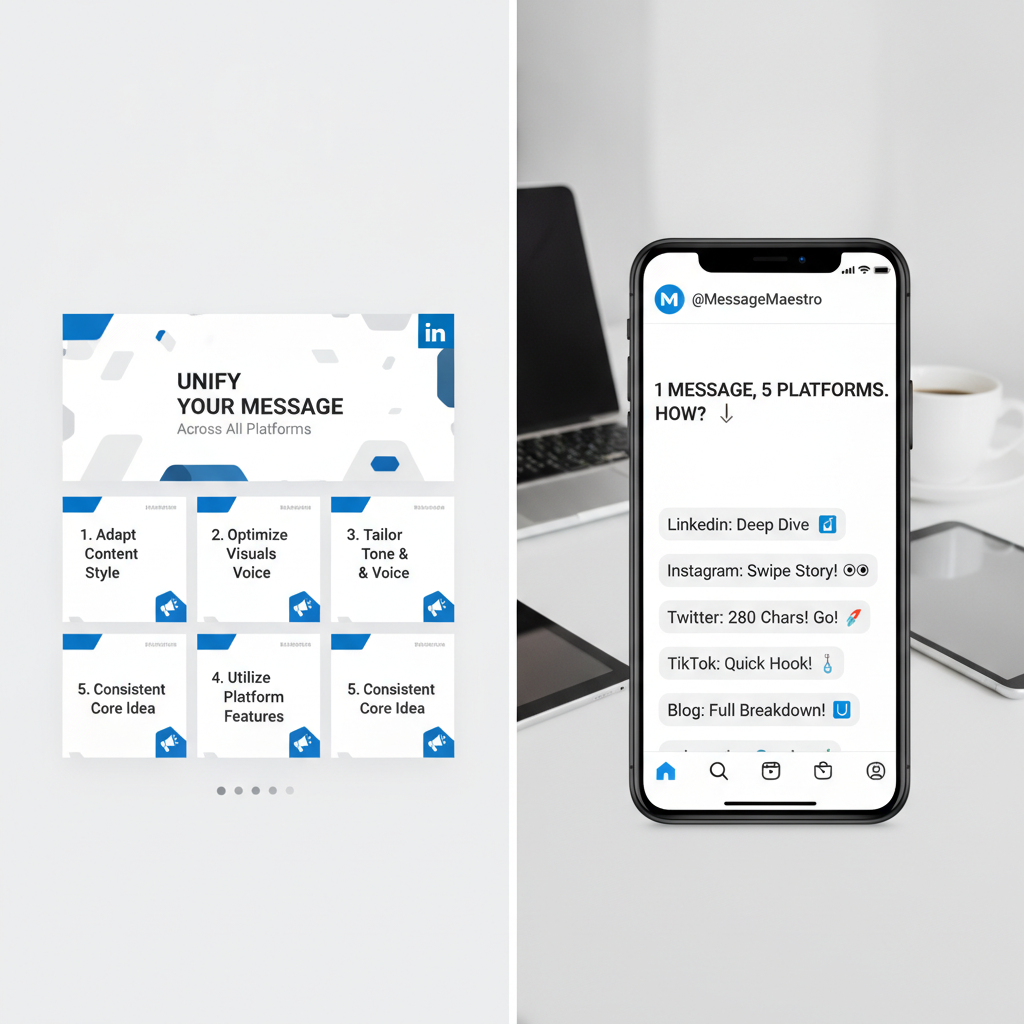
Comparison between professional carousel and text thread formats
How do you adapt content for Instagram?
Instagram is entirely visual first. The best formats are short form vertical videos and vertical image carousels.
Your tone must be aesthetic and human centric. Show the process rather than just explaining it. Demonstrate a product, a workflow, or a final result visually.
According to Meta's 2024 Creator Insights report, Instagram Reels receive significantly more reach than static posts. You must prioritize motion if you want to grow on this app.
The first three seconds of your video determine most of your engagement. Use text overlays to make your content accessible to users watching on mute.
Turn a written tip into a quick visual demonstration. Record yourself executing the advice. Use Stories as a secondary touchpoint for behind the scenes context.
Direct your viewers clearly. Tell them to save the post for later reference.
How do you adapt content for Facebook?
Facebook heavily favors community storytelling and conversation. Use a mix of video and link posts paired with rich, descriptive context.
The platform prioritizes dialogue over broadcasting. Longer captions actually work very well here if they tell a compelling story.
Encourage discussion. Ask questions directly to your community. Frame your updates around the people they impact.
The algorithm pushes posts that generate active comment threads. Engage with commenters in the first hour to boost your initial distribution.
Take a simple product announcement and turn it into a narrative. Explain exactly why this update matters to your specific community members. Highlight a customer who requested the feature.
Prompt your audience to share their own stories in the comments.
How do you adapt content for email?
Email gives you complete control. You own the channel and face no algorithmic interference.
The best format is long form and highly personal. The tone should feel like a direct, one to one conversation with a close colleague.
Add depth that social platforms simply cannot handle. Include extended examples, exclusive research, and detailed case studies.
According to recent data from Litmus Email Analytics (2024), deep personalization directly increases reader retention and click rates. Readers want to feel special.
Structure your email carefully. Start with a compelling subject line. Use curiosity or specific details. Never use clickbait.
Follow up with a personal opening. Deliver massive value in the body text. Close with a single clear call to action. Treat your email list like a private club.
What are the key strategy shifts for 2026?
Search Over Feed Optimization
Social platforms act like search engines now. People look up solutions directly on native apps instead of using traditional browsers.
Use natural language keywords in your captions. Plan your content around the specific questions people ask. Write your text exactly how your ideal customer speaks.
Hashtags are secondary to semantic relevance. Focus on the actual words in your paragraphs.
Vertical First Content Placement
Vertical formats occupy more of the mobile screen. Higher visibility directly translates to higher engagement.
Both LinkedIn and Facebook now prioritize vertical content. Always default to a vertical aspect ratio when creating visual assets. Horizontal videos get lost in the scroll.
Authenticity Requirements
Algorithms actively flag generic, repetitive material. You must add a unique perspective to every version of your post.
Thoughtful adaptation wins over lazy duplication. Check each post to ensure it feels native to its specific destination. Share your personal stance on the topic.
What is the practical workflow for adapting content?
This system cuts content creation time drastically while increasing your relevance across all channels.
Create or identify your core asset. Find the main piece of content. Extract the universal value. Identify the core lesson. Map the idea to platform specific formats. Use the table below as a guide. Transform the copy using native tone and hooks. Adjust the vocabulary. Optimize the final post with tailored calls to action.
| Platform | Best Format | Tone and Approach | Strategic Pro Tip |
| :--- | :--- | :--- | :--- |
| LinkedIn | Carousel or Text and Image | Professional, reflective | Share the how I think perspective behind your work. |
| Twitter | Thread or Short Insight | Punchy, conversational | Break complex ideas into bite sized moments. |
| Instagram | Vertical Video or Carousel | Visual, human centric | Focus entirely on visual hooks in the first three seconds. |
| Facebook | Mixed Video or Link | Community storytelling | Encourage discussion and engage in comments early. |
| Email | Long form Digest | Personal, direct | Treat it like a private conversation with a friend. |
A single blog post becomes a LinkedIn carousel, a text thread, a vertical video, a community story, and a deep dive email. Tools like Repostra.app help streamline this exact sequence.
How do Repostra users apply this strategy?
Real world application matters. Showing is always better than telling.
One recent user saved five hours a week simply by batching their adaptations. They used Repostra.app to manage the formatting templates and scheduling. They extracted the core value once and let the tool help them structure the native formats.
Another brand increased their cross platform engagement by a massive margin. They moved from a pure copy paste approach to strategic adaptation. They stopped blasting the same graphic everywhere.
You can achieve incredible efficiency without sacrificing content quality. A dedicated tool streamlines the transformation and optimization stages. It keeps your workflow organized while respecting the native language of every platform.
FAQ
How long should each platform version be?
LinkedIn needs 150 to 300 words or five to seven carousel slides. Twitter works best with three to seven posts in a thread. Instagram requires 15 to 60 second vertical videos with a short caption. Facebook thrives on 200 to 400 words. Email demands 400 to 800 words of real depth.
Can you automate this process without losing authenticity?
Partial automation works perfectly. Tools handle the scheduling and provide structural templates. Human touch remains essential for adding specific context and unique perspectives. You must still write the personal hooks yourself.
What if you lack time to create multiple versions?
Start with just three channels. Use LinkedIn for professional reach, Instagram for visual engagement, and email for owned relationships. Two excellent posts will always outperform five mediocre ones. Quality always beats quantity.
How do you know if your adaptation is working?
Track your engagement rate per platform rather than just total reach. Look closely at saves, shares, and the quality of comments. Compare your newly adapted content against previously cross posted material over a 30 day period.
Should you post the same core message everywhere on the same day?
Space your posts out by 24 to 48 hours. Different audiences have distinct consumption patterns. Staggering your delivery maintains freshness and lets you test which visual hooks perform best.