How to Create Content Faster With Modular Source Material
Introduce a modular approach to content creation where quotes, stats, stories, and insights are captured in reusable building blocks. Readers learn how this method makes scaling content easier without sacrificing quality or human oversight.

Modular Content: Build Once, Publish Everywhere
Modular content creation breaks information into reusable building blocks like stats, quotes, stories, and insights. You can mix and match these assets across channels. This approach eliminates blank page syndrome and lets teams scale production from days to minutes. By maintaining a central library of pre-approved modules, marketers preserve human oversight and quality while meeting the demand for high volume and authentic messaging.
Key Takeaways
- Modular content builds a library of reusable assets that speeds up production by up to 70 percent
- Pre-approved building blocks ensure consistency and reduce compliance risk across all channels
- Human oversight remains central because you assemble smart combinations instead of relying on unedited AI
- Companies with documented content strategies are 3.5 times more successful than those without (Content Marketing Institute, 2024)
- Topic clusters built from modules rank better than standalone articles, improving discoverability

Illustration showing the transition from chaotic content writing to structured modular assembly
Why Is Writing More The Wrong Answer To The Content Volume Trap?
Marketing teams face immense pressure to publish faster across multiple channels. Most teams respond by working longer hours or hiring more writers. This cycle leads to burnout and inconsistent quality. You do not have to write from scratch every time you need a new post or email.
A modular approach offers a smarter infrastructure. You can stop typing the same product benefits and origin stories repeatedly. By creating a system of reusable components, you can meet high volume demands without sacrificing your sanity or your brand voice.
What Is Modular Content?
Modular content involves breaking information down into small, self-contained, and reusable components. These components are your building blocks. A module might be a customer testimonial quote, a product statistic, a three-sentence origin story, or an industry insight.
Traditional content creation relies on monolithic assets. You write a whitepaper and it stays a whitepaper. Modular creation looks more like building with LEGO bricks. You build custom structures from standardized pieces.
This structural shift directly impacts visibility. Research shows that content organized in modular, topic-cluster structures performs better in search results than standalone articles. The structure helps search engines understand relationships between pieces of content.
Why Does Modular Content Matter Right Now?
Audiences expect deep personalization and absolute consistency. Meeting both expectations manually is nearly impossible.
The rise of artificial intelligence complicates this further. Many marketers now use AI for content creation, but audiences can often identify purely AI-generated content. The robotic tone gives it away. The lack of nuance betrays its origins.
Modular systems solve this paradox. They let humans maintain creative control by assembling AI-assisted blocks rather than publishing raw AI output. You get the speed of automation with the authenticity of human curation.
What Are The Main Benefits Of Using Modular Source Material?
Faster Speed To Market
You eliminate blank-page paralysis entirely. Teams can assemble campaigns in minutes instead of days. When you pull from an existing library of approved assets, production time drops significantly.
Unshakable Consistency Across Channels
Every touchpoint uses verified facts and approved language. This drastically reduces the risk of contradictory messaging. Regulated industries like finance and healthcare find this especially valuable for compliance.
Personalization At Scale
You can mix and match modules for different audience segments. You might use the same core product statistic but swap out the customer story based on the reader's industry vertical. You tailor the message without doubling your workload.
Quality Through Human Oversight
Modules are created and approved once by humans. The assembly process remains editorially supervised. You scale production safely while keeping your brand voice intact.
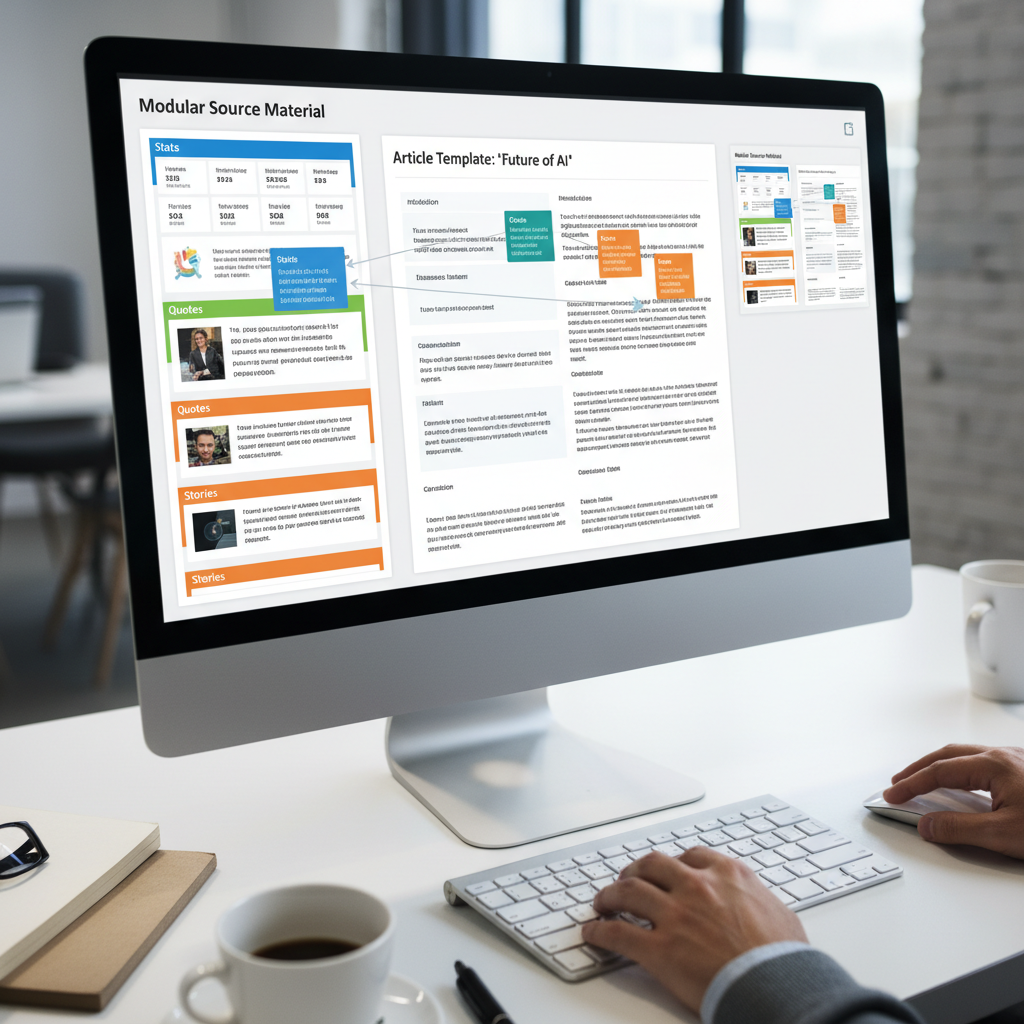
A modular content management system interface showing drag-and-drop assembly
How Do You Build A Modular Content Library?
Step One: Audit your existing content. Review your high-performing blog posts, whitepapers, and case studies. Extract the strongest components. Look for standout statistics, compelling quotes, and memorable anecdotes you have used more than once.
Step Two: Standardize your module categories. Define clear types like Educational Insights, Customer Proof, Product Benefits, FAQ Sections, and Compliance Statements. Create standard templates for each type to ensure a consistent format.
Step Three: Build your central repository. You need a system that is searchable, accessible to the whole team, and easy to update. Tools like Repostra.app are built specifically for this kind of modular content management. Tag your modules by topic, channel suitability, and approval status.
Step Four: Establish governance rules. Assign owners for each module category. Set review cycles to keep information fresh. Evergreen content might need a quarterly review, while data-driven modules require monthly updates.
How Do You Actually Use Modular Content In Daily Creation?
You must shift your mindset from writing to assembling. Start with your message goal. Select supporting modules from your library to answer the core questions. Add connective tissue and context, but let existing blocks do the heavy lifting.
Consider a standard LinkedIn post about a product update. You pull a product benefit module, a customer testimonial module, and a call-to-action module. You add a timely hook based on industry news. A task that once took forty-five minutes now takes five.
Different channels require different assembly methods. Blog posts might combine six modules with original introductions. Email newsletters can mix a news module, a statistic module, and a story module. Social media often needs just a single module paired with a custom hook.
What Are Common Mistakes When Starting With Modular Content?
Many teams try to build too much too soon. Starting small with twenty solid modules beats creating two hundred mediocre ones. Focus on your most-used content types first.
Another common error is making modules too large. If a module is three paragraphs long, it is not flexible enough. It must fit naturally into different contexts. Stale data also ruins credibility, so you must build review cycles into your workflow immediately.
Finally, do not lose the human touch. Concatenating modules without smooth transitions feels robotic.
"The biggest mistake I see teams make is treating modular content like mad libs, plug and play with no thought. The real power comes from thoughtful curation and human-guided assembly, not automation for automation's sake."
— Sarah Chen, Head of Content Strategy, MarketingProfs
How Does Modular Content Work With Artificial Intelligence?
Artificial intelligence is a powerful assistant for modular systems. You can use tools to draft variations of a single module, suggest new combinations, or optimize a block for different social platforms.
The human role shifts to creating the source material, approving the combinations, and maintaining the brand voice. This synergy gives you the best of both worlds. AI speeds up the tedious parts of assembly, while humans ensure quality and resonance.
Try using AI to generate three variations of a new module. Select and refine the best one to add to your permanent library.

Line graph illustrating high content volume maintained alongside high quality using modular methods
What Results Can You Expect From A Modular Content Approach?
Teams typically see a massive reduction in production time within the first few months. Faster time-to-publish gives you a distinct advantage for time-sensitive industry news.
Quality and consistency improve alongside speed. You experience fewer off-brand moments because you are reusing proven, approved material. Junior team members can produce high-quality work much faster, freeing senior strategists to focus on high-value creative campaigns.
According to the Content Marketing Institute (2024), companies with a documented content strategy are 3.5 times more successful than those without. Modularity turns that strategy into daily execution. A documented library allows mid-size companies to double their content output without adding headcount.
How Should You Spend Your First Month With Modular Content?
Week One: Audit and extract. Identify your ten best-performing pieces of content. Pull out twenty reusable components. You do not need a fancy system yet. A simple spreadsheet works perfectly for this stage.
Week Two: Categorize and standardize. Group your extracted modules by type. Create simple templates and ask your team which categories matter most to their daily work.
Week Three: Set up your system. Choose your management tool, such as Repostra.app, and upload your modules with proper tagging. Train your team on how to search and apply the blocks.
Week Four: Test and iterate. Create five new pieces of content using only your modules and some light editing. Gather feedback from the team and refine your categories based on actual usage.
FAQ
Does modular content make everything sound the same?
Not if done correctly. Modules are ingredients rather than finished dishes. The same statistic can support different arguments, and a customer quote can be framed for different audiences. The key is thoughtful assembly and adding unique context for each piece.
How many modules do I need to start seeing benefits?
Most teams see immediate value with just twenty high-quality modules covering their core topics. You do not need hundreds on day one. Start with your most-repeated elements like sales deck statistics and common product benefits.
How often should I update my content modules?
It depends on the specific type of information. Evergreen insight modules might need only a quarterly review. Data-driven statistic modules often require monthly or weekly updates. Review any module that mentions a specific year or ranking at least once a quarter.
Can modular content work for highly technical industries?
Absolutely. Regulated industries like legal, medical, and financial services benefit enormously from pre-approved compliance language. Technical products benefit from standardized specification modules that prevent costly factual errors.
What tools do I need for modular content management?
At a minimum, you need searchable storage with good tagging capabilities. As you scale, dedicated platforms like Repostra.app offer purpose-built features like version control, approval workflows, usage analytics, and team collaboration tools. Start simple and upgrade as your library grows.
From Content Creation To Content Curation
The best content teams are no longer just writing more. They are managing smarter. Modular content transforms your scattered knowledge base into a highly organized strategic asset.
Human creativity remains essential in this new model. You elevate your role from a simple typist to a strategic curator. The infrastructure you build now will compound in value as your approved library grows.
Tools like Repostra.app exist specifically to make this transition seamless. They provide the infrastructure modern content teams need to scale safely. Start your audit this week, identify your first few reusable blocks, and watch your production bottlenecks disappear.