How to Create a Repeatable Brand Voice Across Repurposed Content
Explain how teams can maintain consistency when one idea becomes many assets across platforms. Cover simple voice rules, editing checkpoints, and workflow habits that keep content recognizable and trustworthy.
Creating a Repeatable Brand Voice Across Repurposed Content
Content repurposing is a core strategic pillar for modern brands, not just a productivity hack. But scaling one idea into many assets exposes a critical vulnerability: when your brand sounds different everywhere, audiences notice and disengage. Creating a repeatable brand voice requires a documented messaging foundation that defines your exact tone and vocabulary. Teams must adapt content natively for each platform while preserving core messages through systematic editing checkpoints, centralized brand guidelines, and planning repurposing during the initial creation phase. This approach ensures your content remains recognizable, trustworthy, and effective wherever audiences engage with it.
Key takeaways:
- Document your core values, pillar messages, and voice characteristics before repurposing any content
- Adapt natively for each platform to keep the core message intact while adjusting formatting
- Implement character tests and AI-human synergy reviews to prevent voice drift
- Plan five to seven atomic pieces from every pillar asset during initial content creation
- Measure performance data continuously to double down on formats that resonate most
Your marketing team publishes a brilliant blog post. You frantically adapt it for LinkedIn, Instagram, email, YouTube, and X. Then you realize each version sounds like it came from a completely different company.

A marketing team looking at multiple screens displaying inconsistent brand content
Platforms like Repostra.app help users maximize their reach, but without a solid foundation, you're just multiplying inconsistency. When your brand sounds different everywhere, audiences notice. They disengage.
According to Edelman's Trust Barometer research, 81% of consumers say they need to trust a brand before buying from it. Creating a repeatable brand voice is the bridge between content efficiency and audience trust. You can scale your output without sacrificing the consistency that builds a recognizable identity.
Why Does Brand Voice Consistency Matter When Repurposing Content?
Consistency builds trust, and trust drives revenue.
Audiences process consistent voices quickly and comfortably. Every touchpoint a prospect has with your content either reinforces or dilutes their memory of your brand. In the current digital landscape, audiences encounter multiple brand touchpoints before making a decision.
When products are nearly identical, voice is often your only distinguishing factor. According to Marq's research on brand consistency, consistent brand presentation across all platforms can increase revenue by up to 33%.
The repurposing multiplier effect makes this urgent. One inconsistent piece of content quickly becomes 10 inconsistent impressions. Consistency is not a cosmetic concern. It is a commercial requirement.
What Is a "Messaging House" and Why Do You Need One?
Build a messaging house to prevent voice drift across platforms.
Your messaging house is the structural blueprint for your brand identity. It ensures everyone on your team understands exactly how you speak.
The Foundation Layer:
- Core values: Choose two to four maximum values
- Unique value proposition: State what you do in one clear sentence
- Pain points: List the exact problems you solve for customers
The Pillars Layer:
- Pillar messages: Define two or three supporting messages that anchor all content
- Real-world examples: Think of Apple prioritizing simplicity or Patagonia taking an environmental stance
The Guide Layer:
- Voice characteristics: Decide if you are playful, authoritative, nurturing, or irreverent
- Vocabulary lists: Maintain a list of preferred terms and words you must never use
- Mechanics: Establish grammar rules, such as using the Oxford comma or allowing contractions
Without this documented foundation, even the best repurposing tools will just multiply your inconsistencies.
How Do You Adapt Content Natively Without Losing Your Voice?
Copy-pasting the exact same text across every channel ignores platform context. That's the most common mistake.
Native adaptation means reshaping content for the specific environment where it lives. Your core message stays completely consistent, but you modulate the tone and transform the format.
Platform-specific voice adjustments:
- LinkedIn: Focus on authority and insight-driven formatting
- Instagram: Lean into visual and emotionally resonant language
- X: Keep things conversational and debate-friendly
- Email: Write personal, action-oriented copy
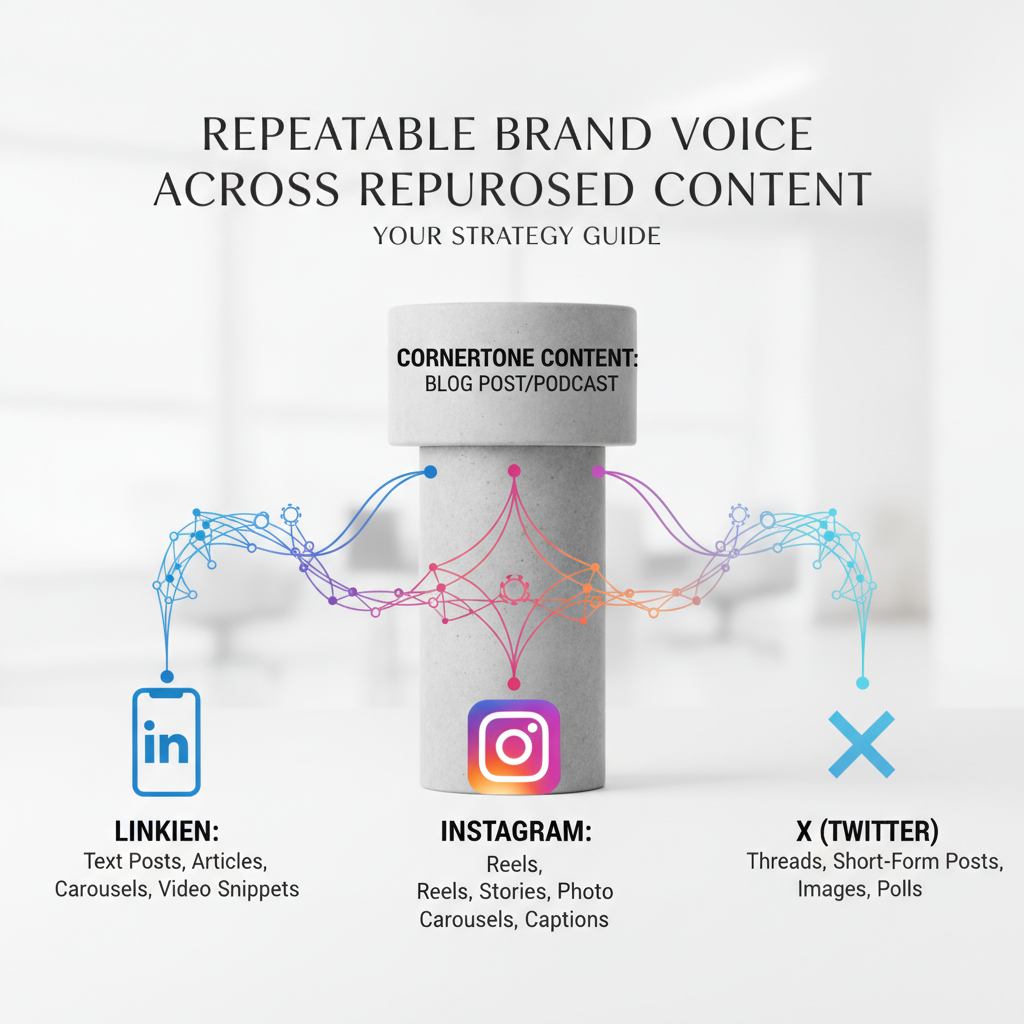
A flowchart illustrating how a single core message adapts natively to different social media platforms
Treat long-form content as source material. Plan five to seven derivative pieces at the moment of creation. A professional blog post about software updates can become a punchy carousel on Instagram or a conversational thread on X. Each atomic piece should feel native to the platform, never excerpted or forced.
What Editing Checkpoints Ensure Consistency Across All Assets?
Implementing hard stops before publishing prevents off-brand content from reaching your audience.
Human and AI collaboration requires strict guardrails. You need specific checkpoints to catch voice drift.
The Character Test: Ask yourself if your brand were a person at a dinner party, would they actually say this? Look for stiff corporate jargon if your brand is playful, or casual slang if your brand is authoritative.
AI-Human Synergy Review: AI models learn from average internet content. They miss your personality quirks and value-driven language. Human editors must inject brand-specific nuance and verify tone alignment.
Cross-Channel Consistency Audit: Set up a monthly review protocol. Check visuals, colors, grammar, and vocabulary across all active platforms to track and learn from inconsistencies.
"Without example-led tone documentation, everyone creates their own version of voice, and chaos ensues."
- Ann Handley, Chief Content Officer at MarketingProfs
What Workflow Habits Sustain Brand Voice at Scale?
Consistency cannot rely on individual memory or effort alone. Systems beat willpower every time.
You need workflow habits that make consistency automatic. Centralize your brand assets so they serve as a single source of truth. Use shared drives or internal wikis, and manage access protocols so everyone uses the most updated guidelines.
According to CoSchedule's State of Marketing Strategy report, businesses with a documented strategy are 313% more likely to report success than those without one.
Build repurposing directly into your planning phase. Assign the social media clips and newsletter blurbs at the exact same time you assign the core blog post. Assign clear roles so everyone knows who owns the native adaptation for each platform.
Finally, measure your results and refine your approach. Track engagement metrics by platform and score your voice consistency qualitatively. Use this data to double down on formats that truly resonate.
How Do You Handle Brand Voice When Multiple Team Members Create Content?
Distributed teams and freelancers require structured onboarding to maintain a unified tone.
You must train new content creators on your brand voice immediately. Provide a sample library showing clear examples of on-brand versus off-brand writing. Conduct voice calibration exercises where new hires rewrite generic text to match your style.
Establish a tiered review system. Appoint specific team members as brand voice stewards. Their job is to provide feedback loops that educate creators rather than just correcting their typos.
Develop a shared internal language for voice characteristics. Use peer review systems and brand voice rubrics for quality assurance. Regular team calibration sessions keep both in-house staff and agency partners completely aligned.
Why Authenticity Matters More Than Volume in 2026
Pumping out massive amounts of generic content damages your credibility.
Audiences detect inauthenticity instantly. The goal is to build a connected content ecosystem where every piece reinforces the others. Recognition compounds over time, and trust accumulates through steady consistency.
Most brands still choose volume over voice. They spam their channels with copy-paste content. Choosing quality repurposing gives you a massive competitive advantage.
The long-term return on investment for consistency is profound. It improves brand recall, increases customer lifetime value, and drives word-of-mouth shareability. This disciplined approach positions your brand perfectly for algorithm changes and platform shifts.
FAQ
How long does it take to establish a consistent brand voice across repurposed content?
Most teams can document their core messaging house in two to four weeks. Achieving full consistency across all repurposed assets typically takes two to three months of intentional practice. The timeline accelerates when you implement systematic checkpoints and centralize brand guidelines from the start.
Can AI tools maintain brand voice when repurposing content?
AI tools can assist with initial adaptation and formatting, but human editors are essential for brand-specific nuance. AI models train on average internet data and miss the unique terminology that makes your voice distinct. The optimal workflow uses AI for structural adaptation and human editors for voice consistency.
What is the biggest mistake teams make when trying to maintain brand voice across platforms?
The most common error is treating repurposing as copy-paste distribution rather than native adaptation. Teams publish identical text across LinkedIn, Instagram, and email. This creates a generic experience and ignores audience expectations. You must keep your core message consistent while adapting tone and format for each platform.
How many pieces of content can you realistically repurpose from one pillar asset?
A well-developed pillar piece can typically yield five to seven high-quality atomic assets. These include social media posts, quote graphics, short videos, email segments, and discussion threads. Beyond that, you risk dilution. Plan these pieces during the initial content creation phase to ensure each has a distinct purpose.
Do small teams need the same brand voice systems as large enterprises?
Small teams absolutely need documented brand voice guidelines. They often work with freelancers or use AI tools, which requires clear onboarding and reference materials. A simple one-page messaging house and a basic editing checklist prevent the problem of having multiple brand personalities across your channels.