How to Audit Underperforming Content for Repurposing Opportunities
Walk through a simple process for identifying old assets that still contain valuable ideas, data, or messaging. Instead of creating from scratch, businesses can learn how to revive overlooked content into stronger multi-channel formats.

How to Audit Underperforming Content and Turn It Into Your Biggest Traffic Driver
Auditing underperforming content means systematically reviewing what you've already published, identifying what works and what doesn't, then transforming valuable assets into new formats. Marketers inventory all published pieces, analyze engagement metrics and click patterns, then categorize each asset to keep, optimize, update, or consolidate. This process revitalizes older content by turning blog posts into videos or merging thin articles into comprehensive guides, dramatically increasing organic traffic while cutting content creation time.
Key Takeaways
- Only 35% of marketers actively repurpose content, despite 94% reporting higher ROI
- Systematically reusing top-performing assets can boost organic traffic by up to 35%
- AI-driven repurposing cuts content creation time by 60 to 80% and costs by 65%
- The audit process follows four steps: inventory, analyze metrics, assign actions, and repurpose
- Quarterly audits for high-value assets prevent your content library from becoming a graveyard
Your Content Library Is a Gold Mine You Are Ignoring
Marketers spend hours creating content that gets published once and immediately forgotten. The industry is stuck in a frustrating loop. Teams prioritize creating new assets over maximizing the value of what already exists.
According to Semrush's 2026 Content Marketing Trends report, 94% of marketers say repurposing increases ROI. Yet only 35% actively do it. This efficiency gap leaves real money on the table.
Learning how to audit underperforming content breaks this cycle. You already own the ideas, the data, and the messaging. A simple audit process helps you identify hidden gems and turn them into fresh, high-performing formats.
Why Does Repurposing Underperforming Content Matter?
Content marketing has matured from an experimental channel into a core business function. Audiences feel overwhelmed by content saturation. Their attention remains highly fragmented. Simply publishing more blog posts rarely cuts through the noise.
Brands that systematically reuse assets see up to a 35% increase in organic traffic, according to HubSpot's 2025 State of Marketing report. Systematic reuse works because it surfaces your best ideas across multiple touchpoints.
Repurposing scales your reach without scaling your workload. According to research by the Content Marketing Institute, AI-driven repurposing cuts creation time by 60 to 80% and production costs by up to 65%.
The 65% of marketers ignoring this strategy abandon a massive advantage. Most businesses already own twelve to twenty-four months of untapped content sitting idle.
"Reusing, recycling & repurposing content isn't lazy. It's smart. After all, if the content works, why shouldn't you squeeze more reach from it?" (Ross Simmonds, Founder of Foundation Marketing)
How Do You Inventory and Categorize Your Content?
You cannot improve what you do not track. A structured content inventory acts as the foundation of your entire strategy.
Choose a central hub. Google Sheets, Notion, Airtable, or a dedicated content management system work perfectly. Start small by gathering your most recent six to twelve months of content.
Log the core tracking fields. Create columns for the following data points:
- Content Title and URL
- Topic and Theme Tags (groups related content for consolidation)
- Content Type (blog, video, podcast, infographic, social post)
- Original Publish Date (identifies age and refresh needs)
- Last Updated Date (tracks refresh cadence)
- Primary Keyword (monitors SEO targeting)
Include columns for author, word count, and target audience to deepen your analysis. The Content Marketing Institute methodology highlights that maintaining a live inventory document directly correlates with long-term content success.
What Metrics Should You Track to Identify Underperforming Content?
Total pageviews alone do not tell the whole story. You need a closer look at visibility and audience behavior to find real opportunities.
Visibility Metrics (Google Search Console)
Monitor impressions and click-through rates. If impressions trend downward, the page is losing its search engine position. A declining click-through rate indicates your title or meta description needs a refresh. Dropping average positions signal that competitors are overtaking you.
Engagement Quality (Google Analytics 4)
Focus heavily on Average Engagement Time based on Google Analytics best practices. Low time on page paired with decent traffic means you have a valuable topic but poor delivery. Look for high bounce rate patterns alongside high traffic. This shows a mismatch between the headline promise and the actual content.
Evergreen Versus Declining Performance
Flag evergreen topics that received zero traffic in the last six weeks. Identify seasonal content to time your refreshes perfectly. Watch out for zombie content. These are pages indexed by search engines but never clicked.
Common mistake? Relying solely on traffic volume. Flag pages with under thirty seconds of engagement time even if they receive hundreds of monthly visitors.
How Should You Categorize Content for Action?
Organize your audit findings into a simple four-tier action framework. This decision matrix dictates exactly what happens to each asset.
Keep (High-Performing Evergreen)
These pages show consistent traffic and high engagement. They need no textual changes. Mark these to be repurposed into new formats like videos or carousels. An example is a guide ranking number one for its target keyword with strong engagement time.
Optimize (Good Foundation, Minor Tweaks)
These assets have solid traffic but clear room for improvement. Update meta tags, add internal links, refresh calls-to-action, or improve the formatting. Think of a page with strong impressions but low clicks in search results.
Update (Outdated Information)
These posts possess a good structure but feature stale data. They represent easy wins for fast search visibility. Refresh the statistics, update screenshots, add recent examples, and change the publish date. A 2024 Social Media Strategy Guide needs this exact treatment.
Consolidate or Prune (Thin or Redundant)
Multiple short posts on the exact same topic cannibalize each other. Merge them into a comprehensive guide using 301 redirects. If a page offers zero value, traffic, or engagement after twelve months, delete and redirect it. Turn five short posts about email subject lines into one ultimate guide.
| Content Status | Metric Indicator | Recommended Action |
|:---|:---|:---|
| High Value | Consistent traffic/high engagement | Repurpose into new formats (e.g., video, carousel) |
| Decaying | Declining impressions/clicks | Refresh data, update links, re-optimize SEO |
| Low Value | Low traffic/low engagement | Consolidate or prune (301 redirect) |
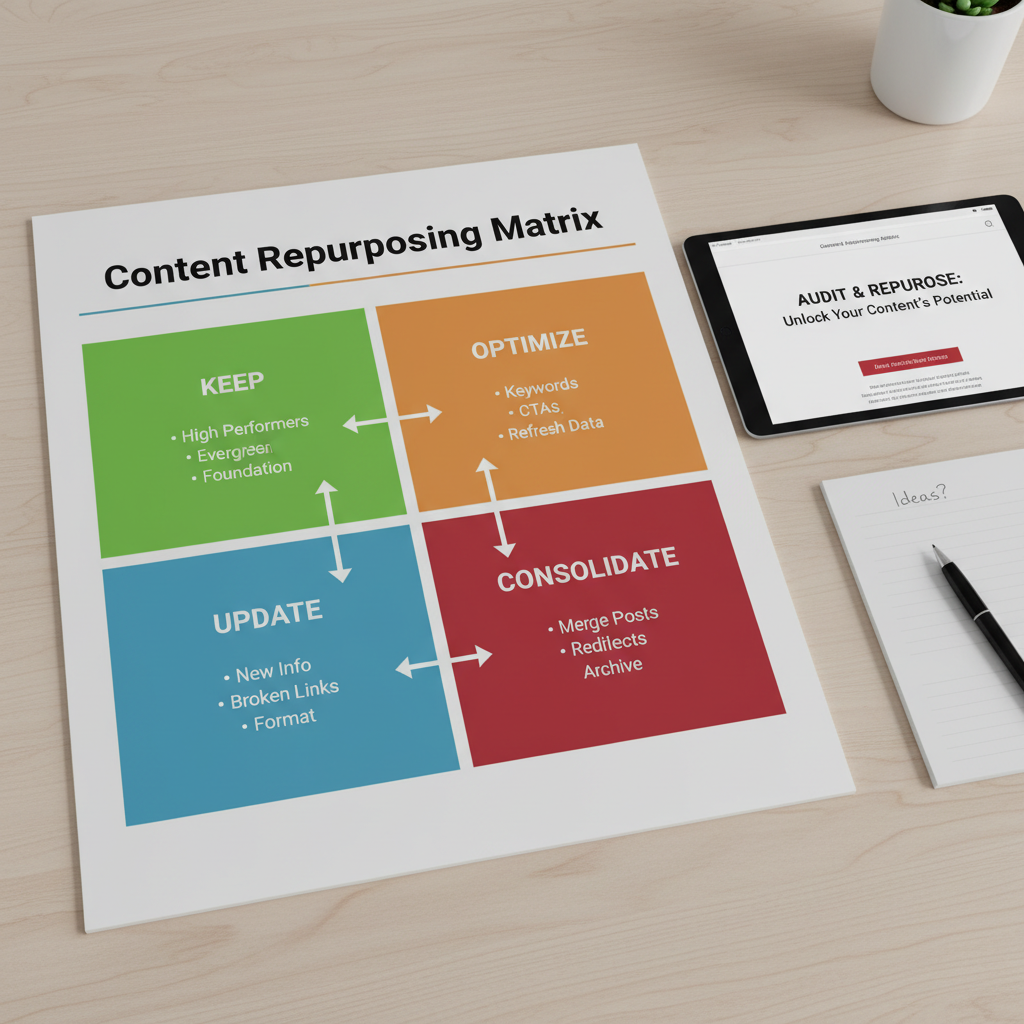
Four-tier content audit framework diagram
What Are the Most Effective Content Repurposing Strategies?
Platform-native transformation always outperforms copy-paste distribution. You must adapt the message to fit the medium.
Atomization
Break long-form content into micro-content. Extract pull quotes for X and LinkedIn. Convert data points into standalone infographics. Turn key steps into carousel posts or slide decks. One long blog post easily becomes ten social posts, one carousel, and three graphics.
Format Transformation
Cross-channel adaptation extends your reach to entirely new audiences. Tools like Repostra.app automate much of this format transformation process.
- Text to Video: Short-form video under sixty seconds delivers massive ROI right now. Use blog hooks as video scripts for Instagram Reels, TikTok, and YouTube Shorts.
- Data to Visuals: Extract statistics from reports for animated infographics.
- Blog to Email Series: Break comprehensive guides into five-day email courses.
- Podcast to Blog: Transcribe and edit audio content into optimized articles.
Refresh and Repromote
Update content substantively rather than just changing the date. Changing the publish date after a major overhaul signals freshness to search engines. Redistribute the refreshed piece through email newsletters, social channels, and internal links. Pitch the updated version to external sites for backlink opportunities.
How Often Should You Audit Your Content?
Regular audits prevent your website from turning into a content graveyard. Catching declining performance early saves search rankings before they plummet.
Quarterly
Review your high-value content and competitive topics every three months. Focus on the top 20% of your traffic-driving pages. Even a two-hour quarterly audit yields significant results for small teams.
Semi-Annually
Analyze your broader evergreen content library every six months. Review all cornerstone content and pillar pages to ensure links and statistics remain accurate.
Annually
Conduct a full content inventory review once a year. This comprehensive review should include hunting for pruning and consolidation candidates.
Workflow tip: Schedule these audits in your content calendar exactly like a new publication deadline.
What Tools Streamline the Content Audit Process?
You do not need an expensive tech stack to get started. Focus on free options first, then scale into automation.
Analytics and Data Collection
Google Search Console tracks traffic, impressions, and position changes. Google Analytics 4 handles engagement and conversion tracking. SEMrush or Ahrefs assist with competitor analysis and keyword ranking shifts.
Inventory Management
Google Sheets or Airtable offer simple and collaborative tracking. Notion provides a visual database with excellent tagging capabilities. Dedicated content marketing platforms handle larger enterprise libraries.
Repurposing and Automation
Repostra.app specifically addresses the repurposing phase by using AI to automate multi-format transformation. Canva remains the standard for visual content creation. Descript handles video editing and fast transcriptions. ChatGPT and Claude excel at content adaptation and rewriting.
Real-World Example: Turning a Single Blog Post Into Multiple Assets
Seeing the process in action clarifies the potential returns. Consider this exact before and after scenario.
The Original Asset
A blog post titled "5 Email Marketing Mistakes to Avoid" published eighteen months ago. Traffic declined from 200 to 50 monthly visits. It still ranked on page two for its target keyword. The average engagement time sat at two minutes and fifteen seconds, a strong signal of underlying value.
Audit Findings
The piece fell into the update and repurpose category. It required updated statistics and modern examples. The clear structure and actionable tips gave it high repurposing potential.
Execution
The team updated the blog post with fresh data and recent examples. They shot a short Instagram Reel highlighting mistake number one. They designed a ten-slide LinkedIn carousel covering all five mistakes. They sent an email newsletter feature with a teaser linking to the full post. They published an X thread detailing one mistake per post. They created a Pinterest infographic showing all five mistakes at a glance.
The Results
Within eight weeks, blog traffic recovered to 180 monthly visits. The Reel generated 12,000 views and 47 link clicks. The LinkedIn carousel earned 3,200 impressions and 87 shares. A single asset refresh generated a total reach of over 15,000.
FAQ
How do I know if content is worth repurposing or should just be deleted?
Ask three questions: Is the topic still relevant to your audience? Does the content have any historical traffic or engagement? Can you update it in under two hours? If you answer yes to at least two, repurpose it. Delete it only if the topic is obsolete, never had traction, and requires a complete rewrite. Even low-traffic pages provide value when consolidated into a larger guide.
What is the difference between updating content and repurposing it?
Updating means refreshing the same asset in its current format by fixing outdated statistics, adding new examples, or improving SEO. Repurposing means transforming that content into different formats for other channels, like turning a blog into a video or podcast. The best strategy updates the original asset first, then repurposes the refreshed version.
Can I change the publish date after updating old content?
Yes, if you make substantial updates. Change the publish date when you add significant new information, update more than 30% of the text, or completely restructure the piece. This signals freshness to search engines and readers. Do not change dates for minor typo fixes. Keep a note detailing the original publish date for transparency.
How much content should I create versus repurpose?
Industry leaders recommend a split favoring repurposing over net-new creation. For every ten pieces of content you publish, six or seven should be repurposed versions of existing assets, and three or four should be original. Small teams can push this to an 80/20 split to build initial momentum.
What if I do not have enough content to audit yet?
You likely have more than you think. Include blog posts, social media updates, email newsletters, video scripts, webinar presentations, and internal documentation. If you published weekly for three months, you have twelve pieces to work with. Repurpose your top three performing pieces into two different formats each to instantly create six new assets.
Turn Your Content Archive Into a Growth Engine
Auditing underperforming content helps you find hidden value rather than constantly starting from scratch. The four-step process of inventorying, analyzing, categorizing, and repurposing turns forgotten posts into active traffic drivers.
With the potential for a 35% traffic increase and massive time savings, regular auditing serves as a distinct competitive advantage in 2026. Start small by auditing your top ten posts this week.
Your content library is not a graveyard. It is a garden. With regular attention, old seeds bloom again. Tools like Repostra.app automate the heavy lifting of format transformation, making it easier than ever. Download a content audit template or start your first spreadsheet inventory today.