How Human Review Makes AI Content Safer and Stronger
Discuss why the best content workflows combine AI speed with human judgment for clarity, accuracy, and brand fit. This gives Repostra a strong angle on responsible automation without sounding overly technical.

Human Review AI Content: Why Editorial Oversight Beats Pure Automation in 2026
Human review AI content workflows combine automation's efficiency with editorial judgment to prevent costly errors, maintain brand voice, and build audience trust. Companies using systematic human oversight achieve 67% better content performance and 45% fewer brand consistency issues. While AI handles drafting and research, human editors ensure accuracy, emotional resonance, and strategic alignment. This transforms content from merely fast to genuinely effective.
Key Takeaways
- AI speed plus human judgment: Systematic human oversight improves content performance by 67%
- Trust is fragile: 68% of consumers lose trust after encountering inaccurate AI content
- Humans catch what AI misses: Up to 94% of AI accuracy issues are preventable through review
- Focus shifts to quality: In 2026, content volume is baseline. Orchestration wins
- The hybrid model works: Human-in-the-loop workflows improve AI accuracy by 15-20%
Marketing teams are drowning in content demands. Audiences grow increasingly skeptical of generic AI output. The digital landscape in 2026 has fundamentally changed. AI is no longer the strategy. It's the infrastructure.
Bottom line: The central tension for brands today is balancing speed with meaning. Generating volume is easy. Building trust is hard. This is exactly where human review AI content strategies become essential.

Team collaborating on AI content workflows
According to a 2025 Consumer Trust Study, 68% of consumers lose trust in a brand after encountering inaccurate AI content. You cannot afford to publish unchecked machine output.
The solution lies in orchestrated workflows. These systems combine machine efficiency with human insight. You get the scale of automation without sacrificing the soul of your brand.
Why Does Human Review Matter for AI Content?
AI offers confidence without accuracy. It can produce tone-deaf output and flat-out hallucinations. An algorithm doesn't understand what it writes. It simply predicts the next logical word.
Human reviewers fill three critical gaps.
Accuracy verification: AI sounds authoritative even when wrong. Human editors fact-check claims and ensure credibility.
Emotional intelligence: Algorithms miss nuance, humor, and cultural sensitivity. Humans inject brand personality and empathy.
Strategic alignment: AI lacks context for your long-term goals or ethical considerations. Humans connect content to broader market reality.
Skipping the review process leads to trust erosion and brand damage. You risk disconnecting from the very audience you want to reach.
According to 2026 industry research on AI content quality, up to 94% of AI accuracy issues can be prevented through systematic human oversight. The Content Marketing Institute consistently recommends hybrid workflows to maintain this exact standard.
Key takeaway: Human review isn't a limitation. It's where differentiation happens. Any brand can click a button to generate text. Only a human-guided brand can consistently publish content that resonates and builds authority.
What Happens When AI Content Lacks Human Oversight?
Your brand reputation is incredibly vulnerable to unverified automation.
Common mistake: Publishing unchecked AI output invites three distinct categories of failure.
Factual errors and hallucinations: Incorrect data erodes your credibility. It instantly damages your status as an industry expert.
Tone-deaf messaging: Unsupervised AI often misses cultural moments. It offends audiences or simply feels robotic and detached.
Strategic misalignment: The output might be perfectly on topic but completely off-brand. It could promote ideas contrary to your core values or mistime a sensitive campaign.

Consumer losing trust over AI errors
The financial and reputational costs are severe. You waste production time and lose your audience. You also face a steep uphill battle to win them back.
According to 2025 brand trust research, recovering from a loss of trust due to inaccurate or misleading content takes an average of 18 months. Think about the viral customer service disasters and factual errors in recent thought leadership. A quick automated post can derail a year of marketing effort. Structured oversight prevents these disasters before they happen.
How Do Human-in-the-Loop Workflows Improve Content Quality?
Human-in-the-loop workflows introduce strategic checkpoints where human judgment shapes AI output. This method maximizes both speed and quality without creating unnecessary bottlenecks.
The model operates in three distinct stages.
Step 1: AI handles the heavy lifting. It conducts initial research, creates first drafts, and formats data.
Step 2: A human adds judgment. The reviewer fact-checks, refines the voice, and ensures strategic fit.
Step 3: The system learns. Your feedback loop improves AI performance for future tasks.
According to a 2025-2026 content operations benchmarking study, companies implementing systematic human oversight achieve 67% better content performance and 45% fewer brand consistency issues.
This hybrid approach is highly effective across various fields. According to 2024-2025 AI governance research, integrating human review into AI decision-making improves accuracy by 15-20%.
"The magic of AI isn't in replacing the writer, but in clearing the path for them. Human oversight is the filter that turns raw data into resonant storytelling." — Dr. Sarah Jenkins, AI Ethics Researcher at the Center for Digital Trust
This structured workflow frees humans from rote tasks. You can focus entirely on high-value strategy. Research from Harvard Business Review on human-AI collaboration highlights that this division of labor is the key to sustainable productivity.
What Should Humans Focus On During Content Review?
Implementing a review process reclaims your time for what truly matters. It should feel like empowerment rather than a burden.
Reviewers should concentrate on five specific areas.
Accuracy and citations: Always fact-check claims. Verify sources and actively hunt for AI hallucinations.
Brand voice and personality: Ensure the tone matches your company identity. It must feel authentic to your audience.
Audience empathy: Check the piece for emotional resonance. Verify cultural sensitivity and overall accessibility.
Strategic intent: Confirm the content aligns with your active campaigns. Check it against business goals and market timing.
Compliance and ethics: Review everything for potential legal issues. Consider transparency needs and ethical implications.
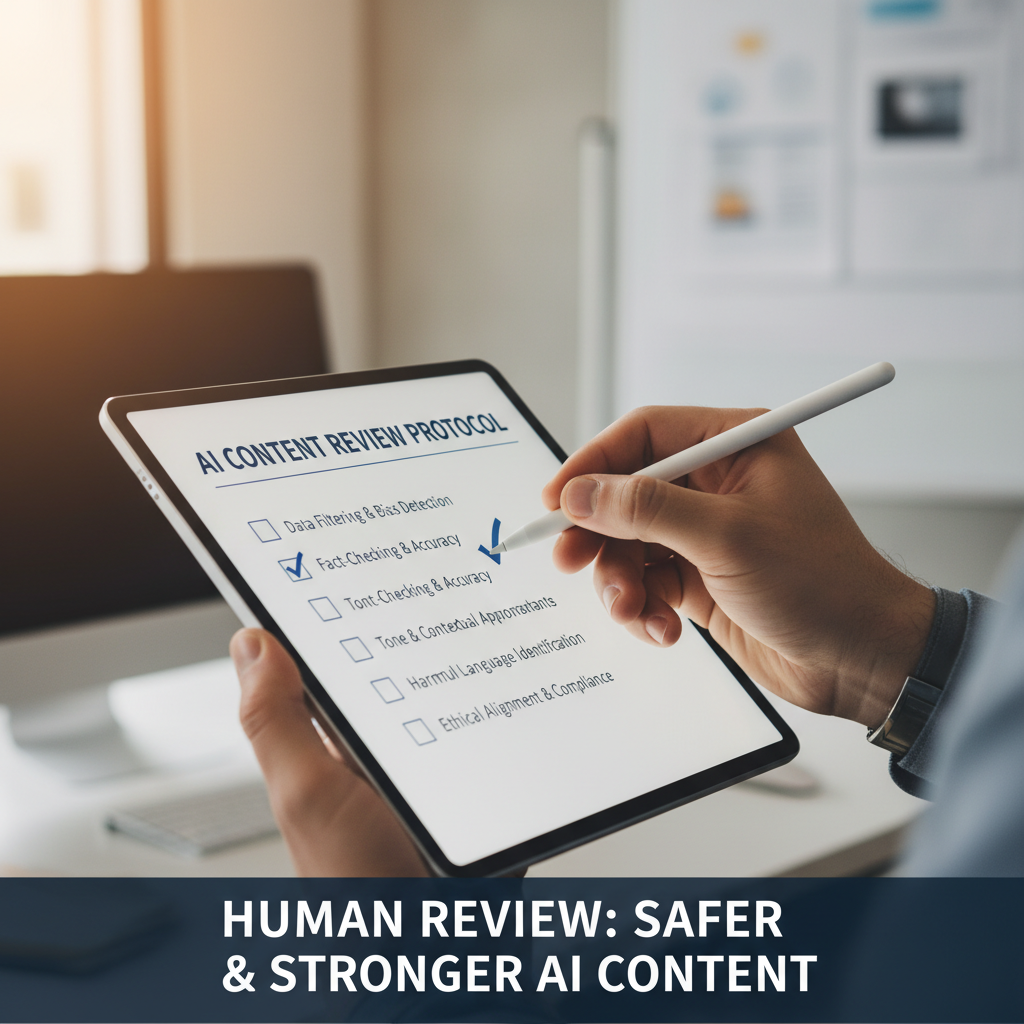
Digital checklist for content review
Practical tip: Create review checklists inside your approval workflows. This turns a complex process into a simple routine.
Think of this as minutes per piece versus hours of damage control. Platforms like Repostra focus heavily on orchestration for this reason. A good governance tool provides transparency features, audit trails, and version control. You maintain complete visibility over what gets published.
How Is the Content Mindset Shifting in 2026?
We must reframe the narrative. AI is your co-pilot, not your replacement.
The early 2020s asked if we could automate. Today asks how we orchestrate. Orchestration, trust, and authentic connection define the winning brands of 2026.
Transparency is now a massive competitive advantage. Audiences value knowing when humans remain in the loop. Authentic connection consistently beats generic volume in the modern trust economy.
Quality is your ultimate differentiator. When every competitor has access to the exact same AI tools, human judgment becomes your only protective moat.
We're moving from automated to augmented. Human creativity is amplified by powerful AI infrastructure. Responsible automation is a strict business imperative. It's not an ethical luxury. You must build systems that prioritize accuracy and connection above raw speed.
FAQ: Human Review and AI Content
How much does human review slow down AI content production?
Structured review adds about 10-15 minutes per piece. This brief pause prevents 18-month trust recovery periods. Avoiding errors, rework, and reputation damage yields a massive net efficiency gain. Consider this a strategic time investment rather than a production bottleneck.
Can AI tools detect their own errors without human review?
Current AI cannot reliably self-correct for accuracy, brand fit, or strategic alignment. Algorithms suffer from a profound confidence versus correctness problem. Even emerging AI review tools still require human validation. Systematic human oversight remains necessary to prevent up to 94% of accuracy issues.
What types of content need the most human oversight?
High-stakes content requires the deepest review. This includes thought leadership, customer-facing materials, and data-driven claims. Lower-risk items like social media variations, internal drafts, or simple formatting tasks need less scrutiny. Build a risk-based framework that applies more oversight to assets with higher brand exposure.
How do you balance speed and quality in content workflows?
The secret is a strategic division of labor. Let AI handle speed tasks like outlining and data gathering. Assign humans to judgment tasks like tone checking and fact verification. Establish clear review criteria once and apply them consistently through templates. Orchestration platforms can streamline these approvals without sacrificing final quality.
Is human review legally required for AI content?
This depends heavily on your industry and region. Regulatory attention is rapidly increasing globally. According to recent EU AI Act mandates and FTC guidelines on deceptive practices, transparency and accuracy protect against liability. Ethical review is an imperative even where it's not yet legally mandated.
Orchestration Over Automation
Making human review AI content workflows the standard is how you win in 2026. Speed is merely the baseline today. Editorial judgment is your true differentiator.
Brands that embrace strategic human-in-the-loop systems will significantly outperform those chasing pure automation. You must audit your current workflows immediately for review gaps.
The future of digital marketing is human creativity amplified by machine efficiency. It's never about replacement. Platforms like Repostra are built to support these exact orchestrated workflows.
Reclaim your strategy. Empower your team to focus on connection, and let AI handle the rest.