How Content Repurposing is Redefining Social Media Strategies Today
Explore how the integration of AI and strategic content repurposing is reshaping the way businesses approach social media marketing, leading to more effective and engaging campaigns.
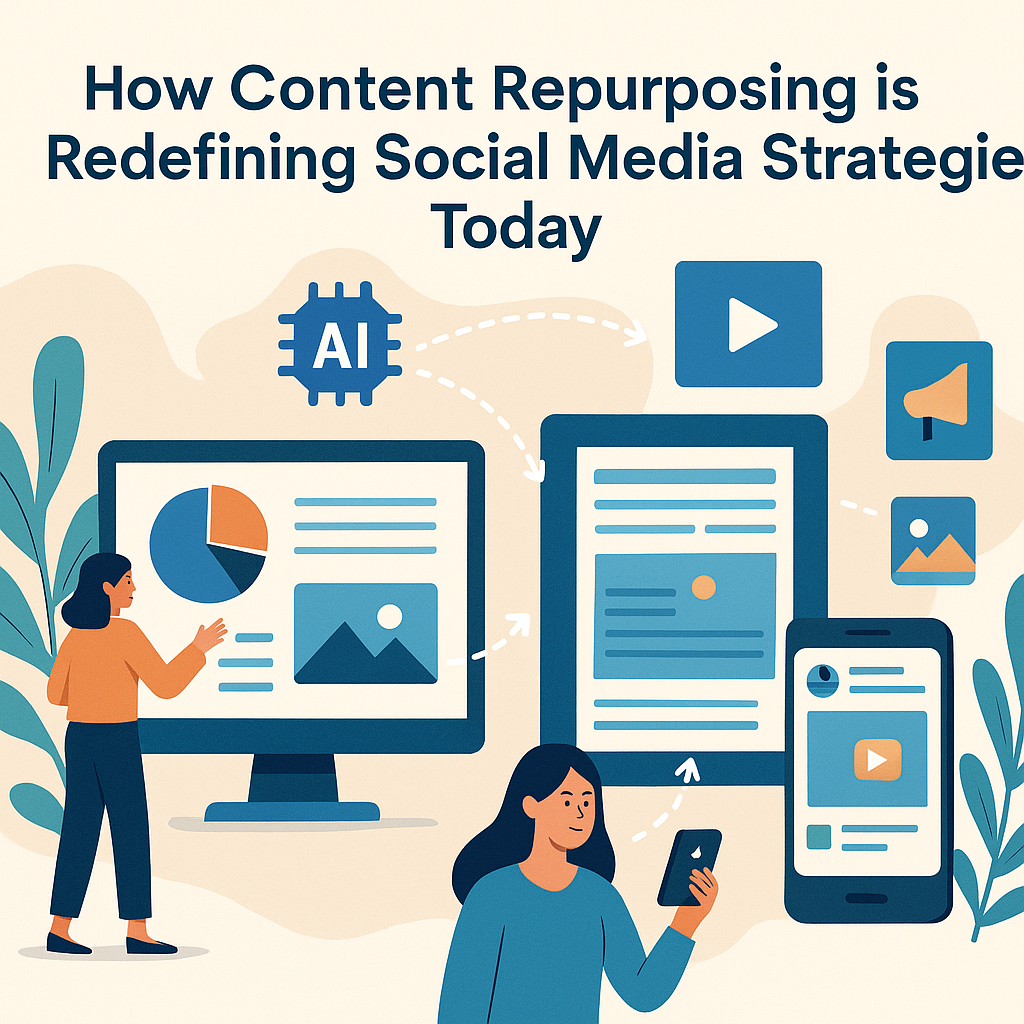
Are You Creating Content, or Just Feeding the Algorithm?
Picture a marketer staring at an empty content calendar on a Monday morning. The pressure is on to post daily across five different platforms. The blank screen blinks back, demanding fresh ideas, catchy hooks, and engaging visuals. This exhausting cycle of constant creation has pushed countless professionals straight into burnout. Quality takes a back seat to sheer volume.
We've all been there. Trying to keep up with the endless demand for new posts is a fast track to exhaustion. But the landscape of social media marketing has experienced a massive shift. We're moving away from volume-based approaches to value-based strategies.
Content repurposing is no longer just a clever trick to save time. It's the absolute foundation of modern social media strategy. Instead of creating ten average posts from scratch, smart marketers create one exceptional piece of content and strategically adapt it. This approach boosts engagement, protects creator energy, and builds real authority in a crowded digital space.
Why Creating Fresh Content Daily No Longer Works
The advice to post three times a day is completely outdated. It's an unsustainable model that feeds a burnout epidemic among marketing managers and small business owners alike. Platforms have changed how they reward content.
We now live in a zero-click reality. Social networks want to keep users on their apps. They prioritize native content that offers immediate value over posts designed simply to drive traffic elsewhere. The algorithms favor quality engagement over posting frequency. A single post that sparks genuine conversation will outperform a dozen generic updates that receive only passing glances.
The goal has shifted from mere presence to genuine visibility. You don't just want to show up in a feed. You want to make an impact. Research shows that the vast majority of marketers now use content repurposing strategies. They recognize that working smarter is the only way to survive the current digital ecosystem.
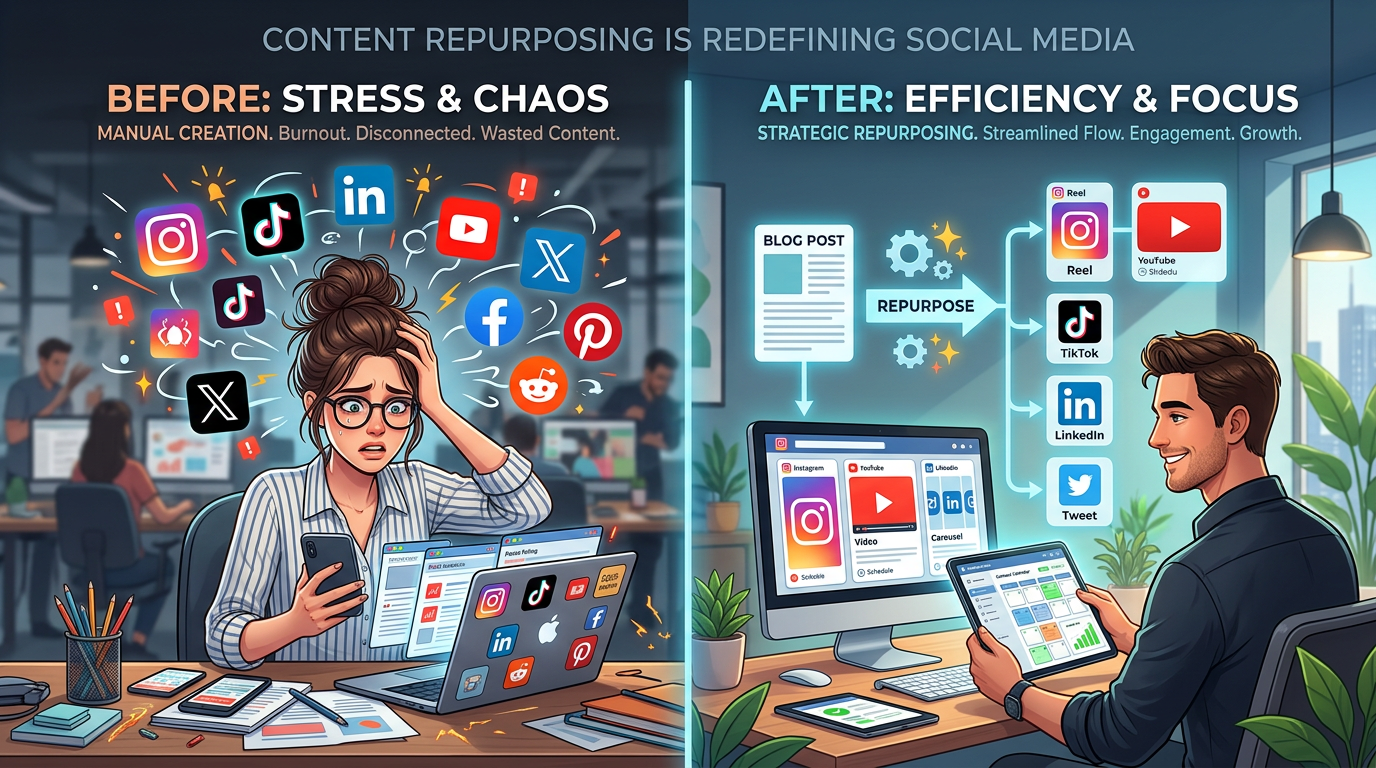
Volume-based versus value-based social media strategy concept
The Authority Asset Framework That's Changing the Game
To succeed today, you need to understand the Authority Asset. An Authority Asset is one high-quality, long-form piece of primary content. This could be a comprehensive blog post, an insightful podcast episode, a detailed YouTube video, or an industry white paper.
The magic happens through the multiplication effect. That single asset doesn't just live in one place. It becomes the source material for ten to twenty platform-specific pieces of content. This allows you to build a cohesive, cross-platform narrative that consistently reinforces your expertise.
Consider the formats that dominate today. A long-form video easily transforms into a series of short-form clips tailored for TikTok and Instagram Reels. A deeply researched blog post breaks down into multiple engaging LinkedIn carousels. A podcast interview translates perfectly into thread-style posts on X. A monthly webinar provides weeks worth of quote graphics and customer testimonials.
Imagine a financial advisor who records a twenty-minute video market update. Instead of scrambling to write separate daily tips, she extracts five short video clips. She turns the video transcript into a detailed newsletter. She pulls out three key statistics to use as standalone text posts on LinkedIn. One afternoon of recording fuels her entire social strategy for two weeks.
How Repurposed Content Gets Found in the Age of Social Search
TikTok, Instagram, and LinkedIn are now primary search engines for Gen Z and Millennials. People don't always turn to traditional web browsers to find answers anymore. They search directly within social apps. This behavioral shift makes Social SEO incredibly important.
When you optimize your captions, transcripts, and metadata with relevant keywords, your content becomes discoverable long after it's posted. Content repurposing gives you a massive advantage here. By adapting your Authority Asset across various formats, you maintain a consistent keyword presence across all major platforms.
This creates a powerful compounding effect. More optimized touchpoints mean more discoverability. When a user searches for your niche topic on LinkedIn, your carousel appears. When they search the same topic on TikTok, your video clip shows up.
The practical trick is maintaining your brand voice and your core keywords when you adapt the content. Don't just paste the exact same text. Tweak the phrasing to match the culture of each specific platform while keeping your target keywords intact.
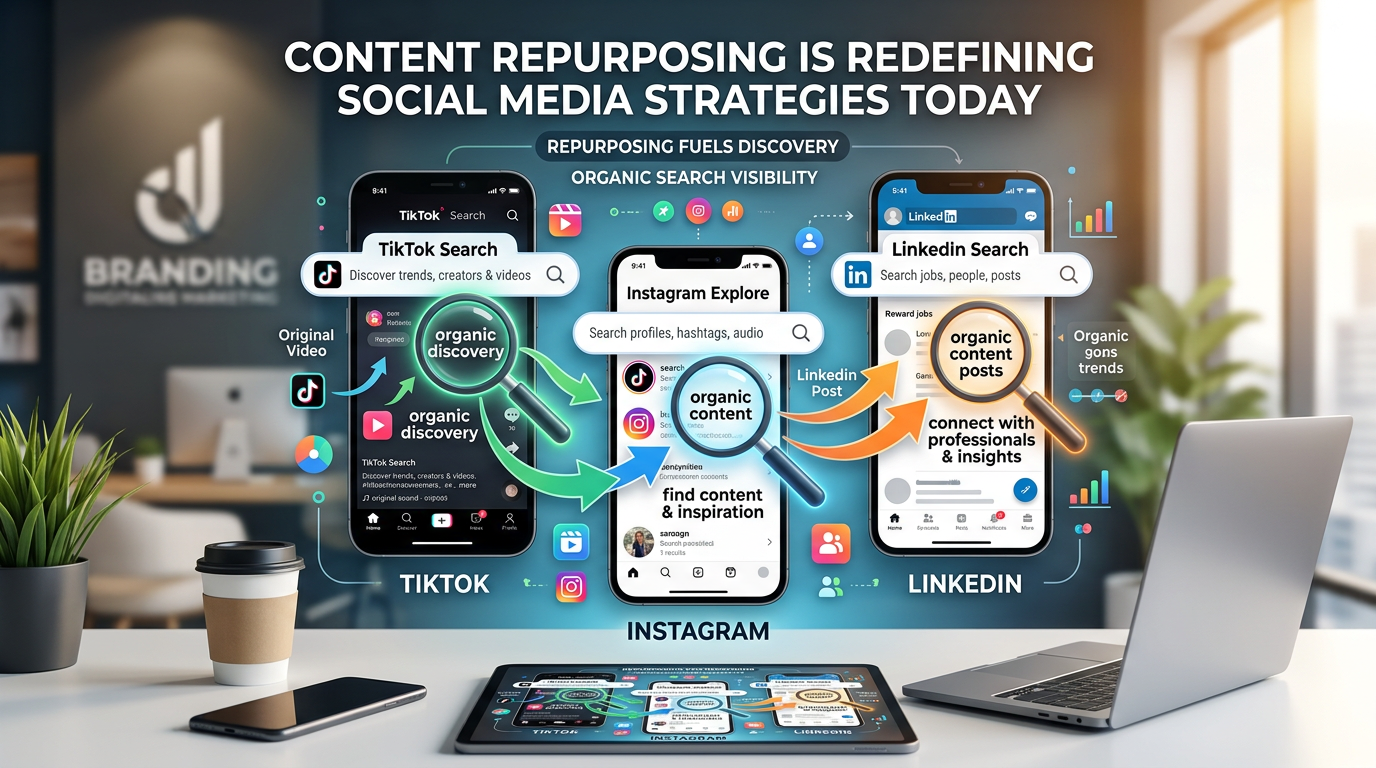
Social SEO and discoverability across multiple networks
Finding the Balance Between Automation and Authenticity
Artificial intelligence has officially moved from an experimental novelty to foundational infrastructure. But the goal isn't to let machines take over your marketing. The goal is to achieve speed without sacrificing your soul.
AI handles certain tasks exceptionally well. It's brilliant at summarizing long-form content. It excels at reformatting text, such as turning a rigid blog structure into an engaging LinkedIn thread. AI can suggest dozens of potential hooks and headlines in seconds. It can also optimize your posting schedule based on audience data.
However, humans must retain control over the core elements that matter. You must dictate the overall strategy and brand positioning. You have to infuse the content with emotional nuance and your unique brand voice. Final editing for authenticity remains a strictly human job. Relationship building and community engagement require real human connection.
When businesses ignore this balance, they fall into the trap of AI slop. Audiences are experiencing severe market fatigue with generic, over-automated content. They scroll right past it. But when used correctly, the technology is highly effective. Studies indicate that AI-assisted content performs better when it's strategically managed, with significant time savings as the primary benefit. The winning formula is simple. Use AI for efficiency and apply the human touch for connection.
Why Human-Generated Content Still Wins And How to Protect It
Consumers are incredibly skeptical. They can detect overly automated content from a mile away, and they actively reject it. Human-generated content remains the top priority for social media users because people crave genuine interaction. This creates an authenticity paradox. How do you scale your output without losing your voice?
Strategic content repurposing actually protects your authenticity. By starting with a genuine, thoughtful primary asset, every subsequent piece of content inherits that original human spark. You're not asking an AI to invent ideas out of thin air. You're simply asking it to help you reformat your own original thoughts.
This ties directly into the slow down to speed up philosophy. It's far better to create fewer, better pieces of primary content. Spend your energy making one amazing podcast or blog post. Then leverage that effort. Because the core idea came from a human brain, the adapted pieces will still sound like you. You just add platform-specific personality rather than settling for generic reformatting.

Creator editing content with a focus on human authenticity
A Step-by-Step System for Success
Building a reliable content repurposing workflow takes the guesswork out of your daily marketing tasks. Having a structured approach ensures you maximize your reach while minimizing your stress.
First, identify your Authority Assets. Look at what content formats suit your expertise best. If you're a great speaker, start with audio or video. If you're a strong writer, start with long-form text.
Second, map your platform-specific adaptations. You need to understand where your audience lives and exactly how they consume content on those specific networks. A B2B audience might prefer deep-dive carousels on LinkedIn, while a consumer audience might prefer fast-paced shorts on TikTok.
Third, create your repurposing matrix. Document exactly which pieces from your core asset will serve which platforms. This serves as your content menu for the week.
Fourth, establish quality controls. Build human review checkpoints into your process. Never auto-publish AI-generated adaptations without reading them out loud to ensure they maintain your brand authenticity.
Fifth, leverage tools strategically. Automation is highly beneficial for content distribution and scheduling. Let software handle the tedious parts of getting the posts online.
Finally, measure what matters. Ignore vanity metrics like raw views. Focus on engagement quality. Look for saves, shares, and meaningful comments. These indicate that your repurposed content is actually resonating.
Technology as Your Distribution Engine, Not Your Creative Director
The modern marketer relies on technology, but the relationship has evolved. You should treat software as your distribution engine rather than your creative director. Content repurposing platforms play a crucial role in modern workflows by taking the repetitive heavy lifting off your plate.
The right tools give you time back for high-value human work. When you're not manually downloading and re-uploading videos, you have time for strategic thinking. You can focus on community management and refining your core storytelling.
It's best to position your content distribution tools as consistency maintainers. They're efficiency creators, not content creators. They also act as social SEO optimization helpers by allowing you to easily manage metadata across different channels.
When evaluating a repurposing tool, look for seamless cross-platform compatibility. You also want features that help preserve your brand voice alongside time-saving automation and solid analytics integration. For example, platforms like Repostra.app serve as the perfect engine that converts your primary content into a multi-platform visibility system. By managing the logistics of sharing your carefully adapted pieces across networks, these tools allow you to maintain a broad footprint without burning out.
Where Content Repurposing Goes Wrong And How to Fix It
Even the best strategies can fail if executed poorly. Knowing the common pitfalls can save you time and protect your brand reputation.
The most frequent mistake is literal copy-pasting across platforms. Ignoring platform culture is a quick way to alienate your audience. A post written for Facebook will look entirely out of place on LinkedIn. The fix is simple. Always adjust the tone and formatting to respect the unwritten rules of each specific network.
Over-automation is another major trap. Letting software generate and post without human oversight leads directly to AI slop. You fix this by keeping a human in the editor seat at all times. Use technology to draft, but use a human to finalize.
Repurposing low-quality source material is equally damaging. You can't multiply zero and expect a positive result. If the original Authority Asset lacks depth or value, the adapted pieces will be equally unhelpful. Always ensure your primary content is genuinely valuable before you begin slicing it up.
Losing brand voice in translation happens when you rely too heavily on generic AI prompts. To avoid this, feed your specific style guidelines into your tools and manually rewrite anything that sounds robotic.
Finally, neglecting performance analysis leaves you flying blind. If you don't track which repurposed formats perform best, you can't improve. Dedicate time each month to review your analytics so you know exactly what's working.

Avoiding the pitfalls of AI slop and over-automation
From Content Hamster Wheel to Authority Builder
The digital landscape has clearly outlined the path forward. We've moved from volume to value, and from exhaustion to efficiency. Content repurposing isn't about cutting corners or being lazy. It's a system of strategic amplification.
This approach provides a massive competitive advantage. While other creators and brands burn themselves out on the content hamster wheel, strategic repurposers are building sustainable authority. They're showing up consistently with high-value insights while working fewer hours.
You already have the knowledge. You likely already have the content sitting in your archives. Now it's time to make that content work harder for you. Start small. Choose one strong Authority Asset this week. Break it down into five distinct pieces tailored for different platforms. Monitor the results and feel the relief of not having to invent something new every single day.
The brands that thrive today and into the future will be those that work smarter. By combining high-quality primary content with strategic distribution, you can stop feeding the algorithm and start building your legacy.