From Expert Interview to Content Engine: A Smarter Workflow for Teams
Map out a practical process for turning one expert conversation into a pipeline of articles, clips, quotes, and social posts. Emphasize structured reuse without making the output feel repetitive.
How to Build an Expert Interview Content Engine That Produces 20+ Assets
A single expert interview can produce over 20 unique content pieces when you use the right system. Modern marketing teams apply structured extraction, atomization, and platform-native formatting to transform expert conversations into articles, social clips, quote cards, and newsletters. This approach maximizes ROI from expert-led content while keeping the authenticity that builds trust in an AI-saturated landscape. In 2026, real human expertise drives credibility and authority more than ever.
Key Takeaways:
- One expert interview yields over 20 distinct content assets through structured atomization
- Strategic pre-interview planning increases extractable insights significantly
- Expert-led content outperforms generic AI text for trust-building in 2026
- Connected content ecosystems amplify search visibility and audience engagement
Why do most teams fall into the content scarcity trap?
Teams spend hours on expert interviews, publish a single article, and move on. Valuable insights get buried in digital filing cabinets. Leading teams in 2026 treat these interviews as content goldmines instead.
The Content Marketing Institute reported in 2025 that marketing teams repurposing expert content see 60 percent higher content ROI compared to one-off publishing strategies. Building an expert interview content engine fixes this scarcity problem entirely.
Why do expert interviews matter more than ever?
AI content saturation has devalued generic text. Expert insights provide real-world experience and nuance that AI cannot replicate. Trust and authority require documented human expertise.
The Gartner B2B Marketing Report in 2026 found that 73 percent of B2B buyers cite expert-led content as very important or essential to vendor credibility.
"In an era of infinite content, finite expertise is the new competitive moat."
— Sarah Chen, Chief Content Officer at ContentScale Labs, Marketing Week 2026
What is a content engine and how does it work?
A content engine is a systematic process for converting one core asset into multiple native-format pieces. The core principle is atomization. Atomization breaks a large idea into smaller, platform-specific formats.
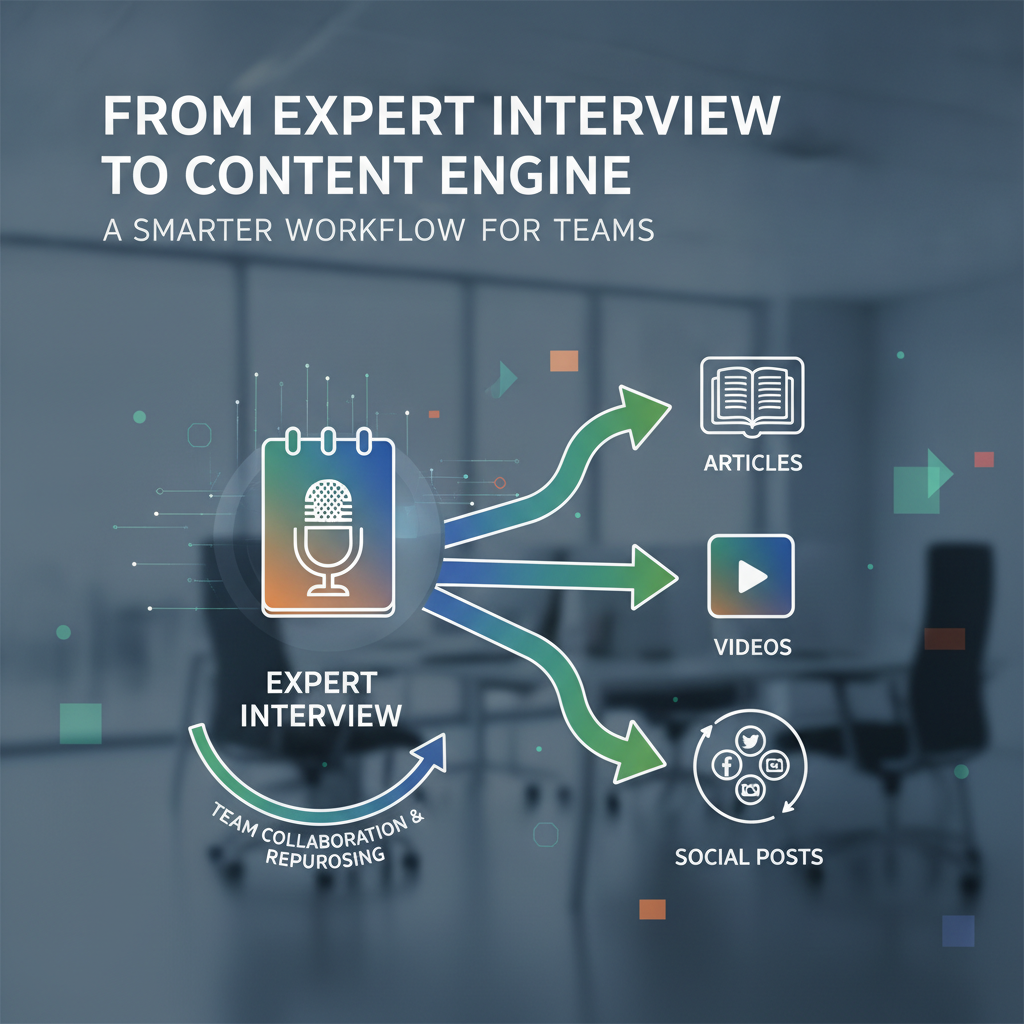
Content engine atomization diagram
This differs entirely from copying and pasting paragraphs across platforms. The workflow relies on three distinct phases: planning, extraction, and atomization.
How should you plan before the interview?
Post-interview extraction misses up to half of all usable content if you skip the planning stage.
Define your specific content goals first. Are you prioritizing SEO, trust-building, or social engagement? Use structured question frameworks instead of broad conversation starters. Ask the expert for specific step-by-step frameworks, contrarian opinions, and personal stories.
Good approach: Ask the expert to detail a time their standard framework failed and how they fixed it.
Bad approach: Ask the expert to share general thoughts on their industry.
What should you extract during content mining?
Treat a 45-minute interview as a database rather than a single media file. AI-powered transcription tools like Whisper AI generate high-accuracy transcripts immediately. Run a dedicated mining session with your team to pull out the most valuable parts.
What to extract:
- Two to four core frameworks or processes
- Five to ten quotable moments
- Three to five personal stories
- One or two contrarian opinions
Pro tip: Speaker-labeled transcripts drastically improve extraction speed for your team.
How do you turn raw interview material into multiple content pieces?
Atomization is where the actual content engine comes to life. Change the angle for each format to avoid repetition.
| Content Type | Format Strategy | Purpose |
| Long-Form Articles | Create distinct articles focusing on different keyword targets | SEO & Authority |
| Social Carousels | Break a framework into several visual slides | Education & Saves |
| Short-Form Video | Edit short clips focusing on one specific point | Reach & Engagement |
| Email Newsletter | Share a behind-the-scenes or contrarian take | Nurturing |
| Quote Cards | Design simple text-on-image assets featuring the best insight | Brand Identity |
One solid framework can easily become an authoritative article, an educational carousel, and a short video clip.
What makes repurposed content feel unique instead of repetitive?
Contextualization always beats copy-pasting. Use platform-specific hooks and address specific audience pain points. A LinkedIn post opening requires a different hook than a post on X.
The underlying insight remains the same, but the application changes based on the audience.
Example: A video clip might focus on the emotional reality of an expert's failure story. The accompanying LinkedIn text breaks down the exact business lessons learned from that same failure. Maintain your core brand voice across all formats, but adapt the delivery for the medium.
How do you build a connected content ecosystem?
Your atomized pieces should never exist in isolation. Implement an interlinking strategy where a social post points to a full article. That article should then embed the relevant video or podcast clip.
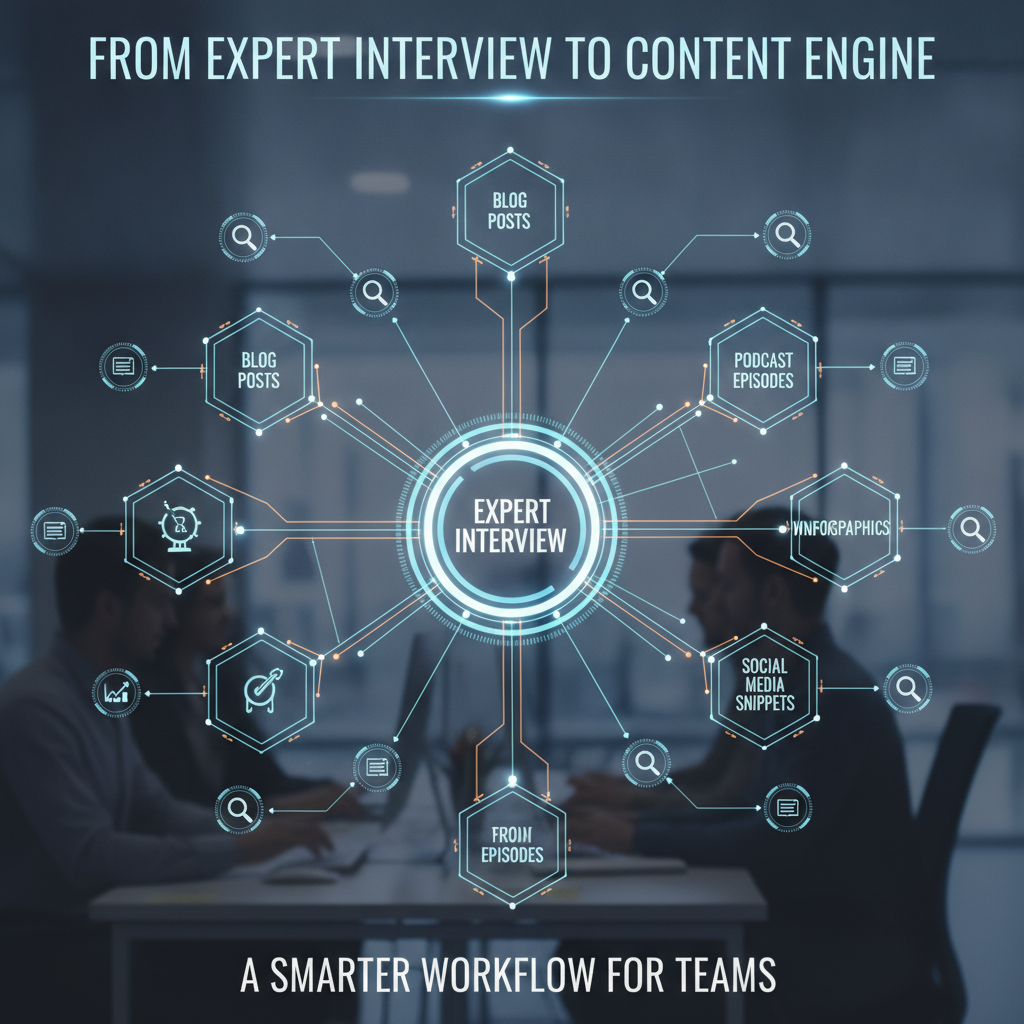
Connected content ecosystem strategy
A Backlinko Content Hub study in 2025 found that creating these connected content clusters significantly boosts topical authority and SEO benefits. Map the user journey so readers naturally flow from short-form discovery content into long-form deep dives. Track your analytics to see which entry points drive the most conversions.
How can teams get the most out of Repostra.app?
Lead with your business objectives before opening the software. Are you focusing on lead generation or brand awareness? Use a human-in-the-loop approach.
Repostra.app can handle the heavy lifting of transcription, initial drafting, and formatting. Human editors should always step in for final polish and brand voice alignment. Integrate your content calendar directly into the workflow.
Schedule these atomized pieces over a period of four to six weeks to maximize reach. Assign clear team roles for who extracts, who creates, and who hits publish. Establish quality control checkpoints at each handoff.
How much time does this workflow actually save?
A traditional approach often turns one interview into one article, which takes eight hours total. The content engine approach turns one interview into fifteen pieces in about twelve hours total. Your hours per piece drops from eight to under one.
Expect an initial setup investment. It usually takes two or three interviews to fully optimize this workflow for your specific team. Once optimized, long-term efficiency gains free up your resources for more strategic work.
What are the common pitfalls and how do you avoid them?
Common mistake: Waiting until after the interview to plan your repurposing strategy. Always plan your desired output formats before you draft the interview questions.
Common mistake: Copy-pasting text without contextualization. Always adjust the hook and formatting for the specific platform.
Common mistake: Failing to interlink between pieces. Every piece of micro-content should point back to a larger pillar asset.
Common mistake: Publishing everything in the same week. This cannibalizes your reach, so spread the assets out.
Common mistake: Over-relying on AI without human editing. Always have a human review the final output to ensure the brand voice remains authentic.
FAQ
How many content pieces can one expert interview realistically produce?
A well-structured interview can produce more than twenty unique content pieces. This typically includes two to three long-form articles, several social posts, short video clips, quote cards, and email content. The key to this volume is strategic pre-interview planning and systematic extraction of frameworks, stories, and quotable moments.
What tools do I need to build a content engine from interviews?
Essential tools include AI transcription software like Whisper AI or Otter.ai. You'll also need a content management platform like Repostra.app to organize the workflow. Most teams rely on video editing tools for clips and design software for quote cards and carousels. Project management tools help track atomized content through the production pipeline.
How do I keep repurposed content from sounding repetitive?
Change the angle and context for each platform. Use different hooks, address platform-specific pain points, and reframe insights for different audience segments. A LinkedIn post should start differently than a post on X, even when drawing from the exact same expert insight. Contextualize the material rather than simply copying and pasting it.
How long should I spread out publishing repurposed content?
Distribute atomized content over four to six weeks rather than publishing everything at once. This extends your content calendar and improves algorithmic reach on social platforms. It also allows you to test which formats resonate most with your audience before creating additional pieces.
Should I use AI for repurposing expert interviews?
Use AI for transcription, initial drafting, and formatting heavy-lifting. However, always apply human oversight for final editing. AI excels at extraction and transformation but cannot replicate brand voice nuance or strategic content decisions. A human-in-the-loop approach balances efficiency with authenticity.