From Blog to Podcast: Easy Content Transformation Techniques
Explore step-by-step processes for converting blog posts into engaging podcast episodes with Repostra.
Converting Blog Posts to Podcasts: Your Complete Guide to Content Repurposing
You just published a highly researched blog post. It took hours of planning, writing, and formatting to create a comprehensive guide. You hit the publish button and wait for the traffic to roll in. The relief washes over you for a moment. But the celebration is incredibly brief. A notification pops up reminding you that your podcast feed has been quiet for two weeks. Your social media manager is asking for short video clips.
The pressure to maintain a presence across every digital channel is relentless today. Content creators often find themselves trapped on a production treadmill. This cycle of endless creation inevitably leads to burnout and exhaustion. You can't possibly film, record, write, and design completely new pieces of media every single day. The math simply doesn't work for a small team or a solo entrepreneur. You want maximum visibility without sacrificing your mental health or the quality of your work.
Converting blog to podcast content is no longer optional in this environment. It's an essential survival strategy. Repurposing allows you to extract maximum value from the hard work you've already completed. Systematic repurposing with tools like Repostra shifts your focus from constant creation to intelligent distribution. This guide explores how you can build a powerful audio presence effortlessly. You'll learn exactly how to turn your existing text into captivating podcast episodes.
Why Convert Blog Posts Into Podcast Episodes?
It takes significant effort to build a dedicated blog audience. You might wonder why you should mess with a winning formula. The truth is that consumer reading habits are fragmenting. Your perfectly crafted article is only reaching a fraction of its potential audience if it remains locked in a text format. You need to meet your audience exactly where they spend their time.
Meet Your Audience Where They Are
Global podcast listenership is projected to surpass 500 million people by 2024, according to Statista. This isn't a niche demographic. It represents a massive slice of the global consumer market. People consume information differently based on their daily routines. Reading requires focused visual attention. You must sit still and look at a screen. Audio offers unparalleled hands-free consumption benefits. A listener can consume your ten-minute business guide while walking the dog, commuting to the office, or folding laundry at home. You integrate your brand directly into their daily life when you offer a podcast version of your written work.
Maximize Your Content Investment
Think of your original blog post as a raw asset. You invested time, money, and creative energy into producing it. Leaving it as a single web page is like buying a large building and only using one room. The heavy lifting is already done. You've completed the research phase. You've structured the argument. You've found the supporting data.
This multi-format approach drives real business results. A blog to podcast workflow gives your evergreen content a second life. A highly relevant article from last year suddenly becomes a brand new podcast episode today.
Build an Interconnected Content Ecosystem
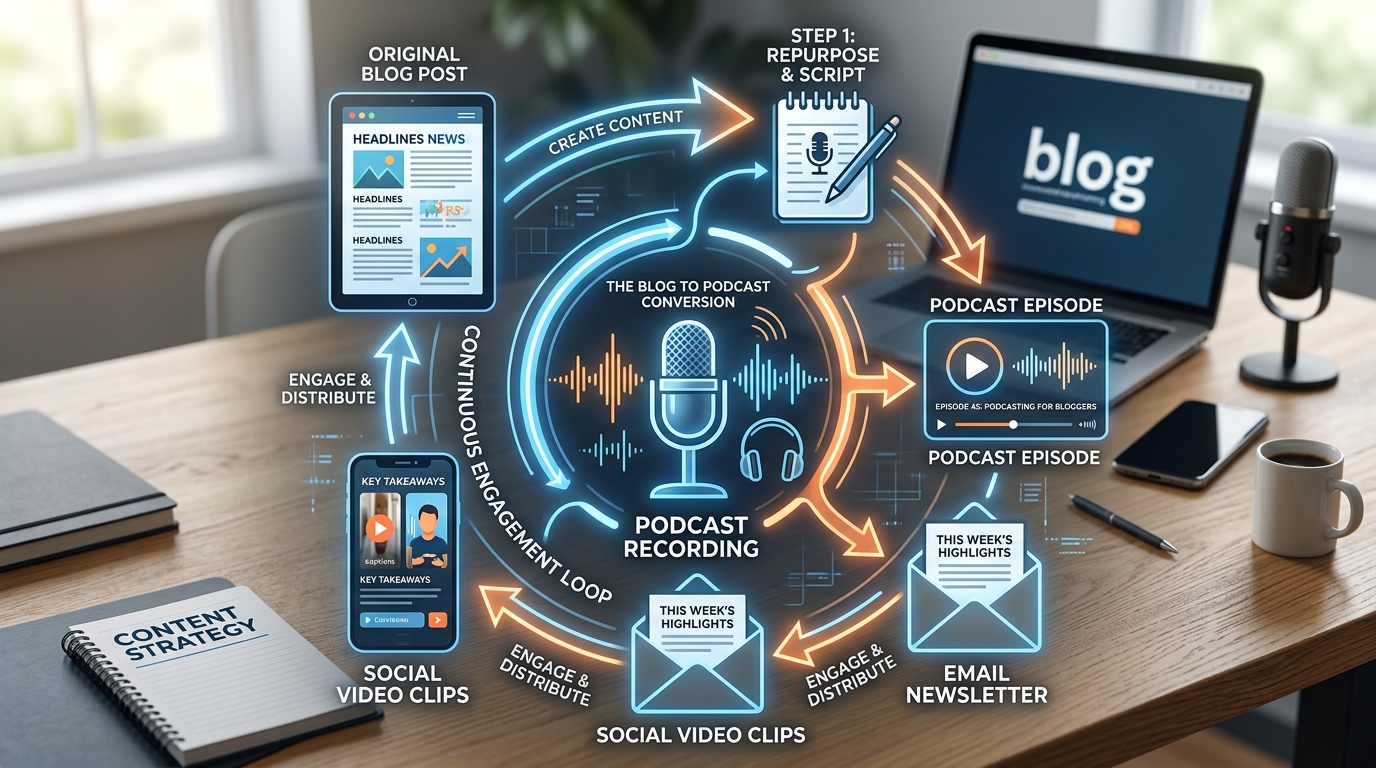
Content ecosystem diagram illustrating the flow from blog post to podcast and social media
The digital landscape is highly competitive. Relying entirely on unpredictable social media algorithms is dangerous for any growing brand. You must build strong owned media channels. Your blog and your podcast are properties you completely control.
Linking these formats together provides incredible search engine optimization benefits. Search algorithms reward websites that keep visitors engaged for longer periods. A visitor might skim an article in two minutes. That same visitor might stay on the page for fifteen minutes if they hit play on an embedded podcast player. This increased dwell time signals to search engines that your page provides high value. Establishing authority requires repeated exposure. A user might discover your website via a Google search, read your post, and then subscribe to your podcast right from the page. You've successfully moved them from a casual visitor to a loyal, long-term subscriber.
The Blog to Podcast Transformation Process
Transitioning into audio takes a bit of finesse. You can't just copy and paste your way to a top-ranking show. It requires a thoughtful workflow to create professional podcast episodes from your existing text. Follow this straightforward process to master the audio transformation workflow.
Audit and Select Your Best Content
Strategic selection is the foundation of a successful repurposing campaign. Not every article belongs on an audio feed. A quick update about a software patch or a time-sensitive holiday sale announcement will offer very little value to a listener six months from now. You need to perform a targeted content audit.
Open your website analytics dashboard. Look for your highest performing posts over the last twelve months. Focus entirely on evergreen topics. These are subjects that remain relevant regardless of the season or the current news cycle. High organic traffic is a strong indicator that people care deeply about the topic. Strong engagement metrics show that the content resonates emotionally.
Pay special attention to articles that generate questions in the comments section. A reader asking for clarification provides a fantastic natural conversation starter for your audio recording. You can address these comments directly in the podcast episode. Target posts that exceed one thousand words. A typical speaking pace is roughly 150 words per minute. A thousand-word article translates to about six or seven minutes of spoken audio. Add a short introduction and an outro, and you have a perfect ten-minute episode. Start by selecting your top five historical posts. This gives you a solid batch of proven material to work with.
Quick Checklist: Blog to Podcast in Thirty Minutes
- Select one evergreen blog post with high organic traffic.
- Run the text through an adaptation tool to make it conversational.
- Review and edit the new script for natural flow.
- Record the audio manually or generate it using text-to-speech tools.
- Add your standard branded intro and outro music.
- Export the final file and embed it on your website.
Adapt Your Script for Audio
This specific step makes or breaks your episode. It's the most crucial part of the content transformation process. Never read your blog post verbatim. Written text and spoken dialogue are fundamentally different languages.
A well-written article often relies heavily on visual references. You might write phrases like "refer to the bulleted list below" or "as demonstrated in this chart." A podcast listener driving down the highway can't look at your chart. They'll feel alienated and confused. Written English typically features long, complex sentences and formal vocabulary. When you read this out loud, you sound robotic, dense, and unnaturally stiff.
You must adapt the text specifically for the ear. You can use artificial intelligence tools, including the specialized features inside Repostra, to rewrite your post for natural conversation. Break long sentences in half. Use contractions like "don't" instead of "do not." Add conversational transitions. Phrases like "Here's the interesting part" or "Let's dive into why this matters" keep the listener engaged and moving forward. Include clear hooks at the beginning to grab attention immediately. Remove every single visual reference or take the time to describe the data verbally.
Your script structure should be remarkably simple. Start with a welcoming intro. Deliver three to five main points clearly. Provide an actionable takeaway. End with a strong call to action.
Consider this before and after example to see the difference clearly.
Blog Version: "The implementation of asynchronous communication tools resulted in a thirty percent decrease in meeting frequency, thereby optimizing overall departmental efficiency."
Podcast Script Version: "We started using asynchronous communication tools, and the results were shocking. We actually dropped our meeting frequency by thirty percent. It completely changed how our team operates."
The second version is warm, human, and perfectly suited for audio consumption.
Record or Generate Your Audio
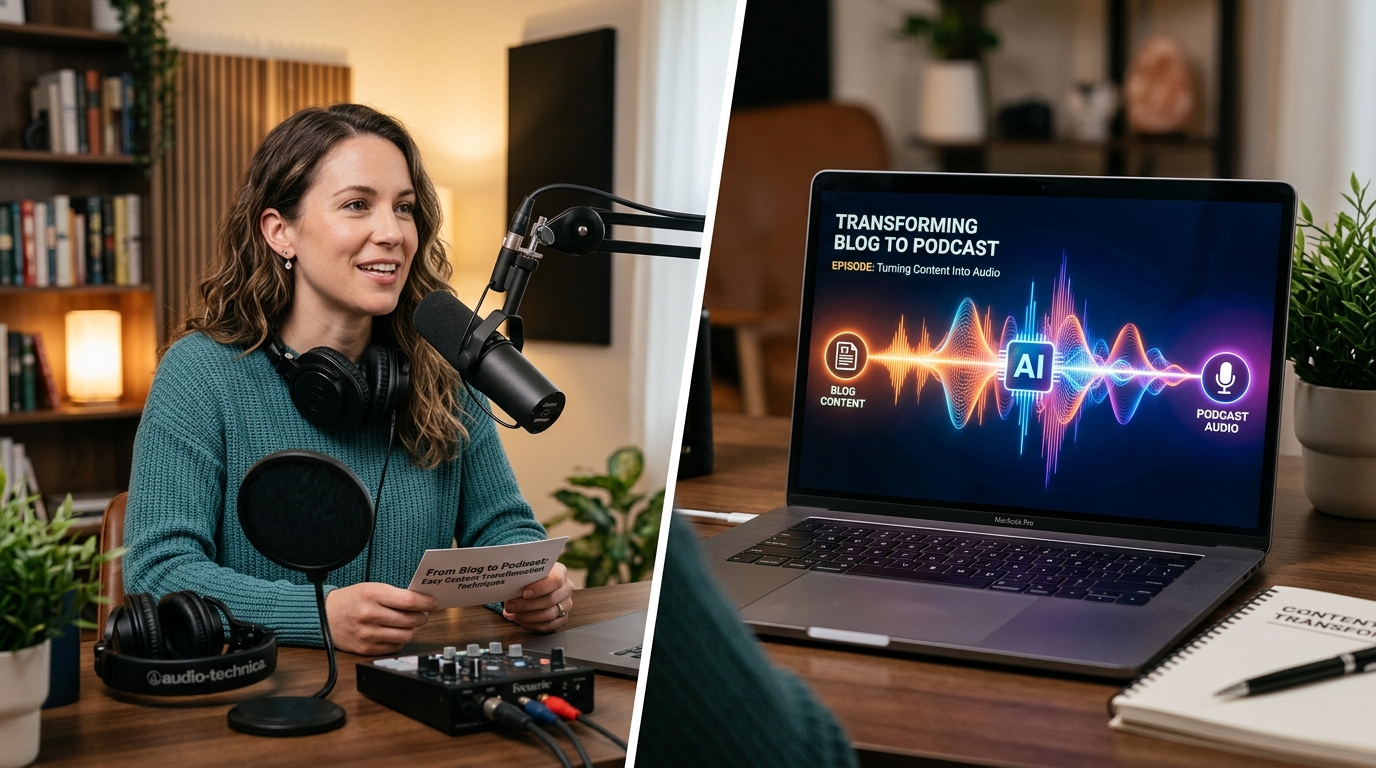
Comparison between human podcast recording and AI audio generation
You have your conversational script ready to go. Now you need to create the actual audio asset. You must balance brand authenticity with production efficiency. You have two primary paths to choose from.
The first option is human recording. Nothing beats the authenticity of a real human voice. You bring emotional nuance, spontaneous energy, and your distinct brand personality to the microphone. You don't need an expensive recording studio to sound professional. A decent quality USB microphone and a quiet space are enough. Rooms with lots of soft furniture like couches or rugs work best to absorb harsh echoes. Free software like Audacity is perfect for capturing the audio on your laptop.
When you sit down to record, try to read naturally. Pretend you're explaining the topic to a friend over coffee. Don't obsess over achieving absolute perfection. A slight stumble or a quick laugh makes you sound approachable. If you mess up a complex sentence, just pause for a second, take a breath, and read that sentence again. You can edit the mistake out easily later.
The second option is artificial intelligence text-to-speech generation. Modern voice generation quality is spectacular today. The synthesized voices available sound warm, varied, and nearly indistinguishable from actual humans. This option is incredible for high-volume content repurposing. If you need to convert fifty historical blog posts into a podcast archive quickly, recording them all manually might take weeks. Generating them takes hours. Repostra features excellent built-in tools for this exact scenario. Always preview your generated audio. Sometimes you need to adjust the spelling of a brand name phonetically so the artificial intelligence pronounces it correctly.
Add Professional Polish
A raw audio file is good, but a polished episode is professional. Small finishing touches signal high quality to your audience. You don't need to become a master sound engineer to achieve this polished sound.
Start with a branded intro. This is a short, five to ten-second piece of royalty-free music that plays at the beginning of every episode. It sets the mood and creates immediate brand recognition. Follow this with a consistent outro. The outro should feature your standard call to action. You might ask listeners to subscribe, leave a review, or visit your website for a free download.
You can also layer subtle, low-volume background music beneath your voice. This covers up minor background room noise and gives the episode a highly produced feel. Perform basic editing to clean up the track. Remove overly long pauses. Cut out loud breaths or obvious mistakes. You can use integrated editors within Repostra to handle these trims quickly. Remember not to over-produce the audio. You want to sound professional, but you still want to sound human. Authenticity will always win over artificial perfection.
Distribute and Cross Promote Strategically
A fantastic podcast episode is useless if nobody hears it. Distribution requires a highly strategic approach. You must host your files on dedicated podcast platforms. Getting your show listed on Apple Podcasts, Spotify, and other major directories exposes you to millions of daily listeners searching for new content.
Third-party platforms are only part of the overall strategy. It's crucial to embed the audio player back into the original blog post on your website. Place the player near the very top of the article. This immediately gives your readers a choice. They can read the text, or they can hit play and listen while they browse other tabs. This simple integration drastically increases your time-on-page metrics.
Create brief show notes for the podcast directory that link directly back to your website. Take the best moments from the episode and repurpose thirty to sixty-second clips for your social media channels. These short audiograms are highly engaging on visual platforms. Don't forget to promote the new format to your email list. Add a small section to your newsletter saying, "Do you prefer to listen? Check out the audio version of this week's guide." Finally, track your performance closely. Watch your download numbers, monitor your listen-through rates, and check your analytics to see how much referral traffic the podcast drives directly to your site.
The Hybrid Content Consumption Advantage
The media landscape changes rapidly. Audio content is incredibly powerful, but hybrid content consumption is the new standard. How do audiences actually behave today? According to Edison Research's Infinite Dial report, a growing percentage of podcast listeners are engaging with video podcast formats on platforms like YouTube and Spotify.
This specific trend means you should consider adding a simple visual element to your audio. You don't need a multi-camera studio setup to succeed here. A static branded image with a moving audio waveform overlay performs exceptionally well on video platforms. Alternatively, you can simply set up a smartphone on a tripod and record yourself reading your adapted podcast script.
This hybrid approach is the ultimate realization of the pillar content model. The pillar content methodology involves creating one highly detailed, authoritative asset. This pillar serves as the firm foundation for an entire promotional campaign. A comprehensive blog post acts as the pillar. You convert it into a podcast episode. You record a video of the podcast. You slice that video into five short vertical clips for social media. You pull the best quotes for a newsletter. One initial effort yields ten unique pieces of media. Repostra fits perfectly into this modern workflow. It acts as the intelligent bridge between your written pillar and your multimedia derivatives.
Common Pitfalls to Avoid When Converting Content
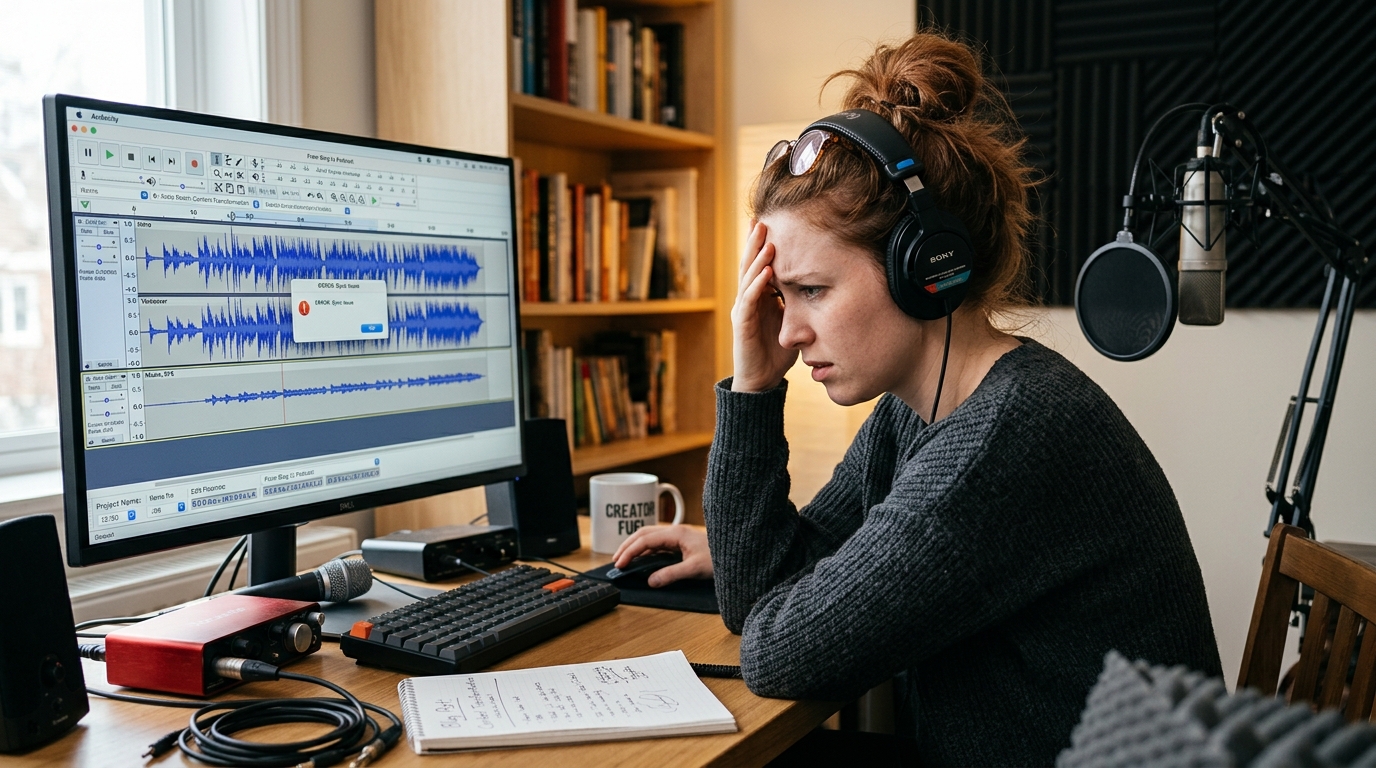
Content creator struggling with podcast audio editing mistakes
Content transformation is highly effective, but it's not foolproof. Many creators stumble when they first start bridging the gap between text and audio. Helping you sidestep these common mistakes is crucial for your long-term success.
Reading Your Blog Word for Word
This remains the single biggest error in content repurposing. A verbatim reading of an academic or highly technical blog post is guaranteed to bore your listener. It sounds stiff, robotic, and unnatural. The fix is absolute discipline during the adaptation phase. You must commit to a conversational rewrite every single time you approach the microphone.
Ignoring Audio Quality
Listeners are surprisingly forgiving of poor video quality. They'll watch a grainy, poorly lit video if the information is highly valuable. They won't forgive bad audio. Poor audio quality results in an instant tune-out. Harsh echoes, static, or muffled vocals are physically unpleasant to listen to. Fix this by investing in a reliable basic microphone and recording in a soft, quiet space.
Forgetting the Call to Action
Every piece of content must have a clear purpose. Listeners need explicit direction on what to do next. An episode that simply fades out is a wasted opportunity. Fix this by ending every recording with a clear, singular call to action. Tell them exactly where to go to download a resource, read the full post, or sign up for your mailing list.
Not Embedding Audio Back in the Blog
Separating your mediums completely limits your growth potential. If your podcast lives on Spotify and your blog lives on your website with no connection between them, you miss massive cross-promotion potential. Fix this by treating the audio as a value-add for your website visitors. Always embed the player directly on the original page.
Inconsistent Publishing Schedule
Audience trust is built entirely on reliability. If you publish an episode on Monday, another on Thursday, and then go silent for three weeks, your audience will forget you exist. Fix this through batch production. Sit down once a month and convert four or five blogs into audio format at the exact same time. Schedule them to release consistently once a week.
How Repostra Streamlines Content Transformation
The idea of content repurposing is brilliant in theory. In practice, it can easily become overwhelming. Juggling writing tools, audio editors, hosting platforms, and video generators often creates a tangled, frustrating workflow. Repurposing your work doesn't have to be complicated.
This is exactly where Repostra adds tremendous value to your daily operations. Repostra is built on a very simple premise. What if you could turn your existing text into polished audio from a single, unified dashboard? The platform eliminates the technical friction of content transformation entirely.
Instead of struggling to rewrite your post manually, you can use built-in artificial intelligence tools to streamline your script adaptation. The system helps you find the natural, conversational rhythm hidden inside your dense text. It automatically removes the visual references that confuse audio listeners.
Once your script is ready, Repostra provides seamless audio generation capabilities. You can create clear, engaging audio tracks without setting up microphones or renting studio time. The platform also focuses heavily on multi-format export. You get the raw audio for your podcast host, but you can also generate the visual elements required for modern social media distribution.
The primary benefit here is leverage. Time is a content creator's most valuable asset. A manual conversion process might take three hours per episode. Intelligent workflow management reduces that time to mere minutes. You achieve higher output, broader reach, and consistent quality without running yourself into the ground. It offers a practical escape from content creator burnout. Start transforming your blog content today. Build your media empire on the firm foundation of the work you've already completed.
Your Content Deserves Multiple Lives
Every insightful, well-researched blog post sitting in your archives is a compelling podcast episode waiting to happen. The heavy lifting of ideation and structuring is already behind you. The efficiency imperative is impossible to ignore today. Repurposing is never a lazy tactic. It's a highly strategic method for scaling your message in a incredibly noisy digital world.
The process is clear and repeatable. You audit your library to find the best material. You adapt the text to suit the human ear. You capture the audio. You add professional finishing touches. You distribute the final product strategically across your entire ecosystem.
You don't need to convert fifty posts overnight. Start small. Pick just one well-performing blog post this week. Run it through the transformation workflow. Try using Repostra to see exactly how quickly you can turn a static page into an immersive audio experience. Building your audio library now is a powerful investment. It establishes a