Content Repurposing Myths That Slow Down Social Media Growth
This post explores common misconceptions about content repurposing and how they can limit reach, consistency, and marketing efficiency. It will show businesses how to turn existing content into a smarter social media strategy without losing quality or control.
Content Repurposing: Why Smart Brands Multiply Their Reach Without Burning Out
TL;DR: Content repurposing transforms your best-performing assets into multiple platform-native formats, cutting production costs by up to 65% while reaching audiences who missed your original post. The strategy isn't about lazy copying but strategic adaptation that turns existing content into a sustainable growth engine without expanding your team.
Key Takeaways
- Only 35% of marketers actively repurpose content, leaving a massive competitive advantage on the table
- Strategic adaptation cuts production costs by up to 65% while maintaining consistency across platforms
- Most audiences never see your original post due to algorithm reach of just 5-10%
- Platform-native formatting separates successful distribution from spam
- Evergreen content often outperforms entirely new posts when adapted correctly
Is your content treadmill breaking your social media team?
Picture a marketing manager spending twenty hours a week creating new content. They hit publish, close their laptop, and watch engagement plateau. Team burnout increases while results stay flat.
Many businesses think more content equals more growth. The math simply doesn't work. Smart brands create less but distribute smarter.
According to the Content Marketing Institute's 2025 research, content marketing generates three times more leads than outbound methods at 62% lower cost. You multiply that return on investment every time you publish an adapted piece of successful content.
Why does content repurposing have such a bad reputation?
The early days of social media created legitimate skepticism. Brands would connect their Twitter and Facebook accounts to auto-publish identical links. That spammy repost era left a bad taste in our mouths.
Common mistake: Many creators still confuse lazy cross-posting with strategic adaptation. Perfectionism makes marketers feel that reusing ideas means admitting defeat.
The psychological trap is simple. We think that if we've seen it, everyone has seen it. Modern distribution strategies focus on reaching your full audience across different contexts.
Will repeating content annoy your audience?
Most of your audience literally never saw your original post. Algorithm reach is notoriously low. Organic posts typically reach only 5-10% of followers on the first share.
According to Statista's 2026 data, the average social media user consumes more than two hours of content daily across multiple platforms. Your single post is a drop in the bucket amid hundreds of daily impressions.
Different audience segments are active at different times and on different platforms. A LinkedIn post on a Tuesday morning reaches different people than an Instagram carousel on a Saturday afternoon.
Key takeaway: Repetition with variation builds brand recall. It doesn't create annoyance.
Is repurposing just lazy copy-pasting?
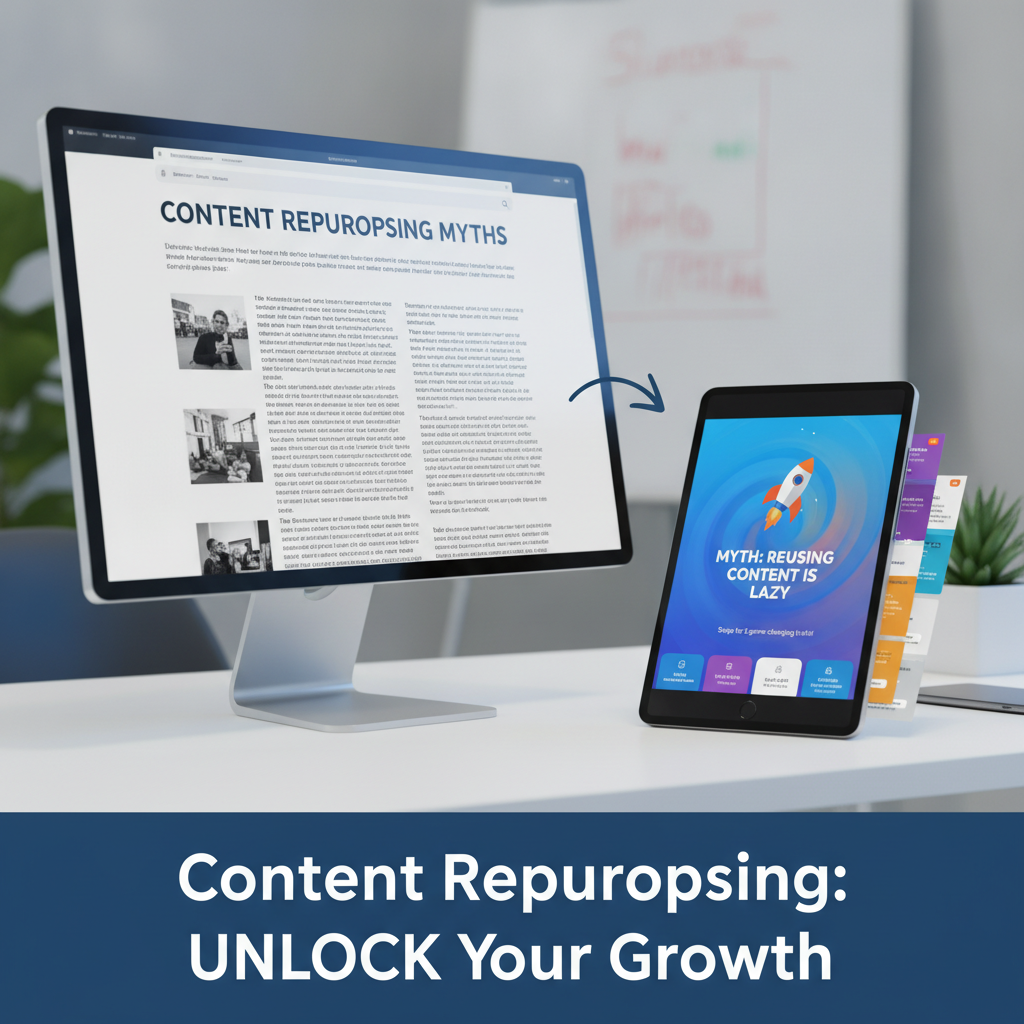
Visual difference between original blog content and adapted social media graphics
True content adaptation involves changing the format. It's never about pure duplication. Effective distribution requires platform-specific hooks, native formatting, and audience-tailored messaging.
Bottom line: Twenty percent of your content generates eighty percent of your results. Adapting formats multiplies your winners.
Consider the cornerstone and derivatives model. A long-form blog post becomes a LinkedIn carousel, a Twitter thread, an Instagram Reels script, and an email newsletter segment. Each format serves different consumption contexts like commuters, desktop researchers, or visual learners.
"The brands winning at social in 2026 aren't creating more. They're creating smarter. One well-researched piece becomes ten platform-optimized touchpoints."
Ross Simmonds, Founder and CEO at Foundation Marketing
Does fresh content actually perform better than adapted content?
Engagement is driven by value and relevance. It's not driven by publication date. Evergreen content maintains strong performance across multiple publication cycles.
Entirely new content has no proven performance history. Adapted winners are pre-validated by your audience.
According to Social Media Examiner's 2026 Industry Report, only 35% of marketers actively adapt their existing content. The marketers who do report significantly higher consistency and efficiency.
Testing new ideas remains valuable. It just shouldn't make up your entire calendar. An optimal mix includes 60% proven content and 40% new experiments. Your best work deserves to reach everyone who would benefit from it.
What makes content adaptation a growth imperative right now?
You gain a massive efficiency multiplier. Adapting existing assets saves 60-80% of content creation time. It reduces production costs by up to 65%.
This strategy allows lean teams to maintain a multi-platform presence. The 65% of marketers who skip this step leave a massive opportunity gap. Early adopters gain a consistency edge while competitors burn out.
Audiences are split across TikTok, LinkedIn, Instagram, YouTube, and newsletters. Different platforms have different content half-lives. Strategic distribution offers omnipresence without requiring a massive team.
Platform algorithms constantly change. A core message remains valuable regardless of the delivery mechanism. A multi-format approach hedges against single-platform volatility.
How do you execute high-quality content adaptation?
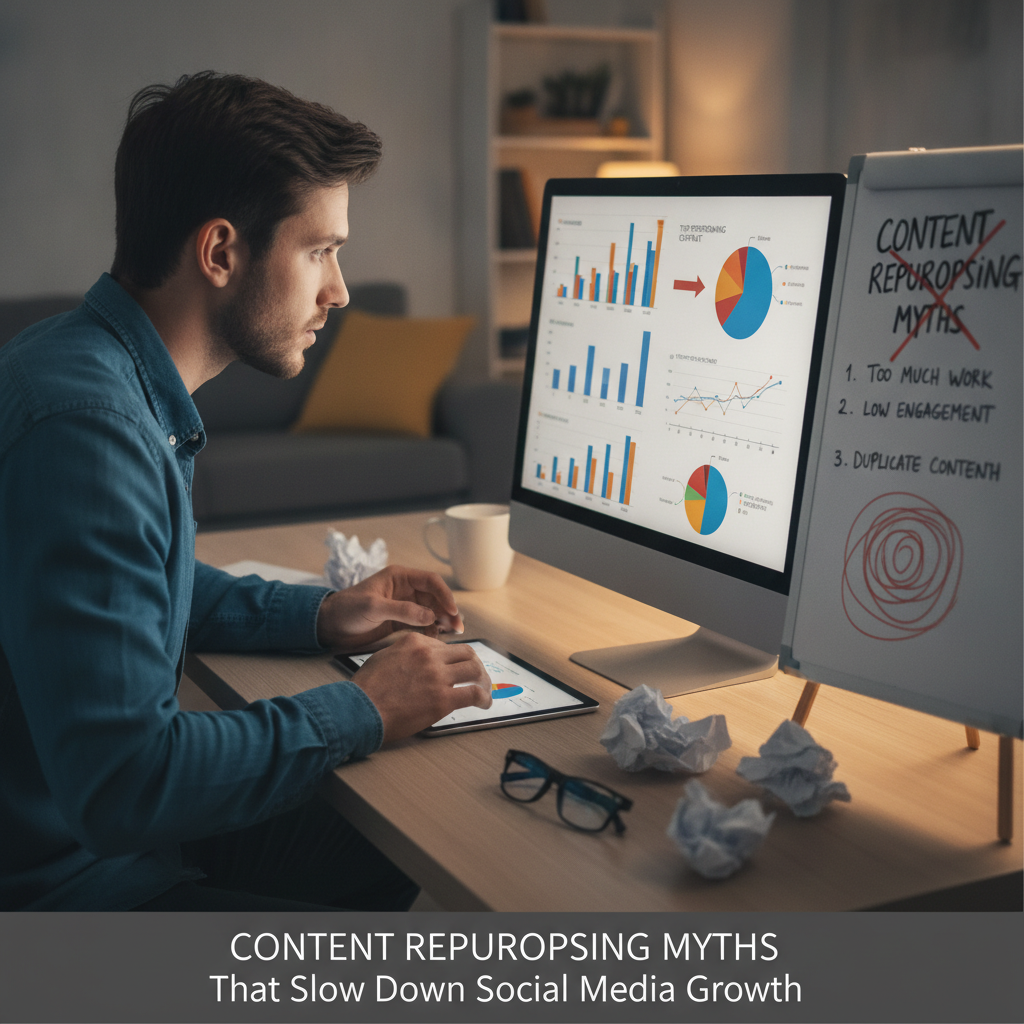
Marketer reviewing analytics to identify cornerstone content pieces
Step 1: Identify your cornerstone assets. Look for the top 20% of your traffic, engagement, or conversion content. Use tools like Google Analytics or native social media insights. Start with proven winners rather than random picks.
Step 2: Adapt for a platform-native experience. The core message stays consistent, but the packaging changes completely.
- LinkedIn requires professional insights and data-driven carousels
- Instagram favors visual storytelling and lifestyle integration
- TikTok demands strong hooks in the first three seconds
- X needs punchy takeaways and conversational threads
Step 3: Measure what matters. Track engagement depth like saves, shares, and link clicks rather than just vanity metrics. A/B test different formats to see which version of the same idea performs best. Build a playbook based on your specific audience data.
How does Repostra.app change the execution game?
Most businesses understand this value intellectually. Manual execution simply takes too much time and lacks consistency. The gap between wanting to do this and actually doing it stalls growth.
Repostra.app operates as a strategic asset maximizer. It turns one deep-dive idea into a week of platform-specific posts. The software handles the mechanical heavy lifting while maintaining human authenticity.
You don't need more content. You need a smarter system for the content you already have.
Key advantage: The platform ensures platform-specific adaptation rather than blind cross-posting. It preserves your tone, hooks, and tweaks while automating the logistics. This turns your existing assets into a strategic advantage rather than disposable commodities.
FAQ
How often can you reuse the same piece of content before it becomes stale?
Evergreen content can be adapted indefinitely if you vary the format and platform. Wait 60-90 days before republishing to the exact same platform. You can adapt the same core message across different platforms simultaneously. Focus on creating new angles or incorporating updated data to keep the material fresh.
What types of content work best for adaptation?
High-performing evergreen pieces like how-to guides, industry insights, case studies, and educational frameworks work best. Look for posts with sustained traffic, high engagement, or strong conversion rates. Avoid time-sensitive news unless you plan to update it with current context.
Does republishing hurt search rankings by creating duplicate content?
Search engines penalize identical content on multiple pages of the same website. Adapting one blog into social posts, videos, or infographics doesn't trigger penalties. Each platform is a separate domain, and format transformation creates entirely unique media. Substantial adaptation prevents any duplicate content issues.
How do you know which format to choose for an older post?
Start by analyzing where your audience is most active. Use your analytics to spot trends. If carousel posts outperform static images on Instagram, turn blog sections into carousels. Let data guide your format decisions rather than personal preference.
Can small teams realistically implement this strategy?
This strategy actively levels the playing field for small teams. Start with one cornerstone piece per week and create three derivative formats. Tools like Repostra.app automate the distribution logistics. Small teams see the biggest efficiency gains because they eliminate the constant creation treadmill.