Content Repurposing Isn’t Lazy—It’s How Modern Teams Stay Visible
This post explores why repurposing content is a smart, sustainable strategy for social media marketing and content creation. It will show how teams can extend the life of strong ideas, maintain quality, and distribute content consistently without burni...
Content Repurposing in 2026: The Strategy That Saves 60-80% of Your Marketing Time
Content repurposing is the highest-impact marketing strategy for 2026, enabling teams to save 60-80% of creation time while maintaining consistent visibility across platforms. By transforming one pillar piece into multiple platform-native formats, modern marketing teams combat creator burnout, escape algorithmic anxiety, and achieve greater output without expanding headcount. This approach ensures teams work smarter in an era of extreme content saturation and AI-driven discovery.
Key Takeaways
- Repurposing saves 60-80% of creation time and boosts total output by 40%
- 62% of creators experienced burnout in 2025-2026 due to constant publishing demands
- Adapting original data into diverse formats increases AI search visibility by up to 40%
- Successful strategies require platform-native adaptation, not simple copy-pasting
- AI-human hybrid workflows automate reformatting while maintaining strategic human oversight
Are Content Treadmills Keeping Your Team Awake at Night?
Marketing teams are trapped. You publish a deeply researched guide on Tuesday. By Thursday, your social media manager is staring at a blank screen, stressed about feeding the algorithmic beast again.
The pressure to constantly produce net-new material creates a devastating cycle. Some leaders view content repurposing as a lazy shortcut. They believe every channel deserves an entirely original thought.
Top-performing marketing teams know better. They use repurposing as their secret weapon. They realize that 2026 has shifted away from a pure volume game. It's no longer about throwing endless spaghetti at the digital wall.
Modern marketing focuses on efficiency and sustainability. When you publish a massive piece of research, letting it collect dust after one email blast is the real failure. A strong content repurposing strategy ensures your best ideas survive beyond a single news cycle.
Why Does Content Repurposing Matter in 2026?
The "always-on" mentality has created a widespread mental health crisis across the creator economy. A 2025-2026 study on content creator mental health found that 62% of creators report experiencing burnout, with 58% saying their self-worth drops when content underperforms. The pressure is simply unsustainable.
Marketers are caught in a consistency trap. Platforms demand daily engagement, but budgets and human endurance remain finite.
We've moved from quantity-focused to efficiency-focused content strategies. Audiences are exposed to thousands of marketing messages daily. A single exposure is rarely enough to drive action.
AI-driven discovery has completely changed how content gets found. Search engines now synthesize information from multiple sources and formats. They pull a statistic from a LinkedIn carousel, a quote from a TikTok clip, and context from a newsletter deep-dive.
If your brand only exists in one format, you're invisible to half the digital ecosystem. Repurposing ensures you occupy multiple touchpoints without driving your team into the ground.
What Actually Is Strategic Content Repurposing?
Strategic content repurposing is the process of transforming one pillar asset into multiple platform-native formats. It's not cross-posting.
Copying a blog URL, pasting it onto LinkedIn, and clicking publish? That's distribution, not repurposing.
Real repurposing requires changing three elements: the hook, the format, and the structure. You must adapt the core message to fit the culture and expectations of the platform you're targeting.
Pillar content serves as the foundation. These are typically heavy, value-dense assets. Examples include long-form articles, hour-long webinars, original research reports, and podcast episodes. You invest heavy resources into creating the pillar once. Then, you extract its value repeatedly.
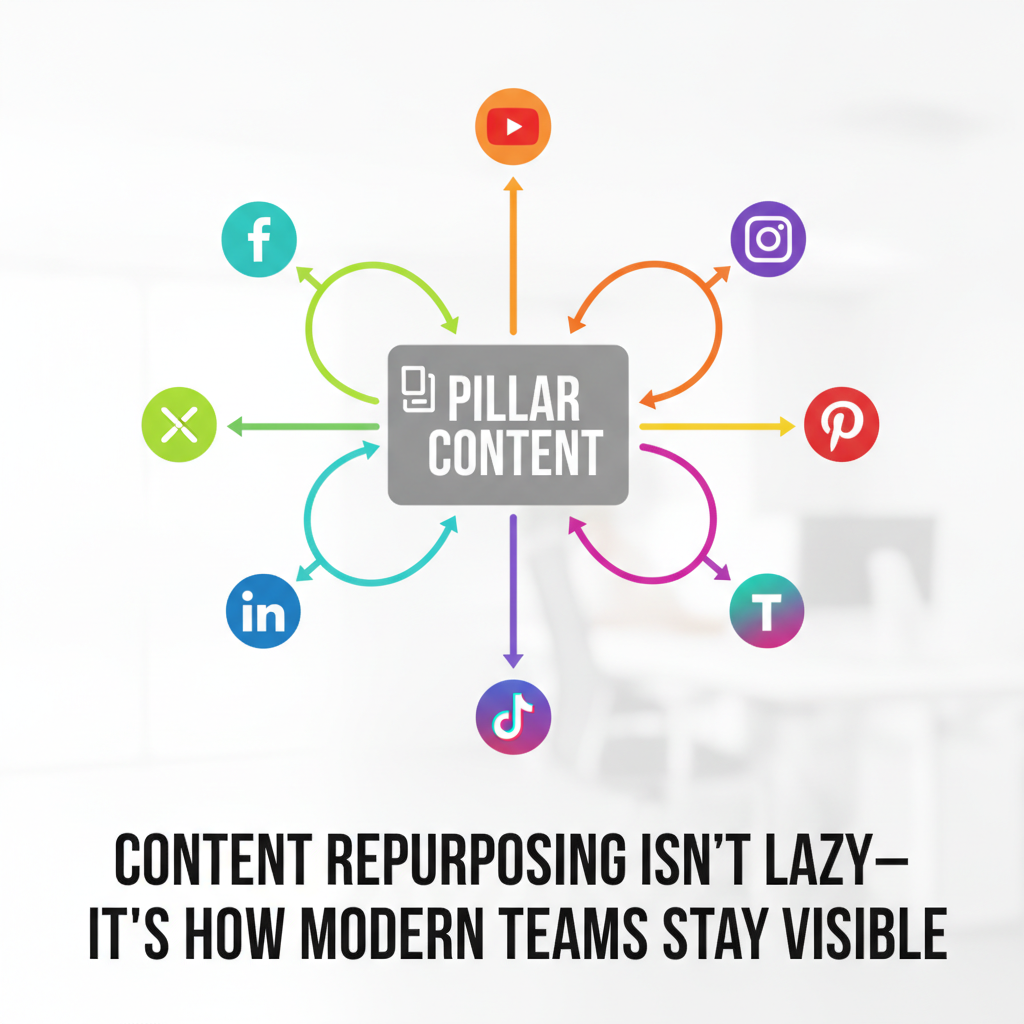
Content repurposing framework diagram showing pillar content split into native social posts
Consider how a single B2B research report adapts across different channels.
Platform-Native Adaptation Matrix:
| Platform | Format Requirement | Adaptation Strategy |
| Professional insights | Extract specific data points. Write a text-only post analyzing what the data means for industry leaders. | |
| TikTok | Entertaining hooks, visual storytelling | Film a 45-second video highlighting the most shocking statistic from the report. Use a green screen. |
| Newsletters | Deeper analysis, exclusivity | Send a behind-the-scenes essay on how you conducted the research and what surprised you the most. |
| Visual data, quick facts | Design a 5-slide carousel summarizing the top five trends found in the report. |
Each piece of derivative content stands on its own. The reader never feels like they're reading an incomplete summary. They receive native value in their preferred format.
How Much Time and Resources Does Content Repurposing Actually Save?
The business case for stretching your assets is undeniable. According to the Content Marketing Institute's 2026 efficiency research, systematic repurposing saves 60-80% of content creation time and boosts output by 40%.
This massive gain comes from eliminating repetitive foundational work.
Where the time savings happen:
- Research Phase: You only conduct interviews, pull data, and verify facts once for the pillar content
- Ideation: A single strong concept naturally generates 6 to 12 derivative pieces. You stop brainstorming from scratch every morning
- Production: Reformatting existing text takes minutes. Drafting a completely new article takes hours
Consider the cost-per-content ratio. If a $2,000 pillar article yields 10 derivative social posts, your cost per asset plummets. You effectively distribute the initial investment across an entire campaign.
A lean, two-person marketing team can achieve the output of a six-person operation.
This creates a compounding return on investment. Unlike paid advertisements that stop working the second your budget dries up, repurposed organic content continues capturing attention. You build a deep library of assets that circulate continuously.
What Are the Competitive Advantages of Content Repurposing?
Efficiency is just the baseline. The true power of a multi-format strategy lies in market positioning.
How Does Diversification Protect Against Algorithmic Volatility?
Relying on a single channel is terrible risk management. If your entire strategy lives on LinkedIn, an algorithm update can destroy your reach overnight.
Repurposing creates a protective moat through platform diversification. You ensure a consistent omnichannel presence. When organic reach drops on one network, your derivative assets continue thriving on another. You stop begging a single algorithm for visibility and start owning your distribution.
Why Does Repurposing Enhance AI Search Visibility?
Generative AI search engines crave diverse data sources. They look for consensus across different mediums to validate an answer.
Research indicates that repurposing original data into multimedia formats increases Generative AI search engine visibility by up to 40%.
AI engines prefer varied formats of authoritative content. When they find your original research cited in a YouTube transcript, a text-based blog, and a structured table, they view your brand as a highly credible source. Data-led content is outperforming opinion-only content in 2026. Structuring that data across multiple platforms ensures the AI tools extract and cite your work.
How Does Repurposing Sustain Authority Building?
People need to hear a message multiple times before they internalize it. Repetition builds brand recognition.
Different audiences also have different learning preferences. Some executives skim bulleted text on LinkedIn. Others listen to audio clips on their commute. By translating your core message into text, video, and audio, you reach every segment of your market. This continuous, multi-sensory presence compounds your credibility over time.
How Should Teams Balance AI and Human Input in Content Repurposing?
Artificial intelligence handles the friction of formatting, but it can't replicate human empathy. According to HubSpot's 2026 marketing AI adoption study, 94% of marketers plan to use AI in their strategy.
The winning formula is simple. Use AI for heavy lifting, and rely on humans for strategy.
AI's role in the repurposing workflow:
- Summarizing 5,000-word transcripts into bullet points
- Reformatting long paragraphs into snappy social media drafts
- Generating short video clips from hour-long webinars
- Suggesting initial variations for different target audiences
Human oversight requirements:
- Setting the strategic direction and core messaging
- Ensuring brand voice and tone remain perfectly consistent
- Fact-checking AI outputs and performing strict quality control
- Injecting platform-specific nuance and cultural context
You can't blindly trust a machine to understand your audience's pain points.
"AI is a magical typewriter for content marketers, but thought leadership is a human-only format. You, the expert, must provide the human oversight and decide how to apply the insights."
— Andy Crestodina, Co-Founder and CMO of Orbit Media
Humans must act as editors and directors. Let the software slice the video, but a human must decide which quote actually matters to your buyers.
What Does a Sustainable Content Repurposing System Look Like?
You can't scale what you don't systemize. A sustainable framework removes the guesswork from daily execution.
Step 1: Identify Pillar Content Candidates
Start by auditing your existing library. Look for high-performing pieces that already resonate with your audience. Prime candidates include original research data, comprehensive how-to frameworks, and recorded event content like webinars or speaking engagements. Don't repurpose average material.
Step 2: Map Platform-Native Formats
Create a matrix connecting one pillar to 8-12 derivative pieces. Define the specific adaptation checklist for each channel.
- Does the LinkedIn post have a strong opening hook?
- Is the TikTok video visually engaging within the first three seconds?
- Does the newsletter variation offer exclusive commentary?

Marketing professional organizing a multi-channel content calendar on a dual-monitor setup
Step 3: Create Repurposing Workflows
Document exactly who does what. Assign the writer to extract quotes, the designer to build carousels, and the social manager to schedule distribution. Define the quality control checkpoints. Integrate your publishing schedule so the derivative pieces release in a logical sequence.
Step 4: Measure and Optimize
Track the metrics that actually matter for repurposed assets. Monitor engagement rates by format. Run A/B tests on different hooks. Identify which content types perform best on specific platforms and double down on those formats in your next cycle.
This is exactly where modern infrastructure becomes necessary. Platforms like Repostra.app systematize these workflows seamlessly. They help teams bridge high-level strategy with daily execution, turning chaotic spreadsheets into an automated, predictable machine.
Which Common Content Repurposing Mistakes Should You Avoid?
Implementation failures usually stem from rushing the process. Avoid these critical errors to protect your brand reputation.
- The copy-paste syndrome: Posting identical, unedited text across every platform screams laziness. It ignores the unique culture of each network
- Over-automation without quality checks: Letting an AI tool auto-publish summaries without human review leads to robotic, hallucinated content
- Forgetting time-sensitive context: If you repurpose a webinar from last year, update the statistics. Stale data destroys credibility
- Garbage in, garbage out: Repurposing weak original content just amplifies bad ideas. Only multiply your best work
- Ignoring performance tracking: If you don't track which derivative formats work, you waste time building the wrong assets
- Overwhelming the audience: Blasting 12 pieces of content from the same pillar on the exact same day exhausts your followers. Spread the distribution over weeks
How Can Repostra.app Help Teams Implement Repurposing at Scale?
Building a system from scratch requires immense trial and error. Repostra.app acts as your sustainability partner, giving you the immediate infrastructure to scale your visibility.
The platform solves three core problems for modern marketing teams.
Stop "Publishing More," Start "Publishing Smarter"
Repostra.app helps you turn high-value assets into multiple formats systematically. You upload a successful pillar piece, and the platform assists in generating platform-native variations. You reclaim hours of manual formatting time while maintaining complete authority over the final message.
Combat Algorithmic Anxiety
Relying on one platform is dangerous. Repostra.app ensures consistent multi-platform distribution. This automated cadence protects your brand against single-platform dependency. If one algorithm changes, your presence on other networks remains strong and steady.
Scale Without Headcount
Lean teams often struggle to maintain an omnichannel presence. Repostra.app enables a small group to achieve the output of a large enterprise organization. By streamlining the workflow from pillar to post, the platform dramatically lowers your cost-per-content outcome.
Your team reclaims time for deep, strategic work instead of drowning in formatting tasks.
Is Repurposing Your Ultimate Competitive Moat?
Content repurposing isn't a shortcut. It's a massive strategic advantage.
The modern marketing triangle consists of sustainability, visibility, and efficiency. The 2026 reality is clear. Teams that repurpose systematically outperform those that refuse to adapt. They maintain a relentless presence across the web without burning out their creators.
The alternative is bleak. Teams trapped on the content treadmill face inconsistency, algorithmic invisibility, and eventual burnout.
Take a look at your existing assets today. Audit your top-performing content and identify three pillar pieces you can break down into native formats this week. Explore how dedicated platforms like Repostra.app can automate the heavy lifting, allowing you to dominate your market with smarter, data-backed distribution.
FAQ
Is content repurposing bad for SEO?
No. When done properly, content repurposing is excellent for SEO. Creating platform-native variations with different formats, angles, and keywords helps you rank for more search terms and reach different audience segments. The key is ensuring each piece provides unique value and isn't just duplicate content. Google and generative AI search engines reward comprehensive topic coverage across multiple content types.
How many pieces of content can you create from one pillar article?
A single comprehensive pillar piece of over 2,000 words can typically generate 8 to 15 derivative assets. This includes social media posts for multiple platforms, short-form video clips, infographics, quote graphics, email newsletter segments, and podcast talking points. The exact number depends on the depth of your original content and the channels you prioritize.
How often should we repurpose the same content?
You can repurpose evergreen content indefinitely by updating statistics and examples. For trending topics, repurpose them within three to six months while they remain relevant. A good rule of thumb is that if more than 30% of your current audience didn't see the original, it's completely new to them. Vary the format and angle each time to provide fresh, immediate value.
What types of content work best for repurposing?
Original research, comprehensive how-to guides, case studies, expert interviews, and framework-based content repurpose most effectively. These "pillar" pieces contain enough depth and varied information to support multiple derivative formats. Opinion pieces and brief news commentary typically have much shorter repurposing lifespans.
Do we need special tools to repurpose content effectively?
While you can repurpose content manually, specialized platforms dramatically reduce time and effort. Tools like Repostra.app systematize workflows, maintain brand consistency, and coordinate multi-platform distribution. For teams publishing regularly, dedicated repurposing infrastructure typically pays for itself within the first month through sheer time savings.