Content Repurposing Is Not a Shortcut—It’s a Smarter Growth System
This post explores why repurposing content is one of the most effective ways to scale social media marketing without sacrificing quality or brand voice. It will show how businesses can combine human oversight with AI-assisted workflows to distribute stronger content more consistently.
Content Repurposing: A Complete Guide to Scaling Your Social Media Marketing
Repurposing content has become essential for marketers who want to scale without burning out. Instead of treating each piece as disposable, smart teams now transform one high-value asset into platform-native content across multiple channels. This approach extends your content's lifespan, slashes production costs, and keeps your brand visible where your audience actually spends time. Done right, you can multiply your reach while cutting both time and money spent on content creation.
Key takeaways:
- Repurposing extends content lifespan while reducing production costs by 70-90%
- Automated extraction paired with editorial judgment preserves brand voice at scale
- Platform-native adaptation meets specific channel requirements and audience expectations
- Batching repurposed content prevents burnout and maintains publishing consistency
- Strategic repurposing is now a competitive necessity, with 94% of marketers adopting it
Why Do Most Marketers Waste Their Best Content?
You know the scenario. A marketer spends weeks creating a premium blog post. They hit publish, share a link on social media, and watch their hard work disappear into the feed within forty-eight hours.
Most businesses treat content as disposable. It shouldn't be.
Creating original content is expensive. A single high-quality piece costs anywhere from $500 to $2,000 to produce in 2026. You cannot afford to waste these assets on a one-and-done publishing schedule.
Content repurposing isn't about cutting corners or getting lazy. It's about building a sustainable, multi-platform machine that actually works.
Marketer staring at declining engagement metrics after publishing a post once
What Is Content Repurposing as a Growth System?
Modern content repurposing goes far beyond cloning a link across all your social profiles. It requires platform-native adaptation with strategic intent.
A true system relies on three pillars: source material quality, automated efficiency, and human editorial oversight.
Instead of a frantic copy-and-paste job, a modern workflow systematically breaks down a core asset into tailored pieces. You extract the best hooks, format them for the right medium, and adjust the pacing for the specific audience.
According to the Content Marketing Institute's 2026 research, modern content strategy requires multi-format distribution to build genuine topical authority.
Systems like Repostra.app help bridge the gap between your raw ideas and professional execution. They provide the necessary structure to make the process repeatable, scalable, and fully measurable.
Why Does Content Repurposing Matter More in 2026?
Audiences are scattered across platforms with very different consumption habits. Search engines and social algorithms heavily reward consistency and deep topical authority. Marketing budgets face intense scrutiny while the demand for fresh content keeps growing.
Brands that publish consistently dominate mindshare. Your audience needs multiple touchpoints before they convert.
Ahava Leibtag, CEO of Aha Media Group, puts it this way:
"Content needs to be repurposed before it's even created. Think information, format, delivery. Which audience needs which information? What format works best for that audience, and which channels are they most likely to engage with?"
HubSpot's 2026 research shows 94% of marketers surveyed are either already repurposing content or planning to do so in the near future. If you ignore this approach, you risk falling behind competitors who maintain a daily presence without increasing their headcounts.
How Does Content Repurposing Maximize Your Return on Investment?
Let's look at the math. One piece of cornerstone content might cost $1,500 to create. That same piece can become a dozen derivative posts at $50 to $200 each.
You're actively extending the lifecycle of your evergreen content, allowing it to generate traffic for months or even years.
Semrush's 2026 data indicates repurposed content strategies can lead to a 300% increase in reach for a fraction of the original creation time. Each repurposed piece links back to your cornerstone asset. This creates compounding returns and boosts your organic search rankings over time.
| Metric | Original Content | Repurposed Content |
| Average Cost | $500 to $2,000 | $50 to $200 |
| Production Time | Weeks | Hours |
| Reach Potential | Single audience | Multiple platform audiences |
| Lifespan | Days | Months to years |
Bottom line: Repurposing improves both quantity and quality.
What Are the Stages of an Automated Repurposing Workflow?
A systematic approach separates top-tier marketing teams from the rest. You need a reliable process to turn one asset into a comprehensive campaign.
Source material capture: Identify your highest-value long-form assets. Webinars, podcasts, whitepapers, and pillar blogs serve as your source of truth. Only select content that performed well or contains clear evergreen value.
Extraction and adaptation: Feed your source material into your tools for transcription and key insight extraction. This is where you apply critical editorial judgment. Extract data points, compelling narratives, and platform-specific hooks.
Platform-specific optimization: Every channel demands a unique approach.
- LinkedIn requires a professional tone, carousel formats, and strong thought leadership angles.
- X needs punchy threads, data-driven hooks, and a conversational tone.
- Instagram prioritizes visual-first storytelling and fast-paced video snippets.
Validation and publishing: Run technical checks on character counts, link previews, and image dimensions. Scheduling your posts for optimal engagement times is crucial. Using a dedicated platform like Repostra.app streamlines these mechanical steps, leaving your team free to focus on messaging and strategy.
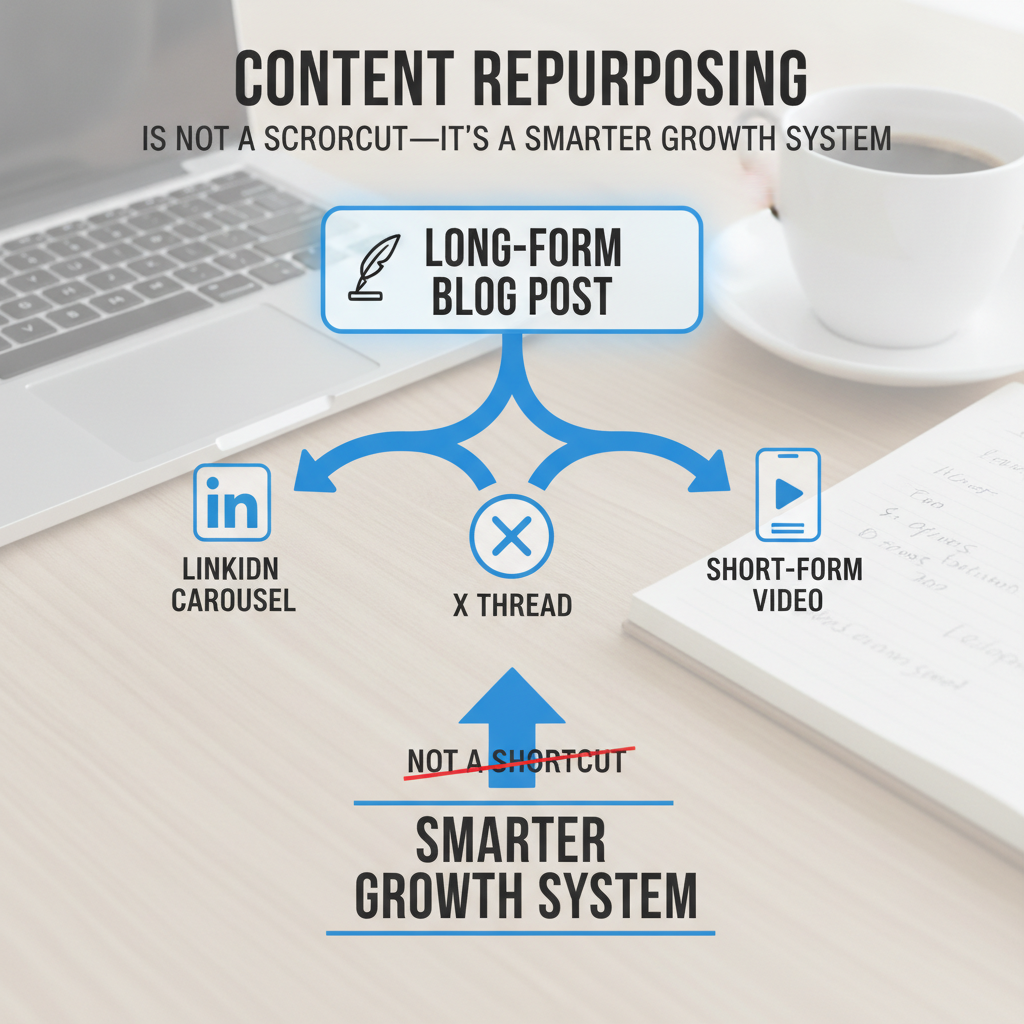
Flowchart illustrating a content repurposing workflow from core asset to multiple platforms
How Do You Maintain Brand Voice While Scaling Output?
Will repurposing dilute my brand? This is the most common concern marketers raise when scaling their output.
Brand voice should act as a filter rather than a limitation. The difference between automated clutter and intentional adaptation lies entirely in human oversight. You must build editorial checkpoints into your workflow.
Apply an editorial review checklist before any scheduled batch goes live. Check for tone alignment, value consistency, and messaging accuracy.
Good repurposing preserves your unique perspective. Bad repurposing reads like a robotic clone. Document your brand guidelines clearly so that any tool or team member processing your content knows exactly how you sound.
What Are the Most Common Content Repurposing Mistakes?
Many teams attempt repurposing but fail to see meaningful results. Avoid these frequent pitfalls to protect your digital presence.
Direct copy-pasting across platforms: Never post identical content without adaptation. Always customize your hook and formatting for the specific platform context.
Over-relying on automation: Build mandatory editorial checkpoints into your weekly workflow. Human review catches tone problems that tools miss.
Repurposing low-performing content: Only recycle proven winners or highly authoritative evergreen pieces. Amplifying mediocre content wastes time.
Ignoring platform-specific best practices: Keep a current requirements checklist for image dimensions and video lengths. Each platform updates its specs regularly.
Forgetting to link back: Create a systematic cross-linking strategy to capture all possible search engine benefits. Every repurposed piece should guide readers to your cornerstone content.
What Results Can You Expect From Strategic Repurposing?
Setting realistic expectations is crucial. You will typically begin to see measurable results within thirty to ninety days of consistent execution.
Track your reach and total impressions across all platforms. Monitor your engagement rate improvements and watch for an uptick in inbound leads. You should also see search ranking improvements for your original cornerstone pieces due to the increased traffic and cross-linking.
The compounding effects become highly visible over a three to six-month period. Your time saved in content production will free you up to focus on higher-level strategy and relationship building.
How Do You Get Started With Content Repurposing?
Starting from scratch can feel overwhelming. A structured first week helps you build momentum quickly.
Conduct a content audit: Identify your top five performing pieces from the past twelve months. Analyze exactly why they performed well and select just one to pilot your new workflow.
Map your platforms: List all your active social channels and document their current requirements. Decide which specific formats make the most sense for your audience on each platform.
Create your first batch: Extract the key insights from your chosen pilot piece. Adapt those insights for three different platforms. Apply your human editorial review to ensure the tone is perfect.
Schedule and measure: Load the content into your calendar. Establish your baseline metrics so you can measure growth accurately. Repostra.app can significantly reduce the learning curve here by centralizing your drafting and formatting into one workspace.
Building More With What You Already Have
Content repurposing serves as a strategic growth system, not a shortcut. It maximizes your financial return, ensures sustainable publishing consistency, and gives you a massive algorithmic advantage.
Stop falling into the trap of creating a great piece of content just to forget it exists a week later. Shift your mindset from simply creating more to building more with what you already possess.
The powerful partnership between automated efficiency and human oversight protects your brand identity while scaling your reach. Start with just one proven asset today, adapt it for three platforms, and watch how quickly your digital footprint expands.
FAQ
How many times can you repurpose the same piece of content?
There is no hard limit as long as you create genuine value and adapt the material for each platform. A single high-quality piece can easily generate a dozen derivative assets. Focus entirely on quality and relevance rather than chasing arbitrary numbers.
Does repurposing content hurt search rankings by creating duplicate content?
No, it doesn't hurt your search rankings when done correctly. Platform-native repurposing creates unique context for each channel. Social media posts don't compete with your primary website in search results. The strategy actually helps your rankings by creating multiple entry points that link back to your cornerstone content.
How much does it cost to repurpose content compared to creating original content?
Original high-quality content typically costs between $500 and $2,000 per piece. Repurposing that same asset costs roughly $50 to $200 per adaptation. This represents a massive cost reduction while allowing you to reach significantly more people.
What is the difference between content repurposing and content syndication?
Content repurposing transforms one piece into multiple platform-native formats tailored for different audiences. Content syndication republishes the exact same piece unchanged across multiple external sites or publications. Repurposing requires creative adaptation, whereas syndication is simply strategic redistribution.
Can small businesses with limited resources benefit from content repurposing?
Absolutely. Repurposing is incredibly valuable for small businesses with tight budgets. It lets you maintain a consistent presence across platforms without hiring a large creative team. Starting with just one high-performing piece per month prevents burnout while building essential brand trust.