Can AI and Human Collaboration Redefine Content Repurposing?
Explore how the synergy between AI automation and human creativity is transforming the art of content repurposing, offering businesses a powerful strategy for effective content marketing.
The 5 Best Social Media Automation Apps in 2026
You post daily. You engage with your audience constantly. You analyze metrics until your eyes blur. Yet somehow you still feel behind schedule.
This is the modern time paradox of digital marketing. We have more tools than ever before, but we spend more hours glued to our screens.
In 2026, successful brands are shifting their approach entirely. They're not working harder. They're working smarter.
At the core of this shift is social media automation. The landscape has matured drastically over the last few years. We've moved far beyond the days of manual posting and clunky spreadsheets. Today, AI-integrated systems run the backend of the most engaging brand accounts on the internet.
Let's explore the tools helping brands reclaim their time while building stronger, more authentic connections with their communities.
Why Social Media Automation Matters in 2026
Artificial intelligence is no longer a fun novelty. It serves as the baseline infrastructure for any competitive digital presence.
Marketing teams report massive efficiency gains and sharp improvements in their return on investment when they embrace these tools. But how do you maintain a human touch while relying on machines? This is what industry experts call the authenticity paradox.
Automation handles the repetitive administrative tasks. This frees up human creators to focus entirely on genuine connection and creative storytelling. Users crave raw, unfiltered content. They want human-centric interactions. You can deliver this easily when a machine handles your posting schedule and hashtag research.
The metrics of success have also shifted. Follower counts act largely as vanity numbers today. Community engagement metrics hold the real power. Brands prioritize comments, saves, and direct messages over simple likes.
Social platforms like TikTok, Instagram, and YouTube now function heavily as search engines. You need proper SEO optimization to be discovered by new audiences. This reality demands a system builder mindset. Moving from reactive, daily posting to strategic workflows is the only way to thrive.

A marketer experiencing the efficiency of modern social media automation tools
The Top Social Media Automation Apps
Buffer: Best for Creators and Small Businesses
Buffer remains the gold standard for creators, solopreneurs, and small businesses. Its primary strength has always been its clean, intuitive interface. It never overwhelms you with unnecessary features.
The pricing model is also a major draw. Buffer offers affordable per-channel pricing. You only pay for the specific platforms you actually use.
Consider a local retail shop trying to maintain a consistent online presence. The owner lacks the time to learn a complex enterprise system. They need simple scheduling and basic team collaboration. Buffer delivers exactly that experience.
The 2026 updates introduced robust AI caption assistance and a highly visual analytics dashboard. This platform is ideal for those new to automation or working with limited marketing budgets.
Best use cases: Simple scheduling, streamlined team collaboration.
2026 features: AI caption assistance, user-friendly analytics dashboard.
Ideal for: Beginners and brands with strict budget constraints.
Hootsuite: Enterprise-Level Automation
Larger organizations and enterprise teams have entirely different requirements. Hootsuite caters directly to this sophisticated audience.
It evolved from a basic scheduling tool into a comprehensive AI-powered marketing automation platform. Its primary strengths include deep social listening, advanced analytics, and strict multi-user governance.
Complex workflows require robust compliance protocols. A multinational corporation needs to route posts through legal and public relations departments before publishing. Hootsuite manages these intricate approval chains effortlessly.
The latest version features predictive analytics that forecast campaign performance before you hit publish. It also boasts deeply integrated CRM capabilities.
The pricing tiers reflect its enterprise nature. It represents a significant investment, but it serves as a complete command center for organizations requiring heavy scalability.
Best use cases: Complex workflows, team management, strict compliance needs.
2026 features: Predictive analytics, integrated CRM capabilities.
Ideal for: Large organizations needing comprehensive oversight.
Sprout Social: CRM-Integrated Social Management
Sprout Social stands out by treating social media as a direct extension of customer service. It targets teams that must integrate social performance with broader customer data.
Its primary strength is the seamless combination of social automation with sophisticated CRM capabilities.
Imagine a customer complaining about a product on X. Sprout Social immediately pulls up that individual's entire purchase history and previous support tickets. The support team responds with full context.
This unified view creates hyper-personalization. The platform allows brands to track the entire customer lifecycle directly from social interactions.
This tool is uniquely suited for relationship-driven brands that prioritize deep community building over simple broadcast marketing.
Best use cases: Customer service teams, relationship-driven brands.
2026 features: Hyper-personalization through CRM sync, lifecycle tracking.
Ideal for: Brands prioritizing community support and sales integration.
SocialBee: Content Recycling Powerhouse
Agencies and businesses relying heavily on evergreen content flock to SocialBee. This platform operates as a massive content recycling powerhouse.
Its primary strengths revolve around content categorization, bulk scheduling, and performance-based recycling.
Simple reposting often feels spammy to audiences. SocialBee takes a much smarter approach. It uses AI-powered content categorization to build sophisticated posting queues.
You create specific categories for educational tips, product spotlights, and client testimonials. The platform then cycles through these categories automatically. It maximizes the lifespan of your best content by adjusting text formats and captions slightly with AI.
This saves countless hours for multi-client marketing agencies.
Best use cases: Managing evergreen content libraries, multi-client agencies.
2026 features: AI-powered categorization, performance-based recycling.
Ideal for: Teams with extensive content libraries needing systematic organization.
Later: Visual Planning for Brand Aesthetics
Visual storytelling completely dominates platforms like Instagram, Pinterest, and TikTok. Later is specifically designed for visual-first brands, influencers, and e-commerce companies.
Its primary strength is the visual grid planner. You can see exactly how your feed will look before any post goes live.
A cohesive brand aesthetic is critical for fashion, lifestyle, and design brands. Later helps you maintain that visual consistency flawlessly.
The current features are highly tailored to modern social commerce. The software offers AI-powered visual composition suggestions and seamless shoppable content integration. The platform specializes in adapting your visual assets perfectly to the unique aesthetic requirements of each network.
Best use cases: Maintaining cohesive aesthetics, product showcases.
2026 features: AI visual composition suggestions, shoppable content.
Ideal for: Brands where visual consistency is absolutely paramount.
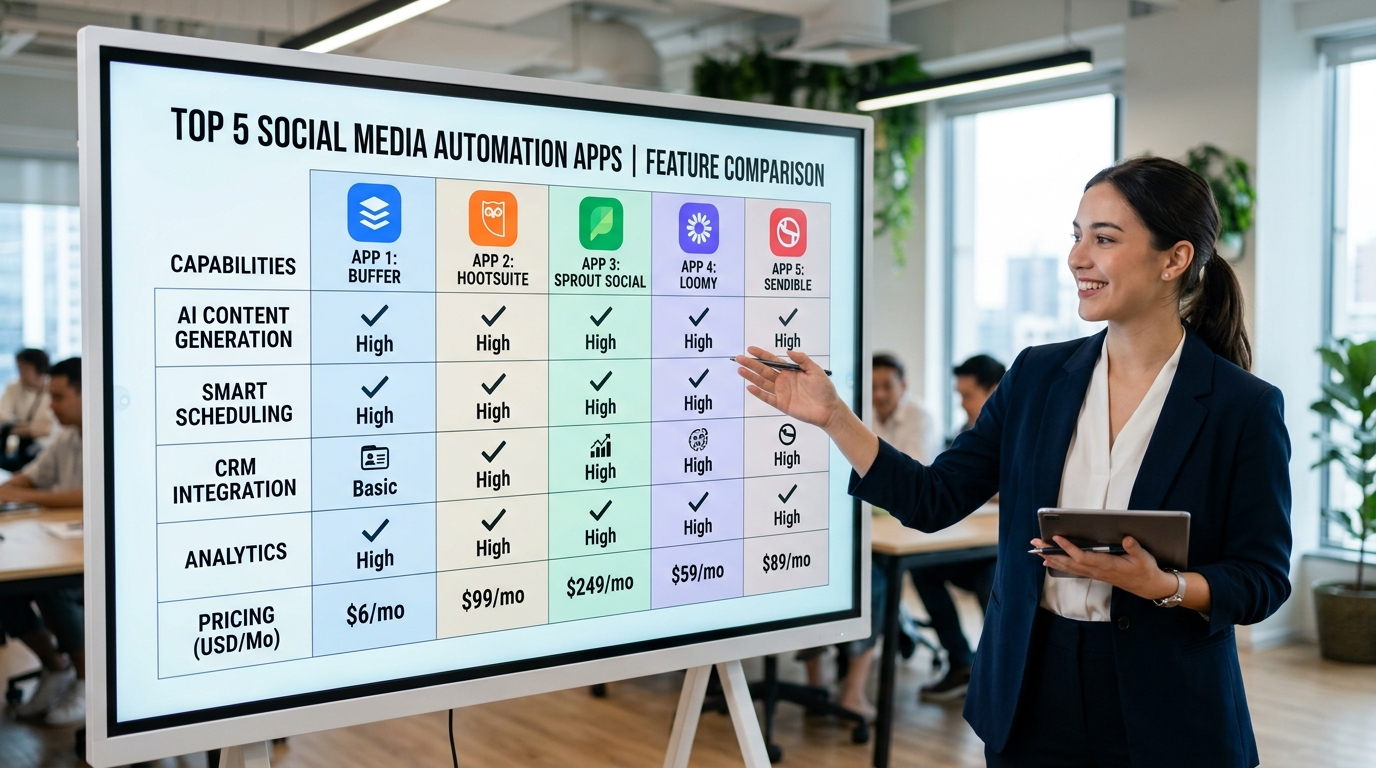
A comparison table matrix of top social media automation tools
Key Features to Look for in Social Media Automation Tools
When evaluating these platforms, you need to look past the flashy marketing copy. Certain features are absolutely critical for success in today's landscape.
AI Capabilities (Not Just Add-Ons)
Artificial intelligence must handle the heavy lifting of your content creation. Look for tools offering intelligent caption generation and ongoing optimization. They should provide dynamic hashtag research and tailored recommendations based on real-time trends.
Advanced platforms now offer visual editing assistance. They use predictive analytics to determine your specific best times to post. They even forecast how well a piece of content might perform based on historical data.
SEO and Discoverability Features
Social platforms operate as the new search engines. Your automation tool must support platform-specific SEO.
This means you need dedicated keyword optimization tools. The software should assist with caption structuring for search algorithms. A great tool helps you adapt your core message for TikTok SEO just as easily as it structures a post for Instagram.
Cross-platform content adaptation is a non-negotiable feature.
Community Management Tools
Your audience expects rapid, personalized responses. A unified inbox pulling all comments and direct messages into one place is essential.
Look for automated response templates that still allow for a human touch. The best systems include priority flagging. They automatically identify high-value interactions, such as a message from a major influencer or a frustrated buyer.
Sentiment analysis tools read the tone of incoming messages and route them to the appropriate team member.
Analytics and Reporting
Vanity metrics look nice on a screen, but they don't pay the bills. You need analytics tracking deep engagement and actual return on investment.
Look for tools providing custom reporting capabilities for your stakeholders. Competitive benchmarking is equally vital. You need to know exactly how your growth compares to competitors in your specific industry.
How to Choose the Right Automation Tool for Your Brand
With so many robust options available, making a choice often feels daunting. Let's break the decision down into a practical framework.
Consider these specific areas before signing a contract.
Team Size and Structure
You must determine if you're operating as a solo creator or managing a massive enterprise team. A single user needs a straightforward interface. A large marketing department requires complex role-based permissions and structured approval workflows.
Primary Platform Focus
You need to identify where your audience spends their time. Visual platforms like Instagram and Pinterest require tools with strong grid planning features.
Text-heavy platforms like LinkedIn demand excellent thread management. Emerging platforms necessitate tools that understand short-form video and rapid cultural trends.
Content Strategy
Your chosen tool must align with your specific marketing strategy. Determine whether you rely on recycling evergreen content or reacting to real-time events.
Brands focused heavily on user-generated content need software designed to source and credit external media easily.
Budget and ROI Expectations
Look closely at the pricing models of each application. Per-channel pricing works beautifully for smaller brands. Flat rates often make more sense for agencies managing dozens of accounts.
Weigh the upfront monetary investment against the measurable productivity gains and massive time savings.
Integration Needs
Your social media tool should never exist in isolation. It needs to talk directly to your existing software stack.
Verify that the platform integrates smoothly with your CRM systems, e-commerce storefronts, and team collaboration software.
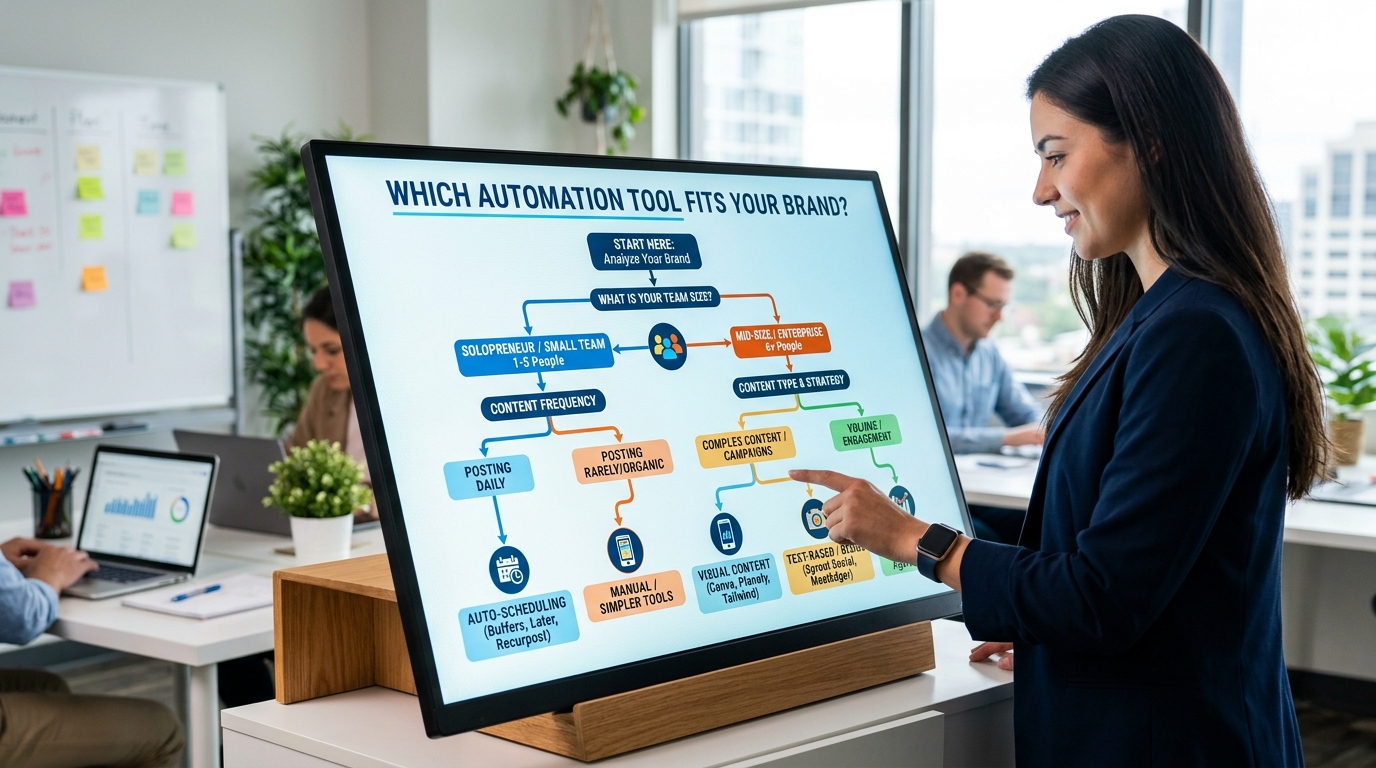
A visual decision flowchart for selecting the right social media management software
Building Systems, Not Just Schedules
The most successful marketers share a common trait today. They act as system builders.
They view automation as a framework for consistency rather than a simple digital calendar. This mindset shift is profound. It allows you to balance pure efficiency with genuine brand authenticity.
Automation is not about replacing human creativity. It's about freeing humans to do the connective work that machines cannot replicate. A sustainable content strategy requires this solid foundation. Better time management enables a true community-first approach.
This is exactly where modern solutions like Repostra.app change the game. Repostra.app operates on the philosophy that you should use automation to build sustainable, long-term systems.
It's crucial to differentiate between enterprise-grade automation platforms and basic repost utilities. Simple repost applications just scrape and republish content without strategy.
Comprehensive tools like Repostra.app combine advanced AI integrations, intelligent scheduling, and deep analytics. They give you complete control over your content lifecycle. You stop reacting to the daily grind and start engineering a predictable growth engine.
The Future of Social Media Automation
The technology continues to evolve at a blistering pace. We're already seeing multimodal AI content creation become mainstream.
Soon, platforms will generate fully edited videos from simple text prompts directly within your scheduling dashboard.
Machine learning will drive even deeper personalization. Automation tools will integrate closer with emerging hardware platforms. Industry forecasts suggest 2027 will bring voice-first content strategies and seamless augmented reality integrations directly within social feeds.
Through all these rapid changes, the core philosophy remains the same. Use technology for efficiency. Rely on humanity for connection.
Continuous learning is your absolute best defense against obsolescence.
From Overwhelmed to In Control
We've completely shifted from manual posting to systematic content engineering. The tools available today are more powerful and accessible than ever before.
Remember the authenticity paradox we discussed earlier. Proper automation equals more time for what truly matters. It gives you the mental space to focus on high-level strategy, boundless creativity, and your loyal community.
Take an honest look at your current daily workflows. Identify the repetitive tasks draining your energy and resources. It's time to let the software do the heavy lifting.
Explore comprehensive tools like Repostra.app to handle your advanced automation needs. Build a framework supporting your growth without burning you out.
The best time to build your system was yesterday. The second best time is today.