Building a Brand Voice for Consistent, Authentic Communication
Get tips on crafting a unique brand voice that resonates with your audience and keeps your messaging consistent.
How to Build a Brand Voice That Sticks in 2026
Picture a social media manager scrolling through their company feed on a Tuesday morning. Something feels off immediately. Monday's post sounds like a corporate lawyer wrote it. Tuesday's update reads like an overly excited teenager. Wednesday's email blast sounds like an emotionless robot. No actual human being communicates like this. This voice confusion is a massive problem many software brands face today.
Audiences in 2026 can spot inauthentic communication instantly. They scroll past anything that feels performative, disjointed, or artificially generated. Building a brand voice is not just about sounding professional. It is about creating genuine connections with the people on the other side of the screen. Authenticity is crucial right now, with 86 percent of consumers citing it as a key driver for their brand loyalty. People want to buy from people. Whether you run a workflow tool like Repostra.app or a complex enterprise platform, your messaging needs to resonate. Here is exactly how you can craft a brand voice that sticks and keeps your customers coming back.

Social media manager looking frustrated at laptop screen
Why Your Brand Voice Matters More Than Ever
The business case for investing in your communication style is undeniable. Trust is the baseline requirement for any software purchase. Currently, 86 percent of consumers say authenticity directly influences which brands they choose to support. The specific context of 2026 makes this even more critical for your company. We are navigating extreme marketplace saturation combined with widespread AI fatigue. Users are constantly bombarded with generic, machine-generated content. They are desperate for actual human connection.
When features are virtually identical across competitors, your voice creates emotional loyalty. Competitors can copy your interface. They can clone your pricing model. They cannot easily copy your distinct personality. The industry focus has shifted entirely over the last few years. It is no longer just about what you say. It is about how you say it. Robotic and overly sales-driven language alienates modern users. It makes them feel like just another metric on a revenue dashboard.
This is especially true for automation software. Tools like Repostra need extra human warmth to balance the perception of cold efficiency. If your product automates daily tasks, your communication must remind users there is a beating heart behind the code. A strong, authentic voice directly improves customer retention. It fuels word-of-mouth recommendations naturally. It ultimately drives higher conversion rates because people feel understood before they even sign up for a trial.
Understanding Brand Voice and Tone
Many marketing teams use these terms interchangeably. They are actually two distinct concepts. Understanding the exact difference between them is foundational for your communication strategy. Voice is your permanent personality. It represents your core traits. If your brand was a person at a dinner party, your voice is their inherent character. Tone is the adaptable emotional coloring you apply based on the context of the situation. The consistency principle is simple. Voice stays constant while tone flexes to fit the specific room you are in.
Consider the practical example of Repostra. Their core voice is a reliable partner in reclaiming creative time. They are always supportive, expert, and efficient. However, their tone variations change depending on where they are speaking and who is listening.
On LinkedIn, the tone leans professional and highly strategic. A post might read, "Help your team scale content without scaling headcount." The environment expects business-focused insights, so the tone adjusts to meet that expectation without losing the core supportive personality.
On platforms like Instagram or TikTok, the tone shifts to become energetic and relatable. A caption might say, "Stop the copy-paste madness," accompanied by a target emoji. The platform rewards casual, snappy dialogue.
In an email onboarding sequence, the tone becomes warm and deeply encouraging. The opening line could be, "Let us get your first workflow set up together." The user might feel overwhelmed by a new tool, so the tone adjusts to offer a steady, comforting hand.
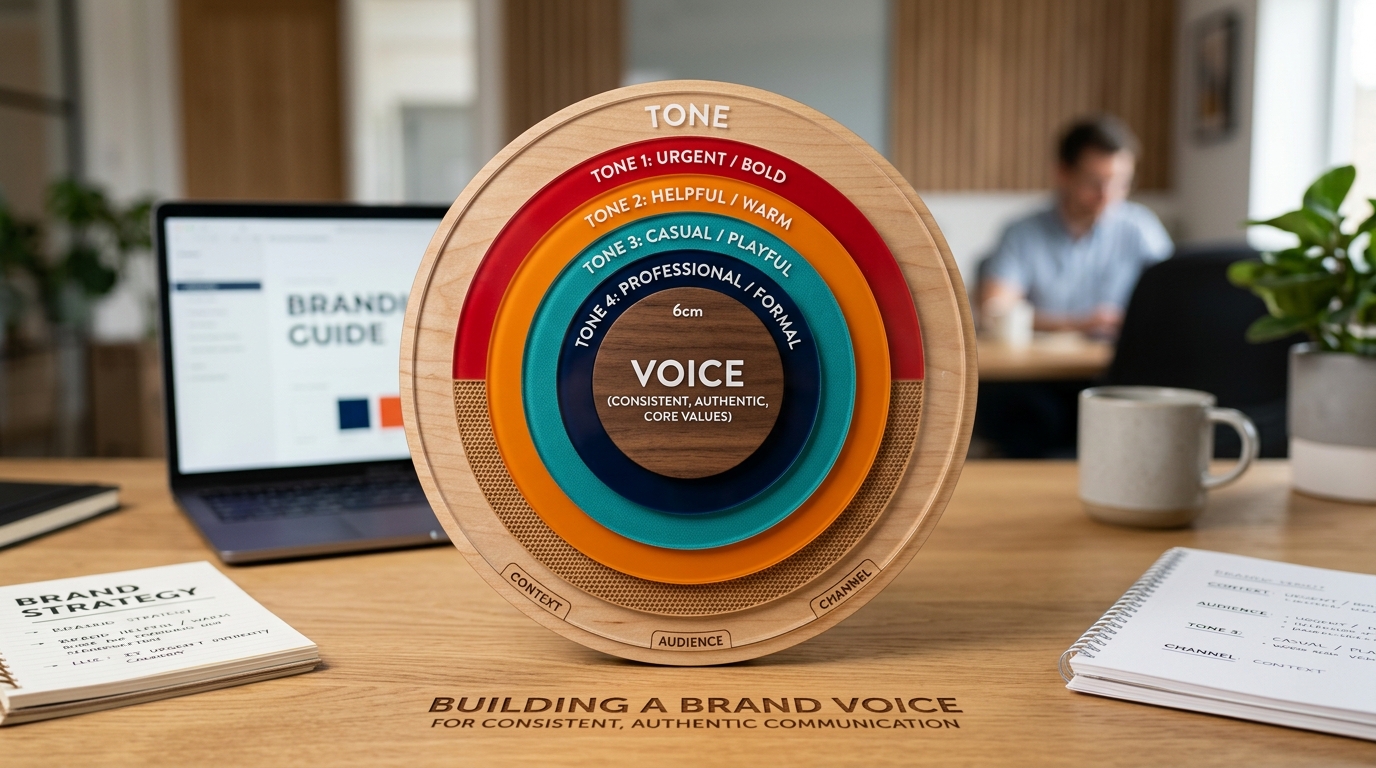
Diagram illustrating the difference between voice and tone
Here is a simple breakdown of how these attributes compare:
| Attribute | Brand Voice | Brand Tone |
| :--- | :--- | :--- |
| Definition | Your fundamental personality | Your emotional inflection |
| Status | Permanent and unchanging | Adaptable and context-driven |
| Analogy | Your actual personality | Your mood on a given day |
| Application | Universal across all channels | Specific to platform and audience state |
Core Principles of Building a Brand Voice
Providing an actionable framework is the only way to turn abstract ideas into real messaging. These foundational steps will help you develop a personality that truly resonates with your target audience.
Anchor in Your Mission Instead of Your Features
Companies often make the fatal mistake of defining their voice by what they do. They label themselves as fast or efficient. You should define your personality by the transformation you create for the user. Do not focus on the mechanics of fast reposting. Focus on empowering creators to spend less time on manual tasks and more time on high-impact strategy.
Try a simple exercise to find this anchor right now. Complete this exact sentence: "We exist to help our audience feel a specific emotion so they can achieve a desired outcome."
For a tool like Repostra, the completed sentence looks like this. "We help content creators feel relieved and empowered so they can spend time on high-impact strategy instead of manual tasks." That statement instantly gives you an emotional baseline for every piece of content you write. You are not just selling a scheduling feature. You are selling immense relief and creative freedom.
Choose Core Personality Traits
Selecting too many traits results in a diluted and confusing voice. You cannot be everything to everyone. You must balance aspirational qualities with highly accessible ones. Do not claim to be innovative, bold, trustworthy, fun, professional, and cutting-edge all at once. It sounds messy and impossible to execute.
Software tools benefit from a specific framework for picking traits. Pick one trait for expertise. This could be knowledgeable or strategic. Pick one trait for personality. Friendly or witty works perfectly here. Finally, pick one trait for your values. Transparent or supportive are excellent choices.
Once you pick your three or four traits, document what each one sounds like in practice. If you choose supportive, explain that this means using inclusive language and offering solutions before ever asking for account upgrades.
Define What You Are Not
Boundaries create immediate clarity for your writers. Establishing what you are not is often more helpful than stating what you are. This prevents voice drift as your team grows and new contractors take over content creation. It serves as a guardrail against bad copy.
A strong list of exclusions keeps everyone perfectly aligned. For Repostra, the exclusions are very specific. They are not overly technical or jargon-heavy. They are not pushy or aggressive in their sales messaging. They are definitely not robotic or reliant on corporate speak. They do not use fear-based marketing. Knowing these boundaries allows a writer to catch themselves before hitting publish on a post that feels too aggressive.
Create a Language Pattern System
Your traits need to translate into actual words on a page. Building a language pattern system helps codify your stylistic preferences. Create detailed lists of preferred vocabulary words and distinctly forbidden jargon. Determine your sentence structure preferences early on. Decide if you prefer short and punchy statements or flowing and descriptive paragraphs.
Always run your copy through a simple humanity check. Read everything aloud. Would a real person actually say this to a friend over a cup of coffee? If the answer is no, rewrite it immediately. You also need to outline your emoji policy, punctuation style, and contraction usage. A highly formal brand might avoid emojis entirely. A supportive, modern tool will embrace them carefully to add warmth.
Making Your Brand Voice Operational
Strategy means very little if your team cannot execute it daily. You have to bridge the wide gap between high-level concepts and actual execution. Documentation is absolutely essential for modern teams. It ensures consistency across different team members, external PR agencies, and even the AI drafting tools you might use. The ultimate growth challenge is maintaining this consistency as you scale up your operations.
Build Your Brand Voice Bible
You need a central source of truth for your messaging. Create a one-page quick reference guide with your voice attributes and tone guidance. Make it highly accessible to anyone writing on behalf of the company. A massive manual will go unread, so keep it concise and highly practical.
Include real examples of approved messaging directly next to rejected messaging. Showing people exactly what a missed opportunity looks like is incredibly educational. You should also include platform-specific tone maps. Here is a highly effective template structure you can adopt today:
- Core Voice: List your three main personality traits.
- We sound like: Name a comparable personality or recognizable archetype.
- We never sound like: List your boundaries and what to avoid at all costs.
- Nailed it: Provide sample phrases that perfectly capture your style.
- Missed it: Provide sample phrases that violate your guidelines.

Marketing team reviewing a brand voice document
Apply Across All Touchpoints
A great personality fails if it only lives on your marketing blog. You must apply it across every single customer interaction. Run a complete audit of your communication touchpoints this quarter. Check your website copy and your daily social media posts. Review your email sequences, including onboarding flows, weekly nurtures, and billing support. Do not forget to inspect your in-app notifications, error messages, and ad copy.
Even customer support responses need to align deeply with your core traits. Set up a consistency checkpoint for the support team. Every touchpoint should feel like the exact same person is speaking to the user. The mood might change from an energetic social post to a calm support ticket regarding a failed payment, but the underlying character must remain identical.
Practical Tips for Software Brands
Industry-specific tactics help ground these communication concepts in reality. Software tools face unique hurdles when building relationships with digital audiences. Here are actionable strategies to keep your communication authentic and effective.
Solve Before You Sell. Shift entirely from feature-focused messaging to outcome-focused messaging. No one truly cares about automated reposting as a standalone technical feature. They care deeply about the result it brings them. Transform your copy from "Use our automated reposting feature" to "Reclaim ten hours per week for the creative work you actually enjoy."
Embrace Quiet Authenticity. A major trend in 2026 is the growing preference for intentional communication over constant noise. Be clear, transparent, and genuinely helpful instead of relying on cheap clickbait. Ditch phrases like "You will not believe this crazy new feature." Replace them with "Here is exactly how this update saves you time today."
Lead with Education Rather Than Promotion. Position your company as a reliable thought leader in your specific niche. At least forty percent of your content should provide extreme value beyond basic product tutorials. Share detailed user stories. Break down complex industry insights into digestible posts. Show behind-the-scenes glimpses of your company culture to build trust.
Humanize Your Automation Angle. Frame your automation capabilities as powerful tools that enhance human creativity, not replace it. Address the anxiety people have about technology taking their jobs head-on. Use reassuring phrasing like, "Your human creativity drives the overall strategy. We just handle the repetitive background stuff."
Use Real Customer Voices. Integrate user-generated content into your strategy whenever possible. Share authentic testimonials written in your customers' own unedited words. Community-driven validation strengthens your overall authenticity. When prospects see real people speaking highly of your tool in normal language, it builds massive trust and significantly shortens the sales cycle.

Educational content analytics displayed on a tablet
Testing and Refining Your Brand Voice
Voice development is never a set-and-forget project. You are building a living, breathing system that requires iteration and constant improvement. Build strong feedback loops with your audience to understand exactly how your messaging lands in the real world.
You need to track specific metrics to gauge your success objectively. Look closely at engagement rates. Are people actually responding and leaving meaningful comments on your posts? Monitor basic sentiment analysis to see how people describe your brand on forums and social media. Pay attention to recurring themes in your customer support feedback. You should also track internal team confusion points. If your writers constantly ask how to phrase things, your guidelines desperately need clarification.
How do you know when to adjust your strategy? Ask yourself these critical audit questions. If engagement suddenly drops, check if you are being too formal, too casual, or too technical for the platform. If your messaging feels disjointed across channels, check if everyone is actually reading and using the brand voice bible. If conversions start to lag, verify that your voice still matches your audience's current expectations and pain points.
Always follow the golden adjustment rule. You can modify your tone as much as needed to fit the context of the situation, but you must fiercely protect your core voice attributes at all times.
Your Checklist for Communication Success
Building a brand voice is a serious investment in long-term relationships with your users. The companies that win in 2026 are not always the loudest ones in the room. They are consistently the most genuine. Your communication style is exactly how you turn casual users into vocal advocates and transform standard customers into a dedicated community.
Here is a quick summary table to keep your entire team on track:
| Principle | Action Item |
| :--- | :--- |
| Authenticity | Ensure forty percent of your content features user stories and values. |
| Consistency | Create and share a one-page voice bible with your entire team. |
| Adaptability | Map your core voice traits to platform-specific tones. |
| Human-First | Frame all automation features as tools that enhance human talent. |
Start small today. Pick your three core traits. Write your first guideline page and begin testing it with your current audience. Ready to build a voice that truly resonates? Define your mission and choose your personality traits right now to set your brand apart.