Are You Repurposing Content Too Late in the Workflow?
This post explores why content repurposing works best when planned from the start, not added at the end. It will show businesses how to build a smoother content creation and social media marketing process with the right mix of human oversight and AI support.

Why Most Marketing Teams Waste 70% of Their Best Content (And How to Fix It)
You just invested 20 hours creating an incredible webinar. You hit publish, share it once on LinkedIn, and move on. That asset then sits collecting digital dust while your team scrambles to create tomorrow's content from scratch. This is the content marketing trap that's burning out teams and killing ROI.
The fix isn't working harder. It's planning your distribution before you create anything. By building repurposing into your workflow from day one using a macro-to-micro framework, you can extend a single asset's reach by 300 percent. You combine AI's speed with human oversight to turn one piece into weeks of platform-native content. Tools like Repostra.app help teams systematize this proactive approach so burnout becomes a thing of the past.
Key Takeaways
- Planning distribution before creation prevents burnout and boosts asset ROI by up to 300 percent
- The macro-to-micro framework systematically breaks one high-value piece into platform-native posts
- AI handles repetitive draft generation while humans provide strategic direction and brand voice
- Repurposing tools like Repostra.app turn single assets into weeks of consistent content
Why does your best content die after one post?

Marketer struggling with single-use content
Most marketing teams treat repurposing like an optional bonus. It's something they'll get to if time allows. Spoiler: time never allows.
This mindset turns content that could easily fuel 15 different posts across multiple channels into a single-use asset. You create it, publish it once, and immediately start stressing about what to post tomorrow. The cycle never ends.
Treating distribution as an afterthought is the hidden workflow bottleneck killing your content ROI. This article will show you how to reverse the process. You'll learn how to ensure repurposing happens first, not last. By shifting your approach, you transform a single heavy lift into a sustainable content engine.
What happens when you repurpose content as an afterthought?
Afterthought repurposing relies on manual, rushed, and inconsistent processes tacked onto the end of production. When you wait until an asset is completely finished to figure out how to share it, your workflow breaks down. Hard.
This reactive approach leads to three specific problems:
- Team Burnout: Creating unique content for every platform from scratch isn't scalable. Your team can't keep up with the demand of modern social channels.
- Wasted Asset Value: A high-quality webinar, case study, or video dies after one use. You leave months of potential engagement on the table.
- Brand Inconsistency: Rushed secondary posts lack a cohesive voice and messaging. They look like afterthoughts because they are afterthoughts.
The Content Marketing Institute's 2024 research found that systematic content repurposing can increase content reach by 300 percent. The old model of creating a piece, publishing it once, and moving on worked when companies only published once a week. That model fails entirely at today's required scale.
You need to make the mental shift from "create and forget" to "create once and distribute everywhere."
Why should you plan content repurposing from the start?
Proactive repurposing means treating distribution as a core part of the initial creation brief. You plan your multi-channel strategy before anyone writes a single word or records a minute of video.
This ensures every asset has clear multi-channel potential before you invest resources into producing it.
Planning early saves teams 40 to 60 percent of their total content production time. It also creates natural consistency because you're adapting the same core message for different contexts. This drastically reduces decision fatigue for creators and marketers who normally scramble to fill social calendars.
HubSpot's State of Marketing Report 2025 revealed that teams integrating repurposing into their initial content planning phase report a 2.5x higher ROI on content investments. The difference is simple. Reactive planning asks what you can do with a finished piece. Proactive planning asks what one piece will become before the first draft is written.
"The most successful content teams don't ask 'Should we repurpose this?' after it's created. They ask 'What will this become?' before the first draft is written."
Sarah Mitchell, VP of Content Strategy, MarketingProfs
How does the macro-to-micro content framework work?
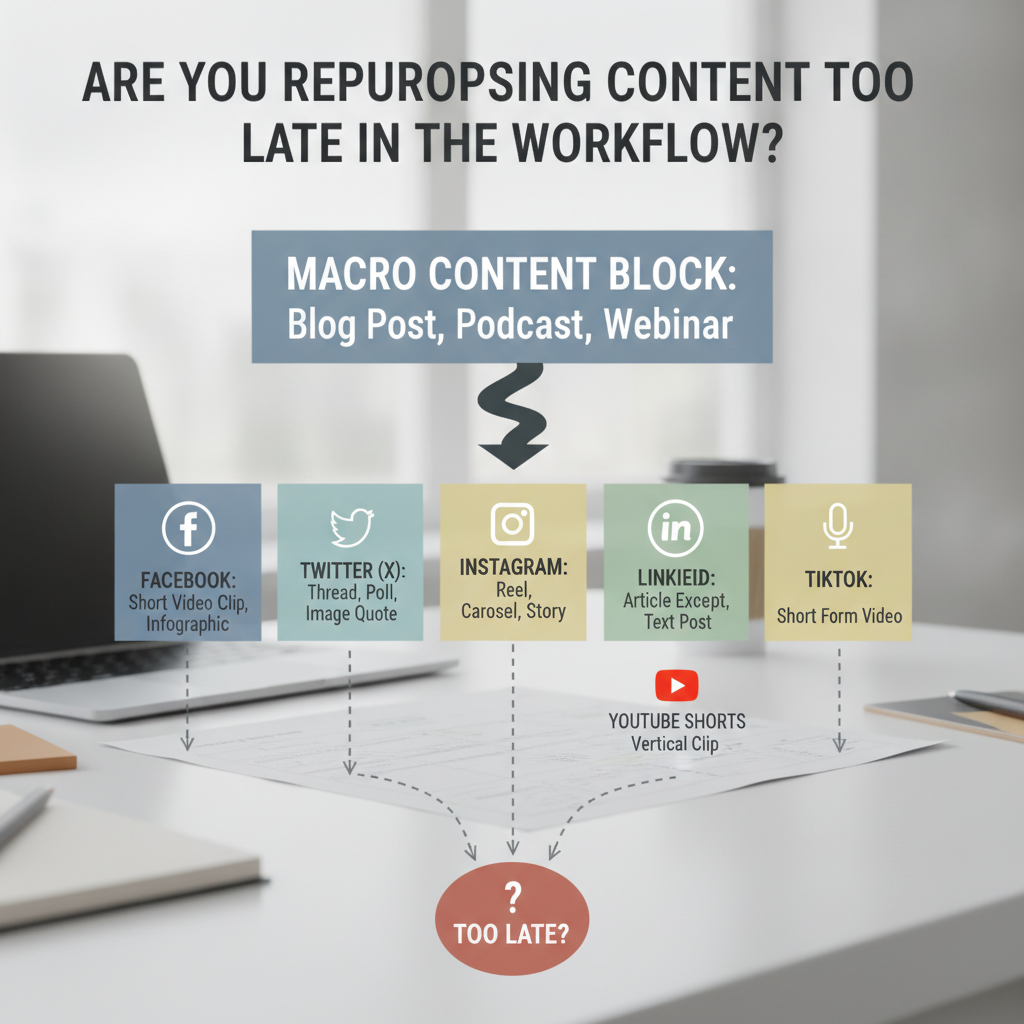
Macro to micro content framework visualization
The macro-to-micro framework is a system designed to scale your output efficiently. You start with one massive "macro" asset. This could be a long-form blog, a webinar, a podcast, or a white paper. This single asset serves as the seed for your entire content calendar.
Step 1: Create the Macro Asset. Produce one high-value, evergreen piece. Think a 2,000-word guide or a 30-minute video packed with insights.
Step 2: Atomize Before Publishing. Extract components during the creation phase. Pull out impactful quotes, surprising statistics, short video clips, and section summaries.
Step 3: Adapt for Platform Context. Reshape each extracted component for the specific audience and format. A visual carousel works best for Instagram. A text-heavy analytical thread fits X or LinkedIn.
Step 4: Schedule Distribution. Plan a four to six-week content calendar originating entirely from this one seed asset.
Real example: One 3,000-word guide easily becomes five LinkedIn posts, three long threads, two Instagram carousels, one email newsletter, and eight short video clips.
This framework is never about mindless copying and pasting. It requires careful, strategic adaptation for each specific network.
What role should AI play in your content repurposing workflow?
AI brings massive efficiency to content marketing, but you need realistic expectations. It's a powerful accelerator for heavy lifting, but it can't replace your brand's unique perspective.
A successful process blends automation with careful human review.
Where AI excels:
- Automatically transcribing and summarizing long-form videos and podcasts
- Generating first-draft text variations tailored to different platform limits
- Identifying high-engagement moments in lengthy video files
- Reformatting structured content like turning a blog into concise bullet points
Where humans remain essential:
- Providing strategic narrative and overriding messaging direction
- Reviewing and refining the output to match the true brand voice
- Adapting content contextually for specific platform nuances and audience tones
- Conducting final quality control and adding personal anecdotes
| Task Type | Best Handled By | Why It Works |
| Transcription & Summarization | AI | Quickly processes hours of audio or thousands of words without fatigue |
| Strategic Narrative | Human | Requires deep empathy, brand understanding, and current business context |
| First-Draft Variations | AI | Generates multiple format options rapidly for human editors to review |
| Final Quality Control | Human | Ensures strict factual accuracy and appropriate emotional tone |
The ideal workflow combines these strengths for a scalable yet authentic result. Many teams worry that AI will make their content sound generic. This only happens if you skip the critical human oversight layer.
MIT Technology Review reported in 2025 that content workflows combining AI automation with human editorial oversight achieved 35 percent higher engagement than purely AI-generated or purely manual approaches.
How can Repostra.app help you build a smarter workflow?
Repostra.app acts as the necessary bridge between your high-level strategy and daily execution. Instead of juggling spreadsheets, chat tools, and multiple native scheduling apps, teams use Repostra to centralize their distribution. It's built specifically for teams that want to scale smarter rather than simply working faster.
Systematize Your Reach: Repostra transforms one large asset into a complete library of platform-native content. It provides structured workflows that guide you through the atomization process step by step.
Maintain Brand Integrity: Built-in review and approval stages ensure consistency at scale. You get the speed of automation with the safety of human editorial control.
Save Time and Resources: By streamlining the extraction and scheduling phases, teams routinely reduce manual labor by over 50 percent while simultaneously increasing their publishing volume.
Real use case: A mid-sized marketing team recently used Repostra to turn a single monthly webinar into 20 unique pieces of content. This proactive system cut their total content creation time from 30 hours a month down to just 12 hours a month. They maintained total control over quality while getting their nights and weekends back.
What does a proactive content repurposing workflow look like in practice?
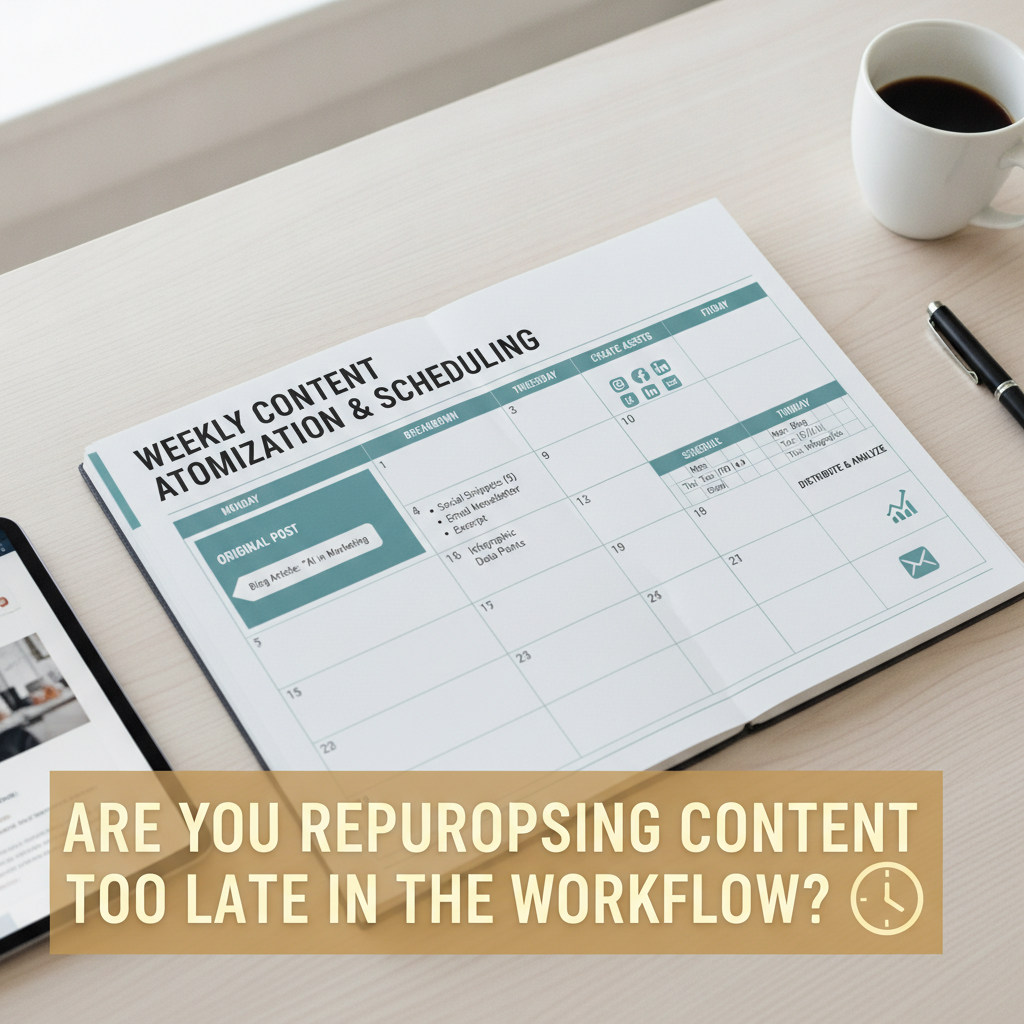
Weekly proactive content repurposing schedule
Building a sustainable routine removes the constant pressure of staring at a blank page. A proactive workflow shifts your team from an "always creating" panic to a "create once, distribute strategically" rhythm.
Here's what a realistic weekly breakdown looks like:
Monday: Publish your macro asset. This is your flagship blog post, podcast episode, or YouTube video going live.
Tuesday and Wednesday: Atomize the content. Feed the macro asset into your AI tools and have your human team review, edit, and polish the extracted drafts.
Thursday: Schedule the adapted pieces. Queue up the micro-posts across your various social platforms to drip out over the next two to four weeks.
Friday: Monitor performance. Review engagement metrics from previous cycles and adjust your messaging strategy for future macro assets.
People often ask if this is just posting the same thing over and over. True repurposing is adaptation, not repetition. You change the angle, the format, and the hook for each channel.
Pro tip: Start small. Pick exactly one high-value asset this month and fully atomize it before trying to scale this process across your entire marketing department.
How much time does content repurposing actually save?
Teams that build repurposing into their initial workflow typically save 40 to 60 percent of their content creation time. Instead of creating ten unique posts from scratch, you create one high-quality macro asset and systematically adapt it.
A 3,000-word blog post can easily generate 15 to 20 pieces of platform-specific content in just two hours of atomization work. Creating those same 15 pieces individually would easily take over 15 hours.
Won't my audience notice I'm repurposing the same content?
They won't notice if you adapt it correctly. Repurposing is strategic adaptation rather than copying and pasting.
Each platform has entirely different audience expectations, content formats, and engagement patterns. A LinkedIn article focuses heavily on professional insights. A post on X pulls out the most provocative statistic with conversational commentary. Your core message stays consistent, but the format and tone shift completely for each channel.
What types of content work best as "macro" assets for repurposing?
The best macro assets are comprehensive, evergreen, and packed with extractable components. Top performers include long-form blog posts over 2,000 words, detailed webinars, video interviews, podcast episodes, and original research reports.
You want content with multiple distinct key points, rich data, quotable moments, and visual elements. These traits give you the most raw material to atomize effectively.
Can small teams or solo creators use this workflow, or is it only for big companies?
This workflow is specifically valuable for small teams and solo creators who face severe time constraints. You simply can't afford to create unique content for every single platform from scratch.
Adopting a macro-to-micro approach allows a one-person operation to maintain a massive, multi-platform presence. Starting with just one macro piece per month can comfortably fuel four to six weeks of daily social content.
How do I maintain quality when repurposing content at scale?
Maintaining quality requires a strict two-layer system of automation followed by human oversight. You use AI or repurposing tools to handle the mechanical work of transcription, draft generation, and formatting.
You then apply manual human review to check for brand voice, proper context, and strategic messaging. Building a simple approval workflow lets you scale your output rapidly while fiercely protecting your brand integrity.
Stop reinventing the wheel and start repurposing smarter
Treating content repurposing as a manual afterthought severely limits your overall ROI and burns out your most talented creators. The old methods of scrambling to chop up a video weeks after it goes live simply can't keep pace with modern digital demands.
You need to integrate repurposing into your planning from day one using a structured macro-to-micro framework. This proactive approach delivers triple the reach, guarantees a consistent brand voice, and cuts your production time in half.
Ready to build a content engine that works as hard as you do? Visit Repostra.app to see how teams systematize their entire distribution process without ever sacrificing quality. The goal isn't to create more content. The goal is to create smarter and extract maximum value from every single asset you produce.