Are You Creating Too Much and Distributing Too Little?
This post explores how businesses can improve content marketing results by shifting more focus from constant content creation to smarter social media distribution and repurposing. It will show how balancing human oversight with AI-assisted workflows helps teams get more value from every strong idea.
Why Your Best Content Keeps Disappearing (And How to Fix It With Distribution-First Strategy)
Most marketing teams are trapped in endless content creation while their best work goes unseen. The real bottleneck isn't production—it's distribution. By shifting focus from creating more to strategically repurposing existing content, businesses reduce production time by 90% and cut costs by 65%. Success requires a distribution-first mindset where AI handles formatting and humans maintain brand authenticity. The solution? Create one strong pillar asset and systematically transform it into dozens of platform-native formats.
Key Takeaways
- The content trap is real: Producing more content without strategy yields lower returns per piece.
- Distribution beats creation: Top-performing teams map out distribution channels before content creation begins.
- Hub-and-spoke wins: One substantial pillar asset generates dozens of specific platform-native formats.
- AI solves distribution: Smart teams apply AI for reformatting, scheduling, and audience analysis.
- Human plus AI works best: Automated efficiency paired with human oversight protects your brand voice.
Why Does Your Best Content Keep Disappearing Into the Void?

Marketing professional viewing low engagement analytics on a computer screen
Your marketing team just spent three weeks writing a comprehensive guide. You publish it, share the link on social media, and get minimal engagement.
This is the content trap of 2026.
Teams stay stuck in a cycle of constant creation while their previous assets quietly collect digital dust. Businesses are producing more content than ever but seeing lower returns per piece in this saturated market. The bottleneck has completely moved from production to distribution.
If this scenario sounds familiar, you're not making the wrong content. You're just caught in the wrong workflow.
What Is Actually Happening in the Marketing Industry?
Anyone can generate text or video instantly. AI tools have democratized content creation to the point where the internet is flooded, making distribution incredibly hard.
According to Sprout Social's 2025 State of Social Media report, 80% of marketers use AI for content creation. Yet most struggle to extract meaningful value from those tools because they're still thinking production-first instead of distribution-first.
"Create once, distribute forever. The industry at large has preached for over a decade that content is king, but without distribution, it's just going to collect dust."
Ross Simmonds, Founder of Foundation Marketing
Why Is Distribution Harder Than Creation?
Platform fragmentation forces creators to adapt to unique format requirements and optimal posting times for every single channel. What works as a long-form post on LinkedIn often flops as a script on TikTok.
Attention scarcity means your audience is drowning in information. Breaking through requires strategic repetition and a multi-format presence.
Compounding this issue is the tool sprawl problem. Teams possess endless creation tools but lack connected distribution systems. This leads to manual copy-and-paste workflows. Creative professionals end up spending 70% of their time on reformatting instead of strategy.
What Is the Hub-and-Spoke Content Distribution Model?
Key takeaway: The hub-and-spoke model atomizes one substantial pillar asset (the hub) into dozens of platform-native formats (the spokes).
Imagine recording a single 30-minute webinar. Instead of posting it once, you transform it into 15 LinkedIn text posts, eight short videos, three image carousels, two blog articles, and an email series.
This framework maximizes the return on investment from your strongest ideas. It forces a mental shift. Instead of asking what you should create this week, you ask how you can make last month's best work reach significantly more people.
A team that used to write 20 separate social posts per week from scratch now records one in-depth video interview and systematically converts it into 40 distinct assets.
How Do You Build a Distribution-First Content Strategy?
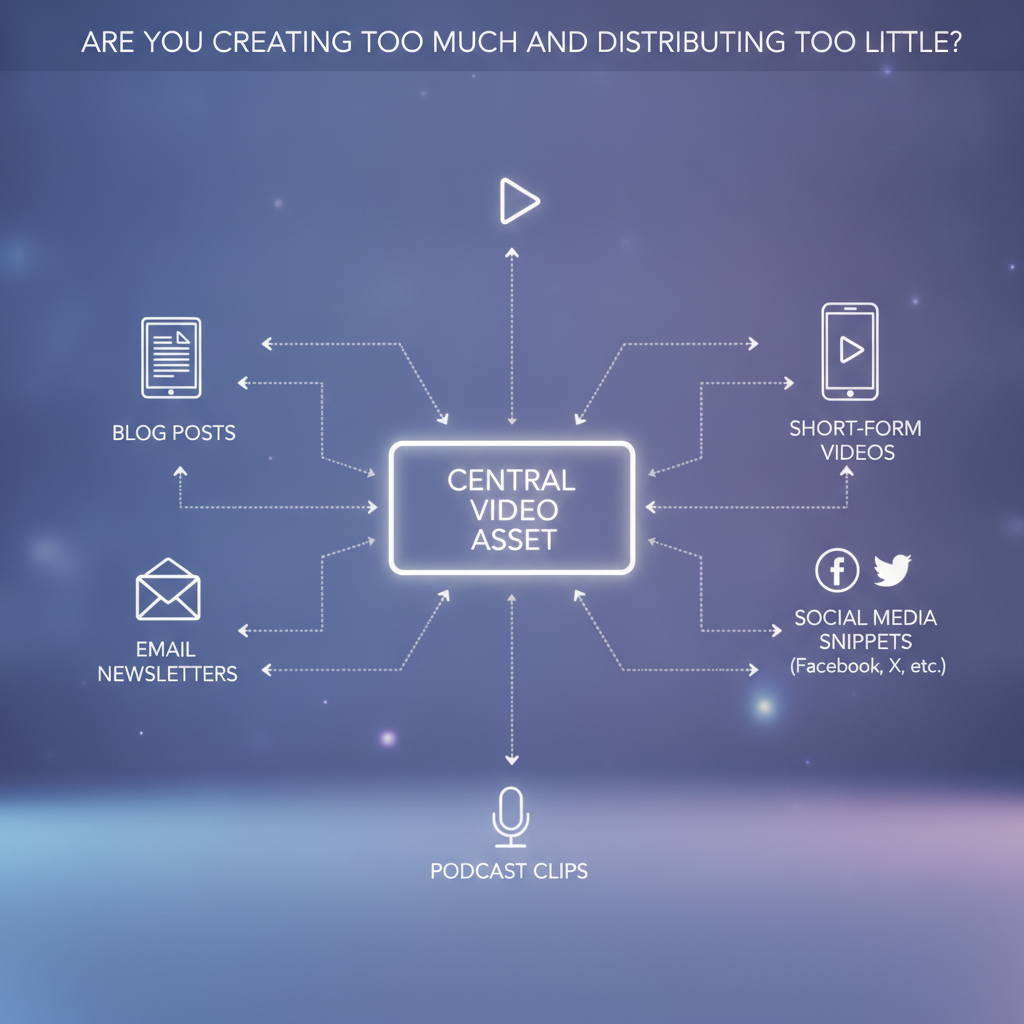
Diagram illustrating the hub-and-spoke content repurposing strategy
Step 1: Reverse your planning process.
Plan your content distribution strategy at the brief stage before creation begins. Outline exactly where the piece will live, how it will adapt, and who will see it.
Step 2: Identify your pillar content.
Determine which formats have real depth. Long-form videos, comprehensive guides, webinars, and podcast interviews work best. The quality bar must be high enough to justify repurposing the asset 20 or more times.
Step 3: Map your spoke formats.
Audit your channels to see what each platform rewards. LinkedIn favors carousels and professional short videos. TikTok and Instagram demand 15-second to 60-second clips with captions. Email audiences prefer condensed insights or weekly roundups.
Step 4: Systematize with artificial intelligence and human oversight.
The most successful 2026 strategies rely on AI for the heavy lifting while keeping human oversight to ensure authenticity and quality. Let AI handle the transcription, reformatting, scheduling, and audience analysis. Humans must manage the brand voice check and strategic curation.
Step 5: Measure distribution success.
Look past vanity metrics. Track the reach per pillar asset, the engagement across different spoke formats, and the cost per quality touchpoint. Iterate your strategy based on what formats perform best on specific platforms.
What Are the Biggest Distribution Mistakes Teams Make?
Common mistake: Copy-and-paste distribution destroys engagement.
Posting identical content across platforms fails because each channel has unique context and format expectations. You need adaptive distribution, which means keeping the same core message but executing it natively for each platform.
Another massive error is creating without distribution capacity. Teams make ambitious assets with no repurposing plan. That two-hour webinar sits untouched because no one has time to clip it. You must build your distribution bandwidth before increasing your production volume.
Treating automation as a set-and-forget tool is equally dangerous. Automating without quality control results in generic, off-brand content that damages consumer trust. Use AI for efficiency and rely on humans for authenticity.
Never ignore platform-specific timing. Software tools can analyze audience activity to identify optimal posting times, so avoid posting just when it's convenient for your schedule.
How Does AI Actually Help With Distribution?
According to Sprout Social's 2025 research, 80% of marketers use AI for content creation, but the smartest teams are now using AI to solve the distribution problem. Repurposing is currently the fastest-growing AI use case in social media.
Artificial intelligence applications for distribution include:
- Content reformatting: Automatically turning long-form text into clips, threads, and carousels.
- Audience analysis: Pinpointing optimal posting times for each specific platform.
- Predictive engagement: Identifying which topics will resonate based on historical data.
- Scheduling intelligence: Automating cross-platform calendars without manual data entry.
- Performance tracking: Aggregating analytics across channels to find winning patterns.
This creates a powerful workflow hybrid. Software handles the resizing, format conversion, and scheduling logistics. Your human team handles message framing, brand alignment, and relationship nuance.
What Should You Look for in a Distribution Platform?
Teams need platforms that unify creative work and distribution. Tool-hopping and context-switching waste hours every week.
Workflow Centralization
Eliminate the need to jump between apps. You need one platform for repurposing, scheduling, and analytics. This centralization saves hours per week and reduces publishing errors.
Adaptive Repurposing
Look for technology that transforms content for platform-specific formats rather than just copying and pasting. It should automatically generate LinkedIn carousels from a video, optimize aspect ratios, and suggest captions while maintaining your brand voice.
Human-in-the-Loop Design
The best tools offer AI suggestions alongside a human approval workflow. This ensures easy editing, customization, and clear quality control checkpoints.
This is exactly where platforms like Repostra.app come in. Repostra is designed specifically to solve the distribution-first workflow challenge by combining algorithmic efficiency with human oversight.
How Do You Actually Implement This Without Overwhelming Your Team?
Start with the one-pillar test if your team is intimidated by new workflows. Choose your best-performing recent content and commit to extracting 20 spokes from it over three weeks.
Week 1: Audit your existing channels.
Document your current posting frequency and engagement benchmarks, then identify your next pillar content opportunity.
Week 2: Create your first hub.
Record one substantial piece, such as a demo, tutorial, or panel discussion. Run the file through transcription software to identify key moments, then map out 20 possible spoke formats.
Week 3: Schedule your spokes across platforms.
Use your chosen tool to distribute content. Monitor the performance and adjust your formatting based on early data.
Bottom line: High-performing teams typically aim for one hub that generates 20 to 40 spokes. It's always better to fully distribute two pillar assets per month than to partially distribute eight.
Assign clear roles. Have a strategist plan the topics, a creator produce the hub, an operator manage the repurposing tool, and a reviewer ensure brand voice consistency.
How much time does hub-and-spoke distribution actually save?
Teams using systematic repurposing report a 60% to 90% reduction in content production time. Instead of creating 20 original social posts weekly, they create one pillar asset in two to three hours. They then use AI-assisted tools to generate 40 platform-specific variations in just a few more hours.
The time savings compound because you maximize the return from your strongest ideas rather than constantly starting from zero.
Can small teams with limited resources really do this?
Yes. This approach is actually more valuable for small teams.
If you only have five hours per week for marketing, you can't compete on volume. You can only win on distribution efficiency. One well-distributed video interview per month will outperform 30 hastily created one-off posts.
Modern AI platforms handle the heavy reformatting work, allowing small teams to achieve reach that previously required dedicated staff.
How do I maintain brand voice when using AI for distribution?
The secret is using technology for speed and humans for authenticity. Set up a hybrid workflow where algorithms handle technical tasks like transcription, resizing, and format conversion. A human must review every public-facing adaptation.
Create brand voice guidelines in your tool and treat AI-generated content as a first draft. Never publish without a human quality check.
What is the ideal ratio of creation time to distribution time?
Top-performing content teams in 2026 typically spend 20% to 30% of their time on creation and 70% to 80% on distribution and promotion. This is nearly the inverse of traditional workflows.
If you have 10 hours weekly for content, spend two hours creating one strong pillar asset and eight hours strategically distributing it across channels.
When should I create new content versus repurpose existing content?
Create new pillar content when you have a genuinely new insight, when you've fully distributed your previous assets, or when you identify a high-value topic through audience questions.
Repurpose existing content when previous assets still have distribution potential or when your team is struggling to keep up with posting frequency. A sustainable rhythm is two new pillar assets monthly, each distributed across 30 spokes over four weeks.
Your Next Steps: Moving From Creation Overload to Distribution Mastery
Stop letting your best ideas disappear into the void.
Shifting from a creation-first to a distribution-first mindset requires a structural change in how you value your team's time. By adopting the hub-and-spoke model, empowering your process with adaptive technology like Repostra.app, and keeping a human in the driver's seat, you can finally scale your reach.
Start with one pillar asset today and watch how far a single great idea can actually go.