Are You Creating Enough Content—or Just Repeating Yourself?
This post explores how businesses can scale content creation without losing originality, using smarter repurposing and AI-assisted workflows. It will show how to keep social media content fresh, consistent, and efficient across channels.
How to Scale Your Content Strategy: The Pillar and Atomize Method That Saves 60% of Production Time
Most businesses struggle with content creation because they treat every post as a new project. In 2026, the smartest brands use a pillar and atomize approach to create one high-value asset and adapt it into multiple platform-native formats. Strategic content repurposing scales your best ideas while maintaining a genuine human voice. This methodical system reduces production hours significantly while keeping your core message fresh across all channels.
Key Takeaways
- Transforming one core asset into native formats saves 60-80% of production time
- Platform-native adaptation maintains audience trust and protects your brand voice
- Consistent brand presentation across channels increases revenue by 33% on average
- AI serves as a co-creator while humans keep editorial control
- Distribution requires more resources than initial creation
The Content Hamster Wheel Is Broken
It is Monday morning. You open your content calendar and see fifteen empty boxes staring back at you. LinkedIn needs a post. Instagram demands three visual stories. Your newsletter is due Thursday. You are already exhausted before the week begins.
This is a universal problem. Many businesses confuse volume with value. They assume they must create endlessly from scratch or risk looking repetitive to their audience.
There is a third option. You can build a robust content ecosystem instead of relying on one-off posts. The goal is amplification rather than recycling.
Why Does Content Repurposing Matter Now?
Audiences have developed a reflex for sameness. Up to 90% of online material is expected to be synthetically assisted by the end of 2026. This creates audience burnout when generic output floods every digital channel.
The trust gap is widening rapidly. According to a 2026 study by the Content Marketing Institute, 89% of B2B marketers use AI for copywriting, yet 52% of consumers actively distrust purely AI-generated content.
Bottom line: Original perspectives and first-hand experiences are the most valuable commodities available today. Curation and unique perspective matter far more than mere technology adoption.
What Separates Repurposing From Repeating Yourself?
Bad repurposing is simply copy-pasting the exact same caption to LinkedIn, Instagram, and Twitter. It ignores the culture of each platform. Strategic repurposing involves adapting the core message to fit how audiences naturally consume information on those specific channels.
The most effective framework is the pillar and atomize model. You create one high-value asset like a webinar or a research report. You then extract five to ten derivative formats from that single pillar.
"The brands winning in 2026 treat content like Lego blocks, modular pieces that build different structures for different audiences."
Ross Simmonds, Founder and CEO at Foundation Marketing.
Repurposing is always about reframing instead of recycling.
| Original Pillar | Platform | Native Format | Goal |
| Industry Webinar | Data-driven document carousel | Professional insight | |
| Industry Webinar | TikTok | Three-second hook video | Entertainment and reach |
| Industry Webinar | In-depth analysis with exclusive Q&A | Relationship nurturing |
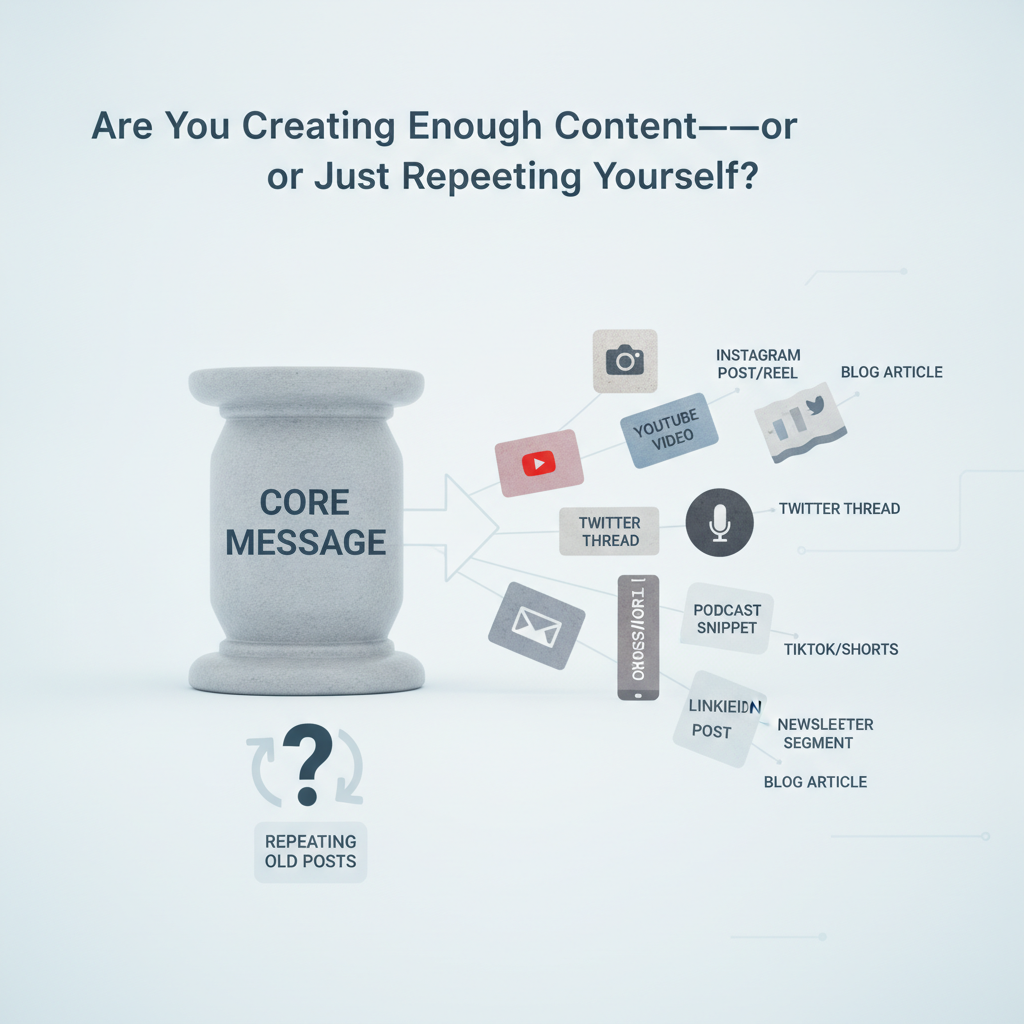
Pillar and atomize content strategy diagram showing one main asset branching into multiple native social media posts
How Much Time Does Content Repurposing Actually Save?
The return on investment for a modular approach is massive. According to a 2025 marketing automation report by Gartner, effective repurposing saves 60% to 80% of content creation time.
It also boosts total output by 40% and cuts production costs by up to 65%.
Consider a traditional scenario. Writing fifteen unique posts a month typically requires twenty to thirty hours. If you take two pillar pieces and atomize them, you achieve the exact same output in just six to ten hours.
Saved time does not mean lower quality. It means you gain strategic focus. You can reinvest those saved hours into audience research, relationship building, and brainstorming better primary assets.
What Does Platform-Native Really Mean?
Cross-posting identical text is a dead strategy. Every social network operates with its own distinct language and expectations. The work is not creating entirely different material. The real work is packaging the exact same insight differently.
Key takeaway: Match your delivery to the platform culture.
- LinkedIn: Professional insight, actionable data, and document carousels drive high engagement.
- Instagram: Visual storytelling and behind-the-scenes moments prioritize connection.
- TikTok: Entertainment leads the way. A strong hook in the first three seconds is mandatory.
- Email: Depth and exclusivity nurture long-term relationships.
- X: Real-time commentary and conversational threads work best.
Imagine you have a new client case study. You post a lesson-focused carousel on LinkedIn. You film a short transformation video for Instagram. You send the full story with an exclusive interview to your email list.
How Should You Use AI Without Losing Your Brand Voice?
The biggest fear around modern content is losing your unique identity. Relying on automation as a complete replacement guarantees generic output and destroys differentiation.
Grand View Research projects the AI content tools market to exceed five billion dollars by 2027. Because everyone has access to these systems, differentiation comes exclusively from how you manage them.
The smartest teams use the co-creator model. Automation speeds up the extraction of highlights and suggests formatting variants. Human writers provide editorial oversight, check the brand voice, and make strategic decisions.
Step 1: Record a thirty-minute expert interview using your subject matter experts.
Step 2: Use transcription software to extract ten key quotes.
Step 3: Have a human editor select three quotes that align perfectly with the brand point of view.
Step 4: Ask your software to suggest five format variations for those quotes.
Step 5: Edit the final drafts for voice and add personal commentary before publishing.
Common mistake: Red flags that software has taken over include content that sounds like everyone else, a lack of specific examples, and zero distinctive opinions.

Human and AI collaborating on content creation process
What Is the Distribution Over Production Principle?
The traditional model forced marketers to spend 80% of their time creating and 20% promoting. The most successful modern brands have inverted this rule completely. They spend 20% on production and 80% on distribution.
Most brilliant ideas die quietly because they are never properly distributed.
An inverted distribution schedule includes atomizing one piece into multiple formats. It requires scheduling across platforms with native optimizations. You must re-share evergreen pieces on a rotation and actively engage with comments.
According to a 2025 brand consistency research study by Lucidpress, consistent brand presentation across all channels can increase revenue by an average of 33%.
Building a robust library means your assets continue working long after you log off.
How Do You Build a Repeatable Content System?
Establishing a systematic approach removes the daily friction of staring at a blank screen.
Step 1: Identify your core types. Look at what you already create. Pick two or three formats like webinars or client interviews to standardize every month.
Step 2: Map your atomization matrix. Define five to ten derivative formats for each pillar. Create reusable visual templates for each specific platform.
Step 3: Set up a frictionless workflow. Assign clear roles for who creates the core asset and who handles the atomization.
Step 4: Maintain the human touch. Implement a brand voice checklist and set up quality gates before anything goes live.
Step 5: Analyze and refine. Track which extracted pieces perform best and which platforms drive the most meaningful engagement.
This is where a platform like Repostra.app becomes invaluable. It connects creation directly to distribution and eliminates massive tool sprawl. It helps maintain your brand voice at scale while turning a single asset into an entire ecosystem.
What Are the Biggest Mistakes in Content Repurposing?
Even with a solid strategy, execution errors can derail your efforts.
Common mistake: Treating adaptation like a copy-paste job. You must adapt the text natively for every single channel.
Common mistake: Only relying on old archives. This creates staleness. Repurpose fresh pillars within a week or two of publication.
Common mistake: Removing human oversight entirely. Letting software do everything ruins trust. Keep a human editor in charge of the final review.
Common mistake: Operating without a calendar. Sporadic posting makes you invisible to algorithms.
Common mistake: Ignoring analytics. If you do not track what works, you miss vital optimization opportunities.
FAQ
How many pieces can I realistically extract from one pillar asset?
You can typically generate five to ten platform-specific pieces. A long blog post can become a document carousel, three graphics, a short text thread, a newsletter section, and a video script. The secret is adapting the core message to fit different audience expectations.
Will my audience notice I am reusing the same ideas?
They will not notice if you execute it strategically. Followers on a professional network rarely overlap completely with followers on a short-form video app. Native formatting makes the same insight feel entirely fresh. Lazy copy-pasting is the real danger.
How often should I create new pillar assets versus repurposing existing ones?
Aim for two or three new primary pieces per month. Spend the vast majority of your working hours distributing them. You can recycle evergreen ideas quarterly by updating the data or finding a new angle.
Can small teams without enterprise tools still work efficiently?
Absolutely. You can start manually by writing one core guide and copying key sections into templates you create once. Dedicated platforms like Repostra.app accelerate the process and reduce manual errors, but a strong underlying strategy matters far more than your software stack.
How do I measure if this approach is actually working?
Track three distinct metrics. Compare the time spent creating against your total output volume. Monitor engagement rates across networks compared to your previous strategy. Finally, measure the actual conversions driven by the repurposed pieces. A sharp increase in output with stable or improved engagement indicates clear success.