AI Can Draft Faster, But Humans Still Shape the Strongest Content
Take a balanced, brand-fit approach to AI in content marketing by showing where automation helps and where human judgment matters most. The article can reassure teams who want efficiency without losing voice or quality.
AI Content Strategy: Speed vs. Authenticity in 2026
AI content tools can draft three times faster and cut costs by 40%, but human-led content drives 5x more traffic and significantly longer session durations. The strongest AI content strategy today uses automation for research, outlining, and data tasks while reserving emotional storytelling and brand voice for human creators. This hybrid approach guarantees efficiency without sacrificing authenticity.
Key Takeaways
- AI handles drafting, data synthesis, and high-volume tasks efficiently but lacks emotional nuance.
- Human-crafted content delivers up to 5x more engagement and lower bounce rates.
- A hybrid model maximizes both production efficiency and audience trust.
- Readers now actively filter generic AI content, making human authenticity a competitive advantage.
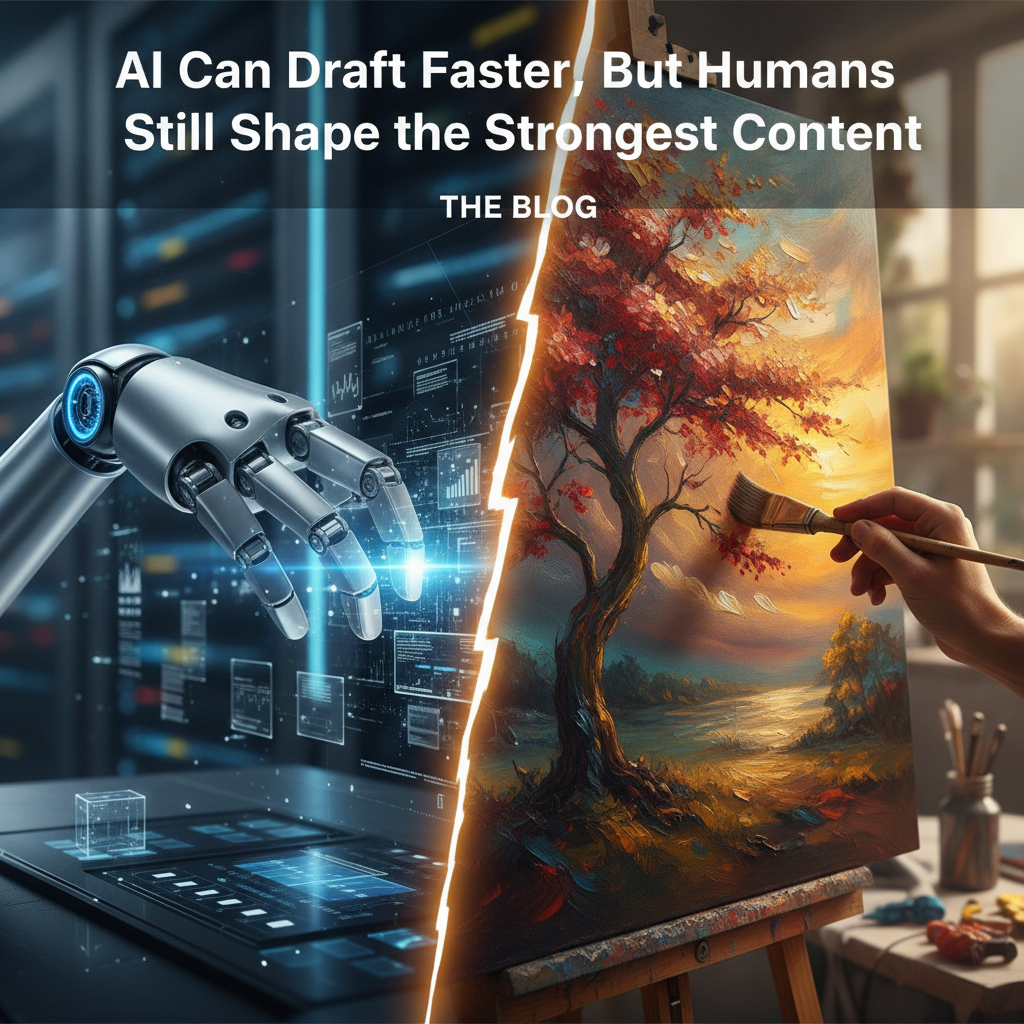
Comparison between AI data processing and human creative storytelling
The Content Marketing Paradox
Your team can now produce a month of blog posts in a single week. So why are your engagement numbers dropping?
Generative AI has transitioned from a shiny novelty to standard infrastructure. Almost every marketing department has access to the exact same language models. You can generate infinite text at zero marginal cost. Yet this abundance has created a unique problem for modern brands. The competitive advantage has shifted entirely. It's no longer about who has the best tools. It's about who applies a thoughtful AI content strategy to maintain audience trust.
We're living through a massive synthetic content hangover. Consumers are flooded with articles that sound vaguely professional but say absolutely nothing. Audiences have developed a subconscious filter for this robotic text. They scan the first paragraph, detect the generic tone, and immediately click away. They can feel when content exists purely for the sake of content.
This creates a paradox. You need the speed of automation to stay competitive, but you need the authenticity of a human to actually convert readers. The promise of this article is simple. You don't have to choose between speed and connection. You can build a balanced approach that delivers both.
Why does human-led content still outperform AI?
Human-led content builds trust and emotional resonance that algorithms can replicate in structure but not in substance.
The performance gap between automated text and human-crafted narratives is no longer a matter of opinion. It's entirely measurable. Audiences crave authenticity because they're exhausted by the digital noise. When every brand sounds exactly the same, a unique human voice acts as a powerful differentiator.
The data tells the story. According to research from HubSpot in 2026, human-crafted content generates up to 5x more traffic than AI-produced pieces. Readers don't just click. They stay on the page. Studies from Marketing Analytics Aggregates in 2026 show that articles with human oversight see 40–60% longer session durations and 20–30% lower bounce rates.
We've entered an age of deepfakes and synthetic media. Trust is the most expensive currency on the internet. When a reader consumes your blog post, they're looking for a shared experience. They want to know that a real person understands their specific pain points. Algorithms predict the next most logical word in a sentence. Humans draw on lived experiences, failures, and triumphs.
This trust crisis directly affects business outcomes. If a potential customer feels patronized by a generic product description, they won't buy. High engagement metrics translate to higher conversion rates, stronger brand loyalty, and better overall brand equity. People buy from people. They always have.
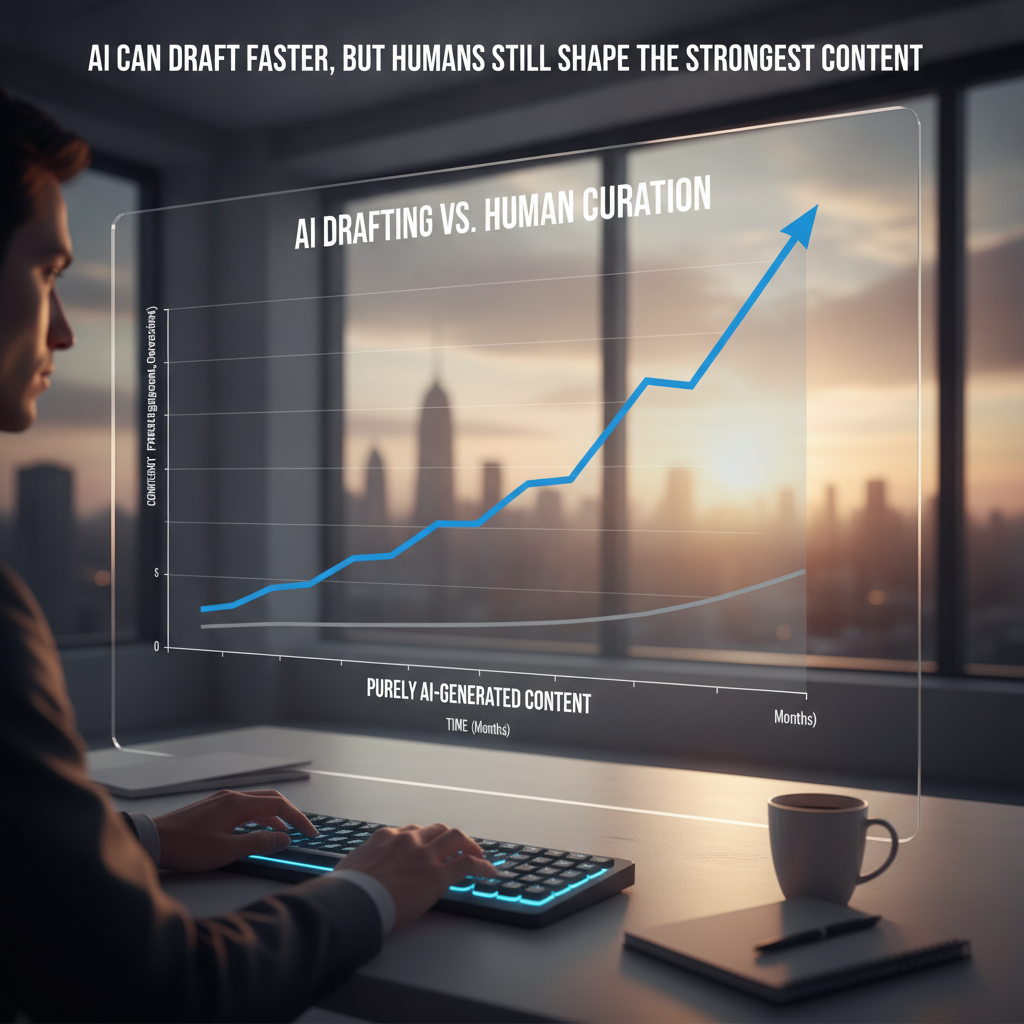
Data chart illustrating the performance gap between human-led and AI-generated content
What does AI actually do better than humans?
AI outperforms humans in speed, data processing, and high-volume structural tasks, but it fails in areas requiring judgment, empathy, or brand alignment.
To win in your market, you must assign the right tasks to the right resources. AI is not a creative director. It's a highly capable production assistant. When you remove the expectation of empathy, artificial intelligence is vastly superior at handling the heavy lifting of content marketing.
Automation removes capacity bottlenecks without creative compromise. According to Generative AI Productivity Benchmarks in 2026, AI can produce content three times faster and reduce costs by approximately 40%. This speed allows your team to scale operations globally.
There are specific areas where AI thrives without any qualifiers. You should use automation for technical product descriptions, SEO metadata generation, content outlines and brief creation, summarizing large datasets or lengthy webinars, and high-volume social media scheduling.
AI-driven analytics also excel at strategy execution. Modern tools can analyze your past performance to suggest specific content pillars and optimal posting times. AI handles the mundane logistics. This setup allows your human writers to focus entirely on the overarching strategy.
Where is human judgment non-negotiable?
Brand voice, emotional storytelling, cultural nuance, and strategic narrative decisions require human expertise that AI cannot replicate.
Speed is useless if the final product actively damages your brand reputation. If you publish unedited AI drafts, you risk falling into a trap of generic sameness. Your content will blend into the background noise of your industry. To stand out, you must rely on human judgment in four non-negotiable areas.
AI has never felt a deadline panic, lost a client, or celebrated a hard-won victory. It can't share a personal anecdote that makes a reader feel seen. Your tone is your fingerprint. Only humans can ensure a piece of content sounds unmistakably like your brand. Only humans can navigate cultural sensitivity and evolving audience expectations in real time. Content is meant to start conversations. An algorithm can't network with an industry peer or respond thoughtfully to a nuanced comment.
Ann Handley, Chief Content Officer at MarketingProfs, notes: "AI can mimic patterns, but only humans can create moments that make audiences feel understood."
Consider a hypothetical scenario from earlier this year. A major B2B software company used an automated system to draft a public response to a service outage. The AI generated a legally precise, robotic apology. Customers were furious. They felt dismissed and ignored. A human PR manager had to step in, scrap the AI draft, and write a simple, empathetic apology. The human version restored trust immediately. Empathy can't be faked.
How do you build a hybrid AI content strategy?
The hybrid model assigns AI to research, outlining, and optimization while humans control ideation, voice, and final narrative decisions.
You don't have to ban artificial intelligence to protect your quality. Instead, you need to build a workflow that keeps a human in the loop at critical junctures. This approach maximizes efficiency while safeguarding your brand identity.
According to the Content Marketing Institute in 2026, brands using human-AI collaboration report a 12% productivity gain and a 30-40% reduction in production costs. They achieve this while maintaining high-quality outputs that readers trust.
The recommended workflow starts with a human strategist identifying a customer pain point and setting the topic. AI conducts the initial research and generates a structural outline. AI drafts the factual sections and pulls relevant data points. A human writer edits the draft for voice, injects personal anecdotes, and refines the narrative arc. A human editor performs a final quality assurance audit to check for robotic phrasing or inaccuracies.
Task Allocation Matrix
| Task | Best Suited For | Why? |
| Ideation & Outlining | AI | Provides a quick starting point and structural skeleton. |
| Research & Fact-Checking | AI + Human | AI finds data. Humans verify accuracy and context. |
| Emotional Storytelling | Human | Requires empathy, personal experience, and cultural nuance. |
| Brand Voice Alignment | Human | Only a human can ensure content feels unmistakably you. |
You must audit AI outputs rigorously. Read the text aloud. If the rhythm feels unnatural, it needs human editing. Implement strict version control in your editorial calendar so you always know which sections were machine-generated and which were human-edited.
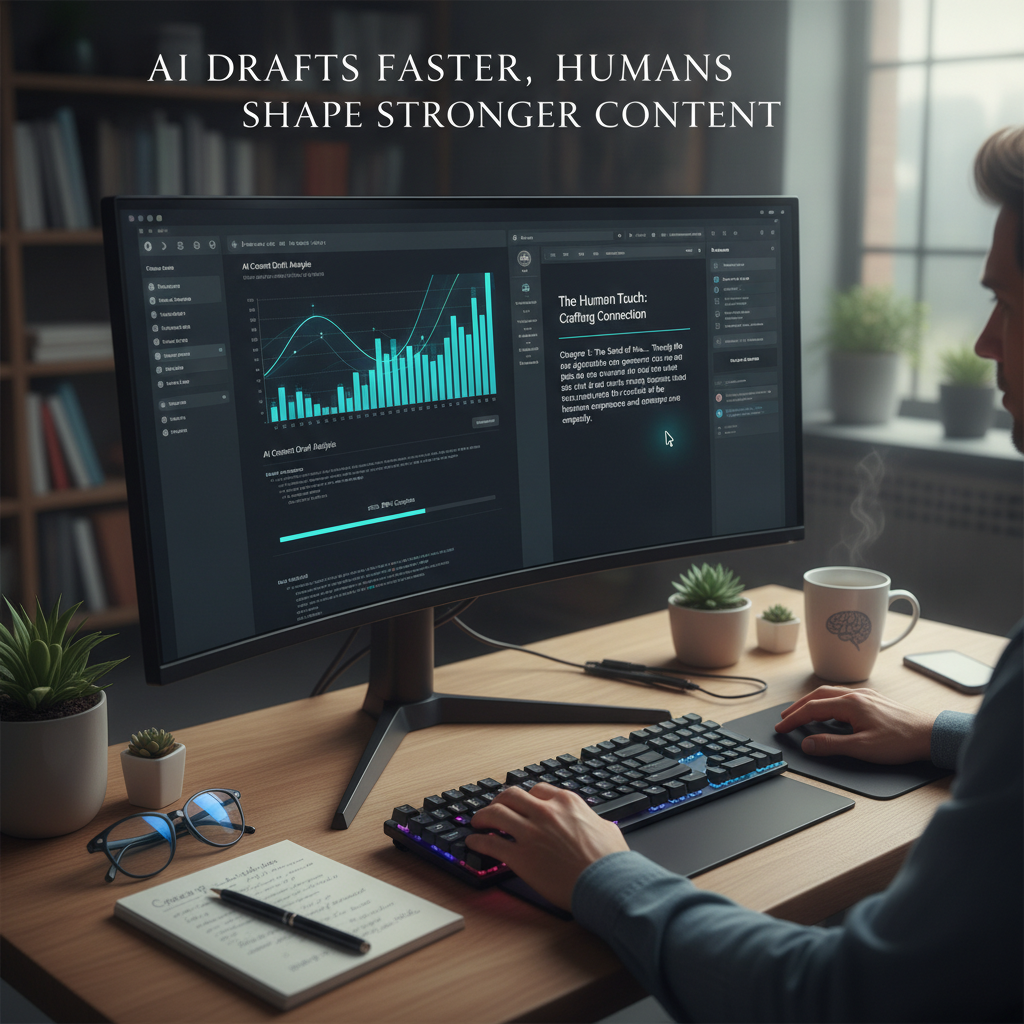
Content marketer using a human-in-the-loop AI strategy on a computer screen
What does this mean for content teams?
Content teams should treat AI as infrastructure that reclaims bandwidth for strategic, high-impact work rather than viewing it as a replacement for creative talent.
Many marketers still worry that automation will replace their jobs. The reality is quite the opposite. AI is a powerful job enabler. It frees you from the drudgery of formatting spreadsheets and writing meta descriptions. You can reframe this efficiency as a massive opportunity. Time saved equals more space for insight and innovation.
When you strip away the mundane tasks, your team can focus on relationship-building and disruptive ideas. You can finally conduct those original customer interviews you never had time for. You can craft that deeply researched whitepaper that will actually move the needle for your sales team.
Tools built for the modern era reflect this philosophy. Platforms like Repostra.app allow teams to seamlessly distribute content and manage social scheduling. When software handles the repetitive distribution loop, your creators get their breathing room back. They can spend their energy creating the core narrative instead of copying and pasting links across six different social channels.
Audit your current workflow this week. Identify three highly repetitive, data-heavy tasks to hand over to an algorithm. Invest your reclaimed time in human skills like strategic planning, advanced copywriting, and audience empathy.
Competitive advantage lies entirely in doing what machines can't do.
The Bottom Line: Efficiency Meets Authenticity
Use AI to build the infrastructure, but trust humans to build the brand.
You must stop viewing this transition as an either-or scenario. It's a mandatory collaboration. The most successful marketing departments lean heavily into the hybrid model. They use language models to scale their output, and they rely on human writers to ensure that output actually matters to the reader.
As technology continues to evolve, human creativity becomes more valuable, not less. We've reached a point where perfect grammar and structure are free. True insight is rare.
Evaluate one piece of content your team produces this week. Ask yourself where the automation helped and where human insight made the final difference. Find that balance, and you'll lead your market.
FAQ
Can AI write content as well as a human today?
AI can draft quickly and handle data-heavy topics, but it lacks the empathy, cultural nuance, and brand voice consistency that human writers provide. Content with human oversight gets 5x more engagement and significantly longer session times than purely automated text.
What content tasks should I automate with AI?
You should automate research, outlining, SEO metadata, technical descriptions, and high-volume social media scheduling. Reserve storytelling, brand voice calibration, and high-level strategic decisions for human team members.
How do I know if my AI content sounds too robotic?
Read it aloud. If the text feels generic, overly formal, or lacks a clear point of view, it needs human editing. Watch out for repetitive phrasing, a lack of concrete examples, and a complete absence of emotional resonance.
Does using AI hurt my brand's credibility?
It won't hurt your brand if you use it correctly. Audiences deeply distrust fully automated, unedited content, but they don't mind efficiency. If you use automation to free up your team so they can add real insight and personality, your credibility will actually improve.
What is the ROI of keeping humans in the content loop?
Human-led content drives measurably better engagement. You can expect up to 5x more traffic, a 40–60% improvement in session durations, and a 20–30% reduction in bounce rates. These engagement metrics directly improve conversions and customer lifetime value.